
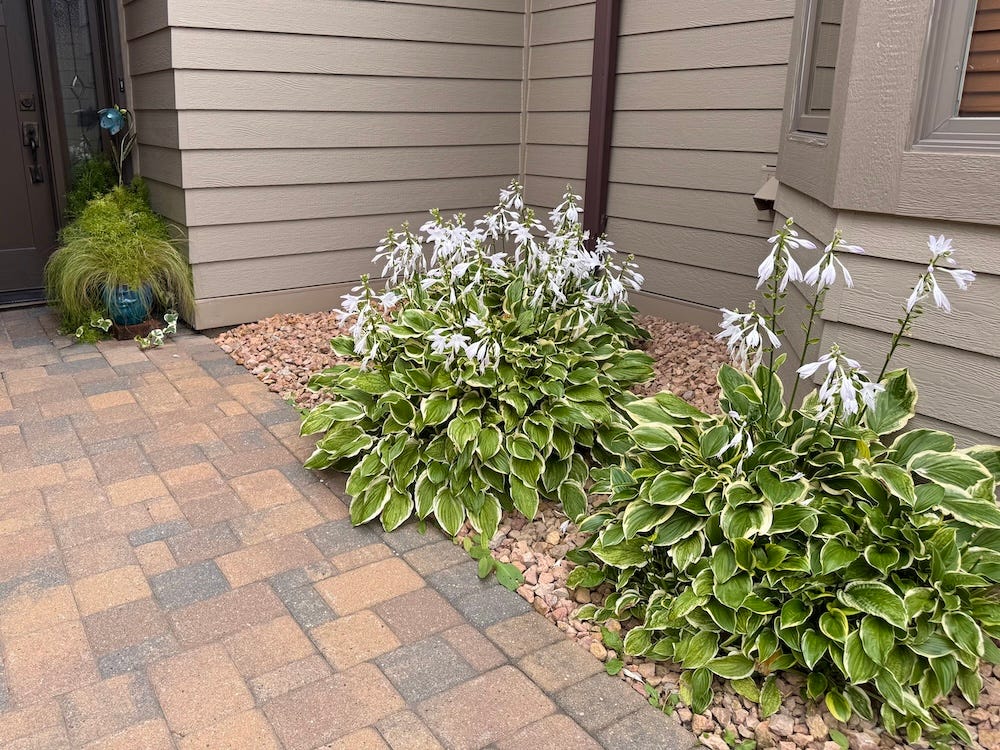
Are you getting ready to chop some of your favorite plants in half?
My front door hostas went through that last year and they look like they could use another trim this year, too.
Even if you know this will be good for your garden, the thought of being a plant surgeon induces fear for some of us. Dividing our perennials is a late summer and fall task, (spring, too) and it brings up a lot of questions. Where do I divide my plants? How much time does a newly divided perennial need to establish roots before the ground freezes?
These are all questions I asked Laura Irish-Hanson, University of Minnesota Extension, and she had some great advice (and no it’s not too early and if you wait, you might be ok, too).
Laura started with perennial grasses. She says downsize them because maybe they started out a foot wide and now they’re three feet wide.
“Feel free to chop that in half and then bring that back to the size that you want.”
She then described watching for the center to die back, especially with sedums or catmints. We might see it with hostas, too.
“It looks nice and lush around the edges. Then the centers look wimpy or they’re not growing really well. That is a perfect time to dig that whole plant up.”
She says to follow these steps.
“Take your spade and chop it into a few pieces, and then you can replant to rejuvenate those plants. So, those are the two big ones for when you should actually divide those plants. You can do that for almost all perennials that we’re growing in Minnesota.”
What she added was some plants will need to be split every three years. Others can wait up to seven years.
“But sometimes it comes down to what you want in your garden. I also have giant hostas. I use them so my cats can lay underneath them.”
Laura pointed out that hostas are good at slowly creeping out and getting larger.
“The biggest thing is they’ll overcrowd other plants. If you have spring bulbs planted around that same area, they can actually start outcompeting those pretty fast. So, you might want to divide them a little sooner.”
If you find crowding an issue in your yard, Laura’s solution is to seek out small hosta cultivars that are only a few inches wide. “Then we have the giant ones. You need to give them six feet of space because they need six feet of space. It’s kind of hard to just give a one-size-fits-all width for hostas, but really it’s aesthetics.”
She says most herbaceous perennials will do fine when divided in the fall.
“Even those spring flowering ones, you can still divide them now. You’re just going to be a little careful with them.” She says don’t be worried about the herbaceous plants as they die back to the ground.
Watering is a theme that came up several times in our conversation.
“You can actually start dividing plants whenever you want, but the critical thing is when we do it earlier, like this week, so mid-August, particularly in the southern part of the state, it can still be really hot and dry. We just want to make sure we’re keeping those newly divided plants well-watered all the way up until the ground freezes.”
She suggests for those gardeners who are a little further north, top third of the state, mid-August is a great time to start dividing because she says you want to have about six to eight weeks for those plant roots to settle in and get ready for winter.
She advises to look at when the ground freezes, not the first hard frost, in your area and count back and approximate the dates that work best for your particular area.
Also consider our three-plus growing zones.
“We have zone three, that’s mostly the northern third. We have zone four, which includes both 4A and 4B, and then we have pockets of five, kind of in the center, but also the southern part of the state. So, we kind of divide it that way.”
If you’re not sure about your growing zone go here- the USDA “find your zone” using your Zip code. I confirmed that my neighborhood is 5a because of the Twin Cities urban heat island effect.
Another thing Laura wants us to know about is correct planting.
“It’s really fun sometimes to dig very deep holes. We don’t want to do that. We want to make sure that we’re growing those plants at the same depth that they were already growing at.”
Her advice is don’t go too shallow either because the crowns of those plants can be more exposed to winter and cold damage if they’re sitting up too high.
“So, just make sure that they’re all at the same level as from where you originally dug them.”
When it comes to peonies she says those should only be one to two inches below the soil surface.
“If they’re buried too deep, they’re probably not going to flower for you.”
She says to use a sharp spade to divide perennials. It’s a must-have.
“There’s nothing worse than having a very dull spade and trying to jump on them. Or use a root pruning saw. Those are really good, too.”
We also talked about jumping worms but I didn’t realize her warnings would apply directly to me (and maybe to you, too).
The U of M Extension says they are a prohibited species and it’s unlawful to move them.
According to the U of M Extension before you transfer or share a division, bare-root it, wash all the soil off at the roots, and look for worms, or the cocoons.
Then replant it clean or in a pot with clean soil. Cocoons can be in the soil year-round, and adults are laying eggs in August.
Now there is good news and bad news. The good news is they’re not yet widespread across the state. The bad news is they have dug in right where I garden. Go to the link and find out about your location.
One of the biggest reminders Laura wants to pass along is to keep watering. Just because our temperatures start to drop doesn’t mean the watering stops. We get less rain in the fall than we do in the spring on average. She also notes that we should water the soil, not the plants.
“Typically we don’t think of fungal diseases being problematic as temperatures cool. There are some that prefer cool environments rather than wet, warm environments.”
I wondered how much water our plants needed and she suggested the dig test.
“After you’re done watering, see how deep the soil is actually moist from where you watered. If it’s only wet at the top inch or two, that’s not deep enough. You’re going to cause roots to start growing right in that top inch or two of the soil. And that’s not good for plants. We want to make sure that their soil is wet at least six inches down after we water.”
She added, if the soil isn’t deeply wet, plants are much more susceptible to winter damage. So deep, infrequent watering is much better than frequent, little amounts of water.
“If you have really heavy clay soil or heavier soil, you might have to water an area, walk away for a couple minutes, let that water start to percolate through. If we water too much and it takes a long time for the water to infiltrate down, we can actually just cause the water to run off. We don’t want to do that either.”
She suggests you keep watering until just before the ground freezes. It’s something that a lot of people stop doing because we want to do the fall cleanup.
“In a lot of cases, we put our hoses away in October, and then we don’t actually have ground freeze until mid to late November in some spots. Those plants might go through a very long dry period. And dry soils in the winter can actually be more damaging.”
If you see plant loss, it is because dry soil cools down much faster than moist soils do.
Laura says there are three things to do starting now:
First- Keep watering or at least monitor for watering and protect your plants, especially after dividing.
Second- Mulch using a straw mulch or a mulch that will break down over time is ideal.
She smiled when she said number three. “Enjoy the full splendor of fall.”
I agree. Between the leaves and what’s still blooming in our gardens, we have a lot to enjoy.
Diana
#bloomwithme
Editing note: I’ve edited some of Laura’s comments for length and brevity.
Comments
Nothing yet. Say the first thing.
Sign in to join the conversation.