
We’re nearing the halfway point in the season after Pentecost. The long lectionary portion on the parables has now ended. In August, we switch to miracles!
I’m genuinely grateful for your encouragement and support —
and I hope my words strengthen your spirit and relieve some of the burden of these days.
Jesus made the disciples get into the boat and go on ahead to the other side, while he dismissed the crowds. And after he had dismissed the crowds, he went up the mountain by himself to pray.
When evening came, he was there alone, but by this time the boat, battered by the waves, was far from the land, for the wind was against them. And early in the morning he came walking toward them on the sea. But when the disciples saw him walking on the sea, they were terrified, saying, “It is a ghost!” And they cried out in fear. But immediately Jesus spoke to them and said, “Take heart, it is I; do not be afraid.”
Peter answered him, “Lord, if it is you, command me to come to you on the water.” He said, “Come.” So Peter got out of the boat, started walking on the water, and came toward Jesus. But when he noticed the strong wind, he became frightened, and beginning to sink, he cried out, “Lord, save me!” Jesus immediately reached out his hand and caught him, saying to him, “You of little faith, why did you doubt?”
When they got into the boat, the wind ceased. And those in the boat worshiped him, saying, “Truly you are the Son of God.”
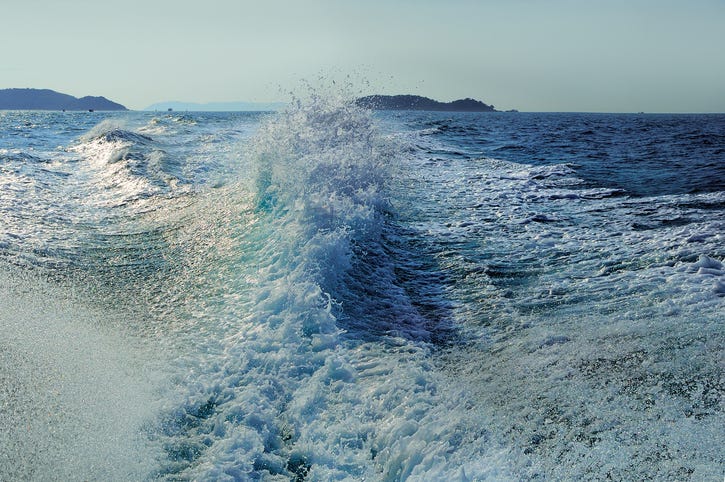
This Sunday, the reading is one of the most dramatic in the New Testament. Jesus has sent his disciples out on a boat when a storm welled up on the sea. They can’t make the journey, the boat is caught in rough waves, and Jesus walks across the water to meet them.
Peter saw Jesus but can’t quite believe his eyes. So, he challenged Jesus to help him walk across the water as well. Jesus did so. Peter walked, and then sank. Jesus nevertheless saved him, and then said, “You of little faith, why did you doubt?”
No one answered. It doesn’t entirely seem as if they understood. Because they “worshiped him.” I think they considered him a kind of magician, a miracle worker (there were more of them than you might think running around the ancient world).
This isn’t one of my favorite New Testament stories. But today, one sentence stood out to me:
“…the boat, battered by the waves, was far from the land, for the wind was against them.”
Maybe this story isn’t really about Jesus. Maybe it is about his followers!
What happens to those who follow Jesus when they face headwinds, and they can’t make it to land?
And then I remembered: I’ve actually written about headwinds in Grateful. In that book, I learned how headwinds and tailwinds are foundational to practicing gratitude. When we recognize headwinds and tailwinds, our entire attitude shifts — and transforms us from ingrates to people who appreciate all the gifts of our lives.
I went back and read the section from Grateful, chapter 4.
One of the most interesting studies related to gratitude explores “headwinds” and “tailwinds” in our lives. Headwinds are exactly that: the resistance one encounters in a race, when “the wind is literally in the athlete’s face.” Tailwinds are the opposite, the “wind at one’s back.” Researchers Shai Davidai and Thomas Gilovich discovered that people tend to pay more attention to life’s headwinds because they are harder to overcome. We ignore tailwinds because we adjust to the advantages they give us. Tailwind benefits tend to be invisible. But headwinds? We boast of fighting them.
As in a race, headwinds and tailwinds work the same way in life. We remember difficult challenges more than what came easily to us. Because we pay more attention to what is hard, what we feel we have worked for, each one of us tends to believe that our own life is more difficult than pretty much everyone else’s, and that our path has been full of “barriers and challenges . . . more severe than those experienced by others.”
This belief, in turn, causes envy. As the researchers note, “When people (falsely) believe that their road has been especially difficult, they can easily become resentful of those they (falsely) believe have had an easier path” resulting in feelings of thwarted entitlement. “The flip side of this toxic stew of resentment, envy, and entitlement,” claim Davidai and Gilovich, “is gratitude.”
While we value the struggle and challenge of headwinds, we literally cannot see the gifts, the “tailwinds” that assist us. “An understanding of how easy it is for people to get in touch with their headwinds,” suggest the authors, “and how hard it is to fully appreciate their tailwinds can help explain why a consistent connection to gratitude can be so elusive.”[1]
Sometimes, we might think of “blessings” as nice things, a kind of pious way of talking about material comfort or personal privilege. But what if “blessings” are, at least in part, the “tailwinds,” of our lives?
The invisible benefits conferred on us – everything from political policies to economic advantages to social relationships – that we receive unnoticed are, indeed, blessings. In this framework, blessings emerge as the contributions others have made to our lives, either as personal gifts or gifts of a larger community (things such as a good public school paid for from tax money).
Blessings are not pious rewards for good behavior. Blessings are the boost bestowed on us by systems, structures, families, and other benefactors who assist us on our way.
Headwinds: barriers. Tailwinds: blessings. Headwinds make us say, “I earned this.” Tailwinds should not be invisible. Instead, they should call forth, “I am so grateful.”
When I read the miracle story with this in mind, I realize how we often get stuck because of headwinds.
Peter sank because he expected a particular sort of miracle from Jesus. Indeed, he insisted on a transaction. “Hey, Jesus, if it is really you, call me from this boat,” he dared, “and I’ll walk on the water, too!”
It’s a strange request. “Jesus, I want to do it, too!" sounds a little a four-year old would say. But Jesus obliged. Maybe not because he wanted Peter to match his own feat — something that would surely prove his power. (Honestly, did Jesus really need to prove anything to these guys?) He wanted to teach them something winds and storms. Or, perhaps it was a larger lesson about God’s generosity and the sacred intention to provide and care for God’s people.
There wasn’t much need for a second miracle. Jesus had done that. And he’d already assured him that everything would be fine. “It is I; don’t be afraid”
That was their tailwind. Jesus was present. His gave his assurance. He loved them. He would protect them.
They should have turned their boat in that direction — so Jesus’ wind was behind them.
But they ignored it and wanted proof (at least Peter did!). Or, they wanted to face the whole situation head-on — to conquer it themselves.
And so, the demand to defy the headwinds. “Make the wind and waves irrelevant,” Peter insisted. “I want to walk, too. I can do what you did!”
But the headwinds and the waves weren’t just some metaphor. They were real. And Peter’s transactional faith wasn’t up to the continuing storm. He started to sink. Headwinds are hard. Really hard.
Jesus is, however, still who Jesus was: “It is I; don’t be afraid.” That tailwind. The truth that had been at their backs — and sides. The very embodiment of God’s ancient promises of gifts and grace.
So Jesus saved him.
And they worshiped him; they gave him thanks. Not because they finally realized the tailwinds — or maybe they recognized them for just a moment. But they appear to worship him because of the miracle against the headwinds.
But if they’d recognized headwinds and tailwinds from the beginning, they wouldn’t have needed to get bailed out by a miracle. They only needed to turn the boat in the right direction.
Would they ever recognize the tailwinds of their lives? Could they understand, at a profound level, how their very lives were gifts? That God loved and treasured and provided for them? And that God wanted the kingdom to come fully among them? For them to live in sabbath provision and genuine peace under their own vines and fig trees?
Or would they stop focusing on the headwinds they faced? Because when we see headwinds for what they are — barriers to be overcome — and the tailwinds that are present — the blessings that we take for granted — everything changes. Especially us.
For a moment, maybe the disciples changed. They did say “thank you.” But I wonder: how much did the lesson of the storm stick? Or did the lesson fade when they arrived at the far shore?
How often do we thank God when a headwind is stilled, a barrier is overcome? An emergency, a health scare, a tragedy — only to get off the boat and go back to exactly as we were?
Most of time. At least that’s true for me.
We need to remember the real lesson of the storm. Not a transaction of salvation, not a magic lesson to reveal Jesus’ identity. Rather, this lesson shows us how hard it is to remember the tailwind of grace always present, even in the storm — “It is I; don’t be afraid.”
And maybe just turn your boat around. Set your sail aright.
You’ll be grateful you did.
[1] The research and quotes in this section are all found in S. Davidai and T. Golovich, “The Headwinds/Tailwinds Asymmetry: An Availability Bias in Assessments of Barriers and Blessings,” in Journal of Personality and Social Psychology, vol. 111, no. 6, 2016: pp. 835-851.
Weak motion of grasses and tern before the sea.
Worry’s school cresting here and everywhere
as failings.
I pace the cliff path, my hands cupped above my eyes.
The glare steals your progress, a kayak needling
the wide open.
Love means you answer, this the child’s rebuke.
A pattern crosses the point, hemming
the horizon: steamship.
I didn’t know you were the green pitch
unable to beat the storm to shore.
You didn’t know I was the lookout.
Get accustomed to the sad girl picking you
out of the sea, the knot caught in her throat,
and the unraveling of her speech: an endless rope
thrown out of me.
— Amber Flora Thomas, “Headwind”
Like Rain it sounded till it curved
And then I knew ‘twas Wind —
It walked as wet as any Wave
But swept as dry as sand —
When it had pushed itself away
To some remotest Plain
A coming as of Hosts was heard
That was indeed the Rain —
It filled the Wells, it pleased the Pools
It warbled in the Road —
It pulled the spigot from the Hills
And let the Floods abroad —
It loosened acres, lifted seas
The sites of Centres stirred
Then like Elijah rode away
Upon a Wheel of Cloud.
— Emily Dickinson, “Like Rain it sounded till it curved”
But to every mind there openeth,
A way, and way, and away,
A high soul climbs the highway,
And the low soul gropes the low,
And in between on the misty flats,
The rest drift to and fro.
But to every man there openeth,
A high way and a low,
And every mind decideth,
The way his soul shall go.
One ship sails East,
And another West,
By the self-same winds that blow,
‘Tis the set of the sails
And not the gales,
That tells the way we go.
Like the winds of the sea
Are the waves of time,
As we journey along through life,
‘Tis the set of the soul,
That determines the goal,
And not the calm or the strife.
— Ella Wheeler Wilcox, “Tis The Set Of The Sail — Or — One Ship Sails East”
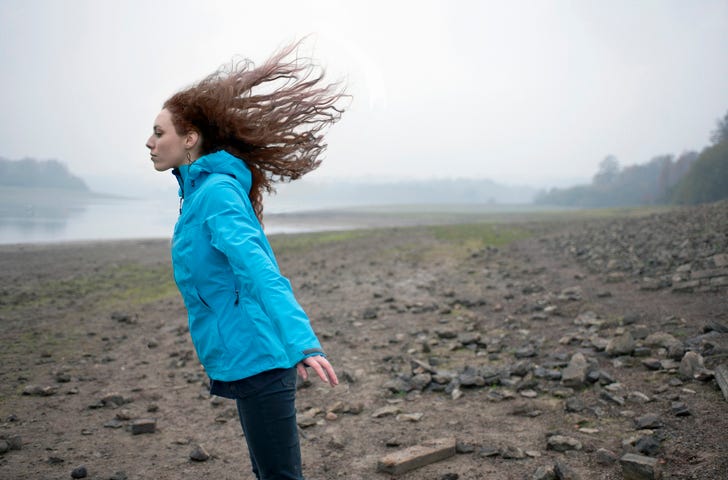
One Note from the Wind
another morning,
another chance to be
utterly rearranged
— Rosemerry Wahtola Trommer
Comments
Nothing yet. Say the first thing.
Sign in to join the conversation.