
Thank you for welcoming my words into your inbox. I’m so grateful for every reader of The Cottage.
I treasure your companionship here.
If you have the means to support this newsletter, please consider becoming a paid subscriber. Those who contribute financially ensure that this place of thoughtful hope remains free and open to all.
I’m taking a break this week at the beach before my busy autumn travel schedule begins.
Today’s musing is a guest post by Josh Scott from three years ago. I learned from this essay when I first read it and benefited from re-reading it this week. I thought the many new readers to the Cottage would appreciate it as well.
Pastor Josh Scott serves GracePointe Church in Nashville, TN, a non-denominational, inclusive, and progressive congregation. Josh is the author of several books including Bible Stories for Grown-Ups. He also writes Re:Imagining Faith on Substack.
Today, Josh takes us on a field trip with Jesus. When I first read his essay, it reminded me that sometimes “Where are we?” is the most important question. Asking the right question can cascade into asking deeper questions about God in our lives.
*
In addition to Josh’s post, I’m including a story (below) that appeared this week from Religion News Service about the end of protective status for Haitian refugees in Springfield, Ohio.
I know that many of you are avoiding the news for your own mental and spiritual health. I completely understand — and I limit my news intake as well. At the same time, we can’t afford to look away from all the wrongs being carried out in the United States today. This story covers the literal “round-up” of human beings who had come to this country fleeing from life-threatening political and social violence in Haiti. They’d made a home here and were contributing to the economic and community rebirth of one declining Midwestern town.
We cannot tolerate these inhumane acts and moral injustices that are being hidden from the view of the larger public. When I read this story, I was sadly reminded of stories of Jews being similarly treated in the early years of the Holocaust. Quite honestly, Anne Frank’s diary came to mind.
I humbly ask you to pay attention to what is happening to these people. Pray for them and the town of Springfield. If you attend a church, ask others to join you in prayer. Consider reaching out to the churches and organizations mentioned in this story and ask how you might help with material or spiritual resources. And, if you happen to know a pro bono immigration lawyer, make sure that professional knows about this situation.
*
Today’s musing and the Haitian story are, of course, connected. What is happening in Springfield, Ohio is the always the price of empire — the denial of the dignity of human beings, demeaning them, and treating them with no grace, mercy, or empathy.
It is worth considering that the United States government is using your money to shackle and starve fearful people, separate them from their families and children, and send them to an uncertain fate. Indeed, Jesus’ words to Peter stand as a stark reminder to all of us: “Whatever you bind on earth will be bound in heaven, and whatever you loose on earth will be loosed in heaven.”
When Jesus came into the district of Caesarea Philippi, he asked his disciples, “Who do people say that the Son of Man is?” And they said, “Some say John the Baptist, but others Elijah, and still others Jeremiah or one of the prophets.” He said to them, “But who do you say that I am?” Simon Peter answered, “You are the Messiah, the Son of the living God.” And Jesus answered him, “Blessed are you, Simon son of Jonah! For flesh and blood has not revealed this to you, but my Father in heaven.
And I tell you, you are Peter, and on this rock I will build my church, and the gates of Hades will not prevail against it. I will give you the keys of the kingdom of heaven, and whatever you bind on earth will be bound in heaven, and whatever you loose on earth will be loosed in heaven.” Then he sternly ordered the disciples not to tell anyone that he was the Messiah.
Is there anything more exciting for a kid than a school field trip?
They are the perfect combination of getting out of assignments for a day and exploring something new and unfamiliar. The most memorable trip for me was my eighth-grade field trip to our State Capitol. Growing up in the hills of eastern Kentucky, it felt like everything was so far away — this destination was a five-hour bus ride one-way — which only added to the sense of excitement and anticipation. Standing in the Capitol, the halls of power that governed life for me and everyone else, for the first time was an eye-opening experience. My thirteen year old self didn’t even have a category for it.
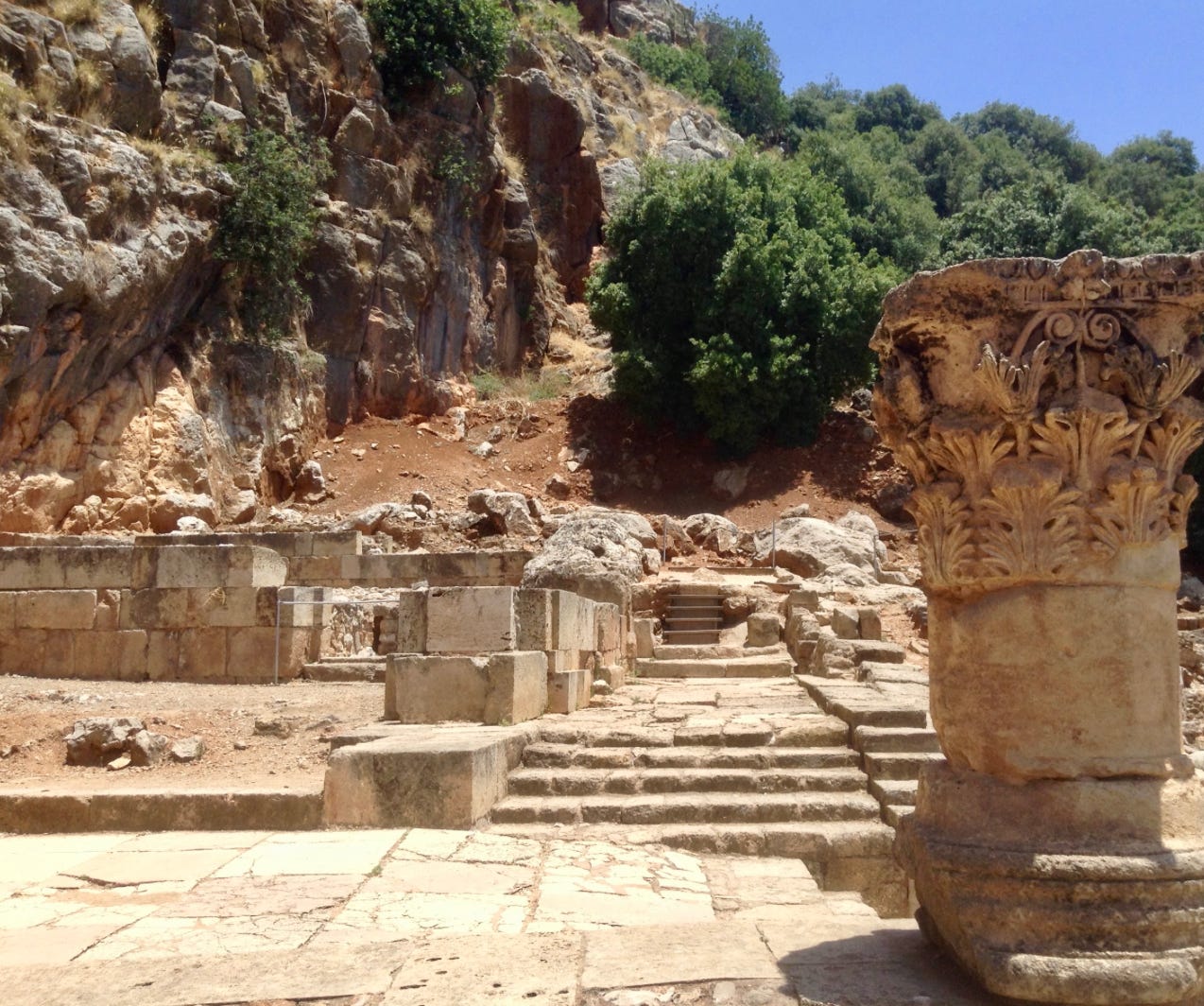
I imagine that Jesus’s disciples shared that sentiment on their field trip to Caesarea Philippi — it was no doubt an experience that shattered their categories and expectations. Located some twenty-five miles north of their home base in Galilee, it probably felt like another planet. They had not often, if ever, been in a city so influenced by the Roman world, and yet it is this strange place that would serve as the backdrop for a life-altering conversation between Jesus and his disciples.
Often when this story comes up we turn our attention to Peter’s confession and the endless debate about exactly who, or what, the rock is on which Jesus builds the church. It’s an interesting debate to engage.
However, it’s not where my attention went as I recently read through this passage once again. One of the wonderful things about literature, like the Bible, is the way a text that we are so familiar with can still surprise us if we keep coming back to it. One such surprise happened to me this week.
The two words that grabbed my attention this time through the text were Caesarea and Philippi. It seems to be a significant detail, otherwise why even name the place where this conversation between Jesus and his disciples occurred? If we spend a moment understanding what this place was and meant, we might see the larger claim being made through this text.
Before it was Caesarea Philippi it was known as Paneas, and was devoted to the worship of a half-goat, half man deity named “Pan.” Just a few decades before our story the Roman emperor, Augustus, had placed governance of Paneas in the hands of Herod the Great.
To express his gratitude Herod built a large temple made of white marble dedicated to his benefactor, Caesar Augustus. After Herod died in 4 BCE, his son Philipp inherited governance of the territory, and a rebrand commenced. Paneas became Caesarea Philippi, named after Caesar Augustus and Philipp himself. It was a place that represented the power of the empire and reiterated the values of imperial theology: Caesar is lord, and Rome wins at any cost.
It was also the place Jesus chose to take his disciples to ask them a question: “Who do you say that I am?”
He’s not asking them if they affirm the Nicene Creed, or if they are on the “correct” side of the debates and disagreements that would divide and define the church in the centuries to come. In a place where the power and methods of the empire were evident, and where Caesar was clearly lord, Jesus is asking his disciples if they align with the empire’s means and ends, or with his Kingdom of God message. Jesus and Caesar embodied two radically different visions for the world, and they implemented dramatically opposite methods to bring that vision to bear.
Peter’s response, then, isn’t just checking off a theological box, but a declaration of commitment to the Way of Jesus, not just as a belief system, but as an actual WAY of bringing the Kingdom on earth as it is in heaven. To call Jesus God’s Messiah/Christ, as Peter does here, isn’t just a claim about Jesus; it’s also a claim about God. For Jesus’s earliest followers this declaration was a way of affirming that Jesus’s message of nonviolence, abundance, generosity, compassion, and inclusivity align with the very character of God.
I think western Christianity finds itself today at a Caesarea Philippi–like moment. Christian Nationalism is presenting a Caesar-like Jesus, who is willing to dominate anyone to achieve his ends—those being life controlled by white, cis, straight men. Though Jesus didn’t bow to the tempter to gain the kingdoms of the world, some of his followers are enthusiastically doing so today. In the face of this rising allegiance to a counterfeit Christ, the Jesus of history has a question for us: “Who do you say that I am?”
Our answer will determine the future of Christianity in the West, and have a deep impact on billions of human lives.
Will we seek to learn and live the Way of the Jesus we meet in the Gospels?
Will we continue to embrace the foolishness of the cross, meaning the commitment to love, even when it costs us?
How will we think about Jesus’s teaching on nonviolence and his call away from scarcity and into abundance (because when everyone shares what they have there will always be enough for all of us)?
These are the Caesarea Philippi questions that we must answer in our own day.
The piers are pummelled by the waves;
In a lonely field the rain
Lashes an abandoned train;
Outlaws fill the mountain caves.
Fantastic grow the evening gowns;
Agents of the Fisc pursue
Absconding tax-defaulters through
The sewers of provincial towns.
Private rites of magic send
The temple prostitutes to sleep;
All the literati keep
An imaginary friend.
Cerebrotonic Cato may
Extol the Ancient Disciplines,
But the muscle-bound Marines
Mutiny for food and pay.
Caesar’s double-bed is warm
As an unimportant clerk
Writes I DO NOT LIKE MY WORK
On a pink official form.
Unendowed with wealth or pity,
Little birds with scarlet legs,
Sitting on their speckled eggs,
Eye each flu-infected city.
Altogether elsewhere, vast
Herds of reindeer move across
Miles and miles of golden moss,
Silently and very fast.
— W.H. Auden, “The Fall of Rome”
We thought we were done with these things but we were wrong.
We thought, because we had power, we had wisdom.
We thought the long train would run to the end of Time.
We thought the light would increase.
Now the long train stands derailed and the bandits loot it.
Now the boar and the asp have power in our time.
Now the night rolls back on the West and the night is solid.
Our fathers and ourselves sowed dragon’s teeth.
Our children know and suffer the armed men.
— Stephen Vincent Benét, “Litany for Dictatorships” (1936)
From Religion News Service:
“As ICE closes in, Ohio churches line up families to care for Haitian kids left behind”
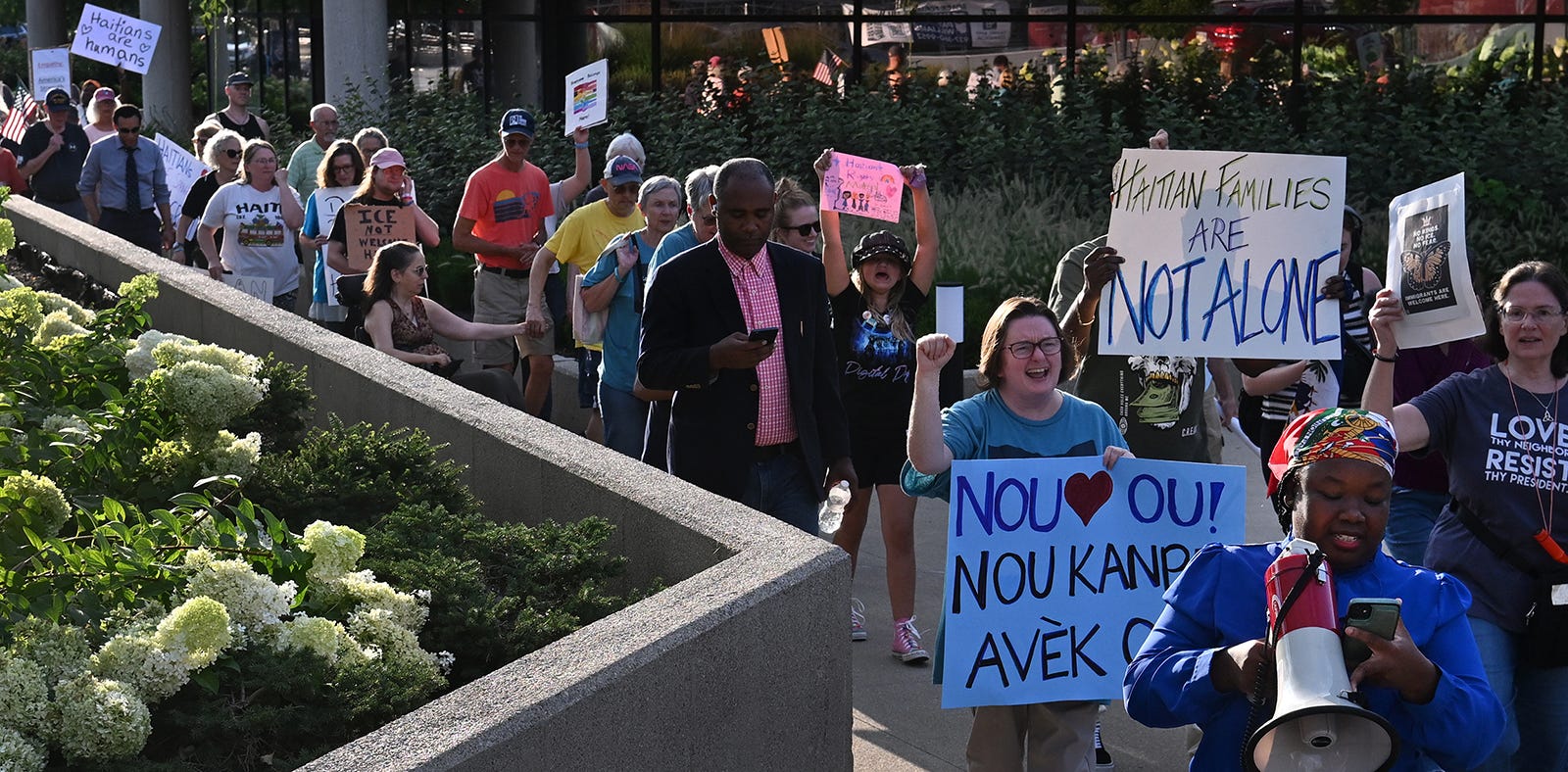
On June 25, the Supreme Court ruled 6-3 to allow Donald Trump to remove Temporary Protected Status from 300,000 Haitians (and many others as well!) who had fled violent social upheaval in their home country to the safety of the United States.
This ruling gave Trump the power to pursue one of his long-standing immigration targets — the Haitian refugee community in Springfield, Ohio. (You might remember September 2024)
TPS expired on July 27, one month after the Supreme Court ruling. And now the long-held goal of removing these people from the United States is underway.
The below quotes are from the article. PLEASE read the entire story.
“Faith leaders had long been bracing for a Minneapolis-style ICE crackdown against the Haitian community in Springfield. Instead, ICE has shifted tactics: Beginning just over a week after the termination of TPS for the country’s 330,000 Haitian recipients became enforceable on Aug. 5, ICE has conducted several rapid, small-scale ICE detentions. And since late July, ICE has sent many Haitian residents in Springfield letters ordering them to report to the Blue Ash ICE office over an hour away, near Cincinnati. There, many former TPS holders, all of whom came to the U.S. legally seeking safety from disastrous conditions in Haiti, have reported being given the choice between self-deporting with $2,600, or being released with ankle monitors — which many in Springfield referred to as “shackles” — and a restriction to limit travel to within a 75-mile radius of their address.
Without work permits, the Haitian residents are struggling to pay for rent and groceries. Some are hiding in their homes, too afraid of ICE to shop at local businesses or attend church. Others have had their drivers’ licenses expire or become nonrenewable. Parents are filling out legal paperwork to give power of attorney to neighbors and friends in case they get separated from their children, especially those born in the U.S. who have legal citizenship. This weekend, local Haitian leaders shared reports that one, possibly two, Haitian immigrants had died by suicide.”
A VOICE: You can’t do this to me.
We got laws. We got courts. We got unions.
A VOICE: You can’t do this to me.
Why, I believe in Karl Marx!
A VOICE: You can’t do this to me.
The Constitution forbids it.
A VOICE: I was always glad to cooperate.
A VOICE: It looked to me like good business.
A VOICE: It looked to me like the class struggle,
A VOICE: It looked to me like peace in our time.
TOTALITARIAN VOICE:
Thank you, ladies and gentlemen.
Democracy is finished.
You are finished.
We are the present!
— Stephen Vincent Benét, excerpt “Listen to the People” (1941)
In this time that fears faith, let us hold hands.
In this time that fears the unwashed, let us hold hands.
In this time that fears age, let us hold hands.
In this time that fears touch, let us hold hands,
brown hands, trembling hands, callused hands, frail
hands, white hands, tired hands, angry hands, new
hands, cold hands, black hands, bold hands.
In town and cities and villages, mano a mano, hand in hand,
in mountains and valleys and plains,
a ring of women circling the world,
the ring strong in our joining,
around our petaled home, this earth, let us join hands.
Don't look away. Don't look down. Don't pretend not to see hurt. Look people in the eye. Even when their pain is overwhelming.
— Brené Brown
Comments
Nothing yet. Say the first thing.
Sign in to join the conversation.