
On August 10, 2026, the President of the United States signed an executive order rewriting the childhood vaccine schedule. It cut the number of recommended diseases to eleven, called for splitting the combined MMR vaccine into three separate shots, and once again tied vaccination to autism, without evidence. At the signing, the president suggested the combined MMR could be “quite lethal,” a claim decades of data flatly contradict.
The scientific response was immediate and unanimous. Dozens of studies across millions of children show no link between vaccines and autism. The American Academy of Pediatrics warned the order would sow confusion and erode confidence in immunization. On the science, there is nothing left to debate.
And that is precisely the point. Because if the evidence is settled, and the order was signed anyway, then this is no longer a scientific argument. It is something else and mistaking it for a medical dispute is the first error to avoid.
There is a distinction that is fundamental here, and it explains why clinicians keep feeling like they are shouting into the wind.
Clinical vaccine hesitancy is an individual concern. A parent worried about a side effect, a patient unsure about timing, a family that wants to understand before they consent. This is real, it is legitimate, and it is exactly what a consultation is for. Good information, patience, and a trusted clinician resolve most of it.
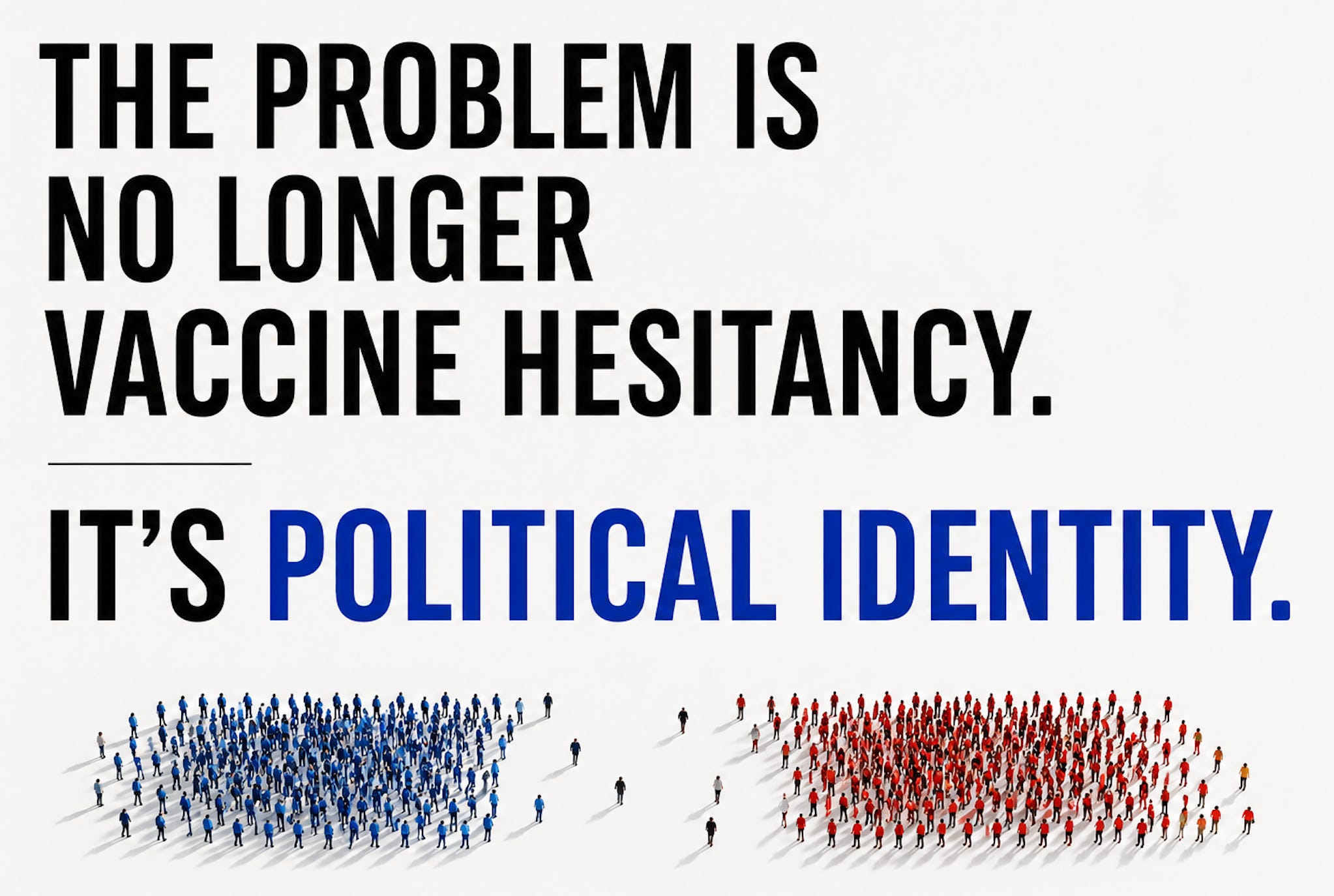
Political vaccine hesitancy is something else entirely. It is not a question about risk, it is a marker of identity. And an identity cannot be dissolved with a pamphlet. When vaccination becomes a way of signaling who you are and whose side you are on, evidence stops working, because accepting the evidence would mean betraying the tribe.
The August order does not belong to the first category. It belongs to the second. It is not a misreading of the science. It is the science being overruled by politics, deliberately, and in public.
Here is what should unsettle us most: none of this is new, and none of it is surprising. The mechanism now playing out in Washington has been documented, measured, and named across several democracies. Two cases make the point.
Brazil offers the starkest evidence that political leadership shapes vaccination at population scale. Researchers found a genuine dose-response relationship: the more a municipality leaned toward Bolsonarismo, the lower its COVID-19 vaccination rates, even after controlling for sociodemographics and healthcare capacity. The mechanism has a name, political cuing. Citizens receive a signal from a leader they identify with, adopt the corresponding position, and fold it into their political identity. The vaccine stops being a medical choice and becomes a badge of allegiance.
France shows the same force from a different angle. There, vaccine hesitancy clustered at both political extremes, but it reflected broad political disenchantment rather than anti-science sentiment as such. Strikingly, more politically sophisticated voters were less hesitant, not more. It was not ignorance driving refusal. It was partisanship. People were adopting hesitancy as an expression of distrust in the system, not as a considered reading of the vaccine data.
Read those two findings together and the American order looks less like an aberration and more like an outcome. When a leader turns a childhood schedule into a political statement, the research tells us what follows: uptake tracks allegiance, and the science becomes almost beside the point.
What is happening in Washington was, in the most literal sense, predictable.
This is the part that most deserves to be sat with, because it is uncomfortable, especially for clinicians.
The entire toolkit, accurate information, scientific consensus, the patient risk-benefit conversation, is built for clinical hesitancy. It is designed for the worried parent/patient across the desk. And for that, it works.
But it was never built for political hesitancy, and against that it has a structural limit. When a position is load-bearing for someone’s identity, the very act of correcting it can entrench it. The research is consistent here: people resist information that threatens who they believe they are. One can be right, patient, and kind, and still lose, not because the evidence is weak, but because evidence is not what is being contested.
This does not make the consultation useless. It means we should stop expecting individual conversations to solve a problem that was manufactured at the political level. What politics has polarized, no clinician can un-polarize one patient at a time.
From this side of the Atlantic, one thing comes into focus that is harder to see from within the American fight.
The order will not change the Swiss schedule, the French one, or any European recommendation. Our references hold. But the argument travels freely: “space them out,” “split them up,” “give parents the choice,” “fewer is safer.” Ideas cross borders without a passport, and this particular set of ideas is built to spread.
So the lesson is not “this is an American problem.” The lesson is that the politicization of vaccination is a mechanism, not an accident, and mechanisms repeat wherever the conditions are met. Depolarizing it is not, in the end, a task for health care professional alone. It requires political leaders willing to place vaccination outside the partisan contest , to treat it as shared ground rather than a battlefield. That is a responsibility scientific community cannot discharge for them.
Which brings us to the one conclusion that is beyond doubt. Defending vaccination is not defending a side. It is defending a method one that is self-correcting, and still the best protection ever built against diseases we had nearly forgotten. The day we protect our children by party line rather than by evidence, public health has already lost the argument that matters most.
Alessandro Diana, clinical vaccinologist
Comments
Nothing yet. Say the first thing.
Sign in to join the conversation.