
We believe ETH represents an outlier opportunity over the next two to three years. The market still values Ethereum at a bear-market trough multiple of the value the network secures, while the fundamentals that drive that value compound, and our probability-weighted 2028 scenarios imply approximately $9,700 per ETH, more than four times the current price.
ETH closed July 2026 at approximately $1,863, about one-third below its December 2025 level, and has since repriced sharply: as of August 20 it trades near $2,280, following the Treasury’s expanded bond buybacks, the SEC’s proposed Regulation Crypto Assets, and a $2.9 billion short liquidation. We read this move as the beginning of a larger repricing rather than the end of one, because the gap between Ethereum’s fundamentals and its valuation remains wide.
While the price fell through the first half of 2026, the fundamentals compounded. Tokenized real-world assets (”RWAs”) on the network roughly tripled over the past year, the United States established a federal stablecoin framework, regulators cleared staking inside ETFs, DTCC moved tokenized securities into live trading, and Visa and Mastercard joined a payment standard built for AI agents.
The thesis rests on two reinforcing adoption curves. First, traditional finance is moving onchain: tokenized RWAs grew from ~$12 billion to $33.5 billion in twelve months, and Ethereum settles roughly half on its base layer, over two-thirds including its L2s, with BlackRock, DTCC, Robinhood, and Cantor Fitzgerald now in production. Second, AI agents require programmable financial infrastructure: an autonomous agent cannot open a bank account, but it can hold a wallet, verify counterparty code, and settle in seconds, which makes public blockchains the natural venue for machine-driven commerce.
We value ETH through the security ratio: ETH market capitalization relative to the value secured on Ethereum. Even after the August rally, the ratio stands near 1.2x, a level associated with bear-market troughs across the past six years, implying the market still assigns little value to future growth. Our 2028 scenarios rely on stablecoin, tokenization, and DeFi growth only; AI-agent adoption supports a separate fee case.
The first half of 2026 delivered a full deleveraging: total crypto market capitalization fell ~47% from its October 2025 peak, ETH traded below $1,800, and US spot ETH ETFs saw ~$4.4 billion of outflows. Positioning reached its lightest level since the ETFs launched, while every adoption metric moved the other way. Ethereum’s base-layer RWA value rose ~300% year over year to over $17 billion, stablecoins crossed $300 billion with roughly half settling on Ethereum, and the network processed a record 200 million L1 transactions in the first quarter.
The repricing has now begun. ETF flows turned positive in mid-July, the ETH/BTC ratio bottomed, and the August 19 rally added ~20% in a day on record buying volume. What has not repriced is the valuation multiple: at ~1.2x value secured, ETH still trades at trough levels while regulation, institutional deployment, and the supply structure have all improved. Windows between the fundamentals turning and the multiple normalizing are where the asymmetry lives.
Traditional finance is moving onchain. Institutions are no longer buying crypto; they are issuing their own products on public rails, because tokenized assets settle in seconds, trade continuously, serve as programmable collateral, and embed compliance in software. Tokenized Treasuries and money-market funds reached ~$13 - 15 billion, led by BlackRock’s BUIDL. Robinhood offers 2,000+ tokenized equities across 120 countries on its own Ethereum-ecosystem chain. DTCC trades tokenized securities live, and Cantor runs blockchain-based IPOs with Securitize. Stablecoins, at ~$310 billion and settling volumes comparable to card networks, show what the mature version of this curve looks like; Treasuries, funds, and equities are following the same path. Settlement concentrates where liquidity and collateral already sit: Ethereum holds ~48% of tokenized RWAs on L1, over 66% including L2s, and ~half of all stablecoins. Our base case assumes sharp deceleration with ~$500 billion of RWAs by 2028 against street forecasts of $2–16 trillion by 2030.
AI agents require native financial infrastructure. An agent in traditional finance cannot satisfy KYC, hold assets in its own name, or verify what an intermediary will do; onchain it creates a wallet in milliseconds, inspects counterparty code, and composes trading, lending, and settlement into one atomic workflow on markets that never close. Tokenization puts assets where agents can reach them; agents create transaction demand tokenization alone would not. The early evidence is directional: Coinbase’s x402 protocol processed 165 million+ transactions within months, Visa, Mastercard, and Ripple joined the standard in July, and Google’s AP2 counts 60+ partners, with most activity settling in USDC on Base, an Ethereum L2. Our valuation scenarios do not require agent adoption; agents underwrite the separate fee-recapture case as Glamsterdam expands L1 capacity.
Neutrality and security are underwriting facts, not ideology. Ethereum has no corporate owner, five-plus independent clients, a permissionless validator set in the hundreds of thousands, and continuous uptime since 2015; every other major L1 reviewed in the Ethereum Foundation’s institutional risk assessment has halted at least once, and one competitor’s corporate backer controls ~42% of token supply. Roughly $76 billion of staked ETH secures the network. Finalizing a fraudulent transaction would cost an attacker tens of billions and destroy the stake. No competing smart-contract network approaches this, and as tokenized value moves into the hundreds of billions, the security behind settlement becomes an explicit institutional constraint.
The operating record is unmatched. Ethereum has rebuilt its own engine mid-flight including replacing its consensus mechanism without a minute of downtime, and now ships major upgrades annually (Pectra, Fusaka delivered on schedule; Glamsterdam in flight). With 11,000+ active EVM developers, it is the only ecosystem formally working on post-quantum cryptography and institutional privacy at protocol level. For a ten-year infrastructure decision, the question is which network remains secure, neutral, and adaptable as requirements change; Ethereum has the strongest record against that standard.
The institutional machine has been parallelized. The Foundation cut its budget ~40%, refocused on protocol stewardship, and stakes rather than selling its treasury. Around it, specialized and independently funded entities now own the go-to-market: Etherealize (institutional tokenization and policy, $40M from Electric Capital and Paradigm), Ethereum Institutional (the entry point for banks and sovereigns), EthLabs (independent R&D), and EthSystems (bank-grade privacy). The Foundation’s own Ethereum for Governments and Institutions now markets the network to states directly.
The roadmap attacks the one real weakness. L1 fees collapsed as activity moved to L2s. Glamsterdam, targeted for late 2026, enables parallel execution and a path toward ~10,000 TPS on L1, while Fusaka’s blob-fee floor already prices L2 data availability into ETH burn. Glamsterdam creates capacity; agents are the credible demand that fills it.
Digital asset treasury companies hold ~7.9 million ETH, 6.5% of supply. BitMine alone holds 5.79 million after 53 consecutive weekly purchases, and stakes 4.9 million of it at ~2.8%, generating over $300 million of annualized income at current prices. This is internal cash flow that a non-yielding treasury asset cannot produce, which is why these vehicles have held through the drawdown without becoming forced sellers. They also fund the ecosystem’s institutional entities, aligning 6%+ of the ownership base with adoption. DAT equities trade at or below NAV; the observed response has been accretive buybacks rather than asset sales, and low leverage limits the unwind risk.
ETFs hold ~$12 billion and, since the March 2026 staking classification, pay yield, BlackRock’s ETHB nets ~2%. With ~30% of supply staked, 6.5% in treasuries, ~5% in ETFs, and net issuance of 0.2 - 0.3% (~$0.6 - 0.8 billion at current prices), identifiable structural demand of $10–20 billion annually in 2027 - 28 meets a thin float. Flows do not set the destination, but they set the speed and the past week demonstrated the mechanism.
Ethereum sells programmable trust: the ability for any two parties, human or machine, to transact with finality without an intermediary. Fee-based valuations broke when scaling succeeded and fees collapsed; the relationship that has held through both fee regimes is between ETH’s market capitalization and the value the network secures. A settlement network is credible only if corrupting it costs more than the theft yields, and Ethereum’s security is denominated in staked ETH, so the cost of attack scales with ETH’s market capitalization.
We define the security ratio as ETH market capitalization divided by value secured (stablecoins ~$154B + tokenized RWAs ~$17B + DeFi TVL ~$56B ≈ $227B). At today’s ~$276 billion market capitalization the ratio is ~1.2x.
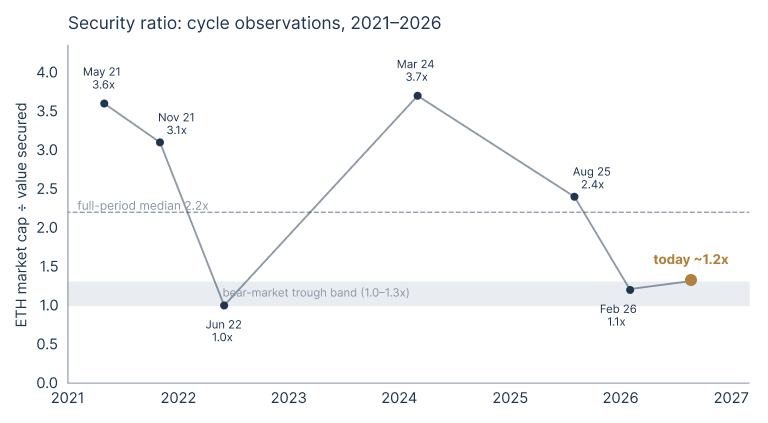
A daily proxy reconstructed from January 2021 (ETH market capitalization over Ethereum stablecoins plus DeFi TVL) ranged from ~1.0x to 3.7x with a median of 2.2x. Bear-market troughs clustered at 1.0 - 1.3x; bull markets reached 2.4 - 3.7x. Today's ~1.2x sits in the trough band. The scenario ratios follow from this record: the bear case's 0.8x is below any sustained level, the base case's 1.3x is normalization to the top of the trough band, still well below the median, and the bull case's 1.5x sits well below the 2.2x median and far below prior bull-market peaks.
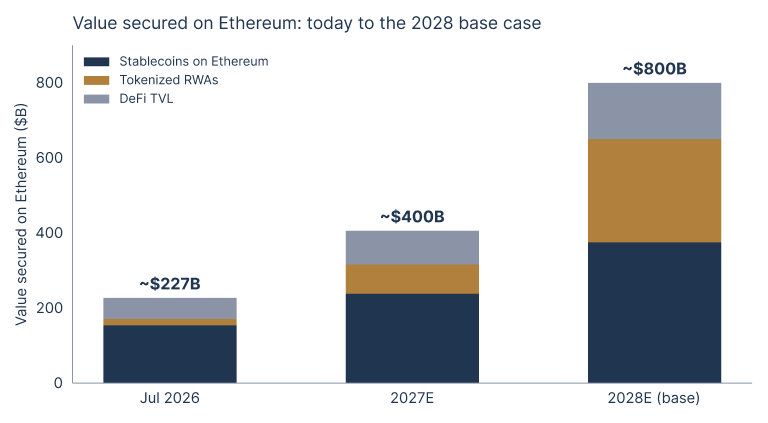
The operating forecast moves value secured from ~$227 billion to ~$400 billion in 2027 and ~$800 billion in the 2028 base case, driven by stablecoins compounding at ~40% annually at flat Ethereum share, RWA growth decelerating to ~$500 billion globally, and DeFi TVL reaching ~$150 billion. Post-Glamsterdam, we expect paid L1 throughput of 2,000 - 5,000 transactions per second by 2028, predominantly agent-driven, producing $0.9 - 3.2 billion of annual fee revenue as a cross-check. Supportive, but not what carries the valuation.
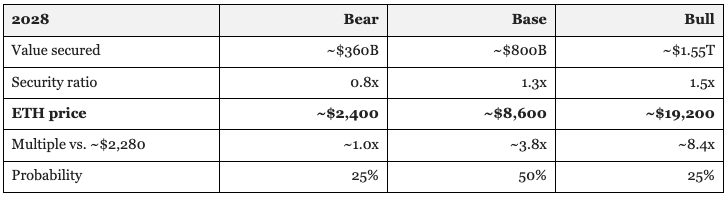
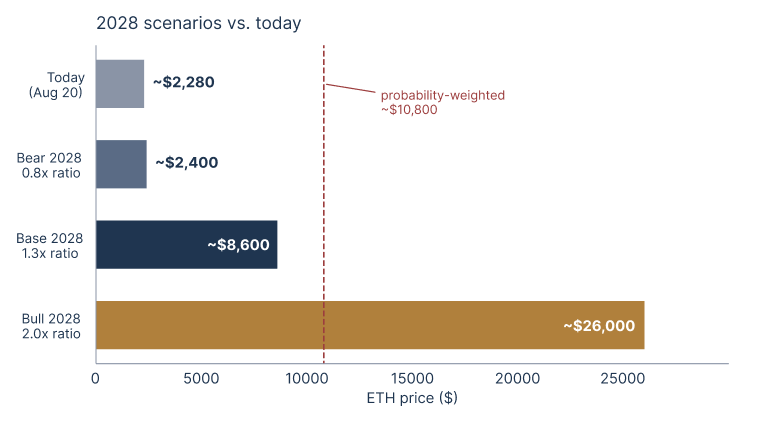
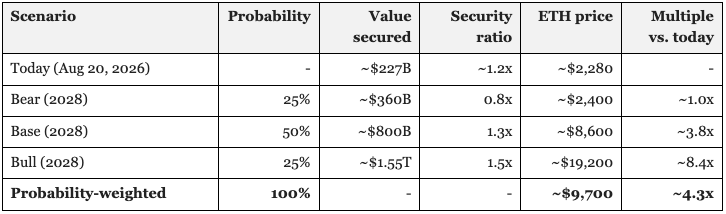
The bear case deserves attention for what it requires: stablecoins growing only 45% in two and a half years despite federal law, RWAs growing 4.5x after 2.8x in the past year alone, Ethereum losing share everywhere, and the multiple de-rating below its six-year floor and the result is approximately today's price. The base case requires no heroics and lands at $8,600, well below Standard Chartered's $25,000 target for 2028. The bull case adds moderate multiple expansion: at the same $1.55 trillion secured, the base-case 1.3x ratio alone would imply ~$16,700, and the re-rating to 1.5x carries the case to ~$19,200 while remaining well below the historical median. The probability-weighted value is ~$9,700, or ~4.3x.
Sensitivity separates the two sources of upside, adoption (rows) and re-rating (columns):

We report value secured, the security ratio, Ethereum’s RWA and stablecoin share, L1 and blob revenue, ETF staking assets, DAT flows, and agentic transaction activity in every investor letter.
The most performant blockchain possible runs on a single computer; the most trustworthy runs on every computer on earth. Neither extreme clears a market, and every network chooses a position between them. Demand pools where use-case requirements match that position, and four durable pockets have formed: Hyperliquid at the performant end, purpose-built for perpetuals; Solana next, with coordinated infrastructure serving high-velocity consumer activity; Ethereum and its L2s in the decentralized range, hosting the assets for which security and neutrality bind; and Bitcoin at the far end, serving exactly one use case, hard money. None is mispositioned but transaction counts concentrate at the performant end, while balance sheets concentrate at the trust end, and our valuation framework measures balance sheets.
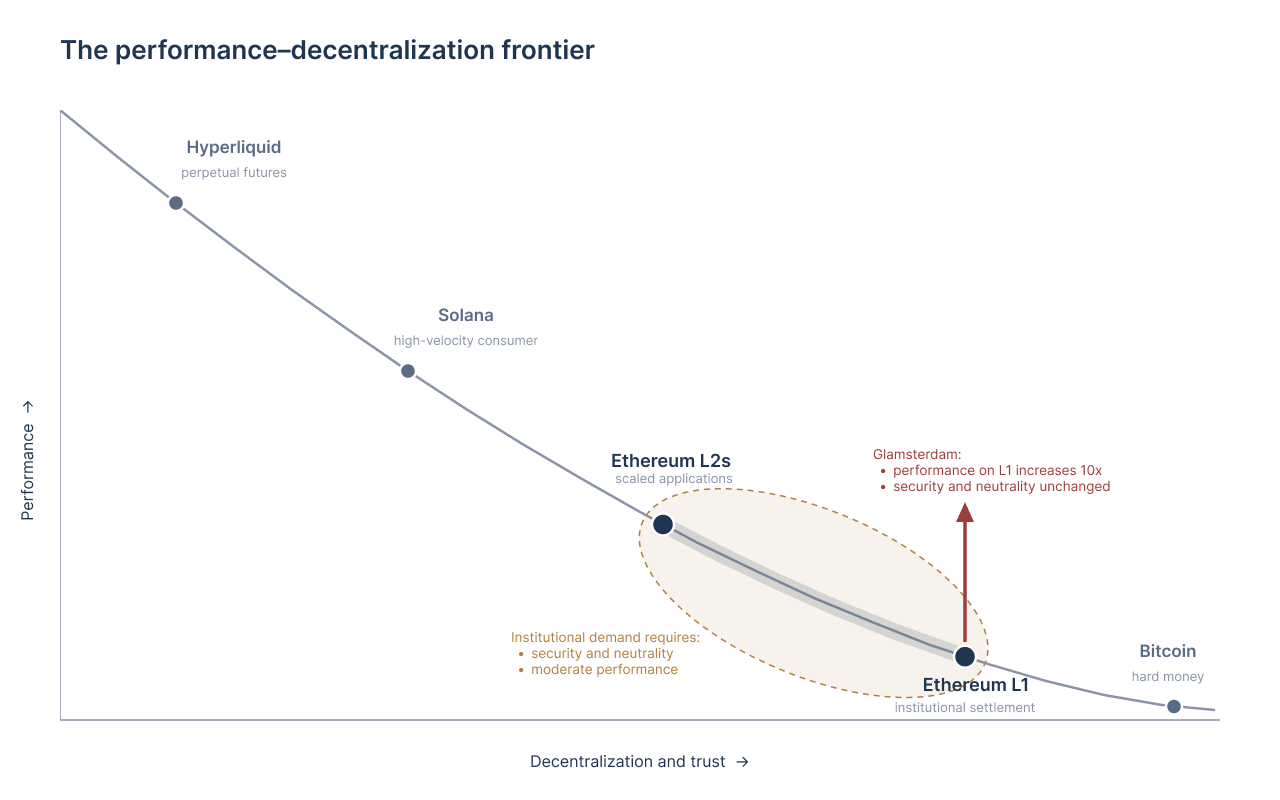
Institutional demand has already revealed where it lands. The permissioned consortium chains of 2016 - 2019 offered maximum performance and control and failed commercially, because settlement without open liquidity and neutral governance is a database with extra steps; the banks that funded them now deploy on public Ethereum, at several times the share of any alternative, despite cheaper blockspace being freely available. Settlement also compounds: each institution that arrives makes every incumbent’s assets more useful as collateral and liquidity, raising switching costs.
The positions are not equally mobile. Performance is an engineering problem and decentralization is a history problem. Ethereum can move toward the performant end and Glamsterdam does exactly that at constant decentralization. While no performant chain can retrofit a decade of uptime, a $76 billion security bond, or credible neutrality within an investment horizon. Through its L2s, Ethereum is also the only ecosystem selling a range of the frontier rather than a single point. Competitors sell one tradeoff; Ethereum sells the curve.
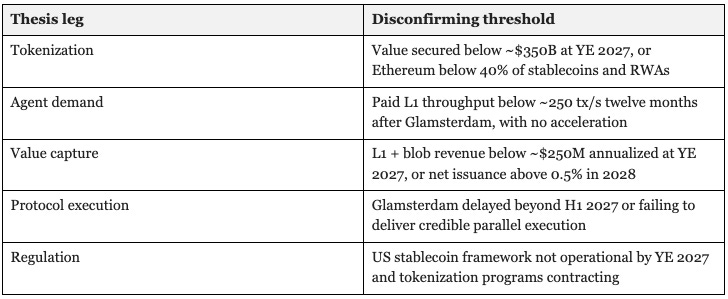
The thesis is designed to be falsifiable. These thresholds trigger formal re-underwriting rather than being treated as volatility:
The most important risk is value-capture failure: activity migrating to L2s that pay the base layer little, leaving ETH widely used but not held. Our counterview is that ETH remains the network’s security, collateral, staking asset, and gas reserve; a growing pool of tokenized value cannot rely indefinitely on an undercapitalized security layer, and Fusaka has already shown the protocol will charge L2s. Regulatory delay would flatten the adoption curve without bending it back. The GENIUS Act takes full effect by January 2027 regardless, and DTCC, BlackRock, and Robinhood built under existing authority. We also monitor DAT reflexivity, competitive share loss, and staking concentration, each observable and reported.
Dialectic has operated natively onchain across multiple cycles. The strategy captures both the re-rating and the yield the convergence creates: tokenized assets need liquidity, staking and restaking carry structural spreads, and DeFi credit markets misprice during regime shifts. The fund holds core ETH exposure and deploys onchain yield strategies around it. In the base case, yield compounds on appreciation; in a flat market, it pays for patience. Dialectic’s relationships across protocols, founders, and the core Ethereum organizations provide direct visibility into tokenization mandates and emerging risks; the monitoring framework in Section 6 is how the strategy is already managed.
The market values ETH at ~1.2x the value Ethereum already secures, a trough multiple, while tokenized assets, stablecoins, institutional infrastructure, and staking products compound. The bear case resolves near today’s price, the base case supports ~$8,600, and the probability-weighted value is ~$9,700. August showed how quickly the gap can start to close. We are positioned for the rest of it.
Disclaimer
This memorandum is for informational purposes only. It does not constitute investment advice, a recommendation, or an offer to buy or sell any security or digital asset, and it is not a solicitation to invest in any Dialectic fund or Machine. It reflects Dialectic’s own research and views as of August 2026 and does not account for any reader’s individual financial situation or objectives.
Scenario values, price levels, and probability weightings in this memorandum are estimates and internal models, not forecasts, targets, or guarantees; actual outcomes may differ materially, and Dialectic does not guarantee any yield or rate of return. Digital assets are volatile and can lose some or all of their value, and past performance is not indicative of future results.
Recipients should conduct their own due diligence and consult independent financial, legal, and tax advisors before making any investment decision.
No posts
Comments
Nothing yet. Say the first thing.
Sign in to join the conversation.