
Problem
Teams spend thousands of hours generating knowledge in code review, but have almost no way to see what they’ve learned collectively, where that knowledge lives, or which parts are ready to turn into standards and automation.
Tricorder Explorer
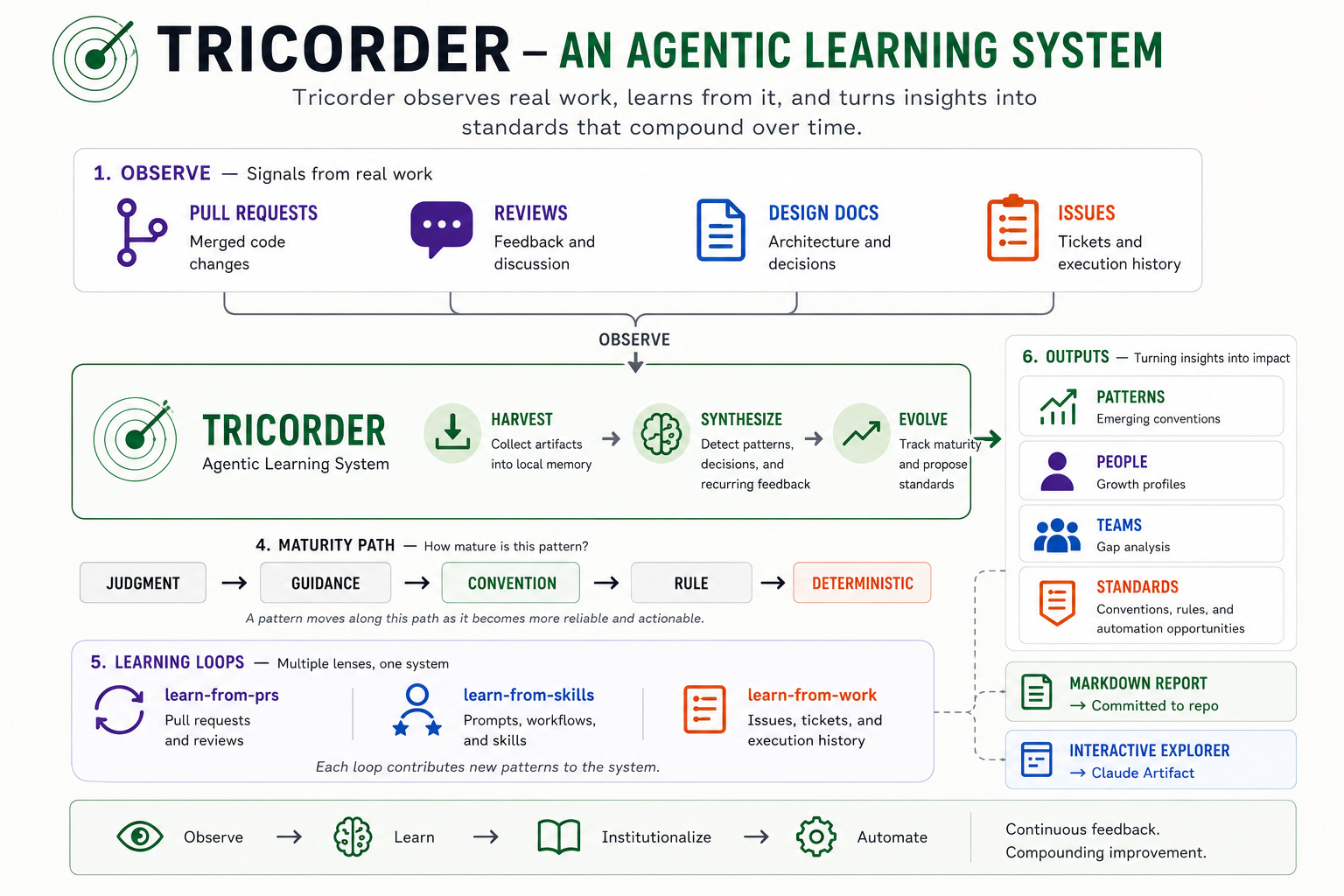
Tricorder analyzes merged GitHub pull request history and uses LLM-based synthesis to extract recurring engineering practices, review patterns, and institutional knowledge from review discussions.
This demo visualizes a sample analysis of ~190 PRs from the cal-itp/data-infra repository. It explores:
Maturity Pipeline — recurring review patterns ranked from human judgment to deterministic rule.
Pattern Coverage — who reviews for what, with drill-down to the underlying review comments.
Team Gaps — missing coverage, blind spots, and opportunities for new standards.
Reviewer Fingerprints — individual reviewer strengths and areas of focus.
Author Profiles — growth and feedback patterns over time (private mode).
The goal is to answer three questions:
What knowledge is this team applying during code review?
Where are the team’s knowledge gaps and dependencies?
Which review practices are mature enough to be codified as tests, checks, or standards?
Start with the interactive Explorer demo to see Tricorder in action:
https://dhk.github.io/tricorder/explorer/?tour=1
Then dive into the source code and run it against your own repositories:
https://github.com/dhk/tricorder
Open Source
MIT License
We generate far more knowledge than we retain. Subscribe if you’d like to explore what becomes possible when teams can systematically learn from their own work
Comments
Nothing yet. Say the first thing.
Sign in to join the conversation.