
This week’s post, our twenty-first following our review of Peter Shull’s Why Teach?, features Giada Scodellaro’s Ruins, Child, which was published last month by New Directions Publishing. New Directions was started in 1936 by James Laughlin on the advice of Ezra Pound. From those dubious beginnings (one wonders what other kinds of advice Pound was dispensing in 1936), it has risen to become one of the most prestigious houses in American publishing, especially renowned for republished modernist classics, literature in translation, and poetry anthologies.
By now you’ve probably heard about “The Serpent in the Grove,” the Commonwealth Prize-winning short story published by Granta that was in all likelihood written by AI. The story has become a sensation not only for how it slipped by the gatekeepers of an elite literary institution (who are themselves being accused of using AI for, at the very least, blurbing the story), but also for the befuddling and often absurd nature of its language. One passage in particular has quickly become infamous:
They called her Zoongie. Maybe it was a name; maybe rain took a shape and decided to keep it. She had the kind of walking that made benches become men. Hair tumbling wild, a dress that caught and released light, laughter with iron under it. Eyes that skimmed and did not land, as if what she wanted was elsewhere and she had to pass through men to get there.
It’s hard to write sentences like these. Sentences that strain for meaning without ever really getting there. It’s like trying to sing just slightly flat on purpose; if you aim to be just a half a key off, you’ll probably just end up barreling out notes all over the scale. In other words, there’s a logic to the prose, only a logic that is different from ours, as if it was written following rules of metaphor and meaning somewhat perpendicular to those we typically follow. Rules that don’t quite make sense to us—but might, you know, make sense to a machine.
At the same time, several commentators have noted that the prose bears an uneasy resemblance to the language of more established postcolonial writers. It turns out that celebrated diaspora novelists from Arundhuti Roy to Ocean Vuong also love warped metaphors and semi-nonsensical imagery. In fact, as one Substacker mentioned, there’s a long history of non-European writers defending their right to not be immediately intelligible to white and European readers. Notably, the Martinican theorist Édouard Glissant elucidated what he called the “right to opacity”: the need to allow minority speakers of a language to produce poems, novels, and speech that are not reducible to the rules, standards, and meaning systems of imperial Western languages like French and English.
From a certain angle, then, “The Serpent in the Grove” marks an unfortunate but also completely predictable confluence of machine-produced language and decolonial literature—unfortunate because, as Karen Hao makes explicit in Empire of AI, the companies behind LLM chatbots are thoroughly imperial projects, mobilizing vast resources for the purpose of capital accumulation, and predictable because, as identity-based fiction has moved from the margins to the center of US literary culture over the last twenty years, a distinct poco/diaspora “style” has emerged in prize-winning fiction that has in turn been fed into LLMs.
This puts postcolonial and minority writers in a tough position. Although it would be unforgivably reductive to take Roy, Vuong, and the recent winners of the Commonwealth Prize as the principal inheritors of Glissant, their success makes it hard to imagine how any writer could maintain a position outside of or opposed to what Glissant called the “transparency” of Western universalism, which might once have been represented by the imposition of standard French across La Francophonie but at this late hour has become isomorphic with the penetration of techno-capital into every sphere of life. After all, what could possible be more transparent than the automatic reading of all texts by an oligarchically-managed, resource-sucking plagiarism machine?
For better or worse, one thing that LLMs seem poised to destroy is the idea of a book written for a specific audience, the kind of book that once demanded a certain level of prerequisite knowledge to comprehend. Now all books are in a sense “readable.” Not only can you have a plot summary in minutes, LLMs can present you with a working aesthetic theory of a text just as fast.
I couldn’t help but think of all this as I read Giada Scodellaro’s Ruins, Child, which also exhibits a kind of off-center logic, a deliberate form of difficulty designed to resist immediate comprehension and swift interpretation. That is not to say, of course, that I think Scodellaro’s novel was written by AI—it’s too idiosyncratic and fragmented. At this point, LLMs have probably not been trained on enough Fiction Collective 2 to reproduce its experimental form and narrative, which loosely centers on a group of children(?) in a former housing project turned post-apocalyptic(?) commune watching a film made by six(?) Black women who live(d) in the same apartment.
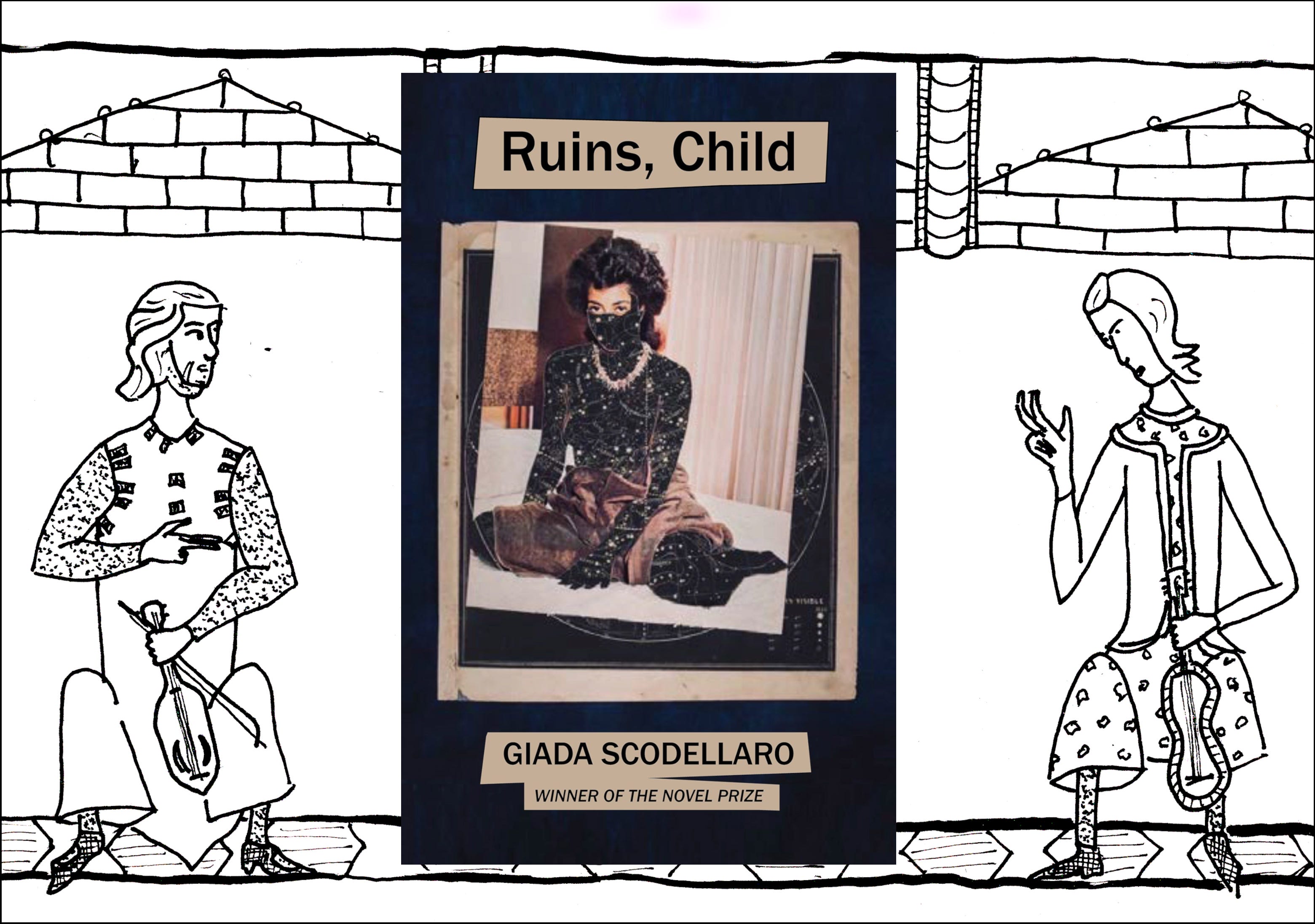
And while Scodellaro is herself a Black woman born in Italy and raised in the Bronx, her style doesn’t really exhibit any of the traits of the minority writer “house style”—or, at least, not in the prize-winning manner of Ocean Vuong. This gives the novel a different kind of “opacity,” with a logic that feels off-beat in a manner slightly different from most identity-based fiction:
“The volume of the television is up so loud it can be heard crystal clear in the backroom. Mhmmm, they say, yes, they say. It’s known that no basement apartment can really withstand or exist anymore, not like when I was a young thing, not even a first floor spot, or they exist, but they’re occupied illegally, the government tells us, okay, and everyone that can manage lives up high, the woman says.
And then Pearl asks her, Von, Vonny, can plants be architecture? Can they exist in reverence the way the old castles still stand, broken? Or when we plant the cypress trees in a line, don’t they provide good shade?
The woman says yes, yes. Sure. Sanaa Lathan says, no.”
There’s not much I can offer in the way of context for this passage, except that it seems to be a scene from the film heard by children listening from the backroom of the apartment. The women speaking are all on the film, including Von (or Vonetta!, often just called the woman, who is both very old and pregnant) and the actress Sanaa Lathan (of Love & Basketball fame).
To the point, while there do seem to be a few aspects of typical identity-based fiction here, these all appear distorted, fragmented, and spliced: the women seem invested in collective memory, or what Toni Morrison called “rememory,” but that’s complicated by the conceit of a film that is watched, rewatched, and subject to misinterpretation; there’s interest in the specific connection between non-Western communities and the natural world, but the setting is undeniably urban; there’s lots of quasi-theoretical talk about identity, but there’s not a ton of answers or half-baked aphorisms.
And this, I find, is how experimental fiction tends to work. Like many, many works of avant-garde prose before it, Ruins, Child uses the form of the novel—setting, characters, plot—to establish an alternative logic from that of standard realist fiction. In this sense, when characters don’t develop like they’re supposed to, we’re meant to ask, well, why not? And when tedious repetition replaces plotting, we’re supposed to think about what the writer might be trying to say by denying use the pleasures of a neat plot. Likewise, when Scodellaro makes use of tropes typically found in minority writing but doesn’t allow them to cohere like they do in Vuong, Roy, or “The Serpent in the Grove,” they’re meant to be stumbling blocks, stones given for bread—things that are meant to get us to think.
But the problem is, it’s extremely difficult to theorize what alternative aesthetic logic a novel like Ruins, Child is trying to establish based off a single reading. It needs time, concentration, and really, it needs work. If you’re not able or willing to put that work into reading it, what you’ll end up with is just a bunch of questions. For instance:
What does Scodellaro want to say about collective memory?
What does she want to say about objectification?
Why is the actress Sanaa Lathan a character?
Why is the poet Dionne Brand a character?
Why does Vonetta! have an exclamation point in her name?
Why does the novel eventually break down into a kind of free verse poetry?
Who the hell is this book for?
It’s this last question that seems the most pertinent. Who is this novel’s imagined audience? Who might be willing to put in the interpretive work of making the novel’s difficult aesthetic legible without feeding it into the interpretation machine? Because, yes, an LLM could probably provide you with a few surface-level talking points, but a novel like this one almost demands not just time and effort but a particularly invested interpretive community—not for nothing is this a novel about people sitting around discussing a film.
The modernist avant-gardes of the early 20th century provided a relatively uniform answer to this question: the difficult work of art is addressed to the future, to a “coming community” that it will in some have played a role in creating. In his 1936 memoir of traveling through the USSR, the French novelist André Gide articulates this idea in an exchange with a Soviet painter who, repeating the official Stalinist position, tells him, “What we want nowadays are works everyone can understand and understand immediately…Art should be popular or be nothing.” Gide—the student of Mallarmé, the friend of Oscar Wilde—is horrified by this. He tells the painter: “A work of art is not merely addressed to the present. The only really valuable works are those messages which are often not understood till later, and a work which exclusively and too perfectly responds to an immediate need runs the risk of soon appearing totally insignificant.”
For Gide and other modernists, this futural audience was embodied in the present by the artist and their coterie. The avant-garde, as scholar Timothy Yu puts it, “is an aesthetic and a social grouping defined as much by its formation of a distinctive kind of community as by its revolutionary aesthetics.” Black and postcolonial avant-gardes have often embraced experimental forms for a similar purpose, envisioning a coming community freed from historically constricted notions of race and identity.
What kind of community does Ruins, Child envision? Does it imagine a future group of refugees passing it around in the ruins like samizdat or perhaps the first mimeographed copies of the Combahee River Collective Statement? Maybe Scolladero already has a circle of likeminded artists who see themselves as the vanguard of the society of the future? And, projecting my own desires here, wouldn’t we want that to be the case? Don’t we want work that goes on in the margins, out of the smothering daylight, undetected until its too late and our way of seeing the world has already been utterly transformed?
Alas, I suspect the answer to all of these questions is a bit more banal. The frustrating part of this entire discussion is the inconvenient fact that for a very long time now, the future and coming communities of most avant-gardes have resided in one place—academia. Since the US university system exploded after WWII, no institution has been better equipped to reproduce a small coterie of aesthetically-minded individuals than the graduate seminar. A university is the place you will most likely learn to appreciate difficult aesthetics, where you will read Glissant, study the Black avant-garde, and meet others who want to change the world the way you do.
No surprise that Ruins, Child comes equipped with a helpful “Notes” section that lists the various artworks and theoretical sources Scodellaro incorporated into the texts—this was a novel written for the seminar table.
Of course, one could argue (and many have) that the university is itself a “transparent” force of Western hegemony, designed to absorb the art and folkways of minority communities and reproduce them as sterile “knowledge.” But if that’s the case, I wouldn’t worry about it too much. Even the professors seem to think the university’s on the way out, while others have made the case that its been in ruins for a very long time now. If that’s the case, then where will books like Ruins, Child be read, cherished, and interpreted? The future is anyone’s guess.
No posts
Comments
Nothing yet. Say the first thing.
Sign in to join the conversation.