
This week’s post, our eighteenth following our review of Greta Schledorn’s Now More Than Ever, features Bruce Holsinger’s Culpability, published in 2025 by Spiegel & Grau. The specific details of S&G are discussed below.
I chose to write about Bruce Holsinger’s Culpability as a bit of a provocation, a lens through which to explore the concept of the independent book press and thus the premise of Dhimmi Monde. I had been adding, at random, a bunch of recent books published by small and independent presses to a list on Goodreads when I noticed something odd. One book on the list had 50,000 ratings, more than double almost every other title.1
Clicking to the page of Culpability, I was bemused by the familiar label on its cover: Oprah’s Book Club. I then checked the publisher, Spiegel & Grau, and did a little research. I had thought, in the back of my mind, that Spiegel & Grau was an imprint of a Big 5 press rather than an autonomous press of its own, and so figured that whatever information I had got about the novel being an “indie” was incorrect.
This confusion proved warranted—Cindy Spiegel and Shirley Grau were the founding editors of Riverhead Books, the very successful Penguin imprint, before getting their own eponymous imprint with Doubleday (2007) and then Random House (2008). The Penguin Random House merger (2013) brought them back, in a fashion, to their old stomping grounds, but was also cited as the eventual cause of their shuttering in 2019.
A year later, Spiegel and Grau re-established their imprint as an independent publishing house. Their financial backing comes from the likes of William Randolph Hearst III and Laurene Powell Jobs, individuals whose wealth is founded in large part on the conglomeration of mass media. The press describes itself as an “independent multi-platform publisher,” eschewing the words “literary” or “book.” They continue:
At Spiegel & Grau we take a holistic approach to content. A book might find new life in film or television; or a podcast might later become a book. Books are at the center of our business, but through strategic and collaborative partnerships and with the experienced guidance of our multi-media team, we are able to amplify writers’ and creators’ voices across a range of platforms that best suit a story’s message, enlarging the very definition and scope of publishing.
This, then, is how the ideas of “independent press” and “Oprah’s Book Club” can be reconciled. It therefore begs the question of the usefulness of “independent” as a descriptor. Like the word “organic” in the marketing of food, it connotes more than it denotes. Just as the former evokes vague ideas of healthy and ethical choices, “independent” seems to promise originality, smallness, and aesthetic and economic radicalism. Spiegel & Grau betray the insufficiency of not only “independent” but also “small”—independent from whom, small compared to what?
Spiegel & Grau is independent of the Big 5 publishers that move increasingly in the direction of monopoly, but what practical difference should we expect when their funding is still derived from billionaires and their business strategies identical to those of Netflix? Likewise, while they don’t call themselves “small,” I’m not sure that would be a misnomer—they certainly publish many fewer books than Penguin Random House and surely have a much smaller staff.
I don’t think this means that “independent” and “small” are entirely useless terms for distinguishing HarperCollins from Dalkey Archive, but we should at least pause before supposing that these words carry any aesthetic or hardly any economic significance in themselves. Expecting a book from an independent press to be inherently different from (let alone better than) one from a mass publisher might be no different than assuming your organic cucumber to be tastier and more nutritious than its non-organic sibling. And as with organic food, you may find that the origins of each are more similar than the names imply.
If a subservience to the market is to blame for the resemblance of some independent presses to conglomerate publishers, then by narrowing our sights to the non-profit press we can rest easy that their books will exist beyond ethical or artistic compromise. Nah, I’m just kidding. In his Big Fiction, Dan Sinykin demonstrates that while not beholden to the market in the same way as for-profit presses, non-profit presses often find themselves duty-bound to the missions of the foundations that support their operations. In the 1990s, the dominant foundational ethic was multiculturalism, and at least to the extent that authors were writing with non-profit publication in mind, they were potentially nudged toward the representation of cultural identity. Yet even if we, with figures like Tyler Austin Harper, were to decry the non-profit sector’s liberal mandates, the logic of difference in a closed field would remain. To the extent that an author is writing with non-profit publication in mind, they are writing against, or at least in distinction from, the aesthetic and sociopolitical values of the conglomerate presses. If we take the stereotypical image of a novel being edited for big press publication by the sanding down of its edges, the concealment of its tattoos, the equally true (or untrue) image of a novel being edited for non-profit publication would be the artificial sharpening of its edges, the addition of a clip-on nose-ring.
As enjoyable as it would be to conclude with a call for Dhimmi Monde to disband and veer either right (it’s all compromised, so let’s just learn to love our conglomerate overlords) or left (it’s all compromised, so let’s just trade in the book review for the Molotov cocktail), I don’t think it’s quite as hopeless as the above seems. For one, while Sinykin’s publishing-centered history of post-1945 literature is invaluable in many ways, it inevitably overstates the impact of the publishing matrix at the level of the individual work of literary fiction. While there are no doubt cases in which novelists have shaped their writing in response to the relative expectations of a conglomerate press or an independent press, Sinykin’s book tends to take for granted that most writers sit down and decide whether they are going to write a Riverhead novel or a Coffee House novel or an FSG novel. This clashes with much of my own reading. Literary agents do not treat manuscripts in this way, either; they do not immediately decide “this is an indie novel” or “this is a Big 5 novel” and submit only to editors of one or the other. There are many other forces shaping the individual literary work—even the author herself!
Second, autonomy from the market (and, obversely, autonomy from the foundation), is relative, not absolute. While there is no perfect catch-all (indie, small, non-profit) to which we can pledge our support, we can draw distinctions between Spiegel & Grau and, say, Semiotext(e). We cannot assume the aesthetic or political radicalism of a non-profit novel, nor can we assume the aesthetic or political traditionalism of a work from a for-profit or conglomerate press. We must, alas, read each novel on its own terms and treat its contextual conditions of being as possibly but not necessarily determining forces. Time and again it’s the same disappointing discovery: we must read.
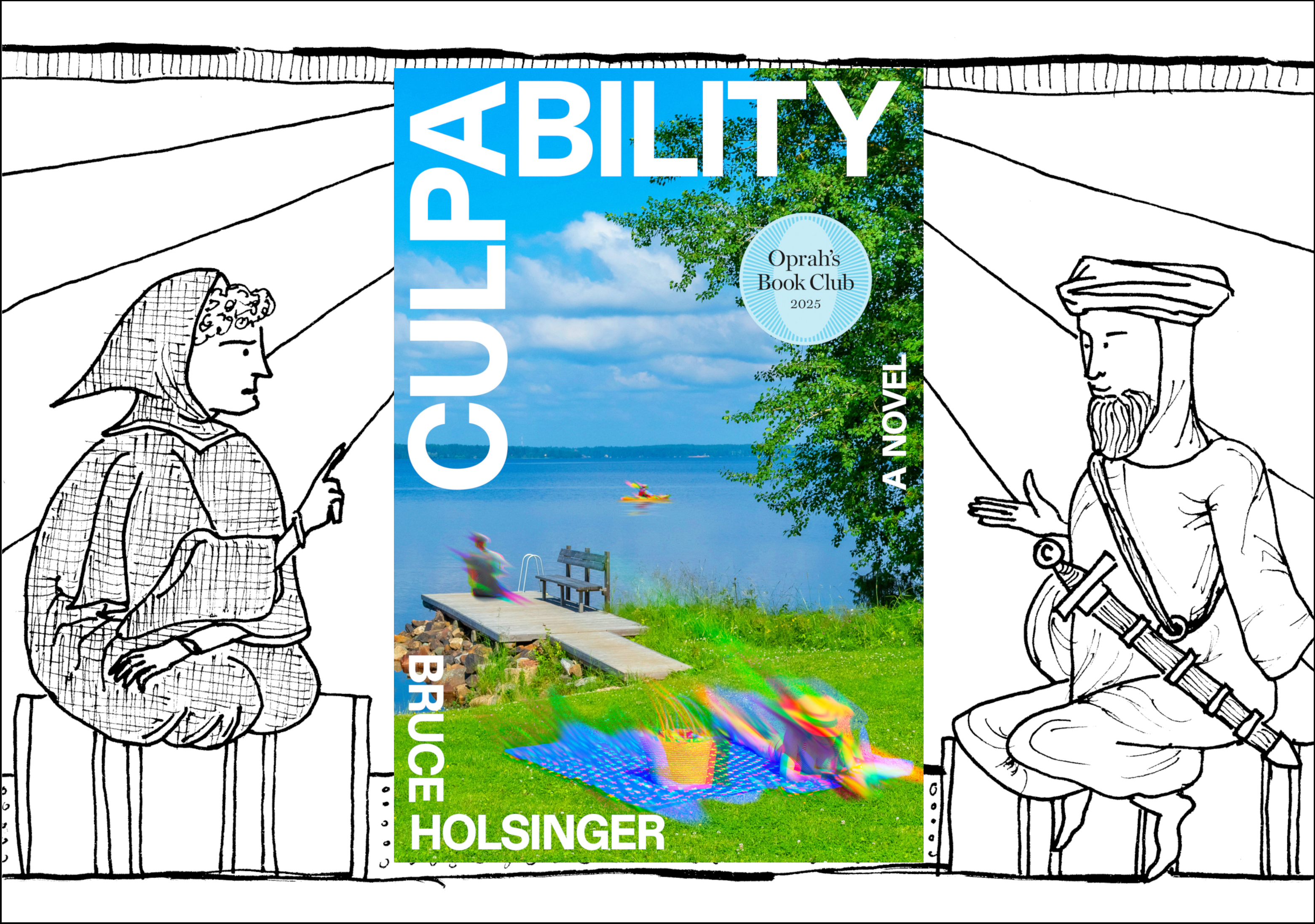
While the curious publishing context of Culpability was the first thing to reel me in, I was further intrigued by the author’s biography and the novel’s premise. I left academia around 2020, and so did not recognize Bruce Holsinger as the scholar who had replaced Rita Felski as the editor of New Literary History in 2018. At the risk of getting too inside-baseball here, New Literary History is the leading academic journal of literary theory. The history of academic literary theorists writing novels is not star-studded. Harold Bloom wrote a novel he was so embarrassed by that he paid the publisher not to reprint it. I haven’t read any of the novels written by Raymond Williams, Terry Eagleton, or Frank Lentricchia, but neither have you. Holsinger is a medievalist, and his first couple of books were historical thrillers that you might expect from someone working in that field. While those seem to have been reasonably successful for an academic, Holsinger found a much larger audience with The Gifted School (2019), a book club-y novel about privilege in suburbia that capitalized on the zeitgeist of the college admissions scandals. Since then, Holsinger has found himself a niche, abandoning the 14th century for the bleeding edge of the present and SEO-friendly premises.
Culpability is tailored to the big questions, fears, and buzzwords of the moment. It’s about artificial intelligence, privilege, billionaire tech companies, effective altruism, and chatbots. You will be astonished that there is no mention of pickleball. My tone is cynical, but I am as attracted to the zeitgeist novel as anyone, and truth be told I read eagerly through much of the novel. It starts shakily—first, with an excerpt from a book on AI ethics written by the narrator’s philosopher wife, Lorelei Shaw:
And this, I propose, is the inhuman soul of the algorithm. It may think for us, it may work for us, it may organize our lives for us. But the algorithm will never bleed for us. The algorithm will never suffer for us. The algorithm will never mourn for us.
In this refusal lies the essence of its moral being.
This isn’t especially original as theory, but maybe Shaw is a little bit of a hack or it’s an older, gen pop book. We then get the facile comparison of an algorithm to a family: “Like an algorithm, a family is endlessly complex yet adaptable and resilient, parents and children working together as parts of an intricate, coordinated whole.” Sure, but the claim that “a family is like an algorithm,” which repeats throughout the story, is really just a meme. Love is like an algorithm. A book is like an algorithm. The comparison is meaningless, asserting nothing more than a vague sense of complexity.
The Big Event of the novel happens almost immediately and so can be revealed without much compunction about spoilers. The narrator (Noah), a reasonably successful corporate lawyer, is sitting in the passenger seat as his 17-year-old son (Charlie) drives the family (including the aforementioned Lorelei Shaw and two daughters) to a lacrosse tournament. Except Charlie isn’t really driving—their car has an autonomous driving mode that allows the pilot to simply monitor rather than direct. Both Noah and Lorelei are absorbed in work when the elder daughter shouts, an apparently distracted Charlie grabs the wheel and swerves, and they collide with another car, killing an elderly couple.
The title should prime the reader for a novel that will explore the relative responsibility for the accident, and what is by far the book’s strongest achievement is its close scrutiny of the ways in which the tragedy unsettles the family’s complacent sense of impunity. When Charlie comes under investigation for involuntary manslaughter, the family’s tight web of solidarity quickly begins to loosen. This becomes most involving as Noah slowly recognizes that his son is a douchebag. Whereas Noah is a kind of J.D Vance lower middle-class striver who has married upward into the aristocratic Shaw family, Charlie (recalling Ethan Couch) is an overly coddled private school jock who seems not exactly unfazed by having killed two people but, we’ll say, insufficiently bothered. Noah is devoted to his son, a “cool dad” who buys him White Claws and describes his athletic body in somewhat discomfiting terms, but notices that “Charlie…treats his good fortune with an air of cheery practicality, as if escaping unscathed from a fatal head-on collision is an assumed entitlement. Of course Charlie is fine. Of course his charmed life will continue to unfold as planned.” At the novel’s relatively early peak, it becomes apparent that Charlie’s best legal defense is for Noah to receive the blame for inattentive parental oversight; in a delicious bit of dark humor, Noah reluctantly agrees to bankroll an expensive attorney for his shitty son who, we have come to learn by this point, was texting just prior to the accident.
Holsinger writes Noah’s encroaching ambivalence about his family engagingly, and I’m convinced that were the novel to limit its scope to a family legal drama, or commit more fully to its black humor, it would be a really good novel. But it wouldn’t be an Oprah’s Book Club pick. One marker of the middlebrow is a certain glibness about ideas, as though written with the eventual Book Club Discussion Questions in mind. Thus, in a novel about ethics, we get detailed explanations of what are probably the two most famous ethical thought experiments—the trolley car problem and Singer’s drowning child—both of which I taught my tenth graders last year. In a pastiche of an Isaac Chotiner New Yorker interview, we get an overview of effective altruism. If fiction is going to compete with television, it should probably expect more of and offer more to its audience than an NBC sitcom.
But the real culprit for the novel’s errors is its desire to be an AI novel. In addition to the autonomous vehicle and Lorelei Shaw’s work as an AI ethicist, Holsinger includes extensive transcripts of the younger daughter’s texts with a ChatBot, an AI-controlled thermostat that malfunctions, a tech billionaire deeply invested in AI, and passing reference to deepfakes. This is designed to spark polite discussion over mimosas2, not to be seriously reckoned with in a 300-page novel. The last third of the novel is very bad, almost entirely a consequence of the many layers of AI talking points that have been constructed on top of the domestic drama. Like many novels, Culpability coasts for a long time by holding in abeyance information that, when finally revealed, proves incredibly stupid and unsatisfying. Such novels rely on the goodwill and faith of the reader, trusting that the set-up, incomplete and largely promissory on its own, will be justified by the prestige.3 By the end, I felt contempt.4
I generally try not to allow disappointing endings to retroactively color an entire work—as I’ve said, I read much of the novel compulsively and relished some of the domestic turmoil. But I can’t help but think about the extent to which Holsinger’s decisions were influenced by a desire for maximum appeal, the possibility of being part of an advertisement for Starbucks’ Salted Caramel Mocha Strato™ Frappuccino® Drink, the potential for cross-platform adaptation. I suspect that however we define “independent” or “small” press, what we really expect from such books is a commitment to the internal integrity of the story, regardless of the commercial incentives. If Culpability is an indie novel, we must consider rethinking our terminology.
And several times more than other non-translations.
I think here of novels as different from Culpability as Hernan Diaz’s Trust and Susan Choi’s Trust Exercise. They are structured in such a way that one feels they cannot properly evaluate them until everything is revealed. This tends to make for eager anticipation followed by the demurral, with Peggy Lee, “is that all there is?”
(Spoilers:) Not least because the revealed details of the accident actually make it, essentially, an AI-irrelevant incident.
No posts
Comments
Nothing yet. Say the first thing.
Sign in to join the conversation.