
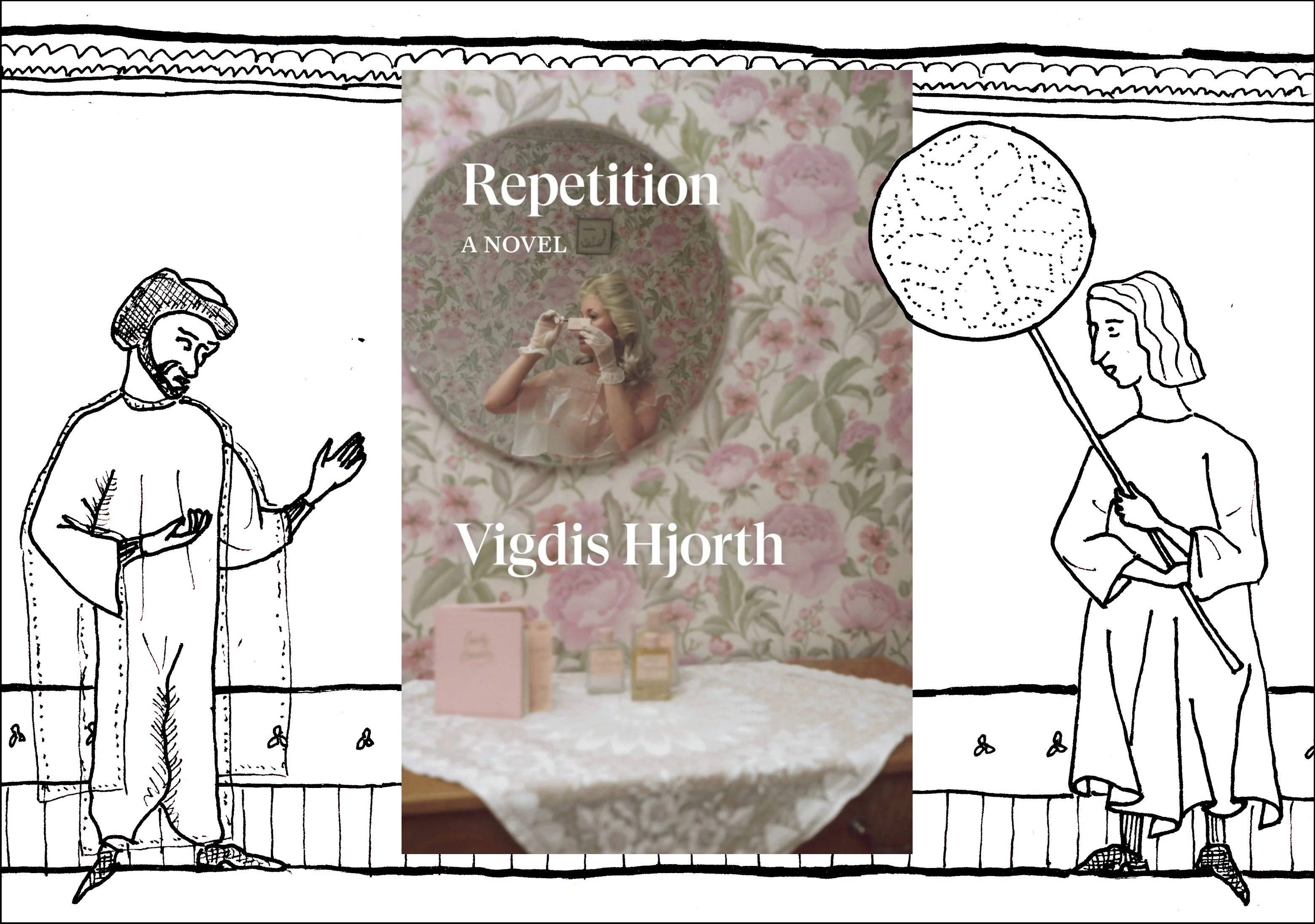
This week’s post, our twenty-third following our review of Sophie Strohmeier’s All Girls Be Mine Alone, features Vigdis Hjorth’s Repetition, which was published in Norwegian in 2023 and in English translation this year by Verso. Launched in the late 1970s as the paperback imprint of New Left Review’s book publishing arm, Verso has become best known for their works of political theory, threading the needle between academia and the commons. More recently, they’ve begun publishing a steady stream of fiction through their Verso Fiction imprint; John W Schneider previously reviewed Hannah Regel’s The Last Sane Woman.
It is perhaps unfair that I read Vigdis Hjorth’s Repetition in the midst of my slow study of Marcel Proust’s Swann’s Way. Many people object to the book review that uses one book—let alone a canonical fixture—as a blacklight to expose the defects of another. But of course it’s no In Search of Lost Time—what were you expecting? Have you considered that maybe Hjorth was trying to *gasp* do something different? But this is to deny the reality of how we read and think about what we read in favor of an ideal. What we have previously read affects our impressions of what we read later; the books we read in proximity to each other become associated, however contingently, in our minds. (Also, I simply find concrete comparison to be a much more substantive form of examination than pretending as though each book is a monad.)
Repetition is structured by a prototypically Proustian recollection. The unnamed narrator, a middle-aged Norwegian novelist who seems designed to encourage identification with the author, is at an orchestral performance when she witnesses a minor quarrel between a teenage girl and her parents. The incident triggers “the memory,” the elusive hole at the novel’s center around which it will whorl without articulating for nearly all of its pages. It is actually a bit more complex than that—the memory the novel focuses on is itself significant foremost for its connection to the recovery of an earlier memory later in her life. The recovery of this primary memory is described in rather more violent terms than Proust’s: “the images came flooding in, unbearable images shot like electric shocks through my brain, lightning-clear and with the force of several thousand volts, and everything fell into place, my mind imploded and I have never been the same since.”
One thing I value about Proust is the utter contingency of so many of the narrator’s recollections, their refusal to derive their value from explanation or material significance. This can occasionally be a bit tedious (I am relatively immune to the lyrical evocation of flowers), but is wonderfully moving when it captures the impossibly subtle, spontaneous non-events that mysteriously structure our selves. The form of Proust’s novel is not, for me at least, conducive to compulsive reading. It is not “unputdownable,” the highest praise of blurbs; I generally put it down every 15 or 20 pages. Those pages demand more concentration and inspire more thought than those of most other writers, and I am enjoying making my way through the book with a balance between diligence and leisure. In contrast, I read the 133 pages of Repetition in two or three days. There is a somewhat hypnotic quality to Hjorth’s prose which—brace yourself now if you get your rocks off from the symmetry between form and theme—is conspicuously repetitive, folding back in on itself in a way that recalls the writing of her compatriot Dag Solstad, or Thomas Bernhard. Additionally, Hjorth’s sentences are often long, paratactic series of clauses whose breathless lack of conjunctions encourage a kind of readerly rapidity. A typical sentence:
He wanted to make out and I made out with him, I wanted to do everything he wanted to do, the word no did not exist in my vocabulary, in my body, we danced and we made out until I had to leave to catch the bus, and fortunately Helle and Unni were willing to leave at the same time as me, we stood in the hall and we made out by way of goodbye with the boys who might now be our boyfriends until we find we had to run for the bus.
The most direct way to make this sentence “grammatical” would be to replace several of these commas with periods. This would, however, produce a choppier effect, a sense of grammatical simplicity and a stop-and-start rhythm. Hjorth’s simultaneous insistence on the long sentence (and, often, paragraph) and eschewal of conjunctions can make a sentence feel like a runaway train, moving the reader through many separate clauses, incidents, and descriptions without pause, or the need to slow down and parse. This is, of course, quite different from Proust’s long sentences, which are hypotactic to the extreme, often demanding multiple readings because of their conjunctive complexity. Hjorth’s is one relatively novel way to make writing unputdownable.
Having sufficiently justified why I read more pages over the past few days of a novel I didn’t especially like than one I insist that I do, my misgivings about Repetition are not really at the level of the sentence (I like Solstad and Bernhard). Repetition is a trauma plot novel in its purest form. It has a few tricks up its sleeve to defamiliarize the trope, but nonetheless the entire propulsive force of the book is toward the inevitable recovery of a childhood trauma that has unconsciously organized the narrator’s entire identity. There are political critiques of the trauma plot (an overweening belief that the personal is political) as well as ethical ones (an exhibitionist and aestheticizing reduction of tragedy to generic conventions). My own distaste is primarily aesthetic—I tend to value narratives that resist the scientific, etiological worldview of the psychologist and, even as I’m susceptible to their seductions, usually find myself disappointed by epiphanic reveals of singular traumatic ground zeroes. I also find stories that foreground passive victimhood dramatically inert; there are many more varied ways to be active than submissive.1
Now, this blending of two of contemporary literary culture’s predominant forms—autofiction and the trauma plot—makes critique difficult, demanding nuanced distinctions. If I question whether Repetition has a sufficiently complex protagonist—one whose self is not wholly defined through a formative trauma—or whether this kind of story has perhaps oversaturated the literary marketplace, it can sound like I am patronizing Hjorth the person, devaluing the significance of trauma, especially the Big One that is sexual violence.2 There is a recurrent game between novelists and critics (to the extent critics who are not themselves novelists still exist) in which novelists conspicuously encourage identification between their protagonist and themselves, and critics subsequently write reviews that take the author as their subject as much as their work. While I’ve grown a bit tired of novelists’ incredulous irritation at suggestions of autobiography when they make formal choices obviously meant to encourage such identification, critics should avoid falling into such a trap and evaluate a novel as a consciously formed work of fiction.
I’m going to pose an incredibly reductive three-pronged model of literary stimulus. There is writing in terms of an imagined audience, which we might call rhetorical. There is writing in terms of a literary ideal, which we might call aesthetic. And then there is writing whose primary warrant is self-expression. Most art is a complex interaction of these distinct ends, and they tend to usefully check and balance one another. Entirely rhetorical writing, unchecked by the aesthetic or the personal, becomes pandering, soulless, lowest common denominator slop. Entirely aesthetic writing is in danger of an impersonal, private perfection. Pure self-expression resists the category of fiction itself, refusing the standards of form or the necessity of a reader. Hjorth’s narrator describes herself as “someone for whom writing is a means of self-expression,” and the trauma plot is overwhelmingly defended on the grounds of the inherent value of externalization, verbalization.3 I, for one, have no interest in reading a novel whose first justification is the psychological relief it gave its author. And it is here where the aesthetic ideal is useful—how to choose among an assortment of novels centered on trauma? It is not enough that this really happened to me or even this is happening all around us. After the initial shock of recognition has worn off on readers, the burden is on the author to find fresh modes of (self-)expression, forms of writing about trauma that transcend (or at least suspend the familiarity of) familiar categories. A bit of metafictional tongue-in-cheek (repetition is the point!) is not quite enough in this case. For now, for me, the childhood trauma held in abeyance until the climax is a dead end, even should the novel call itself Dead End.
In order to head off any gross misreadings and to confirm my own hunch that my taste in contemporary novels has not been against representations of sexual abuse or victimhood tout court, I will note a few that I very much like: Miriam Toews’s Women Talking, Sigrid Nunez’s The Friend, Claire Keegan’s Small Things Like These, Colson Whitehead’s The Underground Railroad and The Nickel Boys. A potentially interesting observation is that none of these are first-person narratives from the victim’s perspective, but the trauma plot doesn’t depend on first-person. I’d argue that none of these novels about trauma (of several varieties) qualify as trauma plots, at least in the sense I am using the term.
There is a fascinating bit in Joan Didion’s long essay on the rape of the Central Park jogger in which Didion criticizes the inadvertent stigmatization of rape resulting from the media’s differential treatment of victims compared to victims of other forms of non-sexual assault. She connects this paternal discursive protection of rape victims to the general lack of conversation about rape in general, a silencing of victims. She writes: “These quite specifically masculine assumptions (women do not want to be raped, nor do they want to have their brains smashed, but very few mystify the difference between the two) tend in general to be self-fulfilling, guiding the victim to define her assault as her protectors do.” Twenty-plus years later, the fact of sexual assault is by no means suppressed by the media, but I can’t help but feel that the “mystification” remains to an extent, even as women have taken hold of the narrative. It does seem to me that, by the conventions of the trauma plot, a merely physical abuse would be regarded as a relatively underwhelming impetus.
Jamie Hood’s introduction to her memoir Trauma Plot defends confessional and other trauma-centered narratives from Parul Seghal and other critics on grounds I don’t find very persuasive, ultimately throwing up her hands: “Then some critics have too much damn time on their hands, so everything they read they read paranoid. Call it Terminal Op-Ed Brain. Call it a salaried position [sic].”
No posts
Comments
Nothing yet. Say the first thing.
Sign in to join the conversation.