
This article is an excerpt from Chapter 4 of the book 《The Simplicity Revolution》.
The Core Idea: Blockchain is not just a financial tool or a cryptocurrency trend; it is a fundamental shift in ledger architecture that redefines how human civilization establishes and maintains digital trust.
What’s Inside: Why modern capital markets suffer from a “trust–efficiency paradox” and how shared ledgers eliminate the hidden cost of permanent reconciliation.
Most technological revolutions announce themselves with spectacle. They promise speed, disruption, and abundance. Blockchain did not arrive that way.
When it first appeared, it seemed almost regressive—slow, intentionally redundant, resistant to optimization. It discarded trusted intermediaries in favor of a shared ledger that anyone could inspect but no single party could unilaterally alter. To many observers, it looked like an ideological experiment masquerading as technology.
That interpretation missed the point.
Blockchain is not revolutionary because it is new. It is revolutionary because it revives a discipline modern systems abandoned under the weight of scale: the discipline of establishing truth once, visibly, and with finality.
To understand why blockchain matters, it must be approached not as a financial instrument or a productivity tool, but as a structural idea. Blockchain is ledger architecture—a way of deciding where truth lives, when it becomes final, and how many versions of reality a system is permitted to maintain.
In this sense, blockchain is less a break from history than a response to its long arc.
Before there were markets, there were ledgers.
Civilization did not begin with trade or money, but with accounting. The earliest writing systems emerged to track grain, labor, and obligation. Long before value could circulate, it had to be recorded. Ledgers are the quiet substrate of coordination—the mechanism by which strangers agree on what is owned, owed, or settled.
Every financial system, regardless of sophistication, ultimately reduces to a simple question:
How many ledgers exist, and which one is authoritative?
For centuries, societies answered this question through centralization. A trusted institution—temple, state, bank, registry—maintained the ledger and enforced its authority. This model worked as long as institutional legitimacy was broadly accepted and operational integrity could be defended.
As systems scaled, however, costs accumulated. Central ledgers became bottlenecks. Parallel records proliferated. Reconciliation became permanent. Truth was no longer established; it was managed.
Blockchain challenges this model not by rejecting ledgers, but by collapsing them.
At its core, blockchain does three simple—but consequential—things.
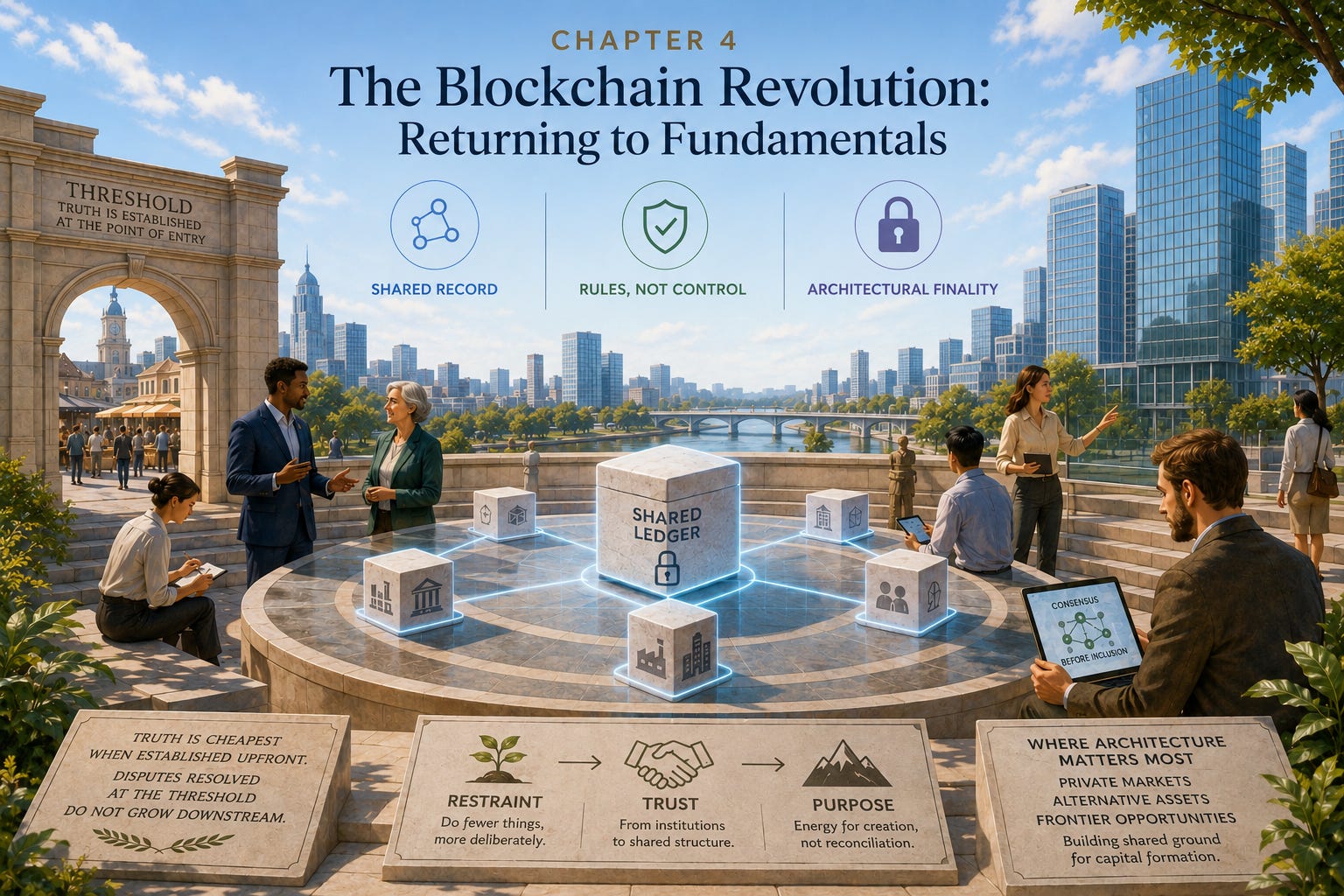
First, it replaces multiple private ledgers with a shared record. Instead of each institution maintaining its own version of truth and reconciling later, participants write to a common ledger. Agreement is reached before inclusion, not after divergence.
Second, it separates validation from control. No single party owns the ledger. Validation follows explicit rules rather than discretionary authority. Governance does not disappear, but it becomes structural rather than procedural.
Third, it enforces finality architecturally. Once a transaction is confirmed, it cannot be altered without rewriting history itself—an act made intentionally impractical. Finality is not granted by policy or trust in an operator; it is embedded in the system’s design.
These features are often described as technical. Their significance is architectural.
Blockchain restores a principle ancient systems understood intuitively: truth is cheapest when established upfront. When disputes are resolved at the threshold, they do not need to be reconstructed downstream.
Chapters 1 through 3 described how societies once relied on physical thresholds—gates, markets, forums—to concentrate legitimacy. These thresholds created shared moments of recognition. They limited where and when truth could be produced.
Modern systems abandoned thresholds in favor of ubiquity. Transactions can occur anywhere, at any time. The cost of that freedom is permanent reconciliation.
Blockchain reintroduces the threshold digitally.
A transaction does not become real because it is proposed. It becomes real only when it passes through consensus—when the network collectively agrees that it is valid. Until that moment, nothing has occurred. After it, the matter is settled.
There is no appeal to a higher record. There is no alternative ledger to reconcile against. The ledger itself is the witness.
This is not decentralization as ideology. It is decentralization as discipline. By forcing agreement at the point of entry, blockchain compresses trust into a single event. Ambiguity is resolved before it spreads.
The resemblance to ancient systems is not symbolic. It is functional.
All systems suffer from complexity, but finance concentrates it faster than any other domain. This is because finance deals almost entirely in abstractions.
A financial asset is not a thing. It is a claim—often a claim on a future claim. Ownership, control, and risk are routinely separated. Time delays are intrinsic. Intermediaries exist to manage uncertainty. Ledgers multiply to manage scale.
As Chapter 2 showed, this architecture produces the trust–efficiency paradox. Safeguards multiply to preserve trust, but those safeguards themselves generate opacity and cost.
Blockchain does not eliminate this tension. It targets its source.
When settlement occurs on a shared ledger, many layers become unnecessary. Clearing becomes implicit. Custody can become structural rather than contractual. Reconciliation shrinks because divergence never occurs.
This does not remove intermediaries. It changes their role. Mechanical custody of truth recedes. What remains—and becomes more important—is judgment, explanation, suitability, negotiation, and accountability. Human responsibility does not disappear; it concentrates.
One of the most persistent misunderstandings about blockchain is the claim that it is trustless.
Blockchain does not eliminate trust. It relocates it.
Participants still trust rules, incentives, cryptography, and governance processes. What they no longer need to trust is the discretion of a single operator. Trust moves from institutional process to shared structure.
This shift mirrors an earlier transition—from personal trust to institutional trust. Blockchain extends that evolution one step further, from institutional discretion to protocol enforcement.
This does not make systems morally superior. Code reflects human values. Governance choices remain. Power does not vanish; it becomes explicit.
What changes is the cost of ambiguity. When the ledger is shared, disputes become rarer. When finality is structural, reversals become exceptional. When transparency is default, opacity must be justified rather than assumed.
These are operational consequences, not ideological claims.
Blockchain is not a universal solution. Finality trades flexibility for certainty. Irreversibility is powerful, but not always desirable. Not every process benefits from being immutable. Governance does not disappear; it becomes harder to avoid.
Many early blockchain experiments failed because they pursued purity rather than coherence. They treated decentralization as an end state instead of a constraint to be managed. They optimized ideology rather than legibility.
The real contribution of blockchain is not decentralization itself. It is architectural honesty.
It forces designers to decide—explicitly—where authority resides, when decisions become final, and how change is permitted. Traditional systems obscure these questions behind process. Blockchain surfaces them.
The deepest value of blockchain is not speed. It is restraint.
By making truth expensive to change but cheap to verify, shared ledgers encourage systems to do fewer things, more deliberately. They shift energy away from reconciliation and toward purpose. They allow capital systems to serve productive activity rather than expending effort merely to preserve internal consistency.
In this sense, blockchain is less about the future than about recovery. It recovers a discipline that ancient systems practiced instinctively: constrain where legitimacy is produced, and complexity shrinks naturally.
The city gate is gone. The market drum is silent. Presence can no longer be enforced physically. But the function they served—the alignment of authority, recognition, and finality—remains essential.
Blockchain offers one way to restore that function digitally. Not by recreating the past, but by respecting its logic.
If blockchain represents a return to fundamentals, the next question is practical rather than philosophical: where does this architecture matter most?
Capital markets are where abstract trust, time, and institutional scale collide most intensely.
Public capital markets already possess infrastructure, however layered and inefficient it may be. Their problem is not absence, but excess. The domains most constrained by fragmented truth lie elsewhere—in private, alternative, and frontier markets where capital formation remains manual, bespoke, and opaque.
These markets do not lack innovation or ambition. They lack shared ground.
They rely on parallel records, improvised compliance, and trust mediated through scale rather than structure. The result is a system that favors incumbents and excludes smaller participants—not by intention, but by design.
If blockchain is to be more than a correction in theory, it must operate inside law, regulation, and institutional accountability. It must function not as an experiment, but as infrastructure. That is the problem addressed in the next chapter.
No posts
Comments
Nothing yet. Say the first thing.
Sign in to join the conversation.