
A sign that says KEEP OUT in four languages tells you a lot about the neighborhood.
I’ve got one that says it in English, French, Russian, and German – all at once, all on the same white panel. There was exactly one place on earth that ever needed a sign like that. Let me show you that one, and two things hanging near it, because together they’re the Cold War I find most interesting: the one that ran on paperwork instead of gunfire.
“Be Security-Conscious” – US Command Berlin
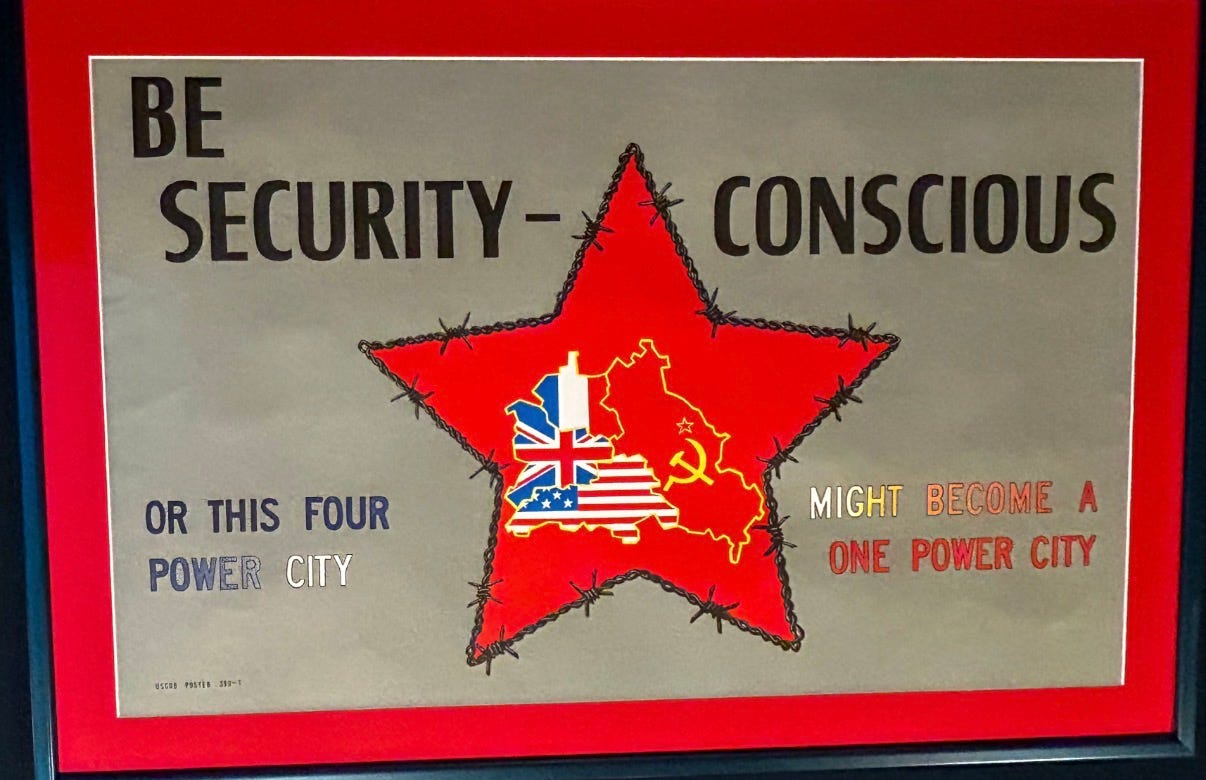
A red star wrapped in barbed wire. Inside it, a little map of Berlin sliced into sectors, three Allied flags jammed into one corner and a hammer-and-sickle sitting in the other. Top and bottom, the whole pitch:
Be security-conscious – or this four power city might become a one power city.
It’s a loose-lips poster, printed to scare young GIs into keeping their mouths shut. But read that tagline again, because somebody in that print shop was sharp. Four power city. One power city. It never tells you which one power. It didn’t need to. Every soldier who walked past it knew precisely which flag would still be flying if the math went the wrong way.
I’ve spent a good chunk of my career in rooms where four or five flags sat at the same table, and here’s what nobody says out loud: that kind of arrangement always feels more permanent than it is. Four armies sharing one city, each quietly running the math on how long the sharing lasts. This poster is that nervousness, printed.
Foreign Military Liaison Missions – Passage Prohibited
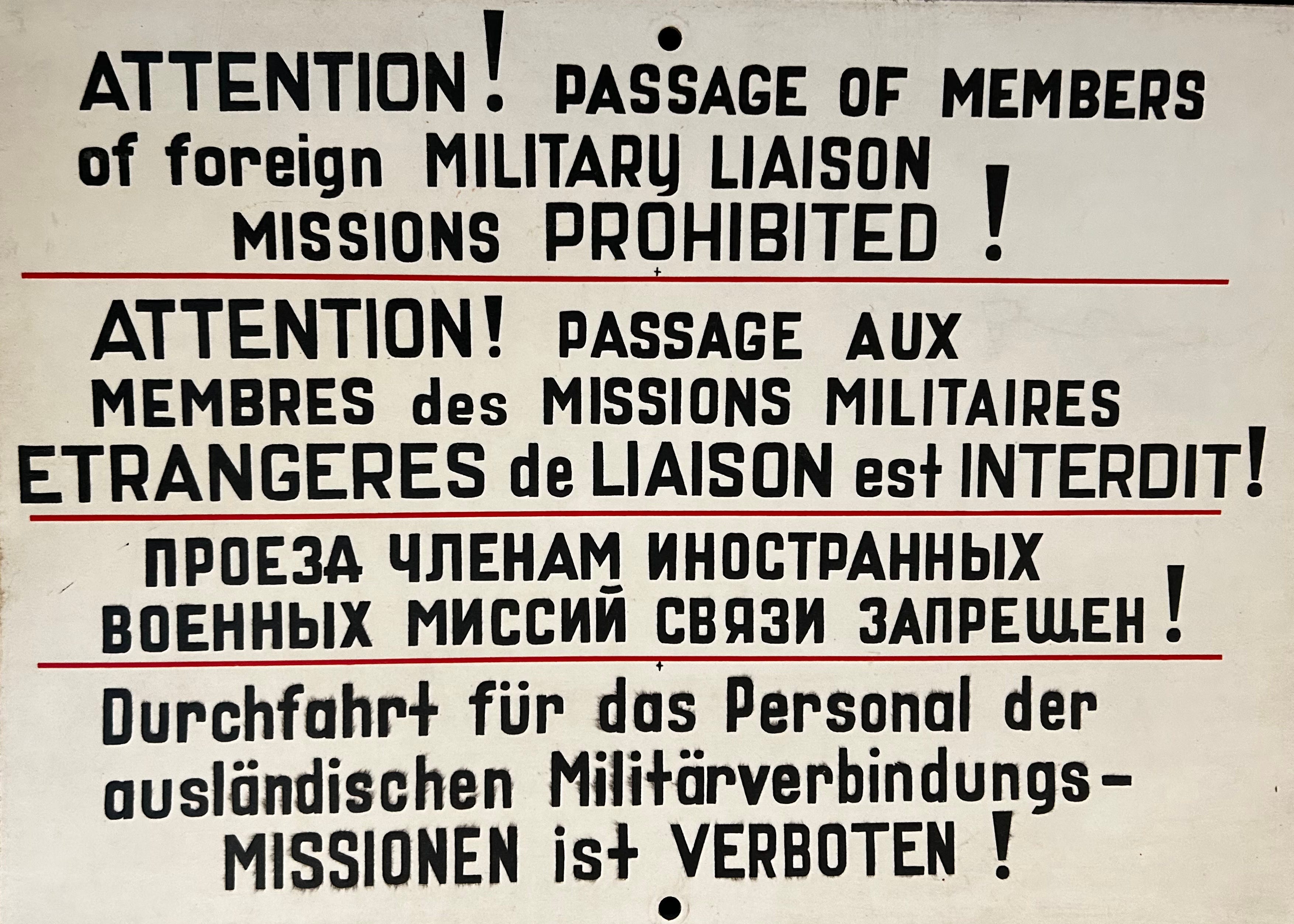
Here’s the one I promised you. Four languages, red rules between them, the same warning four times over: members of foreign military liaison missions, keep out.
Now the fun part. Those liaison missions were licensed spies. And I don’t mean that as a wink – I mean licensed, in writing, by treaty.
After the war the Allies and the Soviets signed reciprocal deals – the Brits first in ‘46, the Americans and the French in ‘47 – that let each side park a handful of uniformed intelligence officers inside the other’s turf in Germany. Marked cars. Full uniform. No weapons. Quasi-diplomatic status, so the other side’s police couldn’t touch them. And everyone at the table knew the real job description: drive around, watch the troops, photograph the hardware, and make sure nobody was quietly loading up for World War III.
That’s spying with a signature at the bottom. Both sides did it. Both sides knew the other was doing it. And both drew a line around the genuinely sensitive sites and said – fine, snoop all you want, but not past here.
This sign is that line. It’s the fence around the fence. I’ve negotiated access arrangements in my own career, and let me say – the whole thing runs on an unspoken understanding that everybody keeps to the deal even while everybody’s cheating a little. That balance holds right up until it doesn’t.
Which brings me to the part of this sign I don’t say lightly. In 1985 a US Army major on the Eastern side, working entirely inside the rules, was shot dead by a Soviet sentry – the last American killed in the line of duty in the Cold War. They handed his body back at the same bridge where the two sides had spent decades trading captured spies.
The permission slip had limits. He found one.
Volkspolizei Revier
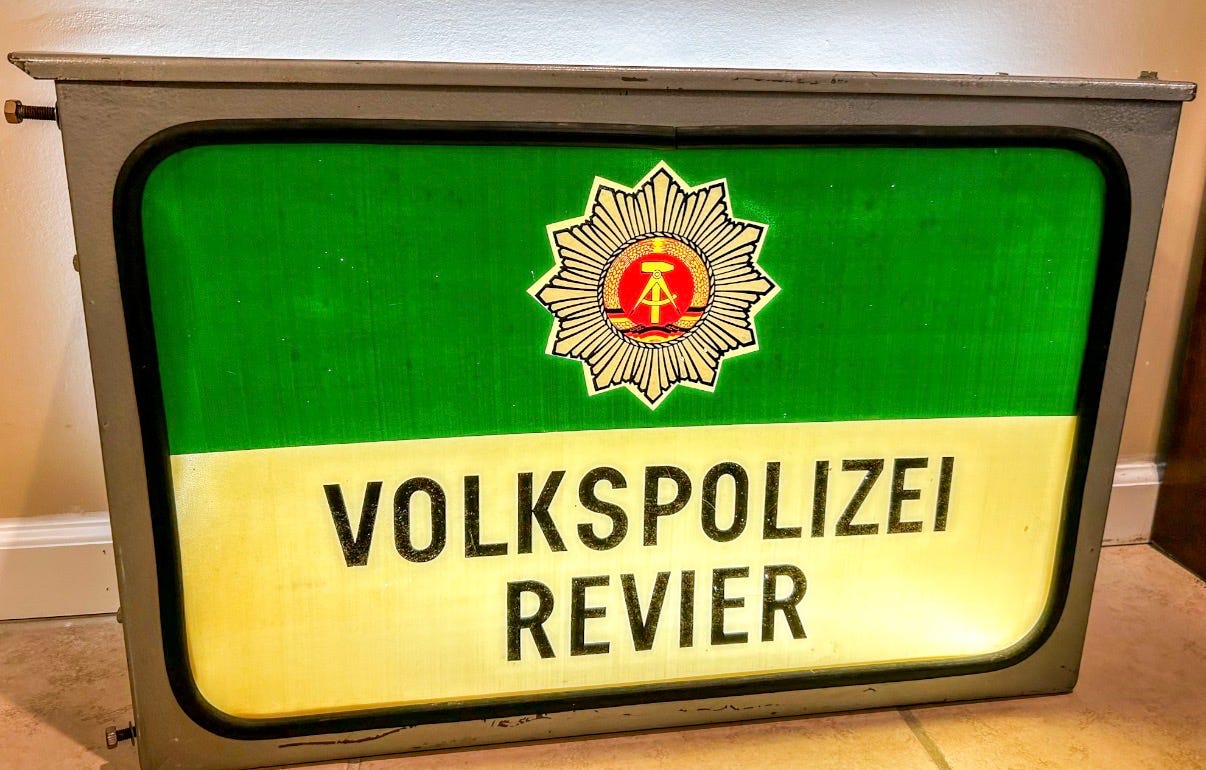
Green and cream, the East German state emblem up top – hammer, compass, ring of rye – and two words that glowed over a doorway every night for forty years: Volkspolizei Revier. People’s Police precinct.
The first two pieces are the view from our side of the glass – our jumpy posters, our spy tours, our keep-out lines. This one is what the watched state looked like from its own sidewalk. And don’t let the name fool you. The East German People’s Police weren’t writing parking tickets. They were one arm of the same state that ran the Stasi and manned the Wall, in a country where the people were the ones being policed.
That’s why I love it, though. It isn’t dramatic. No barbed wire, no four-language warning. Just a lit sign over a station house – the most ordinary object you can picture, worn by one of the least ordinary states of the last century. Somebody walked under it to report a stolen bike. Somebody else walked under it to inform on a neighbor.
It still lights up. I leave it on some nights.
People ask how you even end up with a four-language liaison sign or a working People’s Police light box. The honest answer is patience and a little luck. This stuff wasn’t made to survive – signs got scrapped when the Wall came down, posters got pulped, most of it was classified or disposable or both. What’s left slips out quietly, through estate sales and old soldiers’ basements and dealers who don’t always know what they’re holding. Every piece on this wall is something that was supposed to disappear and didn’t. That’s the part that speaks to me – holding something that outlived the system that made it.
⏳ One more thing. Through July 31, become an annual subscriber and I’ll mail you a free signed paperback – your pick, The Spy Archive or National Security Careers. I sign it. I ship it. On me. Subscribe annually, grab the form in your welcome email, and it’s yours. After July 31, the deal’s gone.
Dexter Ingram spent more than 30 years in national security – State Department, INTERPOL in Lyon, Helmand Province, and an 89-nation coalition against ISIS. He wrote two Amazon #1 New Releases, The Spy Archive and National Security Careers, and keeps one of the largest private intelligence collections outside a government vault – which is exactly where The Collection comes from.
Comments
Nothing yet. Say the first thing.
Sign in to join the conversation.