
The best card in the stack has a dead man on it.
Kim Il Sung, smiling, in the glasses and the dark suit, printed on cheap brown stock. The text tells the reader that the Great Leader never wanted him dying seven thousand kilometers from home for Russia’s imperial interests, and that his real duty is to stay alive and take care of his family. Then a list of what’s on offer. Three meals a day. Medical care. Comfortable conditions.
And then the line that made me stop and put my coffee down.
Whether he goes home or applies for political asylum is his own decision to make.
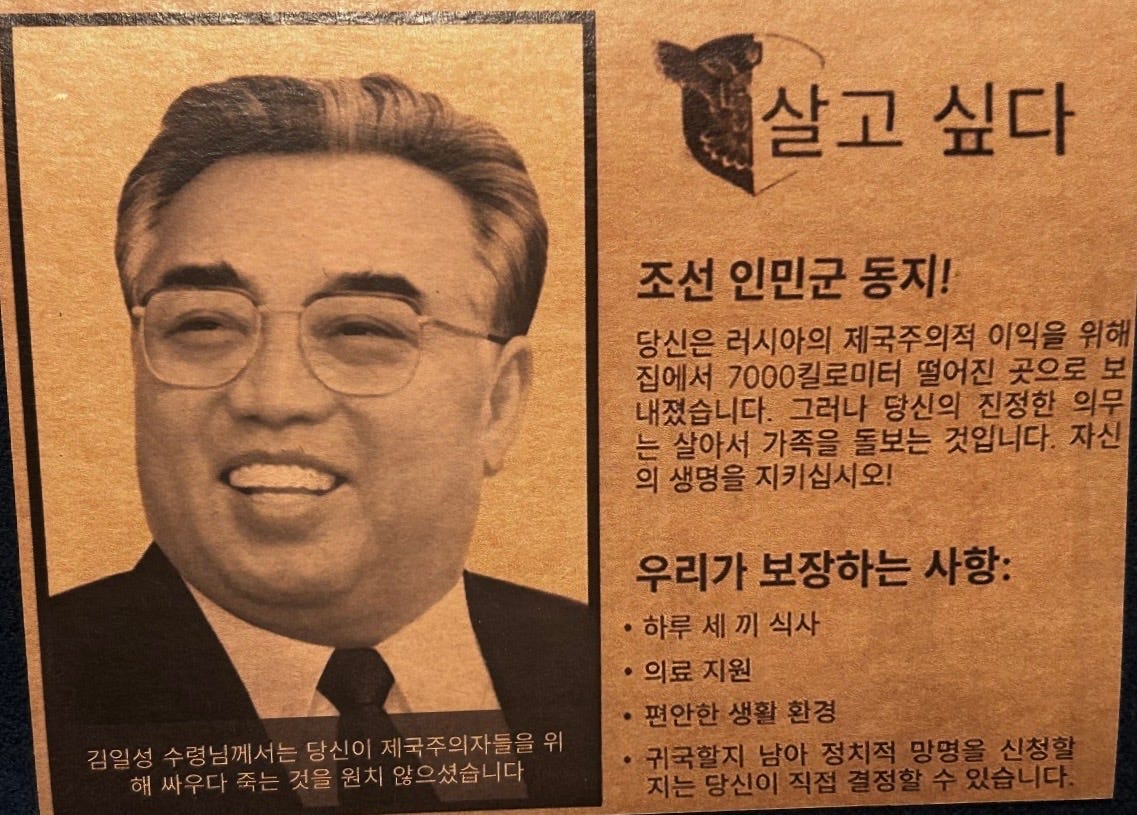
I’ve read a lot of counter-messaging. I ran the State Department office that led this work, alongside the Global Engagement Center. I’ve sat in rooms in Helmand where grown adults argued for an hour about what to put on a leaflet. Most of what gets printed in this business is a committee’s feelings about the enemy rather than anything the enemy would recognize as an offer. This card isn’t that. Somebody sat down, figured out what actually keeps a North Korean soldier in his hole, and wrote to it.
Both my office and the GEC were eliminated last year.
The stack came to me through a dealer I trust, which is the only sourcing note that matters in this hobby. Everything else is a story somebody tells you.
Seoul’s intelligence service put roughly 11,000 DPRK troops in Kursk Oblast at the start of this year, with something like 6,000 already killed or wounded. Zelensky’s been warning since summer that Moscow’s negotiating for another 30,000 to 50,000. Pick whichever number you trust. The operational fact doesn’t move: for the first time since 1953, Ukrainian units are facing a Korean People’s Army formation in the field, and somebody in Kyiv had to figure out how to talk to it.
You don’t stand up a Korean-language leaflet line for fun. It costs money, it costs linguists you don’t have, and every card competes for the same drone that could be carrying a grenade instead. Kyiv decided that talking to these men was worth the airframe.
Two cards in the set are almost aggressively dull, and they’re the ones that would actually save a life.
The first is kraft brown with a small DPRK star in the corner and three numbered steps. Pull the magazine, sling the weapon over your left shoulder with the barrel pointing down. Stand up straight, raise your hands or a white flag, and shout the word out loud. When a Ukrainian soldier tells you to approach, approach, and do exactly what he says. That’s it. No argument about the war. No atrocity photos. No appeal to your conscience.
The second is its twin: drop the weapon, carry a white cloth or this leaflet in your hand, walk toward the men wearing yellow, green or blue armbands with your hands up, and when you get close, get face down on the ground.
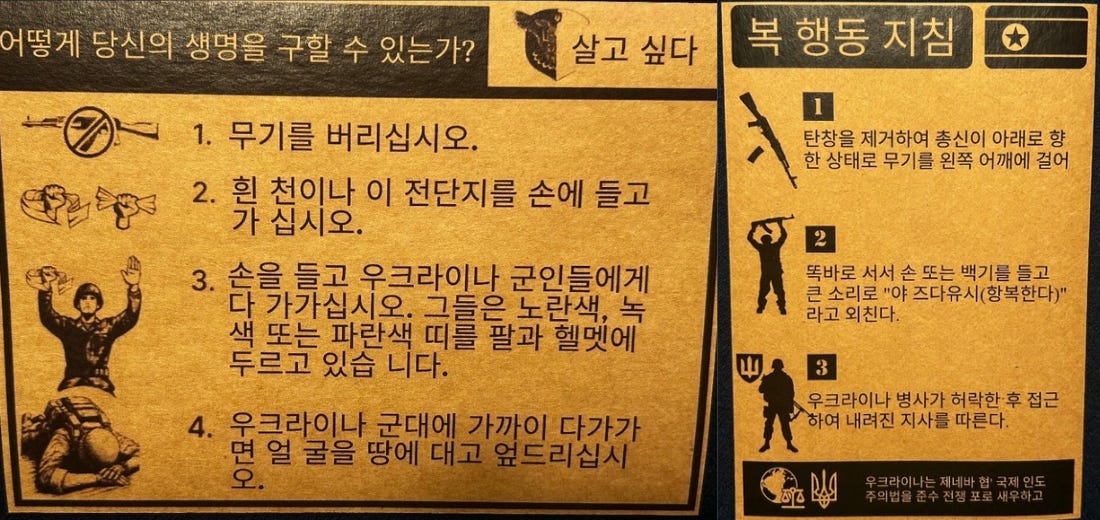
That last instruction is the whole game. The leaflet isn’t only a message. It’s a physical object you hold up so the guy with the rifle understands why you’re walking at him. That’s not a new trick – it’s the German safe-conduct pass from the first war, the Allied ones from the second, the Chieu Hoi cards in Vietnam. Same physics every time. What’s new is that these cards carry Telegram handles, hotline numbers and QR codes, so the paper isn’t the end of the conversation anymore. It’s the front door to one.
Surrendering is the most frightening thing a soldier can voluntarily do. He has to stand up, unarmed, in front of people who’ve been trying to kill him all week, and bet his life that they won’t. Every gram of uncertainty in that moment is another reason to stay in the hole and die there. The whole craft is stripping it out. What do I do with my hands? What do I say? What happens in the first ten seconds?
Answer those and you might get a prisoner. Write a paragraph about freedom and democracy and you get a dead man.
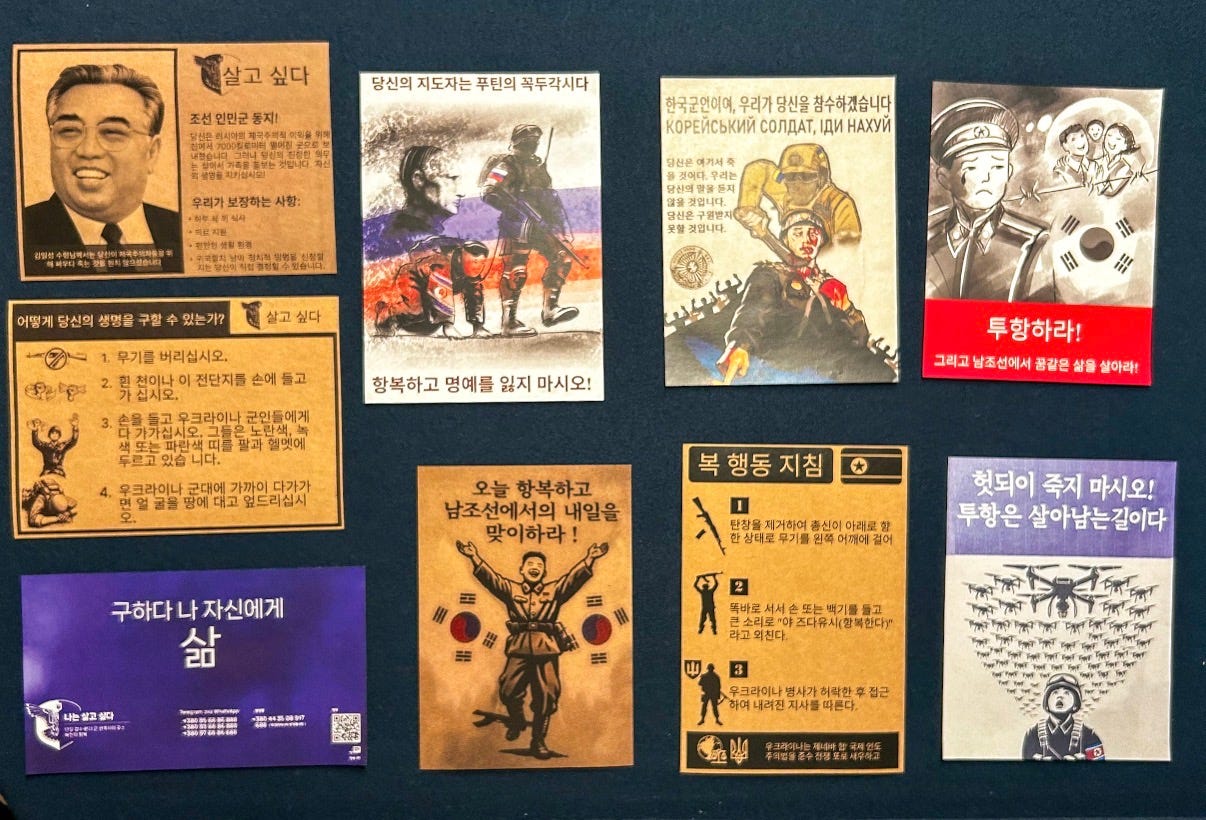
Four cards left on the table.
One makes a legal claim Ukraine has no standing to make. One promises to cut a man’s head off, and undoes everything the other eight were built to do. And one – the card carrying the phone numbers, the one that’s supposed to turn a scared conscript into a defector – has Korean on it that no Korean would say out loud.
That last card gave up the whole operation, and nobody who printed it meant to.
Comments
Nothing yet. Say the first thing.
Sign in to join the conversation.