
Spain is open now.
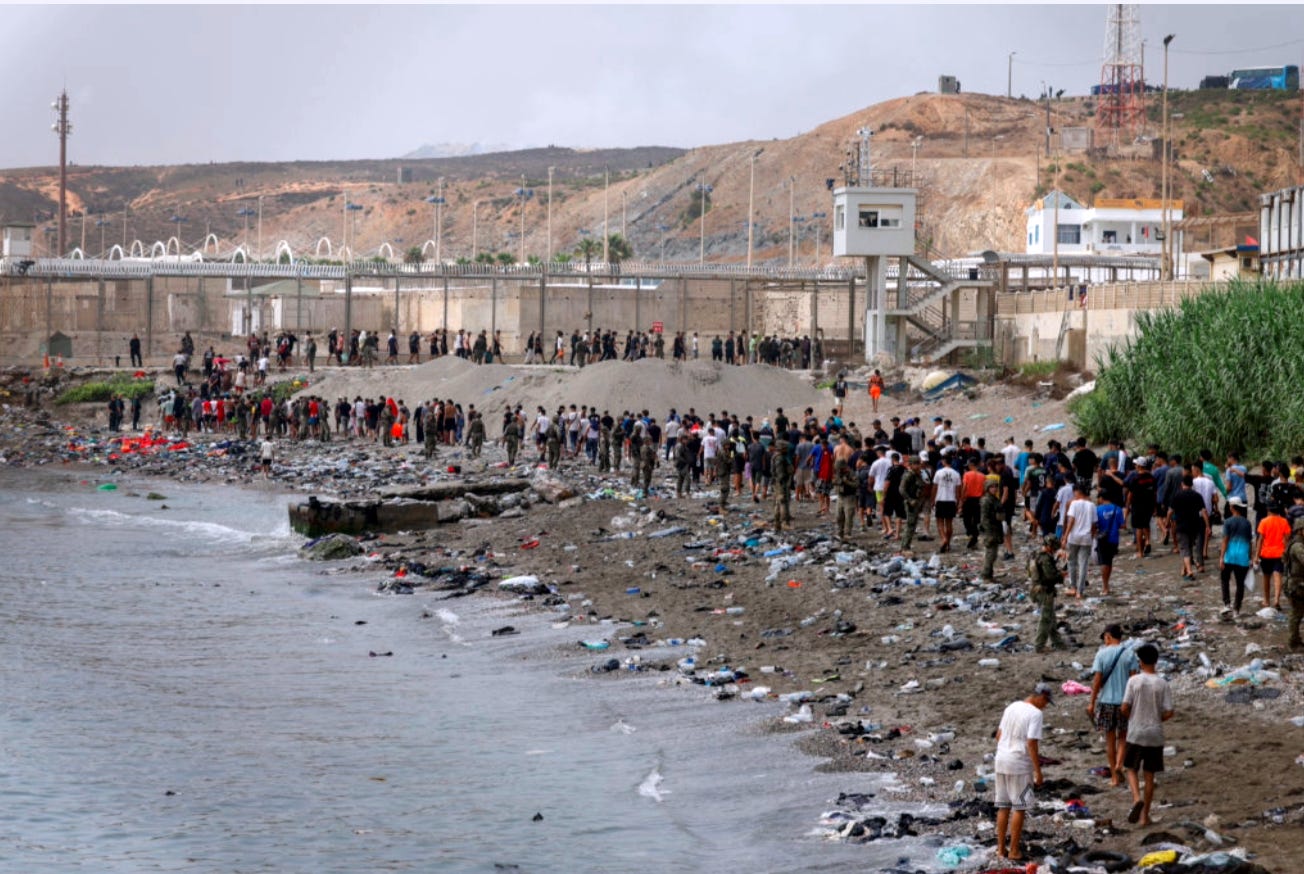
Four words, moving through Facebook groups and WhatsApp threads in northern Morocco. They weren’t true.
Last Thursday, 60,000 people went into the water at Ceuta because of them. At least 72 died finding out, drowned or crushed against the seawall.
Then the same footage went back the other way and got sold to the rest of us. That afternoon Elon Musk posted that what was happening there was “absolutely an invasion,” and spliced the video with old US-Mexico border footage: “This was the United States under Biden.” Within hours the word was everywhere. Party leaders across Europe reached for it one after another until “invasion” was the standard description of something almost none of them had seen. Here at home, the White House said it should be a midterm talking point.
Facebook and WhatsApp moved the young men. X moved the fury about them. Same machine, different gears, running opposite directions off one set of pictures.
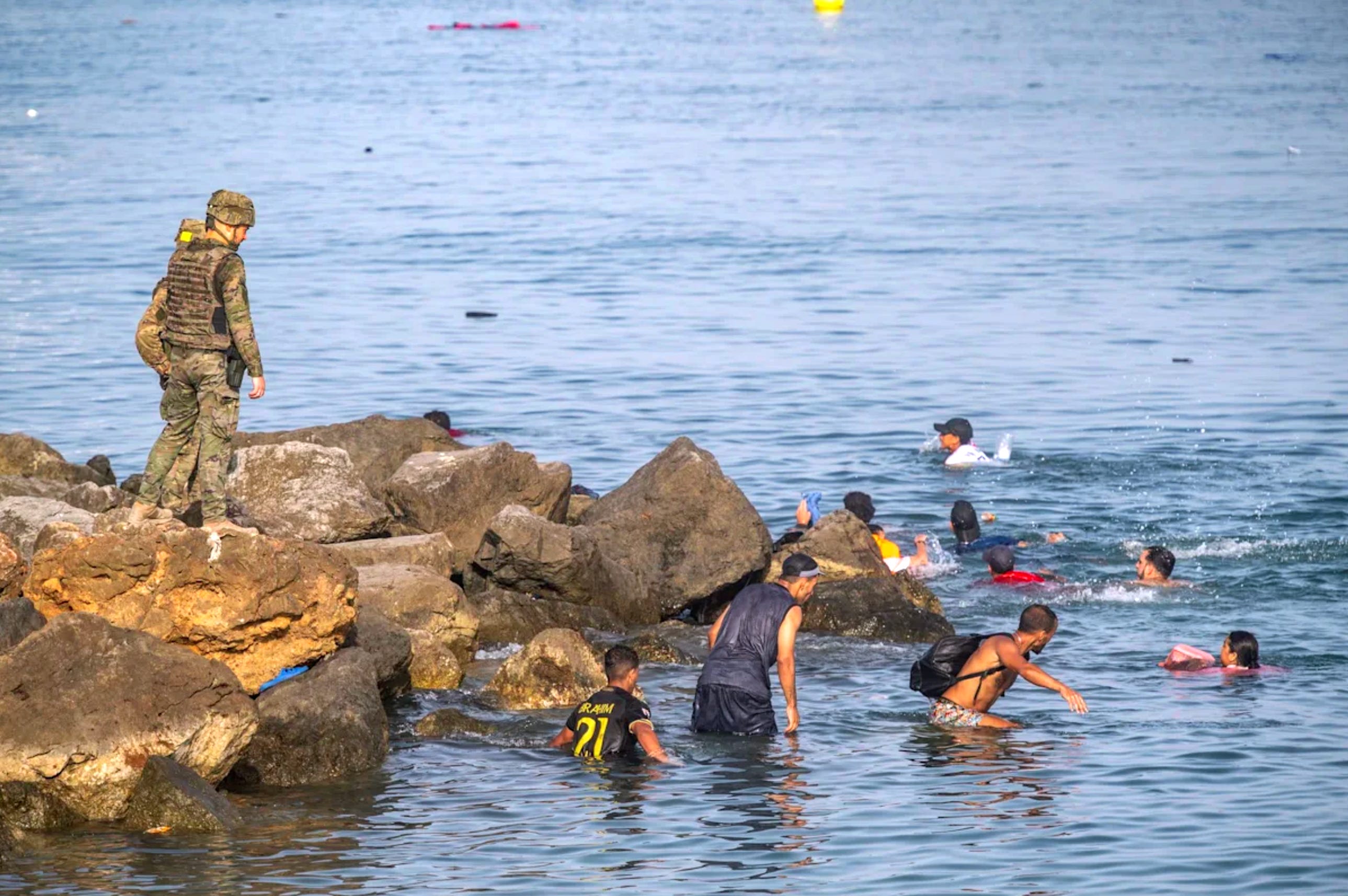
Ceuta isn’t in Spain. It’s a Spanish city on the coast of North Africa, wrapped by Morocco on three sides. You can’t walk from there to Madrid.
What crossed in was about 70 percent of the city’s population, in a day and a half.
The death toll depends on who’s counting. Spain says at least 72. Ceuta’s own officials say 86. A Moroccan human rights group puts it closer to 130. Morocco’s government says 11.
Even the body count is contested. Keep that in mind for everything that follows.
Within two days, more than 48,000 had gone back to Morocco, most walking home on their own because there was no food and nowhere to sleep.
In early July, Spain’s Supreme Court ruled that people arriving by sea can’t be pushed back without being identified first.
That’s the whole thing. It doesn’t say you can stay. It says a cop has to write your name down before he sends you back. Within weeks it was “Spain is open now.”
The logistics sat in plain sight. Public Facebook groups traded swim distances, where to buy fins, taxi routes to the border. One had more than 20,000 members when a local TV station found it, three days before the crossing.
It was never hidden. It just wasn’t anybody’s job to look.
I’ve spent a career watching people get moved by bad information. This one cut both ways.
Misinformation put young Moroccans in the water. Disinformation took the pictures of them dying and used them to scare their base.
On Sunday a Spanish security analyst published a seventy-page reconstruction. The campaign started in early July, the same week as the ruling, running through accounts based in Algeria, Tunisia and France, with activity showing up in the US. Some of the WhatsApp groups handing out swim routes were administered from Algerian phone numbers.
Then the part almost nobody quoted. He says he can’t name who was behind any of it, and doesn’t know the real identities of most of the people running those accounts.
Foreign-run accounts pushed this. That’s documented. It doesn’t follow that a government ran it, and the man who did the work says so himself.
Moroccan prosecutors have opened an investigation. Until it reports, anybody who tells you they know who did this is telling you what they want to be true.
The orchestration question will take months. Here’s one you can answer today.
Madrid and Rabat both blame smuggling networks for exploiting the ruling. That may well be part of it. It’s also the one explanation that costs either government nothing.
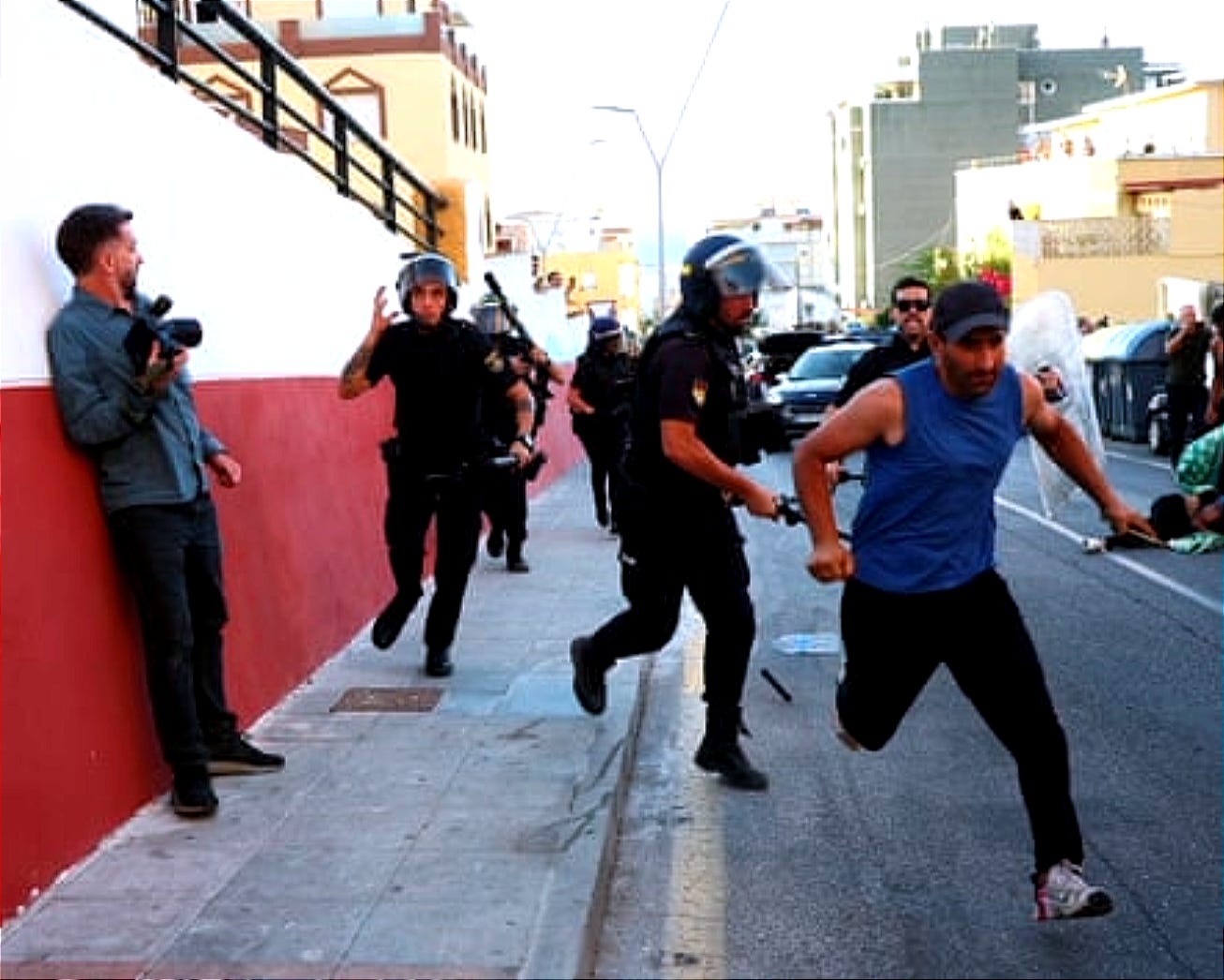
Then the influencers showed up. Over the weekend, far-right politicians and right-wing personalities flew into Ceuta to shoot content. Flights cost money. Nobody books one by accident.
One of them posted to 150,000 followers that he was standing in “the scene of the 60,000 strong invasion” and had already met Moroccan men trying to reach Britain. A reporter working the same beach that week said not one person he talked to mentioned Britain.
Another stood in the city Saturday night demanding migrants be thrown out and got surrounded by residents who weren’t having it, most of them Spanish Muslims whose families have lived there for generations. He ended up hiding in a bar until police walked him out.
The people who actually live on that border came out to argue with the man who flew in to explain it to them.
Germany’s far-right leader posted that Germany was probably where most of these migrants were headed, and used it to demand closed borders. Nobody in Ceuta can travel onward into Europe without a visa. European officials said flatly that Friday that not one migrant had moved toward the continent, and most were already back in Morocco when she posted it.
She needed a fight at home. Ceuta supplied the pictures.
With Musk it isn’t a reaction. It’s a program. He’s posted at least eight times in ten months that Europe is headed for civil war over migration. During the British riots two years ago he wrote “Civil war is inevitable,” which drew nearly ten million views and a rebuke from the British Prime Minister’s office.
A man doesn’t build that record and then stumble into “absolutely an invasion” by coincidence.
And watch the word itself.
“Invasion” is a lever.
European law lets a country throw out the normal rules when a hostile government is deliberately using migrants as a weapon. Spain, the country actually holding that border, never reached for it.
The government closest to the event refused to call it an invasion. People thousands of miles away insisted on the word anyway.
Inside 72 hours it jumped from the fringe to the mainstream, and six governments changed border policy over a wave that never reached Europe.
That's policy, bought with a story, in three days.
None of this is new. Two years ago in England, a man walked into a Taylor Swift dance class and killed three little girls.
Within hours a fake name was circulating, along with a claim that the killer was a Muslim asylum seeker who came by boat. The post said he was on an MI6 watchlist. MI6 doesn’t keep those lists. Nobody checked.
The real killer was born in Wales to Rwandan parents. Not a Muslim. Not a migrant. Police corrected it fast and it changed nothing. Mobs went after mosques, libraries, and hotels housing asylum seekers. At one hotel in northern England, 750 people surrounded a building with 200 asylum seekers inside. Staff locked themselves in a panic room, and a judge later said they believed they were about to die.
Police in Pakistan arrested the man behind the article that spread that fake name. He was a 31-year-old software engineer with no journalism background who ran the website for ad money. Investigators said he was chasing clicks.
The man who lit the fuse under a week of British riots wasn’t an extremist. He wasn’t working for anybody’s intelligence service. He was a guy trying to make rent.
The person who starts the fire usually wants money. The people who pour gas on it want power.
Neither one has to meet the other, and neither has to want the same ending.
Somebody may yet turn up behind those Algerian phone numbers. It won’t change the mechanism. This runs on a market, and a market doesn’t need a mastermind.
Posts blaming Israel and Jewish people for orchestrating Ceuta reached an estimated 103 million people on X in the first 72 hours. Look at what that’s built out of.
Four days before the crossing, the President publicly thanked the King of Morocco for naming a 650-mile highway in his honor. Then people went into the water. Two days after that, the White House reaffirmed American backing for Morocco’s claim to Western Sahara.
All true. Check every one in ten minutes.
And none of it’s evidence that anyone engineered a crossing that killed dozens of Moroccans on the King’s own anniversary and handed Europe’s far right its best week in years.
That’s the trick, and it’s why fact-checking bounces off. You don’t need a single false statement. You need true facts in a suggestive order and a reader who’s already angry.
For that one hotel riot in England, 120 people went to prison. More than 300 years between them. The last defendant was sentenced three weeks ago.
The lie took four hours to travel. The accounting took two years.
Dozens of Moroccan families spent this week giving DNA samples.
So here’s the ask.
When something hits your feed that makes you certain and furious inside four seconds, slow down instead of speeding up.
Four words did this. The next four are already being written.
Subscribe annually and I’ll mail you a signed copy of one of my books – your pick. Details come in your welcome email.
Dexter Ingram is a counterterrorism expert who spent his career in national security. He led the State Department’s Office of Countering Violent Extremism, and oversaw the 89-nation Global Coalition to Defeat ISIS. He is the founder of IN Network and author of “National Security Careers: The Ultimate Guide to Breaking In” and “The Spy Archive: Hidden Lives, Secret Missions, and the History of Espionage.”
Comments
Nothing yet. Say the first thing.
Sign in to join the conversation.