

Introduction: The untradeable charts
Three asymmetries that spot and perps cannot replicate
Where the playbook actually holds up
The honest state of the product
Why the timing still matters
Conclusion
For anyone who has spent real time in crypto markets, dominance charts are a fixture of the workflow. BTCDOM signals cycle phase, tracking whether Bitcoin is consolidating its grip on capital or beginning to distribute it outward. ETHDOM measures whether Ethereum’s role as crypto’s settlement layer is translating into market share. USDTDOM functions as a fear gauge, rising mechanically as risk capital exits and a stable float holds its ground. Traders have been building macro frameworks around these charts for years, then doing something deeply frustrating: setting them aside because no clean instrument existed to act on them at size.
Expressing a relative strength thesis previously meant constructing a basket of offsetting spot or perp positions, paying slippage on both legs, managing carry mismatches, and absorbing directional exposure that was never part of the original view. A trader could be structurally correct and still watch the trade underperform because the proxy bled in ways the thesis never anticipated. Domination Finance is built to close that gap, delivering perpetual futures directly on dominance pairs, each priced against a transparent onchain index that prices an asset’s share of the top 200 cryptocurrencies by market cap, with leverage up to 250x, non-custodially on Base.
The case for dominance futures is not that they offer more leverage or cheaper fees. It is that they price something structurally different from anything else on the market, and three asymmetries make that concrete.
The first is direction independence. A long dominance position does not require the underlying asset to appreciate in dollar terms, only that it loses less than the rest of the market. On a broad red day where BTC sells off 4% and the alt complex drops 12%, a long BTCDOM position prints green despite the underlying candle being red. Spot and perps have no equivalent. They pay for being right about direction. Dominance pays for being right about relative strength, which is a different bet entirely.
The second is beta isolation. Rotation calls have been one of the most consistently correct macro reads this cycle, and one of the most consistently unprofitable trades. The reason is BTC drawdown beta: going long ETH or SOL to express an ecosystem conviction view silently couples the position to Bitcoin’s next leg down. Long ETHDOM or long SOLDOM strips that coupling out. The ecosystem thesis is isolated, and the position no longer bleeds every time BTC sneezes.
The third asymmetry is arithmetic rather than predictive. Stable float does not compress during a market selloff, which means USDTDOM rises mechanically as total market cap shrinks around a fixed numerator. This is not a bet on sentiment or timing. During the liquidity shocks of the March 2020 COVID crash, spot crypto indexes flattened or dropped aggressively, while a dominance-indexed position on stablecoins would have mechanically climbed 109% simply due to the mathematical contraction of the denominator.
Short BTCDOM is the canonical expression of what dominance futures make possible: an alt season thesis that pays the moment capital begins rotating down the curve, without requiring a view on which alt leads. The position fires whether the rotation lands in ETH, SOL, or the long tail. The trader is right about the regime, not about the winner, and the instrument rewards exactly that distinction.
Pair trades extend the logic further into genuinely macro-neutral territory. Short ETHDOM combined with long SOLDOM isolates pure ecosystem competition with zero total market cap exposure on either leg, meaning if crypto as a whole moves up or down, both positions are affected proportionally and the net effect cancels. What remains is a clean directional bet on whether Solana takes share from Ethereum, stripped of the macro noise that would otherwise distort the read.
For spot holders navigating narrative risk or regulatory overhang, the hedging use case may be the most practically valuable of all. Selling a position to reduce exposure triggers a taxable disposal event and unwinds the thesis entirely. A short dominance overlay solves that problem by trimming the unwanted relative leg without touching the underlying, leaving the core position intact and the tax event untriggered.
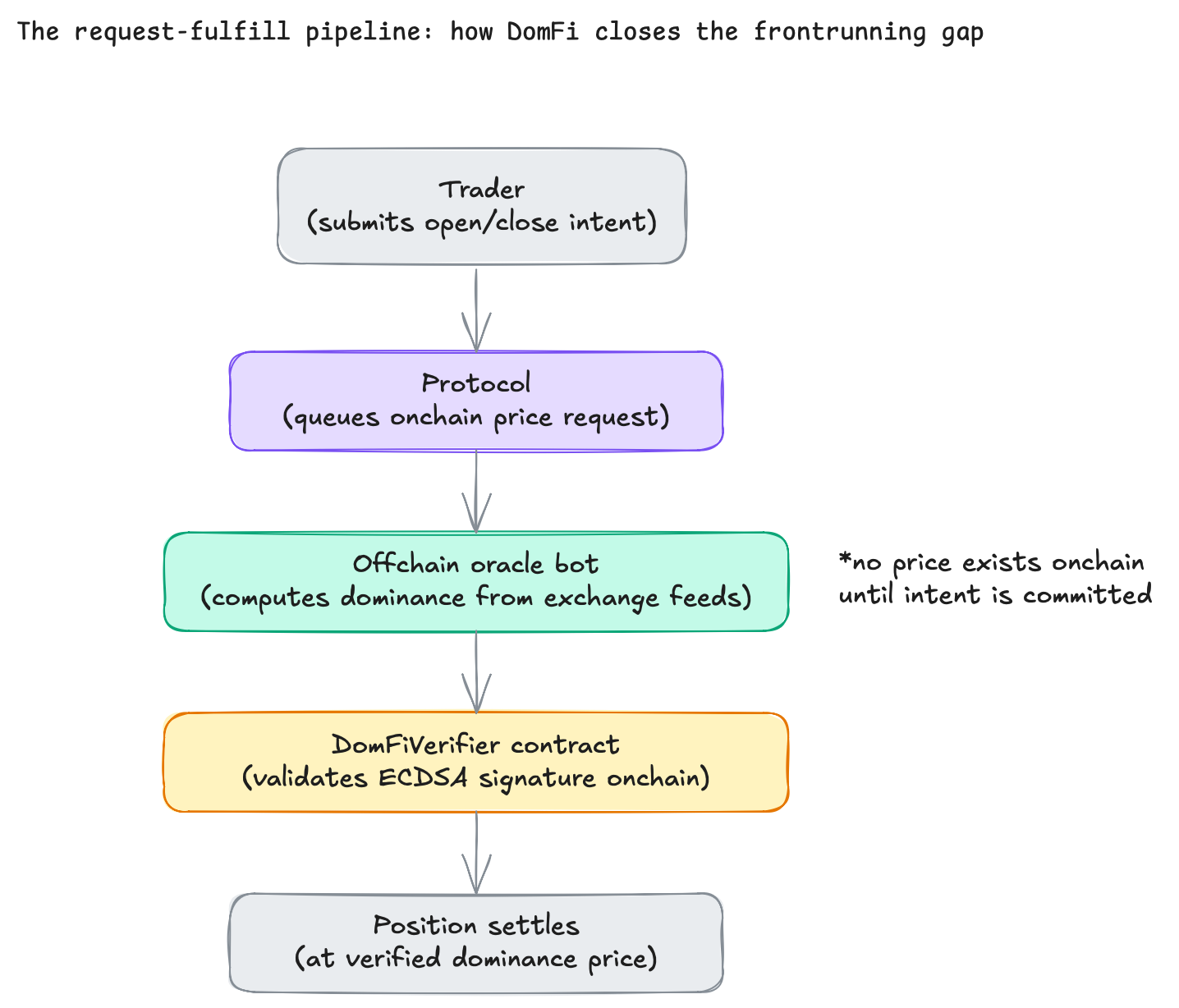
Before assessing the risks, the architecture is worth understanding properly because it resolves concerns a serious trader would reasonably have before touching the product. Trade execution follows a two-step request-fulfill pattern: when a trader submits an intent to open or close a position, the protocol queues an onchain price request; the offchain oracle bot detects it, computes the latest dominance value, and submits it onchain via an ECDSA signature verified by the DomfiVerifier contract. The position settles at that verified price. Frontrunning is structurally closed off because no price exists onchain until after the trade intent is already committed.
The index itself is more sophisticated than a simple top-200 market cap average. To prevent thinly traded assets from introducing artificial price shocks, DomFi runs a continuous volume-weighting engine that assigns each asset a confidence score between 0 and 1 derived from three independent sigmoid signals: the protocol’s own exchange volume relative to the asset’s market cap, coverage of that volume against global trading activity via CoinGecko, and the asset’s overall market liquidity. Any asset whose composite confidence falls below 0.001 is pruned from the index entirely. The five anchored pairs (BTC, ETH, USDT, BNB, and SOL) are hardcoded to a weight of 1.0 and bypass this filter.
The pipeline also strictly excludes wrapped tokens and staked derivatives like WBTC, WETH, and stETH to prevent double-counting, and cross-references live calculations against CoinGecko reference values, automatically rejecting any asset whose market cap diverges by more than 50%.
The risks sit alongside that architecture rather than cancelling it out:
The protocol carries no insurance fund and vault LPs act as direct counterparties to every trade with no auto-deleveraging mechanism. Smart contracts have been fully audited, but in a scenario of sustained trader profitability, vault LP capital absorbs the loss without any external backstop.
The oracle, despite its sophistication at the data pipeline level, remains fully team-operated with no decentralised keeper fallback. For a protocol whose entire value proposition depends on price feed integrity, that is a meaningful single point of failure.
At 250x leverage a 0.4% adverse move triggers full liquidation. Open interest caps per pair and daily PnL limits bound vault LP downside, but these are internal parameters rather than external guarantees.
Where DomFi does get the structure right is the denominator itself. The dominance index displayed on the platform is the same index the contract settles against, closing the basis risk that quietly undermines proxy instruments and making the trade legible in a way that basket approaches never managed to be.
Perp DEX infrastructure has matured to a point where instrument novelty can actually attract real liquidity rather than dilute it. Battle-tested margin systems and a trader base increasingly comfortable with non-custodial venues have created conditions where a new primitive can gain genuine traction without a centralised venue behind it. No established competitor has shipped dominance futures yet, and for a category this structurally obvious, that absence is worth sitting with.
The catch is that first-mover advantage in DeFi compresses quickly once a better-capitalised venue decides to replicate the same instrument on top of existing liquidity depth. The primitive itself is not defensible through capital moats alone. What accrues value over time is index methodology, oracle credibility, and the trader workflows that form around the venue that got there first. DomFi’s strategic position is strong right now precisely because the gap still exists, and how it uses that runway will determine whether it becomes the canonical venue for dominance trading or simply the earliest one.
Sustained liquidity across the remaining pairs and vault LP performance through a genuinely volatile regime are the two signals worth tracking from here, because they test different things. The first tells you whether real position sizing is possible beyond the early adopter base. The second tells you whether a vault-as-counterparty model without an external insurance fund can absorb the kind of trader profitability that a stressed market actually produces, which is a question the current conditions have not yet forced an answer to.
Behind both of those sits the more fundamental question of whether DomFi becomes the canonical venue for dominance trading before the category becomes attractive enough to replicate. The primitive is sound, the timing is right, and the gap in the market is real, but none of that is defensible in perpetuity. First-mover advantage in DeFi tends to be measured in months rather than years once a better-capitalised competitor decides the category is worth entering. What DomFi is really building against is not the product roadmap but the clock.
Website | Docs | Discord | Twitter | Blog
Thanks for reading Dewhales Research! Subscribe for free to receive new posts and support our work.
We’d love to hear your thoughts on the article! Your feedback helps us improve and bring you the best content possible—it won’t take more than 2 minutes.
Also, this post is public, so feel free to share it!
Thank you so much! ❤️
🔗Website
🐦Twitter
✉️Substack
🔸DeBank
Disclaimer: The content presented in this article, along with others, is based on opinions developed by the analysts at Dewhales and does not constitute sponsored content. At Dewhales, we firmly adhere to a transparency-first philosophy, making our wallets openly available to the public through our website or DeBank, and our articles serve as vehicles for self-expression, education, and contribution to the ecosystem.
Dewhales Capital does not provide investment advisory services to the public. Any information should not be taken as investment, accounting, tax or legal advice or as a recommendation to purchase, sell or hold or to pursue any investment style or strategy. The accuracy and appropriateness of the information is not guaranteed by Dewhales Capital.
Comments
Nothing yet. Say the first thing.
Sign in to join the conversation.