

Introduction
What Harmonix Actually Is
The HYPE Vault: Mechanics of the Arbitrage Machine
Extending the Moat: HAR Utility and Capital Flywheel
Risks and Constraints
Arbitrage Trade or Durable Infrastructure?
Conclusion
References
Hyperliquid’s dual-layer architecture creates a yield paradox. HyperCore handles perpetual futures while HyperEVM runs DeFi protocols, but the two operate in isolation. HYPE holders must choose between staking for validator rewards or capturing perpetual funding rates. They cannot access both simultaneously.
This structural fragmentation locks retail users into single-dimensional returns while institutional traders run delta-neutral books across both layers, extracting compounded yield streams through automated cross-layer arbitrage. No native bridge exists to unify these fragmented yield sources, leaving significant alpha inaccessible to average participants. Harmonix builds that bridge.
Harmonix translates hedge fund strategies into composable vaults that retail users can access with a single deposit. The platform automates delta-neutral positioning, options hedging, and funding arbitrage across multiple DeFi protocols, with Hyperliquid forming its operational core. Rather than relying on token emissions, Harmonix extracts structural yield from market inefficiencies and cross-protocol arbitrage opportunities that persist regardless of price direction.
Most DeFi protocols offer single-source returns. Stake for validator rewards, lend for interest, or provide liquidity for fees. Harmonix compounds these primitives into multi-layered positions. Consider a user depositing staked ETH: the vault routes it through Pendle to generate principal token yield, captures funding rates from perpetual markets, and maintains the underlying staking rewards. The position remains delta-neutral throughout.
This architecture enables what Harmonix calls downside yield generation. When markets decline, traditional DeFi positions bleed value. Harmonix vaults extract returns from funding imbalances and options positioning that activate precisely when prices fall.
Harmonix’s core vaults execute the cross-layer arbitrage missing from Hyperliquid’s native infrastructure. haHYPE splits HYPE deposits between spot deployment across HyperEVM protocols (Hyperlend, HypurrFi, Pendle, Ventuals, Unit) and short positions on HyperCore perps. Users earn DeFi yields while capturing funding rates with no directional exposure. hakHYPE applies the same framework to kHYPE with deeper Kinetiq and Veda integration for native restaking rewards.
The stablecoin vault launching under HIP3 takes a different approach. It routes USDH and other stables through Ventuals, Trade[XYZ], and Trove to extract yield from protocol fee sharing and liquidity incentives. No perp hedging required since the underlying assets are already stable.
The broader product evolution is deliberate. Harmonix launched with general ETH and BTC vaults to establish proof of concept. Those are now being phased out. The team is concentrating entirely on Hyperliquid-native assets where they can build exclusive integrations with ecosystem protocols and capture value that scales directly with Hyperliquid’s growth.
The haHYPE vault demonstrates how cross-layer arbitrage works in practice. Users deposit HYPE and receive haHYPE tokens representing their vault position. The vault mints feUSD against the HYPE deposit through Felix, Hyperliquid’s native CDP protocol on HyperEVM.
This creates the capital structure for a split deployment. Fifty percent goes short on HYPE perpetuals to capture funding rates that typically run 10-15% annualized. The other fifty percent gets restaked across HyperEVM DeFi protocols for base yields.
Yield compounds from five sources:
Perpetual funding payments from the short side
DeFi staking and lending returns on the restaked portion
feUSD/USDC arbitrage when the peg deviates
Felix liquidation revenue from undercollateralized positions
Ecosystem points from integrated protocols
Users hold haHYPE as an ERC-4626 vault share that auto-compounds these yields. The vault charges 1% annual management fees and takes 10% of performance on withdrawal.
Three structural factors make this mechanism viable. HYPE perpetuals maintain persistent positive funding because speculative traders stay net long. Shorts collect payments from longs instead of paying them. This inverts the typical crypto derivatives dynamic where funding bleeds short positions. Felix CDPs enable leveraged hedging with conservative collateralization ratios that minimize liquidation risk while maximizing capital efficiency. Most critically, Hyperliquid’s cross-layer composability allows simultaneous perp and DeFi yield extraction from a single deposit. The same HYPE backing the short position generates DeFi returns on HyperEVM.
Season 2 metrics validate the product-market fit. From January 2025 to present, TVL grew from $1.9M to $17M, a 795% increase. Depositors expanded from 909 to 9,190 users, up 912%. Total user yield jumped from $13K to $365K, a 2,700% surge. Monthly revenue climbed from $6K to $18K, up 200%. Monthly active users doubled from 1,000 to 2,100, representing 110% growth. The platform launched three new vault products during this period, each delivering distinct yield profiles.
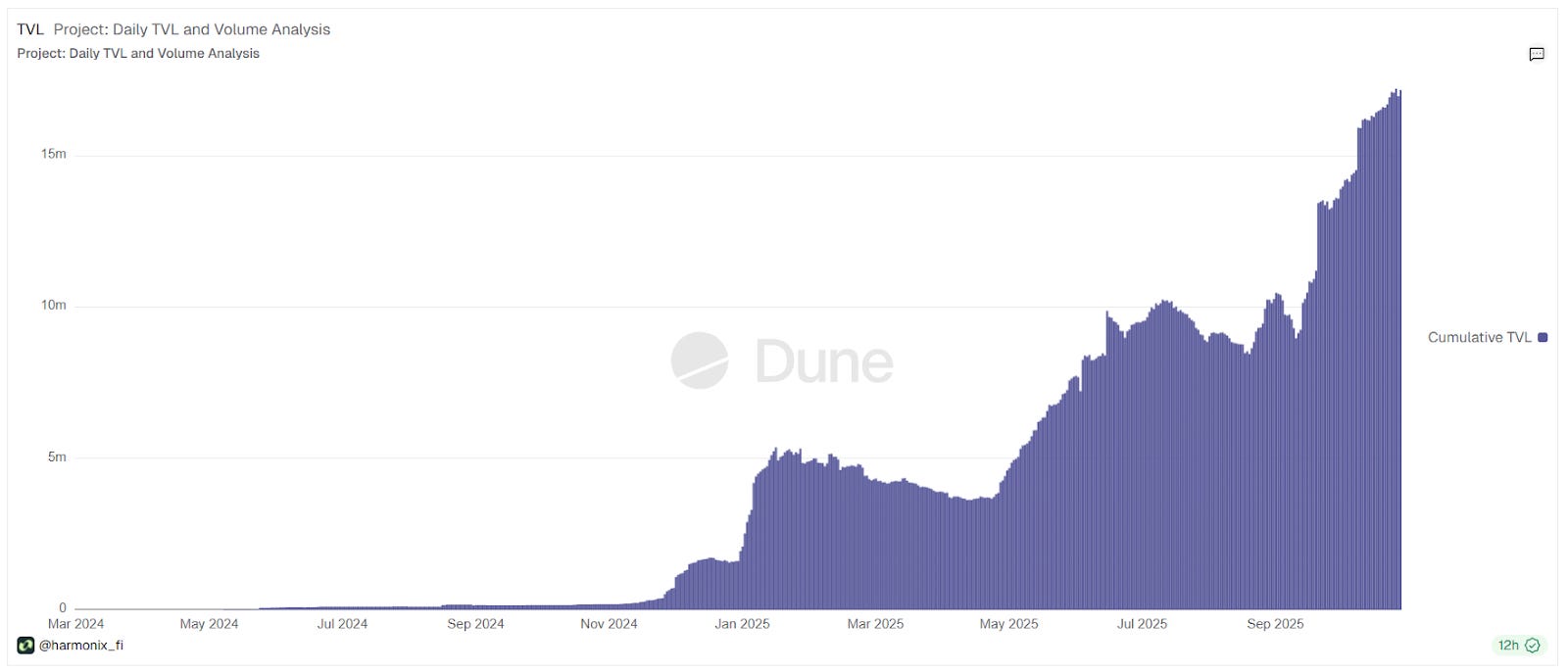
The growth is driven by consistent vault performance across asset types. The Hyperliquid USDC vault averages 13% APY. The kHYPE vault delivers 7.5%. KelperDAO sits at 8%. The HYPE vault generates 5.8%. All vaults outperform simple HYPE staking while maintaining delta-neutral positioning. Harmonix secured integration with Pendle Finance as one of the top two highest fixed-yield providers and now routes through Ventuals for HIP-3 market access, deepening its Hyperliquid ecosystem footprint. DeWhales has committed $435K in strategic liquidity to support Harmonix’s vault execution and cross-protocol coordination.
The vault products establish Harmonix’s technical foundation. The next phase embeds that infrastructure into token mechanics designed to compound ecosystem alignment.
Token launches suffer from a structural misalignment. The users most committed to a protocol get punished by airdrop recipients racing to exit. Harmonix addresses this with the HAR Protection Vault, which converts treasury reserves into a backstop for locked stakers.
The mechanism is straightforward. Lock HAR for 90 days post-TGE, receive a 1.2 times multiplier at maturity if price holds within 30% of the reference. If HAR trades below its reference price during that period, protection multipliers activate, scaling from 1.5 times at moderate drawdowns to 2.1 times in severe scenarios. The vault is pre-funded to cover maximum payouts, eliminating counterparty risk on the protection itself.
Early exits are penalized. Withdrawals before maturity return only 80% of principal and forfeit all bonuses.
Harmonix is adapting OlympusDAO’s Convertible Deposit framework to HYPE. The core insight is that deposits can function as both productive capital and call options simultaneously.
Users deposit HYPE and receive two components: a liquid receipt token (cdHYPE-3m) and a HAR conversion right. The receipt token represents the deposit, redeemable 1:1 for HYPE at maturity. Users can hold it, trade it, or borrow against it without exiting the position. The conversion right provides asymmetric exposure to HAR. If HAR trades above the fixed conversion rate at maturity, users convert and capture the upside. If not, they redeem their original HYPE and the principal stays whole.
For Harmonix, this creates a treasury flywheel. Deposits flow in as productive collateral. Some portion converts to HAR, leaving the underlying HYPE as protocol-owned reserves while creating organic demand for HAR. That HYPE backs additional ecosystem positions. Users get liquidity and optionality while the protocol accumulates strategic reserves without dilutive emissions.
Hyperliquid’s stablecoin landscape is fragmented across USDC, USDT, USDH, and feUSD. Capital sits siloed with inconsistent yield opportunities. harUSD consolidates these into a single vault that accepts multiple stables, deploys capital through delta-neutral strategies and HIP-3 market positions, and returns yield through rising price-per-share rather than rebasing. Users hold one token that appreciates as underlying strategies compound.
The HIP-3 component adds a fee-share dimension. Harmonix uses vault capital to provide liquidity for new perpetual markets, negotiating revenue arrangements in return. This gives harUSD holders indirect exposure to trading volume on markets the vault helps bootstrap, though the fee-share terms and their durability will depend on individual protocol negotiations.
These three products share an underlying architecture. Convert passive holdings into active ecosystem participation while preserving downside floors.
The Protection Vault turns treasury into holder insurance
Convertible Deposits turn user capital into protocol reserves with embedded optionality
harUSD turns fragmented stables into unified market infrastructure
Each mechanism deepens Harmonix’s integration with Hyperliquid’s core primitives. The more capital flows through these systems, the harder they become to replicate. Not because the code is proprietary, but because the liquidity relationships and fee-share arrangements compound over time.
The arbitrage mechanism depends on stable inputs that can deteriorate under stress. feUSD liquidity constraints represent the first vulnerability. When Felix CDP positions face pressure and the stablecoin depegs from USDC, the arbitrage component weakens or stops generating returns.
Funding rate dependency creates a second structural exposure. When funding flips negative, longs pay shorts and the primary yield source disappears. Harmonix implements auto-exit mechanisms to limit damage, but unwinding positions during adverse conditions costs capital through slippage and fees.
Multi-protocol integration compounds these risks. The vault interacts with Felix, Hyperlend, HypurrFi, Pendle, Ventuals, and Unit simultaneously. Verichains audits mitigate but don’t eliminate the risk that a vulnerability in one protocol propagates through the entire system.
Harmonix’s performance is tied directly to Hyperliquid’s infrastructure health. The L1 is relatively new and hasn’t been tested under prolonged market stress or sustained network congestion.
The delta-neutral strategies performed well during Season 2’s favorable conditions but haven’t been validated through a major HYPE drawdown or extended negative funding environment. Felix’s CDP system becomes increasingly critical as TVL scales. Significant liquidation events or persistent feUSD depeg would disrupt the core arbitrage structure. The vaults generate returns by extracting value from Hyperliquid’s ecosystem rather than through protocol-agnostic mechanisms, making their success contingent on the L1’s continued growth and stability.
Harmonix has built genuine technical barriers through cross-layer automation that requires institutional-grade execution infrastructure. Coordinating real-time positions across HyperCore perps, Felix CDPs, and multiple HyperEVM protocols creates operational complexity that can’t be replicated by forking code. Early positioning compounds as new protocols integrate. Each additional yield source strengthens the moat without requiring strategy redesign.
The HIP-3 pivot sharpens this advantage. By embedding into native infrastructure like USDH vaults, vHYPE, and permissionless markets, Harmonix becomes the liquidity router for Hyperliquid’s core primitives rather than another yield aggregator. TVL growth from $1.9M to $17M happened without token emissions, validating that users pay for execution quality. If Hyperliquid scales, Harmonix captures proportional revenue growth through a liquidity flywheel where ecosystem expansion directly feeds protocol returns.
Season 2 ran under ideal conditions with persistent positive funding, stable Felix operations, and rising HYPE prices. None of the core failure modes have been stress-tested. Sustained negative funding would erase the primary yield leg. A 60% HYPE drawdown could trigger liquidation cascades across Felix positions. The automated exit strategy remains unproven when market conditions deteriorate faster than rebalancing can execute.
The technical sophistication sits entirely on Hyperliquid infrastructure. Product launches and protocol integrations don’t reduce the fundamental dependency. If the L1 struggles, execution quality becomes irrelevant. This isn’t diversified DeFi exposure but concentrated platform risk with yield optimization layered on top.
The critical test is behavior under stress rather than TVL during favorable conditions. Funding rates need to flip negative for multiple weeks to validate whether automated hedging protects capital or delays losses. Felix solvency becomes critical as TVL scales. A liquidity crunch in feUSD markets would expose whether position sizing limits are conservative or theoretical. Withdrawal patterns matter more than absolute TVL. If users pull capital during the first sustained drawdown, it signals yield-chasing rather than risk management adoption.
The key question is whether Harmonix performance decouples from Hyperliquid ecosystem health during adverse conditions or whether the two move in lockstep. That answer determines infrastructure versus leveraged exposure. But the broader question is whether Harmonix represents a new category of DeFi infrastructure entirely.
Most DeFi protocols optimize within existing infrastructure. Harmonix built the infrastructure itself. The cross-layer automation that unifies HyperCore and HyperEVM solves a structural problem rather than competing on marginal execution improvements.
The thesis is straightforward. This is a bet on Hyperliquid becoming a tier-one L1 with Harmonix capturing disproportionate value as the embedded liquidity layer. Infrastructure protocols scale faster than the ecosystems they serve. Harmonix positioned itself at that leverage point through HIP-3 alignment and native protocol integration.
The risk is binary. If Hyperliquid fails, Harmonix fails. If the L1 scales, being the yield infrastructure layer delivers asymmetric upside.
Harmonix documentation
$HYPE Vault on HyperEVM (Harmonix docs)
2025 Thesis: A Strategic Liquidity Layer for Hyperliquid
Convertible Deposits: Converting Stability Into Strategy (OlympusDAO)
Website | Docs | Telegram | Discord | Twitter | Github
Thanks for reading Dewhales Research! Subscribe for free to receive new posts and support our work.
We’d love to hear your thoughts on the article! Your feedback helps us improve and bring you the best content possible—it won’t take more than 2 minutes.
Also, this post is public, so feel free to share it!
Thank you so much! ❤️
Our links:
🔗Website
🐦Twitter
✉️Substack
🔸DeBank
Disclaimer: The content presented in this article, along with others, is based on opinions developed by the analysts at Dewhales and does not constitute sponsored content. At Dewhales, we firmly adhere to a transparency-first philosophy, making our wallets openly available to the public through our website or DeBank, and our articles serve as vehicles for self-expression, education, and contribution to the ecosystem. Dewhales Capital does not provide investment advisory services to the public. Any information should not be taken as investment, accounting, tax or legal advice or as a recommendation to purchase, sell or hold or to pursue any investment style or strategy.
Comments
Nothing yet. Say the first thing.
Sign in to join the conversation.