
Imagine you're a traffic controller at a busy airport. Planes (requests) are coming in from all directions, and you need to guide them to the right runways (services).
For years, Ingress has been the go-to tool for managing this traffic in Kubernetes. But as the airport grows more planes, more destinations, more complexity Ingress starts showing its limits.
Enter Gateway API, the next-gen air traffic control system designed to handle modern cloud-native skies. But what makes it different? And why should you care?
Let’s break it down.

Ingress was Kubernetes’ first answer to routing external traffic to services. It worked like a simple tollbooth:
You define rules ("Send traffic for
/shopto the shopping-cart service").An Ingress Controller (like Nginx, Traefik, or AWS ALB) enforces these rules.
But as applications grew, so did the problems:
Ingress doesn’t distinguish between infrastructure owners (who manage routing) and application teams (who own the services). This leads to:
Security risks (Devs might accidentally expose internal services).
Operational bottlenecks (Only cluster admins can configure routes).
If Team A owns payments.example.com and Team B owns support.example.com, both need access to the same Ingress resource. This causes:
Merge conflicts in YAML files.
No clear ownership ("Who broke the routing?").
Need weighted routing (A/B testing) or request mirroring (shadow traffic)? Most Ingress controllers require custom annotations, leading to:
Vendor lock-in (Nginx uses different rules than AWS ALB).
Fragile configurations ("Why did this work in dev but not prod?").

Gateway API is like Ingress 2.0 built for scale, flexibility, and role separation. Here’s how it improves things:
Gateway API introduces distinct Kubernetes resources for different teams:
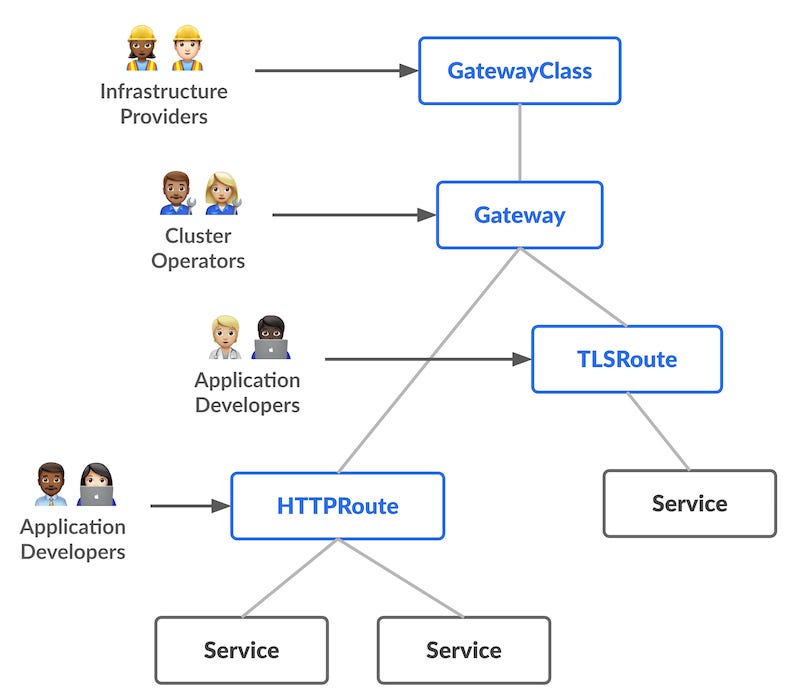
Resource | Who Controls It? | Example Use Case
GatewayClass. → Infrastructure Team → "We use AWS ALB for gateways."
Gateway → Network Team → "Create a gateway for *.prod.example.com."
HTTPRoute. → App Team → "Route /api to the backend service."
Now, app teams can manage their own routes without touching the gateway settings.
No more vendor-specific annotations! Gateway API supports:
Weighted traffic splitting (send 10% of traffic to v2).
Header/query-based routing (mobile users → mobile backend).
Mirroring, timeouts, retries all in a standard way.
Whether you use Istio, Kong, or AWS, Gateway API provides a consistent interface. No more rewriting configs when switching providers.
Before (Ingress):
The platform team manages a single giant Ingress YAML.
Devs constantly request changes, leading to merge conflicts.
A misconfigured route takes down production.
After (Gateway API):
The network team defines a
Gatewayfor prod.The app team attaches their
HTTPRouteindependently.Traffic policies (retries, timeouts) are standardized.
Result? Fewer outages, happier teams.
✅ If you have multiple teams sharing a cluster.
✅ If you need advanced traffic management (A/B tests, canaries).
✅ If you’re tired of vendor-specific Ingress hacks.
If you're on a small project with simple routing? Ingress might still work. But as your Kubernetes ecosystem grows, Gateway API is the future.
Ingress was a great first step, but Gateway API is what Kubernetes routing should have been from the start. It’s not just about new features it’s about better collaboration, security, and scalability.
So, if your cluster is starting to feel like an overcrowded airport, maybe it’s time for a traffic control upgrade. 🚀
Resource :
https://kubernetes.io/docs/concepts/services-networking/gateway/
https://gateway-api.sigs.k8s.io
What’s your experience with Ingress vs. Gateway API?
Have you made the switch yet? Let’s discuss in the comments!
No posts
Comments
Nothing yet. Say the first thing.
Sign in to join the conversation.