
Let me describe a setup I've seen built by at least a dozen engineers who knew what they were doing.
They started with a strong base model, gave it a carefully crafted system prompt, wired in web search and a few APIs, wrapped it in a retry loop, and shipped it. It worked beautifully in demos. In the first week of real use, it was genuinely impressive.
Then it started degrading.
Not breaking — just slowly becoming less useful. The context that made it feel personalized had to be re-fed every session. The instructions that kept it on track had been edited so many times the prompt was now a contradictory mess that only mostly worked. Adding a new tool caused some edge case to blow up in a capability they hadn't touched. No one could explain why. They were debugging a text document.
By month three, every session started with the same ritual: re-explain who you are, re-explain what you're working on, re-explain what the agent should ignore. It was chat. With extra steps.
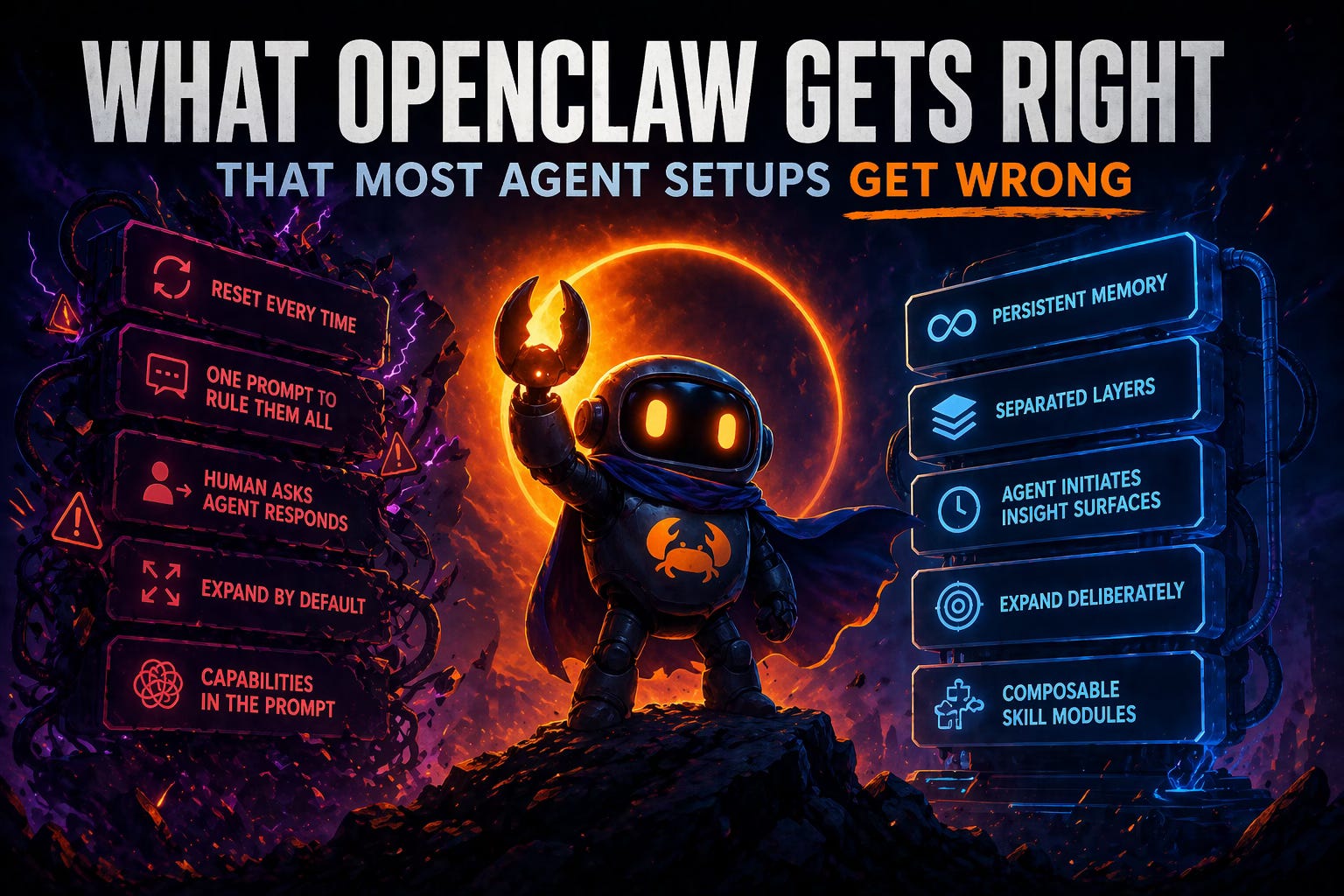
This isn't a failure of skill. It's a failure of architecture. And it's the default outcome when you build agents without the decisions OpenClaw made early.
Here are those five decisions — and why they matter for anyone building with agents, regardless of what they're building on.
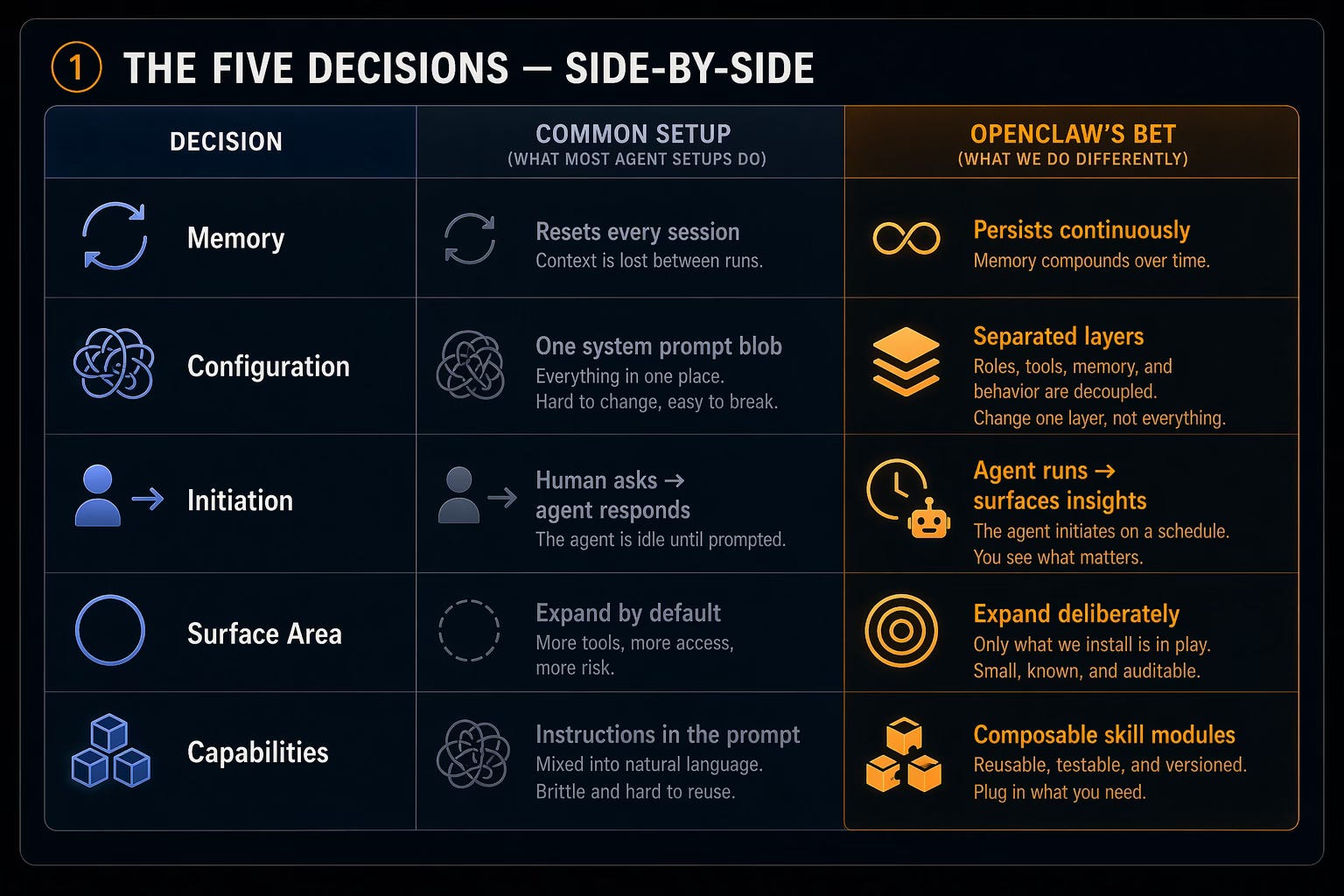
Every agent setup I've seen that didn't have persistence baked in from the start eventually tried to add it later. RAG-based memory, vector stores that get queried at the start of each session, custom retrieval pipelines that insert relevant context before the model sees the prompt. Some of these work. None of them feel right, because they're solving a problem that started at the architecture level.
The failure mode looks like this: your agent helps you draft a project plan on Monday. On Tuesday you come back and ask about the project. The agent has no idea what project you mean. You re-explain. On Wednesday you ask a follow-up. Same thing. After a week of this you're not using the agent for project continuity anymore — you're using it for single-shot tasks only, because that's what it's actually good at.
That's a session model. It's fine for some things. It's not an agent.
OpenClaw treats persistence as foundational rather than as something you add after you've proven out the rest. The agent doesn't reset between interactions. It accumulates state in structured form: a relationship layer that tracks the people you interact with frequently, a goals layer that holds what you're trying to accomplish this week and this quarter, a signals layer that surfaces patterns the agent has noticed over time.
These aren't retrieved from a database and injected into a prompt. They're persistent configurations that shape every output the agent produces — like the difference between an employee who read your notes once and an employee who has been working with you for a year.
The architectural implication is that persistence changes what you can ask an agent to do. You can give it a project to track across days, not just an isolated task to complete now. You can tell it to watch for a pattern and surface it when it appears — not just search for something right now. You can ask "what changed since yesterday" and get a real answer.
When you start from "this agent runs continuously and accumulates context," you design everything differently — the data model, the update cadence, the trust model. When you start from sessions and try to add memory on top, you'll spend the rest of the project managing the seam.
Here is something that happens to every agent setup that lives past three months: someone edits the system prompt to add new behavior, and something unrelated breaks.
It's not because the person editing it was careless. It's because the system prompt is doing three things at once — carrying context about the user, encoding goals the agent should pursue, and specifying what capabilities are available — and those three things have different update cadences, different owners, and different failure modes. Putting them in the same document is like storing user preferences, business logic, and database schema in a single config file and being surprised when changing one thing affects the others.
In a typical agent setup by month four, the system prompt looks like this: a few paragraphs about the user, a section on tone and output format, a list of tools and when to use them, some goals that were added incrementally, some constraints that were added when things went wrong, and several notes that contradict earlier notes because the editor didn't want to fully commit to removing something that used to work. The whole thing is 3,000 words and nobody fully understands it anymore.
Debugging this is an exercise in reasoning about a large, stateful document that affects behavior in non-obvious ways. You change one line. Something else changes. You change it back. The original problem is still there.
OpenClaw separates these concerns explicitly. The goals layer is goals — what you're trying to win, updated when your priorities change. The signals layer is signals — what patterns matter, what to watch for, what to surface. The relationship layer is context about people and projects. The installed skills determine what tools the agent has access to.
When a briefing goes wrong — when the agent is surfacing the wrong things, or missing something important — you know which layer to look at. If it's about what gets noticed, that's signals. If it's about what gets prioritized, that's goals. If it's about what the agent can do, that's skills. The bug lives in exactly one place.
This is separation of concerns. It's not a new idea. We've been applying it to software for forty years. What makes it interesting in the agent contexft is how often we forget to apply it, and how predictable the consequences are when we don't.
This one took me the longest to actually understand, because I kept framing it as a feature when it's a design philosophy.
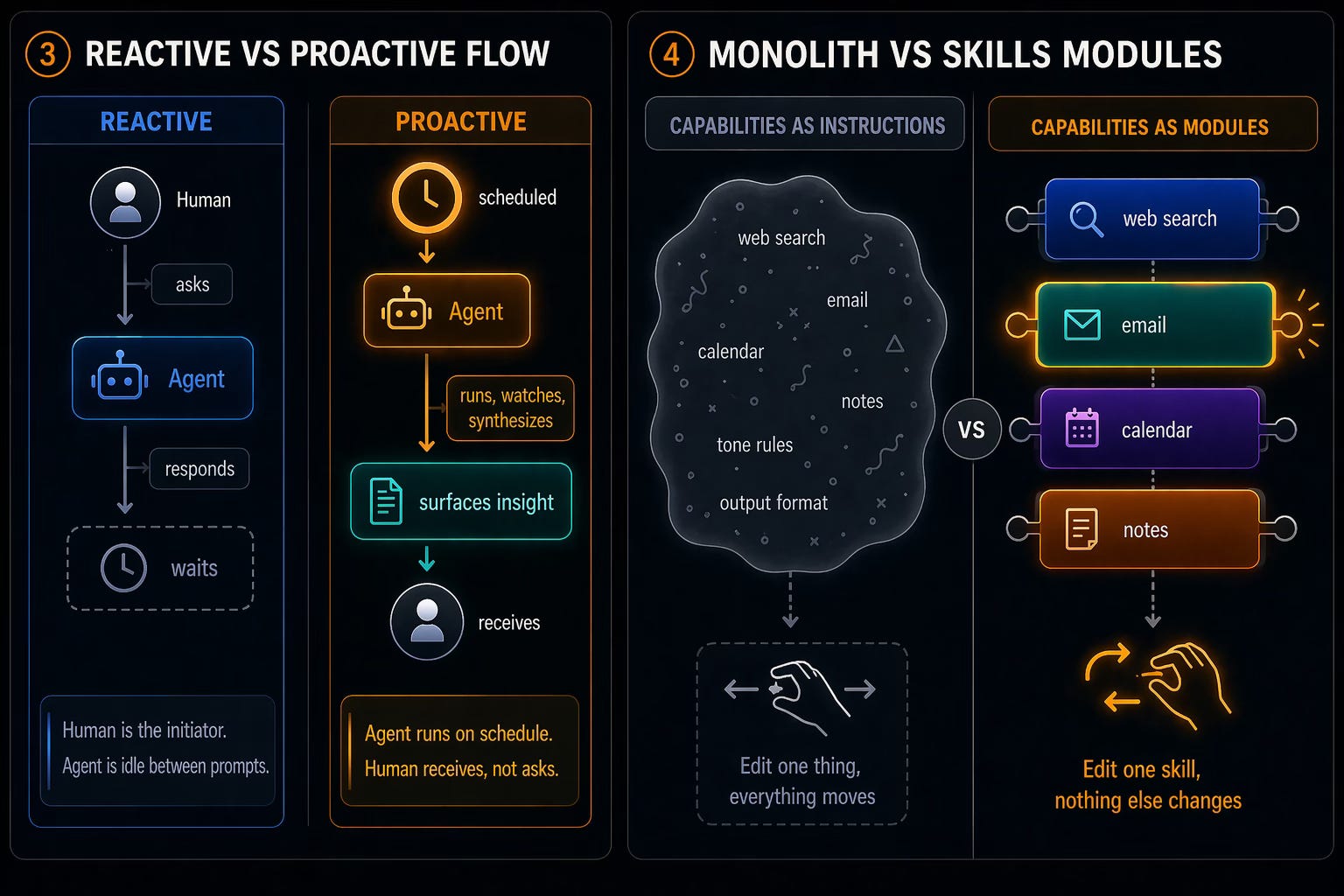
Most AI products — including most things called "agents" — are reactive. You prompt them, they respond. You give them a task, they complete it and wait. The human is the initiator. The AI is fast and capable, but it's still in the tool category: it does things when you tell it to and doesn't do anything when you don't.
OpenClaw's model is the opposite. The daily briefing runs on a schedule whether you ask for it or not. Tasks queued overnight get executed while you sleep. The agent isn't waiting for you — it's running, watching, and reporting back.
Here's what that actually looks like in practice. I had a signal configured to surface anything in my email and calendar that looked like a scheduling conflict or a deadline approaching in the next 72 hours. I hadn't thought to check my schedule on a particular Tuesday morning. At 7am, the briefing surfaced that I had two things on the same day that were mutually incompatible — a commitment I'd made weeks earlier and a deadline I'd added recently — and that I'd need to resolve it by Wednesday. I hadn't asked it to find conflicts. It found one because finding conflicts was part of what it was doing regardless.
That's different from an assistant that answers questions quickly. That's closer to a colleague who reads your calendar and actually thinks about it.
The reason most setups don't build this is trust, not capability. Running an agent proactively means letting it make judgment calls without real-time supervision. You're not watching. It decides what's worth surfacing and what isn't. That requires the configuration to be specific enough that the agent's judgment is reliable — and building that specificity takes time.
OpenClaw handles this through the layered configuration model: you start with a tight set of signals, observe the output for a few days, expand when you trust the results. You're not granting autonomy all at once. You're extending surface area incrementally as confidence builds. That's the right way to trust any system you don't fully control.
The usual argument for running your own infrastructure is privacy. Data stays on your system, you're not feeding sensitive information to a vendor's API, you're not subject to whatever logging policies they have. That argument is real, but it's not the most important one.
The more important argument is: when something goes wrong, how bad can it get?
An agent that has credentials for your email, your calendar, your cloud storage, your project management tool, your development environment, and your financial accounts has an enormous blast radius. If it hallucinates a task, or misunderstands an instruction, or hits an edge case in a new skill that wasn't fully tested — every one of those surfaces is in play. Hosted agent products tend to expand this surface area by default, because more integrations means more value proposition, and the failure modes are someone else's problem.
Self-hosting doesn't eliminate blast radius, but it makes it knowable. When you install the email skill in OpenClaw, you decide what that skill can do: read, draft, or send? Which accounts? Under what conditions? The surface area of the agent is the exact set of capabilities you've deliberately installed, nothing more. When something goes wrong — and something will go wrong — you know the scope.
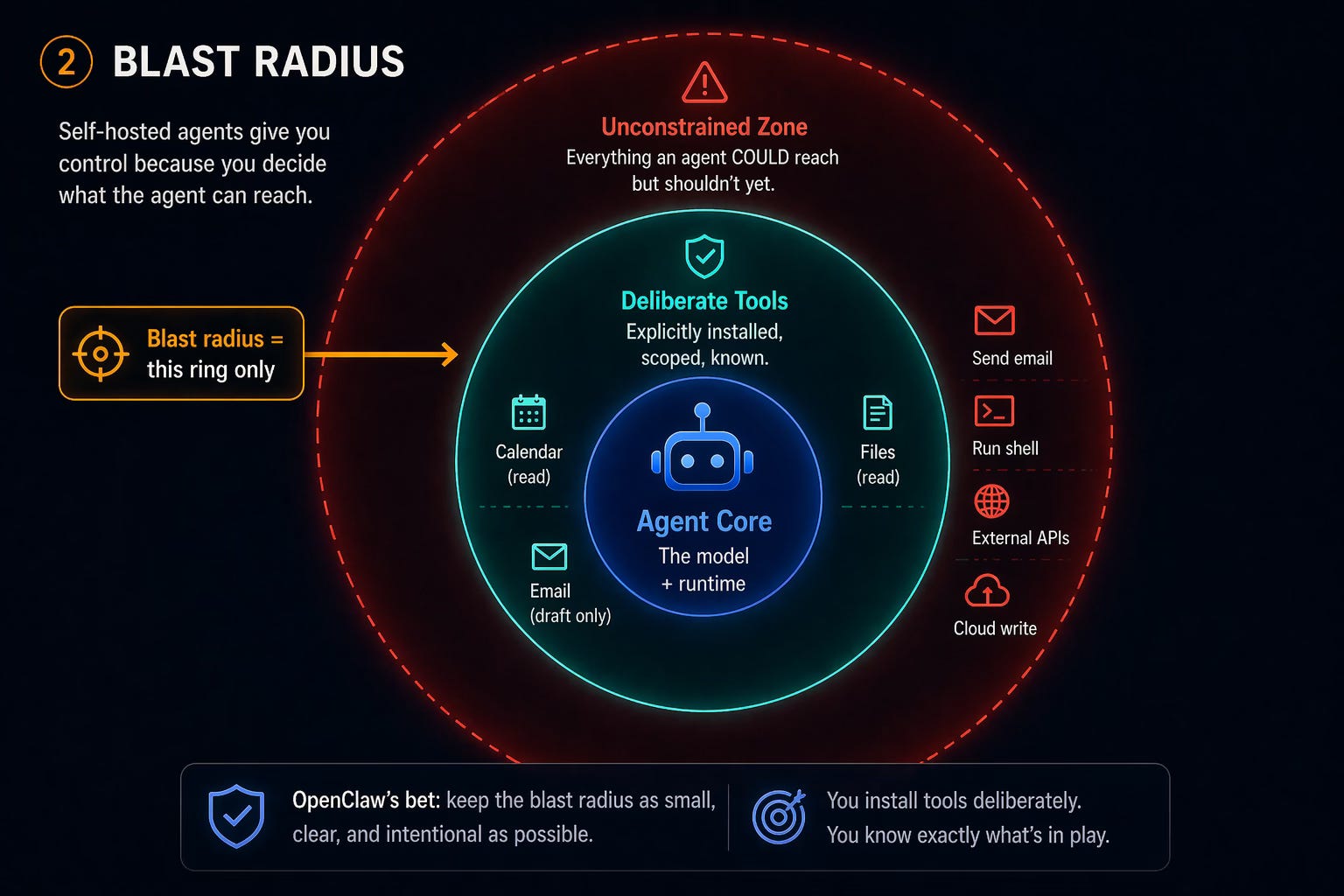
I've had an agent create a draft email I didn't intend. Because the email skill on my setup was configured to draft only, not send, no email was sent. The blast radius was: one draft I had to delete. That's a recoverable error. The same mistake with a send-enabled skill connected to a production email account is a different kind of problem entirely.
The discipline self-hosting forces on you is: before you give your agent a capability, decide what the worst-case outcome of that capability is and whether you're okay with it. This is good practice regardless of your stack. OpenClaw just makes it a requirement by design.
The last one is the most operationally concrete, and it's the one where I see the clearest difference in how setups age over time.
When you extend an agent's capabilities through the system prompt — "you can also do X, when the user asks about Y use tool Z" — the setup feels fine until you have maybe a dozen of those instructions. After that, you have a capabilities negotiation happening silently inside every response. The model is weighing what it can do, what it should do, what it was told to do last Tuesday when you added that new instruction, and what the overall system prompt seems to prioritize. This negotiation isn't visible. It produces outputs that are hard to predict and harder to debug.
The specific failure I see most often: capability interference. You add a new tool and something the agent was doing correctly before now behaves differently. Not obviously differently — subtly. The agent that used to summarize a document in three paragraphs now does it in five. The agent that used to use a specific format when writing project notes now uses a slightly different one. Nothing broke. Something drifted. You don't know why.
OpenClaw's skills model treats capabilities as composable modules. Each skill is a discrete unit with its own configuration, its own defined behavior, its own scope of what it can and can't do. The web search skill doesn't know about the email skill. The calendar skill doesn't compete with the note-taking skill for behavioral real estate in the system prompt. They're isolated.
The practical difference shows up when you want to debug something. Your email skill is producing oddly formal subject lines and you want to understand why. With a monolithic system prompt, you start reading 3,000 words looking for something that might be affecting email formality. With the skills model, you open the email skill configuration, read 200 words, find the tone instruction that's slightly miscalibrated, and fix it.
Same principle when you want to add something new. With OpenClaw, adding a new skill is a contained operation — you define the skill, you install it, you test it in isolation before it touches anything else. The rest of the agent is unchanged. With a monolithic prompt, adding a new capability means editing the document that controls everything and hoping your change is specific enough not to cause drift.
This is just software engineering. We use modules because isolation is good. We learned this from building systems that had to survive past the first working demo. It applies to agents too — and the earlier you apply it, the better your setup ages.
None of these five decisions are proprietary to OpenClaw. They're design choices, and you can apply them in any framework, with any model.
If you're building on LangGraph: split your agent's configuration into separate files by concern — goals in one place, context in another, capability definitions in a third. Edit them independently. Treat the seams as features.
If you're building on CrewAI or AutoGen: schedule your agents. Don't just invoke them when you have a question — give them a recurring run and let them surface things you didn't think to ask for. The first week will produce noise. Tune the signal, don't delete the behavior.
If you're rolling your own: before you connect a new service, decide what the blast radius is. Write it down. Make it explicit. "If this skill misbehaves, the worst that happens is X." Only connect services where X is acceptable.
What OpenClaw did was take these decisions seriously from the beginning, before there was pressure to ship features and before there was a product to defend. The result is an architecture that ages better than most alternatives — not because it's magic, but because its starting assumptions were more correct.
The mental model that all five decisions add up to: the agent is infrastructure, not a tool.
Tools are things you pick up and put down. Infrastructure is always running, has defined interfaces, accumulates state, and fails in known ways. If you're building an agent that you want to trust over time — one that works better next month than it does today — it deserves an architecture designed for that. Not one designed for the session-by-session demo and then extended with bolted-on patches until it stops being worth the maintenance.
Most frameworks are still in the feature race. The architecture race is less visible and more important. OpenClaw made early bets that I think will hold.
Next post: the one pattern most agents get wrong before they even start — prompting agents as if they're ChatGPT.
If this changed how you think about agent architecture, forward it. That's how this newsletter grows.
Want more practical assets — checkout our templates:
Multi-Agent Coordination Kit v1— task checkout, budgets, escalation, audit trail, and scope (for anyone running more than one agent).
AI Marketing Automation Playbook (v1) — 10 workflows, tools, costs, copy-paste prompts
No posts
Comments
Nothing yet. Say the first thing.
Sign in to join the conversation.