
Knapwurst-reading-1600-Oldbookillustrations.com
Recently, the adventurer’s league I play in weekly had a surge of new players. Awesome stuff. With that surge, we had to split the table. When the new semester started I lost the weekly game that I ran where I experimented with different games, and when we split the Wednesday game, I volunteered to GM. Because it is Adventurer’s League we only play 5e, but I decided to lay on some of the optional rules and dig out a lot of the stuff that has been slowly brewing in the background.
Slowly I have been making progress on the latest version of my medieval fantasy alchemy/herbalism crafting system, The Practice. I simplified a lot of the rules that alienated everyone (even me) and I finally got a playtest pdf together and put it up on the itch page. If you want to check it out, for the duration of the playtest (unknown by the way), it will be free.
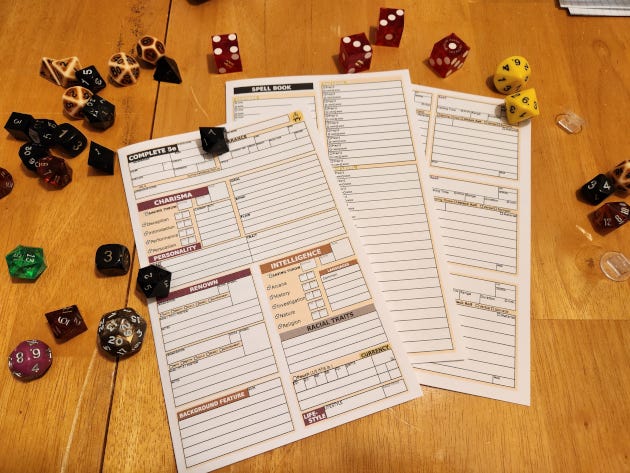
I call it complete because it has everything that pertains to your character. You know, the kind of stuff you would want on your quick reference page that IS a character sheet! This work in progress for some reason really matters to me, so I keep going back when I have a new idea, direction, or iteration. And the latest I am really proud of. The latest idea I stole from some other great developers, no idea which ones specifically, was adding color to the character sheet, and I think it helps so much. That one is not free, but it’s only $2, and then you have any and all future copies.
CompleteSheetV5.1Cover-me
This is a subject I have been investigating for some time, but I don’t know yet how to talk about it. So, I’m just going to talk about it.
Every medieval fantasy TRPG I play in or run ends up with some of the same problems, and I don’t think it is the fault of the developers, of me, or of the other GMs in whose games I have played. I think it is the fault of everyone in this hobby space, though fault is a strong word, because maybe no one else cares.
When I began looking into the actual historical medieval society years ago when I started into this hobby, I began finding things I never see in the games we play. Every game has guards moving around and behaving like police, when that was not their function and they didn’t behave like that. All of these games talk about the mighty monsters and vicious foes you will face, but the local lord doesn’t even have enough magical protection to keep the bard from charming him into handing over his titles and land. And he doesn’t even have land, because out modern conception of wealth is tied into cold hard plastic (for me it’s still cash, but I am old). Just outside of town are savage goblins, trollocs, and all sorts of other menacing nuisances, but not a single town or farming village has a defensive wall, let alone a picket fence.
Burgundians-sleeping-1600-Oldbookillustrations.com
From all of my research, and I am not finished with my history degree yet, so calm down, has shown me some very surprising facts. The most jaw-dropping was the fact that murder was most often treated with a fine, a monetary penance paid to the family because a community already losing one person is bad enough, but losing two could be disastrous.
This fine was called the wergeld, weregild, or “man-money.” In fact, most crimes were handled with fines or damages, paid to the injured or to the community, the local government. Fines allowed everyone to have their justice while not fracturing the whole society into pieces and risking their next winter with a depletion of food. In extreme cases, some criminals may spend some time in the stocks or the pillory, allowing the community to exorcise their chastisement and rain shame down on the accused, but it wasn’t often long. That criminal needs to get back to work.
Flogging, as well as other physical mutilations and punishments, were handed out when deemed necessary. Another common response was the edict, where a local lord would speak of the crime in a sort of legal declaration, and if the criminal was accused again, the punishment would be more severe. This was often the case for lesser infractions, almost a warning that would remain on the record in case the person messed up again.
Want to annoy your friends? Send this!
Something that will come as no surprise to those of us in modern America is the idea that justice is different depending on your status, or how much money you have. If a criminal was imprisoned for their charges, they often remained in shackles, while in their cell. For a price though, one could remain shackle-free, and this price was called a sewet. So the wealthy, even though they committed a crime and were imprisoned, could pay an additional fee in order to remain free of the shackles during their stay.
Another difference for the classes was who did the judging. For the nobility, only other nobles could stand in judgment, which could be especially problematic when the nobles were torturing and tormenting their peasantry. Only the king could stand in judgment of the highest nobles and appointees of the government in the land, and lesser nobles would often be judged by family or friends, given the very social nature of those in power.
The clergy also stood apart from the normal justice system. If a member of the church performed some crime, only higher members of the church could stand in judgment of them. If nobles or peasants performed some crime against the church, or against their god, the clergy also stood in judgment of them, because their crimes pertained to the holy rather than the secular. Either way, the clergy got the best deal, because no matter which laws they broke, they only had to deal with their own group.
There were also laws regarding what people could wear, because this was a time when identity had to be worn or pronounced or carried. In the ages past when there were no identification cards, social media, or internet databases, people wore their status and thus their identity. Only royals could wear certain colors, and nobles could wear certain materials, and peasants could wear colors but always had to keep simpler materials. A person had to be known by sight so that in any circumstance where it was important, the right people could make out who they were dealing with.
So far it has been difficult to come up with a complete understanding of how the actual process worked. Maybe I don’t know what to look for or maybe I just missed it, but I think I have the gist, and I am working on refining it. I want to improve this not just for the sake of knowing it, but I also want to make a guide for bringing all of these details into your games as well as mine.
Someone accused.
Accuser can summon wardens.
If accused is deemed dangerous, apprehended.
Can be held in a cell indefinitely.
If accused is not dangerous, remains free.
Accuser goes to court.
Petitions magistrate for justice.
Magistrate hears accusation.
If the magistrate is satisfied, they can make a ruling.
If they are unsatisfied, they may schedule a hearing.
Magistrate sets a trial date.
The accused is summoned.
Accused may request a different kind of trial (ordeal, adoration, combat, etc.).
Witnesses are summoned.
Accounts are given.
Magistrate makes a ruling.
The King’s Justice is served.
Appeals can be made to a triumvirate of magistrates.
If accepted, they will hear the case.
If not, the initial ruling stands.
This sounds fairly normal, so if you are wanting to run a game where there may be run-ins with the law or maybe a whole legal adventure, this should work as we would guess. But, look at 1.a.ii. If accused is not dangerous, remains free. The accused would remain free until summoned to court (court being not only the place but the function of people appealing to their lords for justice, assistance, or mercy). Even those accused of murder could remain free until they were summoned, and then they show up to have their day in court.
Also pay attention to 3.a.i. Accused may request a different kind of trial. Most trials were only heard by the magistrates, often the local lord who presided over the region, and later a traveling magistrate, judge, or even a group of judges. This is what I would consider the biggest distinction from our own modern justice system, where the accused, or even some courts (especially religious), could request a different kind of trial. One of the sources I found had a particularly long list of different kinds of ordeals, essentially physical torments that the accused would have to endure to “prove” their innocence.
Both accused and accuser must participate.
Both stand on either side of a holy relic with arms outstretched.
The first to lower their arms is guilty, or liable.
Often used to avoid judicial duels (trial by combat).
Especially prominent among the mid and high class.
Both accused and accuser must participate.
Oil is brought to boiling in a cauldron.
One-Fold, oil up to wrist.
Three-Fold, oil up to elbow.
A stone or ring of metal is placed at the bottom.
Both must retrieve the object.
Whoever came away the worse off was deemed guilty, or liable.
There are references in various places to One-Fold, Two-Fold, and Three-Fold, which I am led to believe indicates the severity of the crime, but I cannot yet find anything certain.Two parties in dispute, engage in combat to settle it.
Two individuals.
An individual and a government or organization.
Two organizations, or two governments.
The accused can request a Trial by Combat, the accuser cannot.
One or both parties can designate a champion to act on their behalf.
One-Fold, To the Blood.
The first party to bleed or be wounded loses.
Two-Fold, To the Best.
The first party to submit loses.
Three-Fold, To the Death.
The party that dies loses.
The loser is deemed guilty, or liable.
Combat between groups is less common but still happens.
Accused to walk under a piece of turf.
If the turf falls onto their head, they were guilty.
Rarely employed in non-criminal, civil, proceedings.
Very sensitive to status and reputation of the accused.
One ruler declared that untrustworthy men were to be sent to the triple ordeal, an ordeal of hot iron where the iron is 3x heavier than in a simple ordeal, unless his lord and two other knights swear that he has not been accused of a crime recently, in which case he would be sent to an ordinary ordeal of hot iron.
Here it is again, the concept of Folds, from above, but told in numbers; the "triple ordeal" or the "simple ordeal," with no numbers or folds.
There is also the concept of people vouching for one another, which is called Compurgation (see below).
Distinction made between those accused fama publica (by public outcry) and those accused on the basis of specific facts.
Public outcry were able to exculpate themselves by means of compurgation.
Specific facts and those thought to have bad character were made to undergo the ordeal.
Guilt or innocence of accused (called proband) determined by subjecting them to painful, or at least unpleasant, usually dangerous experience.
The wound was checked after three days.
If healing, they were deemed innocent.
If festering, they were guilty.
Often used by the churches and temples.
Priest blesses dry bread and cheese.
The accused must eat all of the blessed food.
If they choked they were deemed guilty.
Prescribed for murder.
The accused approaches the body of the victim.
If the body bleeds, they are guilty.
Prescribed for crimes worthy or exile or death.
More a form of torture than a test or trial.
Red-hot plowshares are placed over the ground.
One-Fold, 3 paces long.
Two-Fold, 6 paces long, or two laps.
Three-Fold, 9 paces long, or three laps.
The accused must walk the length of burning metal.
If they refused, they were deemed guilty.
If there was no wound, they were deemed innocent.
Boiling water placed in a cauldron.
One-Fold, water up to wrist.
Three-Fold, water up to elbow.
A stone or ring of metal is placed at the bottom.
The accused must retrieve the object.
If they refused, they were deemed guilty.
If there was no wound, they were deemed innocent.
Often held in a church or temple.
Innocent man was to be paid 3 shekels by the accuser.
Accused was to leap into a river, unsure if drowning or surviving proved innocence.
In the witch hunts the accused was innocent if they sank.
Trial by oath, wager of law, oath-helping.
Civil defense for no and low class, or untrustworthy, persons.
Mid and high class persons can clear themselves with an oath.
Defendant takes an oath of innocence, or non-liability.
Defendant meets the number of compurgators.
If defendant cannot find compurgators: trial by ordeal.
Adams-house-2-1600-Oldbookillustrations.com
The compurgation defense requires typically twelve persons, initially kin, but they can be neighbors, to swear they believe the defendant’s oath. These persons are compurgators.
I am also working on a list of laws, along with a set of regular punishments. This has also been rather difficult as I am trying to figure out how the medieval world, an established set of different societies and religions and peoples, would deal with the powers of magic in the legal sense.
Using magic to influence a Lord without consent. Imprisonment up to a year, and fine or damages up to 1,000gp.
Using magic to influence an official without consent. Fine or damages up to 1,000gp and edict.
Spellcasting in Court. The offender is flogged and shackled; struck until unconscious, bound, and gagged. They are then fined and imprisoned for a tenday. If done so during proceedings, court continues, and the punishment is added to the rest of their sentencing.
Violation of Any Edict. The offender is sentenced to manual labor at the direction of the presiding lord. This could mean repairing walls or bridges, filling in potholes and washouts on roads, mending roofs or chimneys, shoveling or plowing snow in winter, or – the old fallback – cutting, splitting, and stacking firewood. A fine also applies, plus a new trial if the violation involves new offenses against the Code.
Decree of Rights Noble. Commoners are obligated, to the cost of their lives, to aid nobles in times of need and danger.
Right of Summons. A Lord has a right to pronounce summons on any citizen or guest of their lands. This makes it an obligation of those pronounced to immediately seek audience with the summoning lord.
Right of Seizure. Lords, and their representative knights, have the right to search you upon request.
Right of Obedience. Bow your head to royalty and the local nobility.
Right of Purpose. Attacking an official is considered “attacking the realm” and “assault upon a citizen.”
Cursing. It is illegal for an individual to receive payment, in the form of money or valuables, to remove the effects of a spell they themselves had cast.
Hampering Justice. Defined as refusing to testify, hiding from the Watch, preventing the Watch from entry or impeding the Watch’s chasing of someone or seizure of something. The offender must pay a fine and serve a sentence of hard labor.
Declaration. All persons entering a kingdom or realm must register with the officials of a border garrison.
Brandishing weapons without due cause. Imprisonment up to a tenday and/or fine up to 10gp.
All weapons must be peace-bonded. The only persons exempt from this law are members of chartered adventuring groups and members of mercenary groups that can offer proof of employment.
Naming Laws. Businesses are forbidden from naming themselves after anything involving the royal family, existing noble families, as well as any battles, victories, or heraldries. This is so as to not misrepresent or cause offense.
Safeguard. Foreign currency must be traded only at certain businesses that are permitted to do so. This is to prevent foreign coinage being introduced into the local economy and devaluing the local currency.
Foreign currency can only be used in certain locations. Please exchange your coins for the local currency at your first opportunity.
Assaulting a priest or lay worshiper. Imprisonment up to a tenday and damages up to 500gp.
Tomb Robbing. The thief must pay a fine to the city and damages to the injured party (usually a relative of the tomb’s inhabitant), and is then branded as a tomb-robber.
Theft of temple goods or offerings. Imprisonment up to a tenday and damages up to double the cost of the stolen items.
Public Blasphemy. The offender is imprisoned for half a day, or overnight if the trial is held in the evening.
Inebriation. Illegal to be drunk. Often punished with the stocks or pillory.
Blood Alchemy. Truth Serum, and alchemicals of similar potency, are only allowed to be in the possession of those with a charter or a writ form a lord or sheriff. This includes possession of ingredients that come from humanoids, civilized creatures, and other recognized conscious entities.
Ignoring the Hue-and-Cry. Defined as refusing to aid in the apprehension of an accused. The offender must pay a fine, which can include labor.
Disturbing the peace. Fine up to 25gp and edict.
MAGIC IN THE WORLD
There are the obvious uses of course:
Any person with a modest amount of money could probably afford to alarm their home or business on a regular basis.
Traveling merchants, dignitaries, wanderers, all would have some sort of comprehend languages at hand.
I don’t know of a single inn or tavern that wouldn’t want a regular casting of detect poison and disease at their door.
Merchants, especially those with more money or wealthier customers, would be carrying detect magic and identify.
Purify food and drink would be of regular use to anyone in power, and would likely be sold in a wand or trinket that only need tap the container.
Floating disk and unseen servant are both easy to find uses for when the whole world needs to move large amounts of resources from here to there.
Anyone with business or relations spanning the countryside would readily make use of animal messenger.
Espionage would be a regular problem if everyone thought about using beast sense.
Funerals would be much cleaner and safer with the use of gentle repose.
Harvesting and hunting would be a much quicker process with locate animals or plants.
Magic mouth could leave messages like an answering machine, advertise to passersby, or recite edicts endlessly for the masses.
In movies there are always those special places where silence is mandatory, and having the silence spell could go a long way towards keeping that peace.
If the alarm spell wasn’t enough, those with a little extra money could seal their homes or businesses away with a regular application of tiny hut.
For short distance travel stables could offer a special kind of mount, the phantom steed.
Diving and exploring the depths of the oceans would be relatively easy with water breathing.
Live in a group of islands or an archipelago? Water walk will keep you from waiting in line for the barge.
All of these are ritual spells from 5e, meaning a spellcaster can be hired, a scroll can be bought, or a simple wand or token can be bought to have the spell regularly. Most of the settings are also high magic, meaning magic and magical items tend to be everywhere, and available for trade, so why the people wouldn’t have them is a question worth exploring.
Immersion my friends, immersion. No, it is very unlikely that the structure of your societies and laws and repercussions will come up in play very often. No, the players will likely not put on their lawyer or historian hat and dispute or argue or even care about the whole thing. So why even bother?
Because you will know. If you have these ideas in the back of your head while you are spinning your tales or creating your worlds, then these details will come out. It is in those moments, when both you and your players least expect something different, that you will both be surprised, and intrigued, which will lead to immersion.
Your knowing will lead to immersion.
When the level 1 rogue steals a piece of fruit or some knickknack from a passerby, the player will expect someone to call the guard when they get caught, not that the whole crowd of people around them will turn against them in the hue-and-cry.
As the bard is leaving they twiddle their fingers and expect to pay for nothing as the innkeeper (obviously a 1/8 CR NPC) fails their saving throw, only to be baffled by protective magic, courtesy of the local mages guild to ensure fair business and trade in a magical society.
The warlock with a dark pact is being questioned by the local lord and his clerical advisor about the affair in the cursed home, and unfortunately that 19 Charisma just isn’t going to allow them to bluff or lie their way out when they are dragged into a zone of truth. And the cleric will know if they lie, and lying to a lord was a good way to get a tongue cut out.
The reason this matters so much to me is because the medieval world is strange. The more I look into and learn about the ancient world the more I recognize that humanity, and our societies, have truly changed over time. The way these people lived was so very different from the way we lived, and I feel like these games would be so much more interesting and engaging if we were able to pull in at least a little bit of the historical context and mixed it up with all the magical, pseudo-alchemical, mutating and other weird fantasy stuff that people come up with.
By the way, as soon as I have better documentation or guidance on bringing these laws, customs, or systems of society into your games, I will let you know, so long as you keep reading.
No posts
Comments
Nothing yet. Say the first thing.
Sign in to join the conversation.