
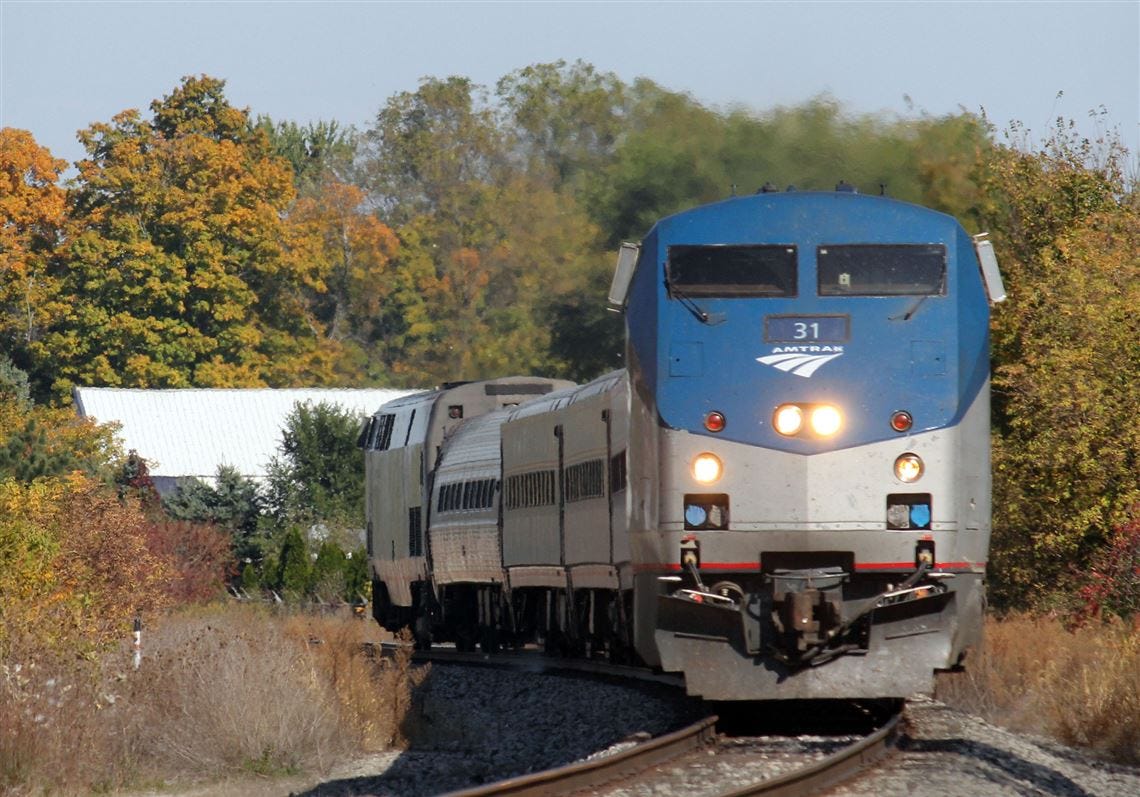
There have been a handful of successful projects in the US which have significantly enhanced passenger rail service, and boosted ridership in the process. In Connecticut, for example, CDOT spent $760 million to double track the southern half of the New Haven-Springfield Corridor, add passing sidings to the northern half, and raise track speed limits to 110mph. In Pennsylvania, Amtrak and PennDOT spent $145 million to electrify tracks from Philadelphia to Harrisburg, and upgrade tracks to 110mph. The Keystone service which now runs along the route is the 5th highest ridership route in the Amtrak system. In Michigan, the MDOT bought sections of railroad that Norfolk Southern wanted to abandon, and began upgrading them to… 110mph. In Illinois, IDOT used Obama-era high speed rail funds to upgrade the Chicago-St Louis train to… 110mph.
Attempts to build trains that exceed 110mph in the US have been difficult and expensive. California high speed rail is the most well-known example. Most of the $13.2 billion spent on the project so far has been spent on building overpasses. The overpasses are required because trains are not allowed to pass through a grade crossing at speeds exceeding 110mph, half of the planned “over 200mph” (220mph?) operating speed. In the 119-mile Fresno-Bakersfield segment alone, 92 structures have to be built to move trains or cars out of the way of each other, of which 57 have been built. These structures are expensive, and by themselves make the train too expensive for the American political system to bear.
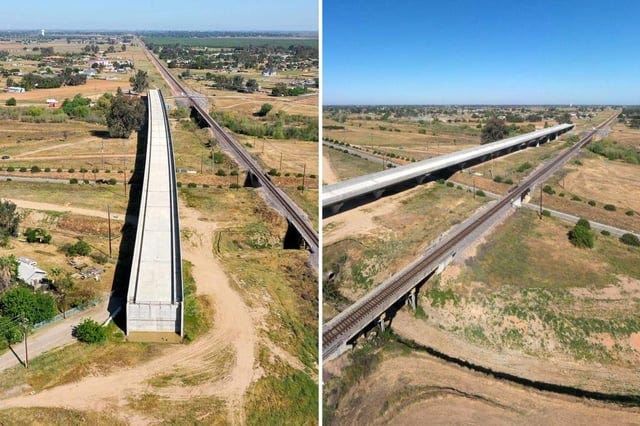
Brightline West also plans to run trains at well over 110mph. To avoid spending tens of billions of dollars on overpasses, Brightline plans to build in the median of Interstate 15, where the overpasses have already been built for them. While less bad than the Californian route, building in a highway median comes with its own set of expensive constraints, and Brightline is currently struggling to find sufficient funding to move forward. Brightline East briefly operates at 125mph in its own highway-adjacent section. The Northeast Corridor also operates at 125mph, because most grade crossings on the route were removed a century ago.
110mph is a pretty stark dividing line for intercity passenger rail projects in the US. Below 110mph, a project can be implemented with standardized methodologies and relatively low investment. As such, these projects are likely to clear a cost-benefit analysis and be successful. Attempts to break the 110mph barrier require either a very large project or a lot of increments. The resulting projects are likely to encounter cost overruns, political cost, and end up recognized as failures. Seeing as there’s a significant cost jump in building >110mph track, the FRA must have a well-reasoned, coherent argument for putting the barrier at specifically 110mph. Right?
Of course not.
Americans have been running trains that border on high speed for a long time. The Hiawatha sustained speeds of over 100mph for the majority of its route when introduced in 1935 between Chicago and Minneapolis. The Pennsylvania Railroad’s GG1 electric locomotive was also introduced in 1935 and was designed to operate trains at 100mph. Steam locomotives on the Pennsylvania Railroad also achieved speeds which might be referred to as “high speed rail” - one Popular Mechanics reporter in 1941 timed an S1 steam engine from Wanatah, IN to Hannah, IN. The train covered the 6.3 miles in 2 minutes 50 seconds, for an average speed of 133mph.
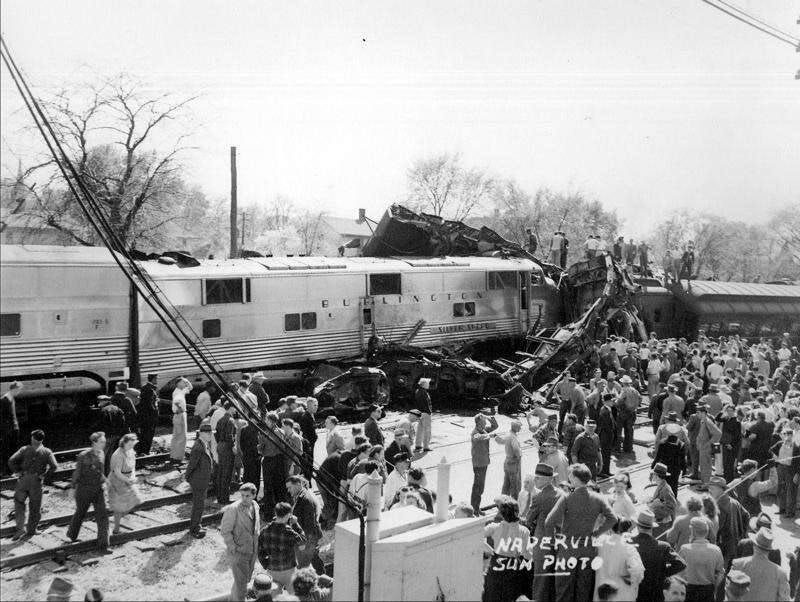
All of that ended in 1946, when a piece of debris flew off of an Advance Exposition Flyer from Chicago to LA, traveling at 80mph in Naperville, IL. The train entered emergency stop so that the debris could be retrieved. The following train, another component of the Exposition Flyer (which had to be broken up because it was too long), was only 3 minutes behind it. The operator of the following Exposition Flyer missed a yellow signal, then a red signal, then applied brakes only when in visual range of the Advance Exposition Flyer. The following train rear-ended the Advance train at 45mph and telescoped through the rear car, killing 45 and injuring 125. The rounds of rulemaking that followed, in 1947 and 1951, would make high speed rail illegal in the United States.
Railroads in 1946 were weird place. Ridership was super high, as civilian car production had been curtailed during World War II, and the gap wasn’t going to be filled until the 1950s. At the same time, maintenance had also been cut back to a bare minimum during the war. Railroads faced high but falling ridership, a gigantic maintenance backlog, and growing competition from cars. To compete, trains had to be faster than cars, even with stops, and also offer low cost service. Higher speeds on lower-cost infrastructure were the answer to this conundrum - faster trains are in service for less time, which lowers both labor and maintenance costs.
Railroads just needed to get away with operating these fast trains on infrastructure which was less than robust. Which should have been easy, given that they had already been doing that for 20 years.
In response to the 1946 Naperville disaster, the FRA passed a rule in 1947 requiring that trains implement either Automatic Train Stop (ATS) or cab signals for all track carrying passenger trains at over 79mph. The expectation was that railroads would implement Automatic Train Stop, to preserve train speeds. What actually happened was that railroads decided ATS was prohibitively expensive, and limited all trains to 79mph. There were only three exceptions: the Pennsylvania Railroad (now the Amtrak Northeast Corridor), the Atchison, Topeka, and Santa Fe railroad (now part of BNSF, carrying the Southwest Chief), and the Atlantic Coast Line (now the host of the Silver Meteor).
: Schedule, Interior, Route")
If the story ended here, it would be a relatively sad story. But it also leaves open the door to a recovery, given that there’s now far more money and political capital allocated to improving passenger trains, both from passengers and from the government. Unfortunately, regulations would continue to get stricter.
Despite the long history of high speed (ish) trains in the US, the first country to invent “high speed rail” in its modern form was Japan. The Shinkansen launched service in 1964, with a top speed of 130mph. The creation of the Shinkansen did not require any genuinely novel technology. Instead, it simply rolled together many existing railroad technologies and applied them uniformly over a corridor in a way no other railroad project had at the time. The Shinkansen used electric trains with powerful motors and cab signals, grade separated to ensure reliability and a lack of collisions. Many other countries began copycat efforts, most notably France.
Progressive president Lyndon Baines Johnson embarked on one such effort. With his administration’s prodding, congress passed The High-Speed Ground Transportation Act of 1965. The law was partly a research and testing effort, but it also involved paying the Pennsylvania Railroad to purchase and operate high speed trains, which were targeted at 125mph. The trains were accepted into service in 1969 after a two-year testing delay, and had an initial maximum service speed of 120mph. The speed limit was lowered to 110mph before service even started, and then lowered again to 100mph as the track quality degraded. In the span of 1966-1971 Pennsylvania Railroad slowly went broke, merged into the Penn Central railroad, and then went broke again. The railroad was in no financial position to improve track quality.
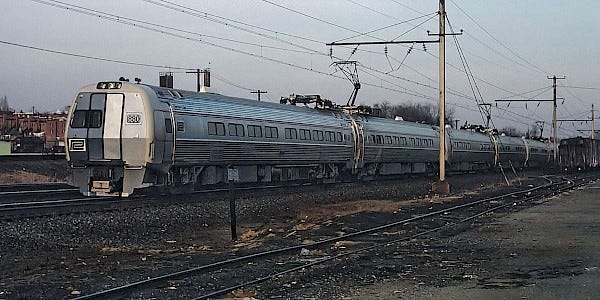
It’s important to note that the Metroliner was, at the time, the only train in the US capable of operating above 90mph. In part due to deteriorating track conditions, the PRR only decided to use 80 of the 100mph that their GG1 locomotives were capable of. On the only other high speed railroad in the US (the Chicago to LA train from earlier), a speed limit of 90mph was applied. Documentation isn’t super clear, but railroad forum users seem to have a consensus that operations above 90mph on the ATSF ended in 1958, 13 years before the FRA’s track classification system. Higher speed operations on the ACL ended when the railroad merged into the Seaboard Railroad.
The FRA had to support speeds of at least 110mph, but only because the Metroliner and its accompanying federal law required it to. In fact, the accompanying federal law suggested 125mph, but the FRA didn’t even accommodate that much.
In 1970, congress passed the Federal Railroad Safety Act of 1970, authorizing the FRA to write more explicit regulations surrounding track quality and maintenance. In 1971, the FRA followed up by actually writing those standards, creating the first 6 classes of track and standardizing operations up to 110 mph. Importantly to our story, contemporary analysis also noted that the new rules banned trains from operating over 110mph anywhere in the United States. In fairness to congress and the FRA, they had good reason to want more aggressive regulation. In the late 1960s, the financial duress of eastern and midwestern railroads led to deferred maintenance, leading to a procession of negative news stories about trains and railroad safety. From Ian Savage’s book, “The Economics of Railroad Safety” (p23):
The improvement in safety witnessed in previous decades was reversed. Employee fatality and injury rates increased by sixteen percent and seventy-five percent respectively between 1960 and 1970. The major cause was the decline in railroad finances, especially in the East and Midwest with the bankruptcies of the Penn Central, Rock Island and Milwaukee Road, which lead to considerable deferred track maintenance. The rate of accidents per ton-mile caused by track defects doubled between 1966 and 1974 (Office of Technology Assessment, 1978). Simultaneously with the decline in track maintenance was the introduction of larger freight cars. This led to a sharp rise in derailments due to broken rails (NTSB, 1974).
The capstone incident happened in 1969, when two Penn Central trains on the New Canaan branch of the New Haven line ran into each other head-on. The crash killed 4 railroad crew and injured 40 passengers. Not only was it a major accident on a busy railroad, New Canaan is a well-connected, wealthy place very likely to get its way. Although, in fairness to affluent New Canaan lobbyists, things really were getting out of hand. When researching this section I at one point asked GPT about the “1969 Penn Central incident” and apparently was not specific enough. GPT thought I was referring to the incident in which three diesel locomotives were left idling in a Boston yard, rolled away, and ended up in the middle of Interstate 93:
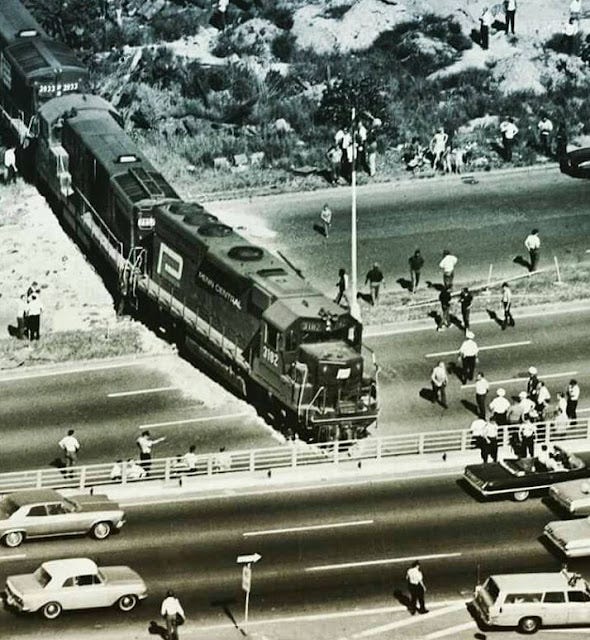
Of course, also in 1971, the Pennsylvania Central Railroad went broke, in the largest bankruptcy in US history to date. To ensure that passenger train service continued to exist in the Northeast, the Nixon Administration formed Amtrak. As such, the financial situation of the Northeast Corridor’s owner went from “dead flat broke” to merely “strapped for cash”. In 1976, the federal government passed the Railroad Revitalization and Regulatory Reform Act, which initiated a 2.19 billion dollar project to improve the corridor. With more stable financial footing and better track, Amtrak began raising speed limits. The old GG1s were allowed to operate at 90mph. After a couple false starts, Amtrak managed to engineer a locomotive suitable for 125mph operations. By 1982, Amtrak reported that locomotive-hauled Northeast Corridor trains were operating at a full 120mph in certain sections. Maximum speeds would later rise to 125mph.
In 1971, when the FRA codified track speeds, it didn’t really need to accommodate trains above 110mph - literally no such trains existed. By 1998, however, every single train on the Northeast Corridor was being regulated, in part, by nonstandard waivers. Worse, procurement was underway for the first generation of Acela Express trainsets, which were expected to operate at 150mph. 12 trainsets going 10mph over the national speed limit were one thing, the entire corridor 15 over, and a new fleet of trains going 40mph over were another. More pressure to rewrite rules comprehensively came from freight railroads. Unions were upset about a backlog of compliance cases, freight railroads were upset at the lack of modern reporting and inspection techniques, and the GAO was also upset at FRA for nonresponsiveness. In 1992 and again in 1994, congress asked FRA to comprehensively rewrite track quality rules, which it did in 1998.
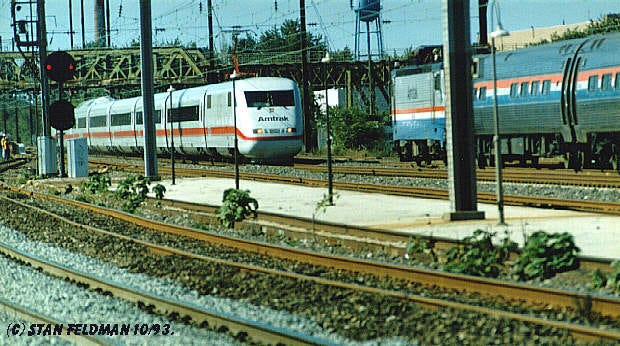
Before covering subpart G, the section of that 1998 rewrite which covers high speed trains, the FRA’s institutional outlook on grade crossings is worth covering. Separate to their rules rewrite but also in 1998, the FRA issued an Order of Particular Applicability regarding signal systems, in preparation for high speed (ie, Acela) service. In it, the FRA lowered the grade crossing speed limit from 110mph to 80mph, rising to 95mph if unusually extensive warning systems for crossing vehicles are implemented. Their stated rationale for lower speeds is that:
the density of NEC operations and the increased possibility that a collision with a motor vehicle might cause a secondary collision between trains operating at very high combined closing speeds
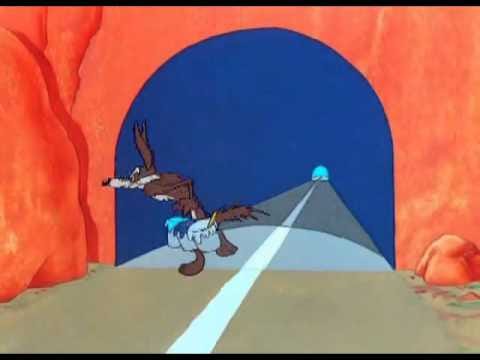
In other words, the FRA was concerned about a Loony-Tunes-esque situation in which a train strikes a truck at a grade crossing and then derails into the path of an oncoming train. Even if trains were speed limited to 110mph, the resulting situation could result in which trains had a relative speed of up to 220mph. But this is a situation so rare it borders on impossible - the odds of an oncoming train being in the right place to strike the original train is ~one in several thousand. I’m not sure that anything resembling this hypothetical situation has ever happened, but this strikes me as a moment of regulatory adventurism unjustified by the facts on the ground.
Okay, finally, we get to the part in which I explain what the modern rules actually are. Class 6 got redesignated as “high speed”, but grade crossings continued to be allowed on the basis that:
Presently no highway-rail crossings exist on Class 6 track (on Amtrak and commuter railroads), although highwayrail crossings existed for several years on Class 6 track on the Northeast Corridor. (CFR vol 63, p34021)
However, Class 6 was the only speed regime where grade crossings were effectively grandfathered in. Class 7 speeds (111-125mph) were only achieved after the grade crossings were removed. Class 7 was set based on the accumulated knowledge of Amtrak trains already going that fast, while Class 8 was based on knowledge gained from preliminary Acela testing. In both of those cases, the associated speeds were not achieved in an area which had grade crossings, so the FRA felt no need to allow them. On the other hand, the FRA felt significant need to not allow grade crossings, because:
FRA does not believe that sufficiently refined analytical techniques currently exist to predict the effect of increased speeds on damage to the passenger train through the initial collision, possible derailment, and possible secondary collisions— including interaction among the units in the consist. Collisions with heavy trucks, construction equipment and agricultural equipment are an issue of particular concern. FRA believes it is prudent to take the safe course and ensure against collisions by the most secure means possible, rather than risk the occurrence of a catastrophic event involving multiple fatalities to crew members and passengers. (CFR vol 63, p34022)
The FRA did leave a tiny crack in the door open for Class 7. Apparently, systems still in testing in 1998 could allow for automatic verification of clear intersections and could be combined with Automatic Train Stop to protect higher-speed trains at grade crossings. FRA said that if these systems became the standard, they could allow for speeds of up to 125mph. The systems faced significant opposition because false positives would delay freight trains, and longer “gate down” times could incite more drivers to go around crossing gates instead of wait. In the 2000s, New York explored trying to certify a system for their Empire Corridor, but the plan never actually went ahead. To date, no grade crossing system has been certified to allow Class 7 speeds at grade crossings, leaving the grade crossing speed limit at 110mph.
So the very, very long answer to why successful American passenger train projects are capped at 110mph:
- Despite a long history of American trains operating at or over 110mph through grade crossings,
- the 1946 Naperville Wreck, plus 40s/50s cost cutting meant no train over 90mph survived to the modern regulatory regime.
- But a one-off initiative of the LBJ administration meant the FRA had to concede that trains had operated at 110mph through grade crossings, and it was fine.
- Faster trains had never been attempted because they were “by permit only”, and the FRA only ever had to issue permits for the hermetically sealed northeast corridor and so was never forced to confront an institutional hatred of grade crossings.
- That hatred was confirmed by its Loony Tunes concern for future Acela operations through grade crossings, including the creation of a 95mph speed threshold found nowhere else in Federal regulations and seemingly made up on the spot.
- Consequently, building a train today which travels faster than 110mph is prohibitively expensive.
One of my biggest problems with these regulations is that their justification seems extraordinarily flimsy. The FRA drew grade crossing regulations by envisioning the most absurd, 0.0001% chance event and then closed off the chance to save millions of man hours of travel time. The FRA even said, at the time of writing the rules, that no testing simply had occurred and as such the FRA was simply completely in the dark about train-vehicle collision dynamics at >110mph. But the solution to that problem is to perform the missing tests, not to make travelling faster completely illegal.
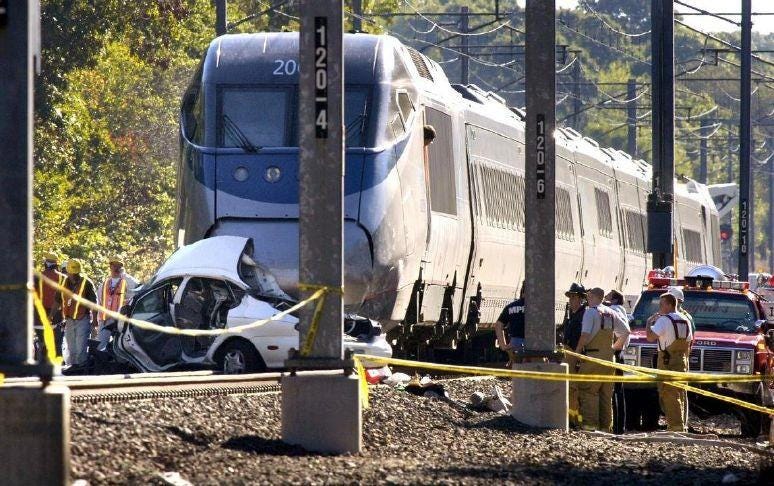
Since the FRA wrote these regulations, though, the US has built 400 miles of 110mph track, and some trains on those tracks have hit vehicles at grade crossings. We can actually check to see if the FRA’s conservatism was warranted. Since 1975, Amtrak or Brightline trains have collided with vehicles at over 90mph 48 times, and over 91mph 20 times.1 Out of 48 collisions, zero derailments occurred. Cars and light trucks by themselves are just not heavy enough to derail trains, and that still holds at high speeds. Of course, extensive testing could reveal more details but it seems apparent to me that the FRA was far, far, too conservative in their 110mph ruling, let alone their 95mph ruling.
The only times where Amtrak trains derail is when they strike heavy trucks. That’s because heavy trucks are the only vehicles that can cause the train to jump if they get lodged under the train in the right way. At 79mph or faster, Amtrak or Brightline trains have struck 1214 vehicles since 1975. Of those, only 373 were vehicles heavy enough to derail a train. FRA database statistics don’t include a “derailed” column, but we can use injuries and fatalities as a proxy - an incident with zero deaths on the train or under 5 injuries is unlikely to be a notable derailment. Of the 373 collisions, 32 met the criteria to plausibly be notable derailments. Of those, only 92 were identified as derailments, which is a 3% derailment rate over heavy trucks. Counting cars, the derailment rate is less than 1%.
What should we do about this? My position is that we should allow grade crossings on high speed lines. Especially for class 7 (-125mph) rights of way, I think that grade crossings should be allowed in the same way that they are allowed for Class 6. Given that not a single heavy vehicle has caused a derailment on >90mph track, I would argue that the FRA’s existing rules on high speed grade crossings are sufficient for class 8 as well. At the very least, I’d like to see the results of crash-testing the retiring Acela Express units at class 8 speeds, because I suspect they’d hold up. The FRA has significantly stronger equipment crash strength standards for 160mph railcars than they do for the standard 125mph equipment. I’d like to see those requirements put to good use freeing up resources elsewhere.
There’s also a significant difference between trucks and cars that can be exploited. Trucks are way more dangerous to Amtrak riders than cars are, since they can derail a train in a way a light passenger vehicle simply cannot. They’re also more likely to get stuck at grade crossings - trucks make up 10% of vehicles in the US but 30% of all high speed Amtrak-vehicle collisions (see above statistics). There are a lot of reasons for that, including unreasonable vertical geometry which caused trucks to bottom out, tight turns near grade crossings, and trucks physical length causing them to get stuck on crossing arms more often. All of those causes can and should be included in guidance for grade crossings on high speed lines, and can be mitigated at a low price.
The other thing about trucks at grade crossings is that they’re entirely optional.
Grade crossings can either be removed in two ways. Either a grade separation (an overpass or underpass) is built, or the grade crossing is closed without replacement. The former is expensive, the latter is politically costly as drivers will complain to their representatives. But truckers are not ordinary drivers, they’re much fewer in number and their whole job is driving, so sympathy for longer truck routes is not anywhere near as strong as sympathy for drivers whose commutes got longer. But trucks (and other heavy vehicles) are the dangerous component of grade crossings. If they can be removed then grade crossings don’t have to be closed or replaced.
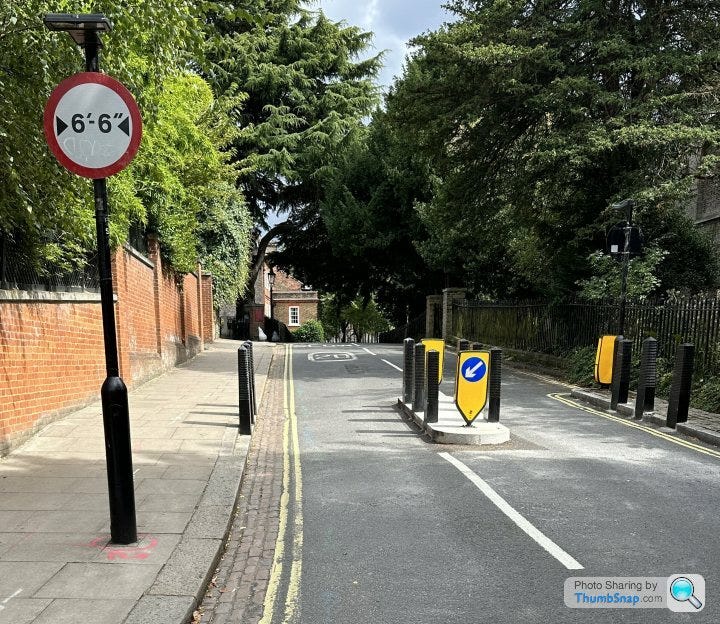
In Europe, they have plenty of traffic control devices which allow cars to pass but not trucks. In the Northeastern United States, a similar effect is accomplished with height-restricted bridges on parkways. Federal guidance could be assembled which diverts large, dangerous vehicles to grade separated roads while continuing to allow most road users to continue using grade crossings in a way that doesn’t endanger train passengers.
I don’t want to overstate the consequences of these changes. It is also generally true that in terms of making a train faster, the most effective thing one can do is reduce time stationary, and then time travelling slowly. A train which travels 80mph but does so for the entire route without interruption is faster than a train which peaks at 160mph but also spends extended time going 30mph. Most middle-distance Amtrak routes simply struggle to eliminate their slowest sections, and speeding up the peak section an expensive and ineffective way of compensating for their shortcomings. The best Amtrak project that could be funded today is the improvement to Chicago approaches, and after this rule change that would remain the best project.
On the other hand - the 110mph barrier puts a low ceiling on best-case corridor quality, which deters investment in the first place. A well-run Amtrak train on an 80mph corridor, like the Borealis, averages around 55mph when stops are taken into account. Trying to make the Borealis faster is nigh on impossible - higher speeds would require expensive upgrades over the whole route, which are impossible to justify for only 1 or 2 daily borealis trains. High-speed upgrades only make sense where there are lots of trains, like the Northeast Corridor. But where there are lots of trains, rail congestion and urbanization make projects much more expensive. Northeast corridor speeds are far, far cheaper outside of the Northeast Corridor itself.
Changing the rules would substantially change the cost-benefit of rail upgrades outside the Northeast. Cab signals offer much more benefit when the payoff is 70mph of additional speed instead of 30, which allows Amtrak to spend more on signals per daily train. Trains which are appreciably faster than cars generate far more in economic benefits than trains which are as fast as driving, so again, investment is easier to justify. Average speed rises from 55-60mph under an 80mph speed limit to only around 70mph in the 110/125mph speed limit, but would rise to over 100mph under a 160mph speed limit.
If cheap speed were 160mph instead of 110, substantially more options become available. The finished average speed rises from 55mph to something more like 100mph. Routes like Miami-Atlanta (600 miles), Kansas City-Dallas (500 miles), or Denver-Albuquerque (450 miles), which previously looked absurdly optimistic, start to look like real possibilities. Routes like Chicago-Cleveland (300 miles) which previously looked like a reach at 5.5 hours start to look obvious at 3 hours. If the trains we can afford to build were substantially better, we’d build substantially more of them. We could finally return high speed rail to the American tech tree, and implement the rail system that Americans have been demanding for decades.
https://chatgpt.com/share/6970a179-a390-8000-9987-e0516470d470
No posts
Comments
Nothing yet. Say the first thing.
Sign in to join the conversation.