
This week, my kids went back to school.
Well... kind of.
Half days.
New routines.
Everybody needing something at the same time.
School supplies.
Permission slips.
Paperwork out the wazoo.
The grocery bill doing whatever the hell it is doing.
Trying to remember who has to be where and what time while also trying to keep everybody fed, rested, and mostly regulated.
Trying to sort out when I can get to the gym, and when I can work.
And let’s not even talk about gas with the back and forth and car lines.
It has been kicking my butt.
And somewhere between drop-off, pick-up, and standing in the kitchen wondering what I came in there for, I kept thinking about the same question:
How are we supposed to make all of this work?
I know I am not the only one asking it.
Maybe for you it is groceries.
Maybe it is rent.
Childcare.
Healthcare.
A job that does not stretch the way it used to.
A business that costs more to run while people have less to spend.
Maybe it is simply the feeling that you are doing everything you are supposed to do and still cannot quite get ahead.
A lot of us are trying to create safety in a world that keeps moving the finish line.
That is why Black August feels especially important to me this year.
Not because the history changed.
Because I did.
If you have been with me for a while, you may remember my 2024 Black August series.
Together, we examined America through the lens of a business.
We talked about accounts and ledgers.
Colonization through an accounting lens.
Marketing and propaganda.
The legal framework that helped build and protect a corporate nation.
Governance.
The American Dream.
Extraction.
We looked at how this country was built, how its wealth was created, and who was expected to pay the price.
That work mattered.
It still matters. We need the analysis. We need the history. We need the receipts.
We need to understand what we are standing inside of.
But over the last two years, something has shifted in me.
I am less interested in only understanding oppressive systems.
I have become deeply interested in understanding liberated ones.
So this year, we are taking the next step.
We are asking a different question:
If we understand how systems of extraction work, what does a system of liberation look like?
What does it look like in our homes?
In our work?
In our communities?
In the way we share resources?
In the way we build institutions?
In the way we pay people?
In the way we receive support?
This is what it means when I say Liberation is a Lifestyle…
and that is where I want to go this Black August.
Black August is a month of remembrance, political education, discipline, and resistance.
It honors George Jackson, Black political prisoners, freedom fighters, organizers, and the long legacy of Black people resisting incarceration, state violence, exploitation, and oppression.
It is serious history.
It deserves to be treated as serious history.
But Black August is also about the practices Black communities created because the systems around them were never built for their survival.
People organized.
They shared food.
They pooled resources.
They taught one another.
They created political education programs.
They built cooperative economies.
They cared for children who were not biologically theirs.
They raised money for commissary, legal defense, rent, funerals, and freedom.
They practiced mutual aid long before social media turned it into a phrase people could put in a bio.
They understood something we keep having to relearn:
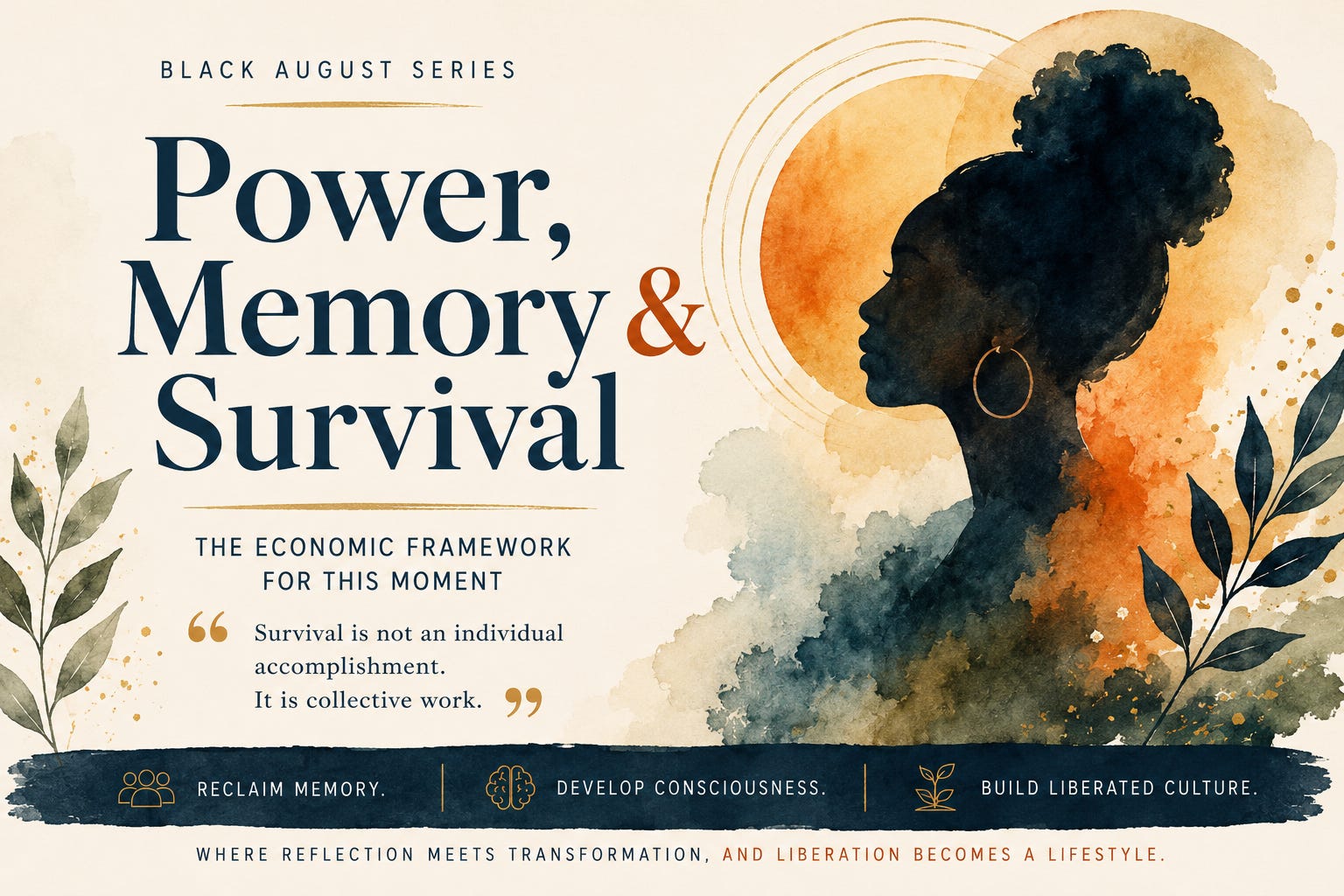
Survival is not an individual accomplishment.
It is collective work.
I am not saying we are living through the exact same conditions that gave birth to Black August.
We are not.
And I do not want to flatten history by pretending every hard moment is the same hard moment.
But I do believe our people left us frameworks.
Not just stories of resistance.
Frameworks.
Ways of thinking about power.
Ways of sharing resources.
Ways of learning together.
Ways of surviving systems that were not invested in our survival.
That matters right now because so many of us are being told to solve structural problems through individual effort.
Budget better.
Work harder.
Wake up earlier.
Start a side hustle.
Buy in bulk.
Meal prep.
Monetize your hobby.
As though the problem is that we have not optimized ourselves enough.
Black August reminds us that sometimes the answer is not more individual discipline.
Sometimes the answer is community.
Sometimes the answer is redistribution.
Sometimes the answer is political education.
Sometimes the answer is refusing to pretend that we can hustle our way out of systems built on extraction.
When people hear the word economics, they often think about the stock market, inflation, interest rates, employment numbers, or whatever economists are arguing about on television.
But economics is also much closer to home.
Economics is equity.
Economics is who cooks dinner after working all day.
It is who watches the children so somebody else can rest.
It is who remembers the appointments, buys the birthday gifts, checks on the elders, and notices when the toilet paper is running low.
It is whose labor gets called “help.”
It is whose labor gets called “professional.”
It is who is expected to give for free.
It is who is allowed to charge.
Economics is money, yes.
But it is also time.
Energy.
Attention.
Care.
Access.
Land.
Knowledge.
Relationships.
And this month, I am sitting with one question more than any other:
Where is my labor being extracted, and where is it aligned?
That question is not theoretical for me. It is personal.
I decided to make this opening article available to everyone.
Black August is political education, and I want this doorway into the series to remain open.
But open access does not mean the work appears without labor, resources, or cost.
Paid subscriptions allow me to continue creating rigorous, accessible liberation education while building the frameworks, tools, and communal practices that move us beyond performance and toward embodied transformation.
This is the reciprocity that keeps Liberation Education sustainable.
You can support the work at:
$10 per month
$100 per year
$150 per year as an Equity Partner, helping fund scholarship access for community members who need it.
And if cost is the barrier, you are not excluded here.
Scholarships are available at scholarships@desireebstephens.com.
No application.
No explanation.
No questions asked.
You can become a paid subscriber because you want full access to the ongoing Black August series, practices, Liberation Ledgers, and my transparent Road to $100K.
You can also subscribe because you believe independent liberation education should exist, remain accessible, and be sustained without requiring the educator to disappear inside the work.
Your subscription does not simply purchase content.
It helps build the infrastructure that allows this work to continue.
And whether you become a paid subscriber today or continue reading freely, I am glad you are here.
Now, before we move any deeper, let’s pause.
Before we keep going...
Take a moment to notice your body.
Not your thoughts.
Your body.
Are your shoulders creeping toward your ears?
Is your jaw clenched?
Have you been holding your breath without realizing it?
Can your feet find the floor?
Take one slow breath in.
And an even slower breath out.
Look around the room.
Find three things that tell your nervous system you are here.
Maybe it’s the light coming through the window.
A favorite mug.
A sleeping pet.
The sound of your air conditioner.
There is nowhere to rush.
This work asks us to remember.
But it also asks us to stay present while we remember.
When you’re ready...
Let’s continue.
For a long time, I believed accessibility meant I had to absorb the cost.
I thought being committed to liberation meant making everything free, even when creating it cost me time, money, energy, and health.
I worried that asking people to financially support the work might somehow compromise the work.
I thought generosity meant giving until there was nothing left of me.
And I know I am not the only one who learned that…
And if I am honest, I think that is a tension many of us in anti-racism, decolonization, and justice work have quietly carried.
How do we pursue equity while also paying our bills?
How do we make education accessible without expecting educators to absorb every cost?
How do we redistribute resources without creating new forms of depletion?
How do we balance the scales without asking the very people doing the labor to disappear in the process?
Those are not easy questions.
For a long time, I believed (like so many of you) the more I gave away, the more committed I was to liberation.
I wore exhaustion like a badge of honor.
If I was tired, I told myself it meant I cared.
If I was overextended, I convinced myself it meant I was living my values.
But eventually I realized something that was difficult to admit:
A movement that depends on the exhaustion of its educators, organizers, artists, healers, and community builders is not sustainable.
And sustainability is not the opposite of liberation. It is one of its conditions.
That realization changed how I think about reciprocity.
It changed how I think about accessibility.
It changed how I think about charging for my work, offering scholarships, practicing mutual aid, and building institutions instead of simply producing content.
Because I no longer believe the choice is between equity and eating.
I believe our work is to imagine (and build) models where both are possible.
Where educators are paid.
Where communities are supported.
Where scholarships exist because people who have capacity help create access for those who do not.
Where generosity flows in every direction instead of always asking the same people to give.
That, to me, feels much closer to liberation.
So many of us, especially Black women, caregivers, educators, organizers, healers, and community builders, have been taught that the proof of our commitment is how much of ourselves we are willing to sacrifice.
How much we can carry.
How little we can ask for.
How long we can keep going without support.
But eventually, I had to sit with an uncomfortable truth:
If liberation education is only accessible because the educator is exhausted, underpaid, and disappearing inside the work, then we have not built a liberated model.
We have recreated extraction using better, more politically correct language.
I am no longer interested in building work that survives by consuming the person who created it, or those that desire to participate in building liberated communities.
I want to build work that can hold people.
Including me.
I want to build spaces where accessibility and sustainability are not treated as enemies.
Where people who can contribute do.
Where people who need support can receive it without shame.
Where scholarships are funded.
Where educators are paid.
Where collaborators are compensated.
Where rest does not threaten the survival of the institution.
Where the work can continue even when I need to step away, take care of my children, tend to my health, or simply be a human being.
That is part of my evolution.
I am not only asking how to make liberation education available.
I am asking how to make it sustainable, reciprocal, and capable of becoming infrastructure that outlives me.
If you follow me on Facebook, I often say “community is wealth.” I say that because I know I live a life that for many would cost (financially) more than is accessible to them. However, because of my community, I have ease, access, support, and all the things money is supposed to buy.
So it had me thinking a lot about wealth lately.
Not wealth as endless accumulation.
Not wealth as proving you are better than someone else.
Not wealth as hoarding so much that other people have to go without.
I mean wealth as capacity.
Enough food for everybody at the table.
A friend who can pick up your child.
An educator who can afford to keep teaching.
An artist who does not have to create from the edge of exhaustion.
An elder who is cared for.
A disabled person who does not have to beg for access.
A community that knows how to respond before somebody reaches crisis.
Knowledge that is shared.
Resources that move.
Support that is reciprocal.
Time to rest.
The ability to ask for help without having to prove that you deserve it.
That is wealth too.
Maybe it is the kind we should have been measuring all along.
Because what good is money if everyone around you is depleted?
What good is success if you have no capacity left to enjoy it?
What good is independence if it means nobody knows when you are struggling?
Black communities have always understood that wealth is not only what one person owns.
It is what a community can access.
What it can share.
What it can sustain.
What it can protect.
What it can pass forward.
That is the kind of wealth I want us to study this month.
And it is the kind of wealth I am building.
This is also why I am talking publicly about my Road to $100K.
Not because $100,000 is some magical number that will liberate me.
Not because I believe revenue alone is proof that the work is valuable.
And definitely not because I am trying to turn liberation into another hustle challenge.
The Road to $100K is a real-time case study.
Can liberation work be transparent?
Can it be accessible?
Can it pay educators and collaborators?
Can it fund scholarships?
Can it support mutual aid?
Can it create resources that remain available beyond one social media post?
Can it grow without turning people into numbers?
Can it become sustainable without becoming extractive?
I want to explore those questions in public.
I want to show what it actually costs to build the Liberation Education Academy, develop curriculum, maintain technology, create accessible resources, support community spaces, compensate collaborators, and make scholarship access possible.
Because too often, we only talk about money when something is falling apart.
We wait until the organizer is burned out.
Until the community space is closing.
Until the educator cannot continue.
Until the mutual aid fund is empty.
Then we scramble.
I want to practice something else.
Transparency before crisis.
Stewardship before depletion.
Reciprocity before resentment.
That is what the Road to $100K means to me.
It is not simply a revenue goal.
It is an experiment in building liberation infrastructure in public.
This Black August, we are going to talk about history.
But we are also going to talk about practice.
We are going to look at what Black August remembers and why that memory still matters.
We are going to talk about mutual aid and why it is not the same thing as charity.
We are going to talk about cooperative economics.
We are going to talk about power and who gets to hold it.
We are going to talk about individualism and why it leaves so many of us isolated.
We are going to talk about burnout, overgiving, free labor, and why liberation work cannot depend on martyrdom.
We are going to talk about compensation.
Receiving.
Redistribution.
Accessibility.
Transparency.
Stewardship.
And what it actually costs to build work that can hold people over time.
We are going to study Black August not only as history, but as a teacher.
A teacher of memory.
A teacher of discipline.
A teacher of community.
A teacher of survival.
A teacher of what becomes possible when we stop believing we have to do everything alone.
We are beginning on August 6.
I am not going to cram five days of content into two because a calendar told me I am behind.
That would be teaching urgency while writing about liberation.
No.
We are starting where we are.
Black August: Power, Memory & Survival
The piece you are reading now.
Our doorway into Black August as history, practice, and an economic framework for this moment.
What Black August Remembers, and Why We Still Need It
A deeper look at the history, discipline, political education, and people Black August asks us not to forget.
Liberation Practice: Map Where Your Labor Goes
A guided reflection on paid labor, unpaid labor, emotional labor, care work, creative labor, and the places where your energy is extracted or aligned.
Mutual Aid Is Not Charity
A conversation about the difference between generosity, rescue, solidarity, reciprocity, redistribution, and collective care.
Liberation Practice: What Did You Redistribute This Week?
Because redistribution is not only money.
It can be food.
Time.
Knowledge.
Childcare.
A ride.
A referral.
A resource.
An opportunity.
Liberation Work Should Not Require Martyrdom
A conversation about who gets expected to overgive, who gets praised for sacrifice, and why access cannot depend on someone else’s depletion.
The Liberation Ledger: What It Costs to Build This Work
A transparent look at what this ecosystem requires, how resources move, and what community support makes possible.
The Road to $100K: Building Liberation Infrastructure in Public
A closing reflection on money, sustainability, transparency, stewardship, and the work of building something meant to last.
Liberation becomes real when it moves from what we believe into how we live.
So this week, I want you to sit with one question:
Where is my labor extracted, and where is it aligned?
Not only your paid job.
All of your labor.
Your care.
Your creativity.
Your listening.
Your planning.
Your organizing.
Your emotional capacity.
Your ability to anticipate what everyone else needs.
Notice without judging yourself.
Where are you spending energy faster than you can replenish it?
What parts of your labor feel connected to your values?
What parts of your labor require you to abandon yourself?
Where are you overgiving because you were taught that boundaries are selfish?
Where might you need to ask for support?
Who carries the invisible labor in your home?
Who remembers?
Who plans?
Who notices?
Who gets to rest without asking?
What responsibility could be named, shared, or redistributed this week?
What would make your home feel more reciprocal?
Who benefits from your labor?
Is your contribution acknowledged, compensated, or supported?
Where are people relying on your care without helping sustain your capacity?
Which businesses, educators, organizers, artists, or community spaces could you support more intentionally?
What skill, resource, connection, or opportunity could you redistribute?
You do not have to answer everything today.
Just notice.
Then choose one action.
Maybe you ask for help.
Maybe you pay someone for labor you usually expect for free.
Maybe you share a resource.
Maybe you purchase from a Black-owned business.
Maybe you offer childcare.
Maybe you set a boundary.
Maybe you receive support without apologizing.
Maybe you redirect your energy toward work that is more aligned.
Praxis is not perfection.
It is the practice of bringing our values into relationship with our choices.
Throughout Black August, I will be sharing essays, reflections, practices, and tools to help us move these ideas beyond theory.
You can also visit my shop for self-guided resources designed to help you unpack supremacy culture, reclaim your story, deepen your political education, and bring liberation into your actual life.
Not only your language.
Your home.
Your work.
Your relationships.
Your choices.
Your practice.
Every purchase helps sustain the larger ecosystem I am building, including accessible liberation education, the Liberation Education Academy, community resources, scholarship access, and tools that can keep circulating beyond a single post.
And buying something is not the only way to participate.
You can read.
Share the work.
Gift a resource.
Become a paid subscriber.
Support a Black-owned business.
Pay an educator.
Offer a ride.
Cook a meal.
Share a skill.
Make a referral.
Ask for help.
Receive help without apologizing for needing it.
Redistribute what you can.
That is part of the practice too.
This month is not about performing liberation perfectly.
It is not about proving that we are more conscious than someone else.
It is not about collecting the right language while our relationships remain unchanged.
It is about remembering that Black communities have always created ways to survive, share, teach, protect, and build under conditions that were never designed for our well-being.
Those practices are not relics.
They are living frameworks.
And they are asking something of us now.
To remember.
To notice where our labor goes.
To question what we have been taught about wealth.
To practice reciprocity.
To redistribute what we can.
To receive what we need.
To build systems that do not require somebody else’s disappearance.
Because liberation is not an event. It is not a destination.
It is a practice.
And survival has never been something we accomplished alone.
We have always built it together.
I am glad you are here.
Let’s get into it.
Reclaim memory. Develop consciousness. Build liberated culture.
Where reflection meets transformation, and liberation becomes a lifestyle.
In solidarity and liberation,
Desireé B. Stephens
Educator • Counselor • Community Builder
Founder, Make Shi(f)t Happen
Writer of Liberation Education
Steward of The Healing Homestead Collective
Comments
Nothing yet. Say the first thing.
Sign in to join the conversation.