
A design review this month turned into a small crisis over one dropdown menu. Figma showed four actions. Storybook showed the same four, behaving exactly as documented. Production showed two. Nobody had made a mistake. Engineering had quietly removed two actions because real users kept clicking things they had no permission to use, and every click was turning into a support ticket. The fix solved a real problem. Nobody had told the design file. Storybook was still faithfully demonstrating the version that no longer shipped.
Surendar Selvaraj’s account of that meeting, published through Design Systems Collective this month, spent twenty minutes on a question nobody in the room could actually answer: which one is correct? Reading through what the DSC community wrote during July, that question turns out to be the real story hiding under several different bylines.
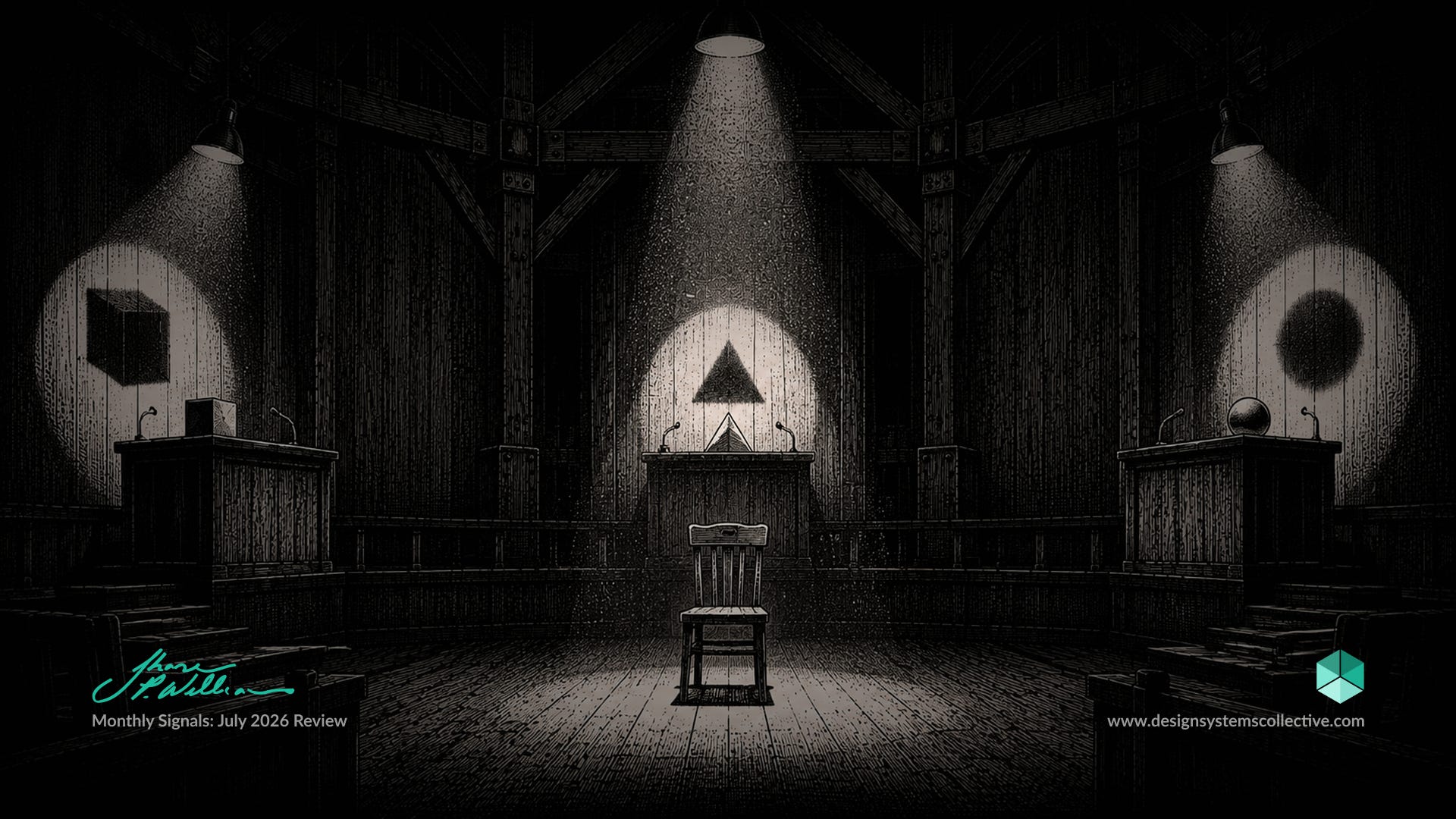
Selvaraj’s own answer, in The Design File Is No Longer the Source of Truth, is the sharpest model to come out of the community all month. Figma preserves intent: what the team deliberately chose. Storybook preserves behaviour: what the component actually does. Production preserves something neither can, the delivered reality of business rules, permissions and experiments no mockup ever modelled. None of the three is lying. They are each authoritative for a different question, and the industry spent two decades hunting for a single artefact that could answer all of them at once.
The timing is what makes this worth naming outright rather than filing under “worth watching.” Within a day of each other, ABDÜSSAMED TEZER and Ashish Garg arrived at the same diagnosis from opposite entry points, one reporting live from Figma Config on archives nobody prunes, the other going straight after the phrase “Figma is the source of truth” as the industry’s most comfortable lie. Three writers, two days, zero coordination, the same conclusion. That is not a trend piece waiting to happen. It already happened.
Selvaraj’s piece ends on the question it doesn’t answer: once truth lives in layers, who is actually responsible for keeping them honest with each other. That gap sat with me longer than the model itself did, because the honest answer isn’t a tool.
AI is genuinely good at the half of this problem that was never the hard part. Reading Figma, cross-checking it against Storybook, comparing both to what production actually shipped, that is retrieval and comparison, and an agent that does it continuously is close to a solved problem. What it can’t do is the other half: deciding whether a given gap is the system quietly getting smarter or the system quietly rotting. Selvaraj’s own dropdown was healthy adaptation, not a bug. Telling those two apart is judgment, and judgment needs an owner, not a dashboard.
That is a real shift in what the job is, not an argument for automating the job away. Evidence gets faster and cheaper. The verdict still needs someone who can be asked why, in public, and answer. You can see the same instinct running through the rest of Selvaraj’s July output. In I Built a Design Review Skill, Selvaraj’s own tool audited its documentation and found the exact failure it had been built to catch, sitting inside its own scoring model. The fix wasn’t a better number. It was refusing to score categories the evidence couldn’t support. Tina Singh made the identical call from a completely different project, watching a self-built validator return 89 percent and choosing to trust it over a green 100 that had never really been looking. Neither of them automated the judgment. Both of them built the evidence honest enough to make the judgment worth trusting.
None of that discipline has a job title yet. Reconciling intent, behaviour and reality is becoming the actual work, quietly, inside pieces about tooling rather than pieces about roles. Someone should name it before a worse name gets attached to it by default.
Here is what nobody writing about this in July seemed to notice: almost none of it was written from inside an understaffed team. The corpus’s implicit voice is either conference altitude, Config keynotes and four-layer architectures presented to a room, or unconstrained solo-project altitude, one determined builder with open-ended evenings to spend on a side repository. Most teams running an actual design system sit at three to five people, understaffed by their own report, regardless of how large the company around them is.
Both things are true at once, and which one is load-bearing depends entirely on where the reader is standing. For a small team or a solo builder like Selvaraj or Singh, this kind of infrastructure genuinely raises the ceiling: more leverage, more reach, a real system built without needing a real headcount. It also hands that same small team more to reconcile, permanently, with nobody spare to own it. For a larger organisation, headcount buys reach but not alignment. More people touch Figma, Storybook and production every day, so the gap between the three layers widens faster, and the reconciliation work becomes the harder, more consequential problem exactly where the resourcing exists to actually solve it. Neither camp gets to claim the whole story.
The other argument the community couldn’t agree on this month reached for the same historical comparison and drew opposite conclusions from it. J Gibbens, naming what the piece calls the purple slop problem, compares AI’s visual monoculture to Bootstrap: a powerful tool applied without a coherent foundation, producing the same look everywhere it lands. Brady Starr reaches for the identical comparison in an argument for the defence: Bootstrap made every startup site on earth look the same, and the actual effect was that the worst sites on the internet got dramatically better overnight while good designers moved their effort somewhere Bootstrap couldn’t reach. Two writers, one analogy, opposite verdicts.
Angus Ewing frames the stakes correctly even where the taste debate doesn’t: every democratising technology moves value to whatever it can’t automate. My honest read is that the taste argument is the wrong argument to be having. Once the floor rises for everyone, indistinguishable output stops being an aesthetic problem and becomes a branding one. If a customer can’t tell your product from three competitors by looking at it, taste didn’t fail you. Differentiation did. Good taste was always a proxy for recognisable, not a proxy for beautiful, and recognisable is the thing actually getting scarce.
Nobody in that dropdown review was wrong. Figma, Storybook and production were each answering a different question honestly, and the argument only existed because everyone assumed there could be just one answer. That is the thread underneath everything the community wrote in July, whichever surface it showed up on: intent and behaviour and reality quietly refusing to agree by default, and the industry still acting as though picking a winner were the job.
It was never the job. The job is deciding, in public, which layer governs a given decision and being able to say why. AI will keep getting better at handing that decision to someone faster and with better evidence behind it. It will not do the deciding. August will produce more receipts. It won’t fill the vacancy. Someone still has to take the job.
A note on process: the reading, the pattern-finding and the first draft of this piece had AI assistance. The verdicts are mine.
Comments
Nothing yet. Say the first thing.
Sign in to join the conversation.