
What if the thing keeping your design system honest was never governance, never review, never the senior voice in a comment thread saying this doesn’t match anything else we’ve shipped? What if it was simply how long everything used to take?
Slow production looked like discipline. Mostly, it was just latency. When a component took days to build and weeks to ship, someone had time to notice the one that didn’t belong, to ask where a token actually came from, to catch drift before it hardened into precedent. The friction felt like process. It was never process. It was the clock, quietly doing a job nobody had built a system to do on its own.
Remove the clock and the job doesn’t disappear. It just goes undone, loudly and all at once. That’s the thread running underneath this issue, whatever shape each piece takes on the surface: encoding conventions into agents so the checking still happens, holding a product together while output accelerates past what review can absorb, a community spending a month arguing over whether “design system” still means anything specific now that everyone can see the parts that never got agreed on. Different fights, same exposed wiring.
The instinct so far has been to rebuild the friction as infrastructure, which is the right instinct. But infrastructure can only encode what the team actually agreed on in the first place. So before anyone encodes anything: does your system know what it is, or has slowness simply never given you the chance to find out?
📚 Featured Articles
📰 Published in the Last Week
🗓️ Monthly Signals
🎙️ From the Conference Floor
✨ Inspiration
🎗️Support us
📝 Closing Thoughts
Must-read articles at www.designsystemscollective.com.
💡 Have an article to share? Submit it here!

AI Didn’t Break Design. It Exposed It. by Hadi Buddy
Why We Like It: A rigorous, humane framing of what AI actually changes in design practice — shifting scarcity from execution to understanding and intent.
Don’t Miss: This essay reframes the conversation from tool fluency to context and intent engineering: pragmatic, philosophical, and essential reading for leaders who must re-skill teams for an AI-assisted future. It explains why design value will concentrate in interpretation, not surface production.
How I Get AI to Write Cleaner React Code with 4 Architecture Patterns by Abdul Basit
Why We Like It: Practical, example-led guidance that helps engineers and design-system engineers prompt AI to produce maintainable, scalable React.
Pro Tip: Concrete patterns with code samples show how to steer AI toward good architecture: split UIs into clear components, extract custom hooks, use polymorphic components, and prefer reducer-based state for complex features. Developers will get immediate wins by adopting these prompts and structures.

The Figma Agent with Skills: Your Design System’s New Team Member by Madhesh P
Why We Like It: Clear explanation of how Figma Skills can encode team conventions and reduce repetitive review work.
Perfect For: Teams looking to operationalise a design system for AI workflows: this piece explains what to encode as Skills, how they reduce drift, and why governance matters as Skills become part of the system. Practical and timely for system owners.
When AI Moves Fast, UX Has to Hold the Product Together by Kristy Mapp
Why We Like It: A pragmatic account of hands-on systems work needed to keep AI-driven output coherent in live products.
Hot Take: Speed from AI exposes gaps in product architecture and component governance; UX must act as the control layer, not polish. The article gives a tight prescription for prioritising system-level fixes before scaling automated generation.
Monthly Signals is a monthly point of view on the ideas and patterns surfacing across Design Systems Collective, what the community is actually saying and what it means.
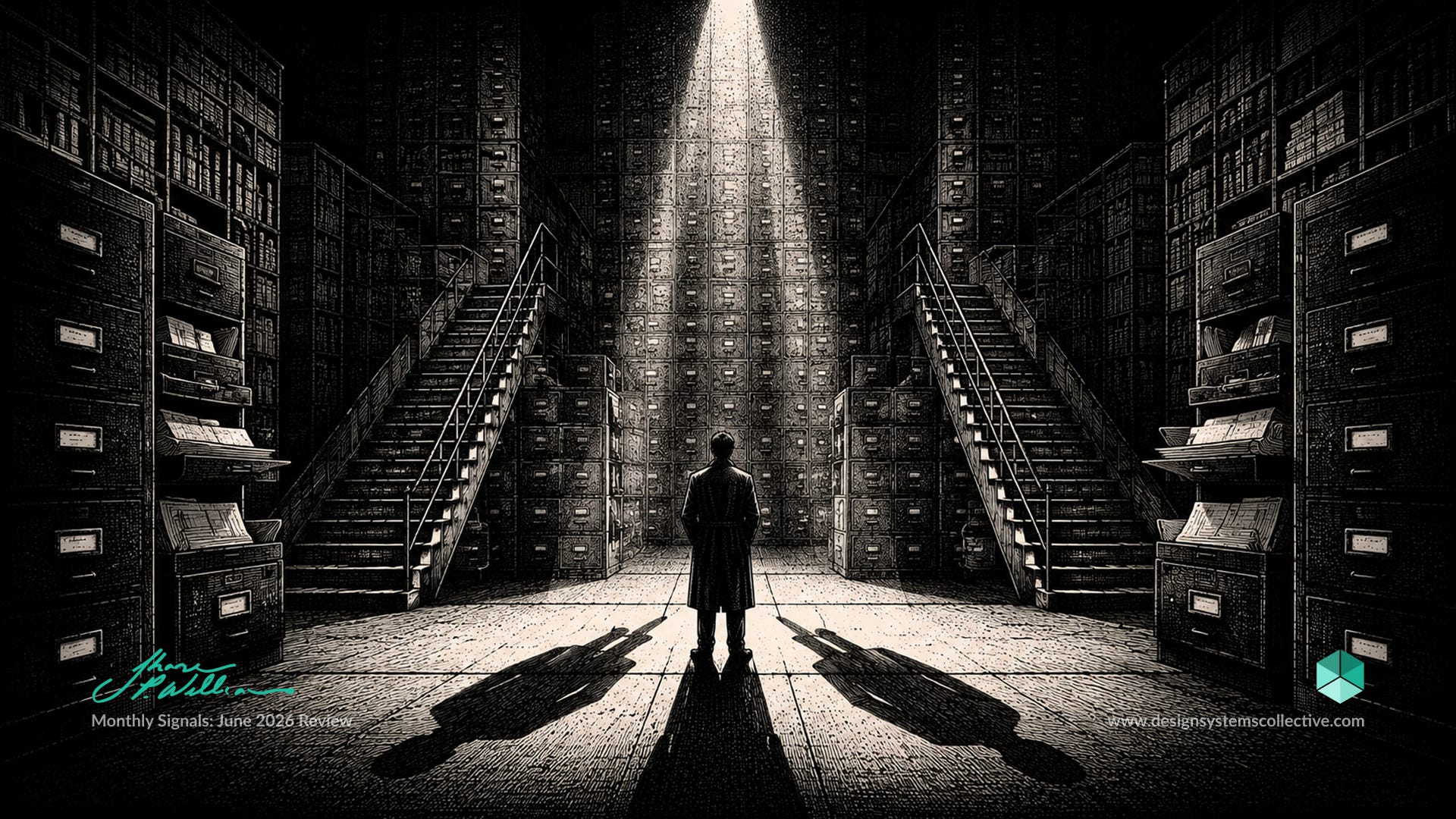
Design systems people spent June disagreeing with each other. About consistency, about tokens, about whether the whole exercise still deserves the name design system. Underneath the noise sits one real question: does your system know what it actually is, or does it just look like it does. This month's Signals goes looking for the answer across ninety of June's articles and everything I'd already been arguing in the newsletter since May. Read the full breakdown 👉
To stay updated on the latest articles, we share every new article on our LinkedIn page.
👉 When AI Moves Fast, UX Has to Hold the Product Together by Kristy Mapp
👉 AI Is Making Invisible UX Thinking Visible by Kristy Mapp
👉 Why Custom Agents Are Essential to Design Systems by Peter Michaels Allen
👉 The Figma Agent with Skills: Your Design System’s New Team Member by Madhesh P
👉 The Most Important Role in an AI-Assisted Product Organization Is Not What You Think. by Eddie Lou
👉 How I Get AI to Write Cleaner React Code with 4 Architecture Patterns by Abdul Basit
👉 Vibe code your way to component library and design system- PART 1 by Shyam Krishnan
👉 Stop Re-Explaining Your Components to AI Every Single Time by Hamed Sattarian
👉 Building Resilient Design Systems in 2026: Lessons, Trends, and Practical Advice for Scalable Teams by Damini Patil
👉 Design Debt: The Silent Killer of Product Teams by Aviraj Chindarkar
👉 How to Pitch a Design System to Non-Designers: Turning UI Consistency into Business Value by rakesh patel
👉 Stop Using One Loader Everywhere by Curious dev
👉 Figma Motion Just Made Animation a Design System Problem by Madhesh P
👉 Stop Fighting Material 3 — Build a Theme System That Actually Scales by Muhammad Usman
👉 Why Your Disabled Button Disappears on Video Backgrounds (And Why Material Design Isn’t Wrong) by Vedant
👉 Figma Slots & Design Systems by Ben Ellis
👉 Figma Config 2026: The Shrinking Distance Between Drawing an Interface and Building It by Appibara LTD
👉 The Spec Is the Work. by Stephan Simorka
👉 The Senior Designer Plateau Isn’t a Skill Problem. It’s a Scope Problem. by Abhi Chatterjee
👉 The AI Paradox in UX Hiring: Companies Want AI Skills — But Not AI-Generated Designers by rakesh patel
👉 How I Transitioned from a Visual Designer to a Design System Designer by Miao
👉 Why Every Company Has a Different Design System by Hyeonjun Kim
👉 AI Didn’t Break Design. It Exposed It. by Hadi Buddy
👉 What is DesignerPunk’s Rosetta System? by Peter Michaels Allen
👉 The System Arguing With Itself by Shane P Williams
👉 Stop designing screens. Start designing systems. by Anna Parker | Business & Tech Analyst
👉 The Worst Designed Future (On Purpose) by Shaista Aben e Azar

Learn how designers at WhatsApp, Atlassian, Figma and others use AI in their daily workflows.
As a Design Systems Collective reader, you get 10% off. Use code DSCOLLECTIVE at checkout. Get the recordings here
Are you constantly searching for innovative ideas and fresh insights in design? Look no further! Here’s a curated list of intriguing content that has sparked our interest lately:
🔗 The Future of AI Interaction Design
Discover how AI is redefining interactive experiences and what this means for design professionals.🔗 Embracing AI in Creative Workflows
Explore the integration of AI technologies in creative processes and their impact on innovation.
If you find our content helpful, here’s how you can support us:
Forward this email to a friend and invite them to subscribe
Support our writers by visiting the Design Systems Collective website
In my experience, most review cycles did less work than they got credit for. They just moved at the same pace as everything else, which looked a lot like rigour right up until the clock stopped.
Founding Editor, Design Systems Collective
Comments
Nothing yet. Say the first thing.
Sign in to join the conversation.