
The 8D process stands apart from more open-ended approaches like the Double Diamond or IBM Design Thinking. Rather than encouraging exploration, 8D is a rigid, standardised method built specifically to tackle crises. It guides a team through identifying a problem, tracing it back to its root cause, and landing on a solution that actually sticks. Everything gets captured in an 8D report, which documents each of the eight stages in turn.
When companies hit a crisis, they need a way to work through problems quickly without wasting resources. This is where structured techniques like TRIZ, Hurson’s Productive Thinking Model, and 8D come in. Remember to differentiate between tame and wicked problems. Tame problems are usually repeated or have a clear direction to solve them, and this is where you can use these tools. Wicked problems, in contrast, have no clear direction to reach the solution. Actually, we don’t know the solution until we reach it. You can read more about design problems in my article: Design Thinking Books You Must Read.
8D has military roots, originating as Army Directive 1520 during World War II, aimed at handling nonconforming materials. It wasn’t until 1987 that the method found its modern form, when Ford Motor Company formalised it in their Team Oriented Problem Solving (TOPS) manual. Originally designed to handle quality and safety issues at Ford, it evolved into the team-based problem-solving framework used widely today. A ninth step, D0 (Plan), was tacked onto the front of the process in the mid-90s.

The full sequence runs: D0 Plan, D1 Team Formation, D2 Describe the Problem, D3 Temporary Containment Plan, D4 Determine and Verify Root Causes, D5 Verify the Permanent Solution, D6 Implement the Permanent Solution, D7 Prevent Recurrence, and D8 Congratulate the Team.
Across these steps, the underlying goals are to get the team thinking collectively, pin down the situation and its causes, identify contributing factors, put a stopgap in place to limit damage, remove the actual causes (not just symptoms), and stop the problem coming back.
8D is built for complex problems, the kind that are too big for one person to solve alone and that need coordination across different levels of an organisation. Sometimes a client or management team will explicitly require an 8D report as part of their process. It particularly suits recurring issues within a project or company.
It’s not the right tool for everything, though. Simple problems with quick, individual fixes don’t need this level of structure. The 8D is meant for issues that take weeks (sometimes longer) to resolve and typically involve at least four people. It’s also not designed for choosing between multiple possible solutions; other tools are better suited to that kind of decision-making.
D0: Plan: Sometimes called Pre-8D, this stage checks whether 8D is even the right approach. The team asks whether the problem is new or recurring, what its history looks like, and how it’s been handled before.
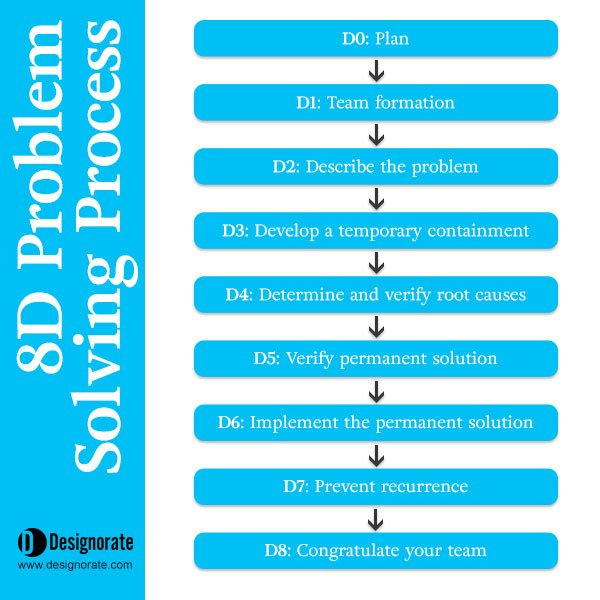
D1: Team Formation: Problems get solved better collectively than individually. The team should include every relevant stakeholder, and if members don’t already know each other, early sessions can double as a way to build rapport, using techniques like Six Thinking Hats to get ideas flowing.
D2: Describe the Problem: With the team in place, the focus shifts to understanding the problem and assessing its risk to the project. Tools like SCAMPER help view the issue from multiple angles, ensuring everyone shares the same understanding before moving forward.
D3: Temporary Containment Plan: A short-term fix — extra labour, tighter quality checks, a risk mitigation plan — stops the problem from spreading while the real solution is worked out. It’s important that this stays purely a stopgap and doesn’t get mistaken for the actual fix, or delay the search for one.
D4: Determine and Verify Root Causes: Arguably the heart of the whole process. What looks like the cause of a problem is frequently just a symptom of something deeper, and mistaking one for the other can lead to fixes that don’t actually work — or that create new problems down the line. This stage calls for real investigative rigour, using tools such as brainstorming, statistical analysis, flow charts, and audits to dig past the symptoms.
D5: Verify the Permanent Solution: Once the root cause is clear, a solution usually presents itself — but surrounding symptoms and complicating factors still need to be weighed. A solid permanent solution should be practical, feasible, cost-effective, robust in production, and applicable across every affected part of the organisation.
D6: Implement the Permanent Solution: This becomes an action plan: what needs doing, and who’s responsible. Complex solutions may call for more detailed documentation, team training, and ongoing progress checks.
D7: Prevent Recurrence: Once the plan is in motion, the team needs to guard against the problem resurfacing. This means testing and documenting the action plan, using tools like Control Charts, Capability Analysis, and Control Plans.
D8: Congratulate the Team: The process closes with recognition and celebration. Beyond team morale, this acknowledgement from management sends a positive signal throughout the organisation about the value of the effort put in.
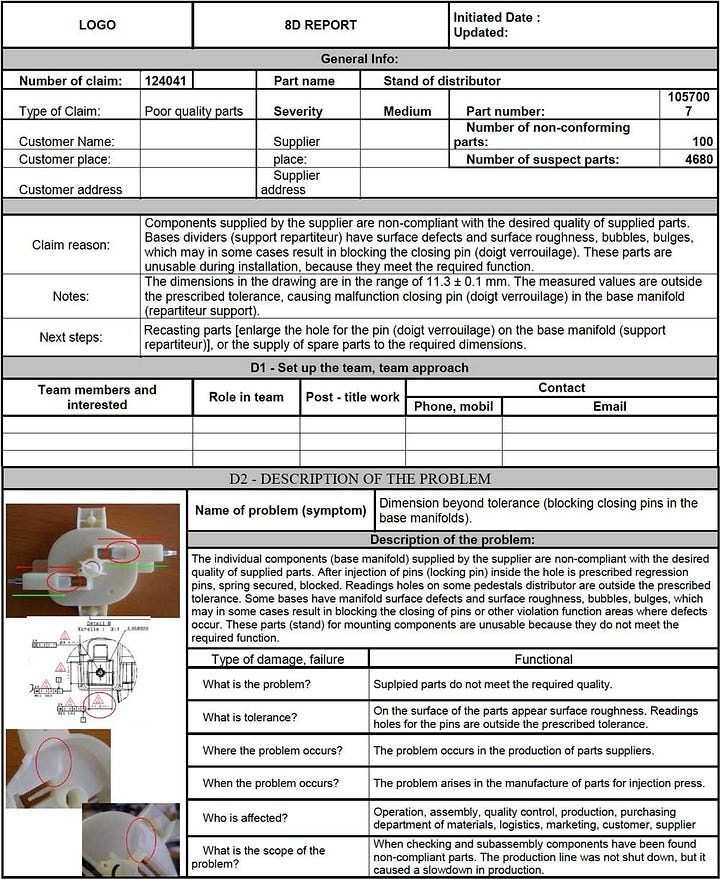
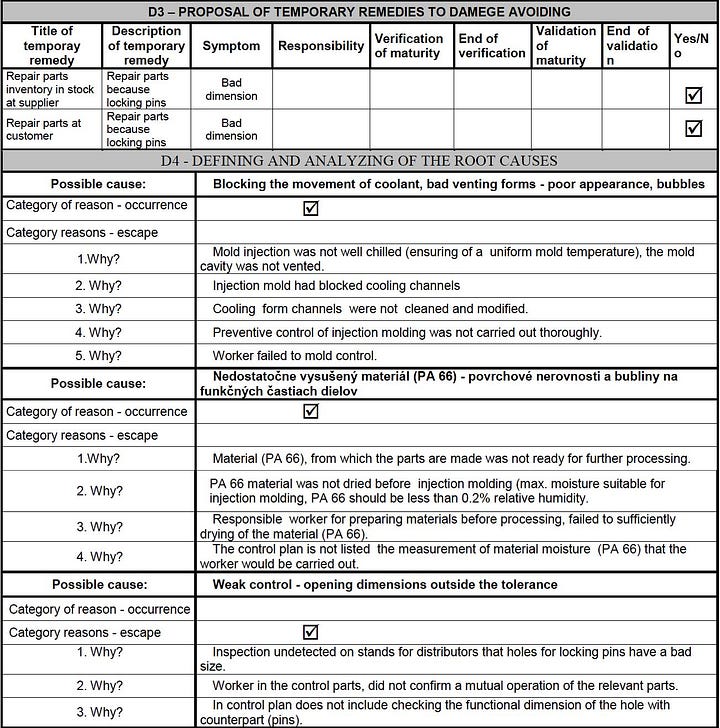
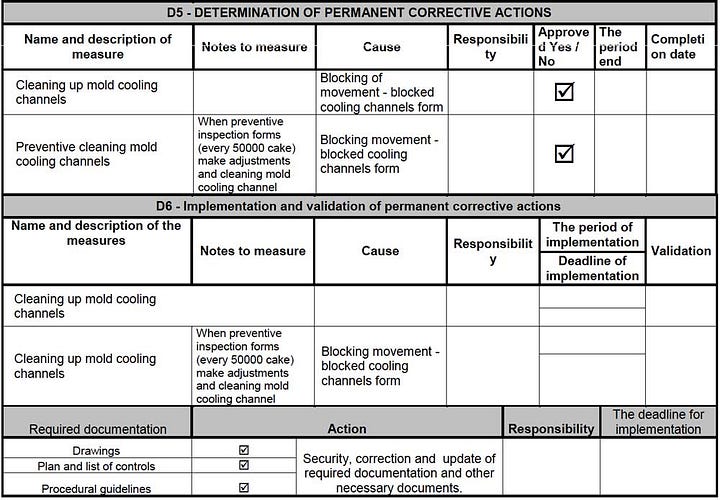
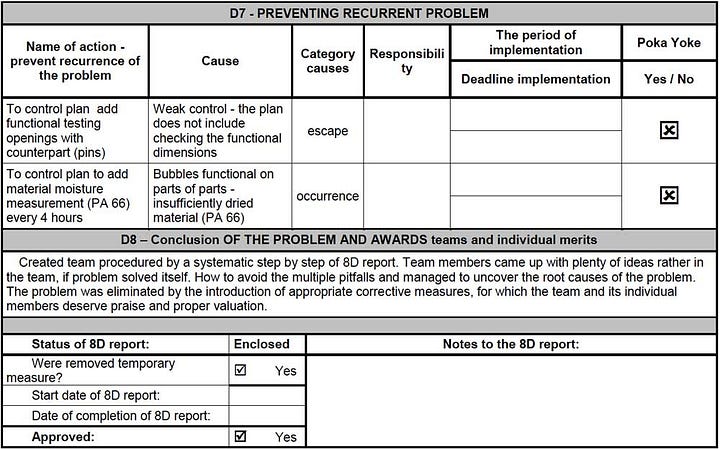
The 8D report is the process’s core piece of documentation, and each discipline has its own section. D0 covers the problem and project background; D1 lists the team, their roles, and contact details; D2 gives a detailed problem description, ideally with supporting images and details on the type and location of the failure.
D3 documents the temporary fix, what it addresses, who’s responsible, and how it was validated. D4 typically uses root-cause tools like the 5 Whys or a Fishbone (Cause-Effect) diagram to trace the problem to its source. D5 lays out the permanent solution: what it’s called, why it was chosen, who owns it, what approvals it received, and the expected completion date. D6 then documents implementation and validation of that solution.
D7 covers recurrence-prevention actions, including their rationale and ownership, while D8 wraps up with a summary of the whole process and its approvals.
8D offers a structured, dependable way to work through complex problems by getting to their actual root causes and making sure they don’t return. It’s best suited to problems substantial enough to take weeks or months to resolve — which is exactly why the process starts by asking whether 8D is even the right tool for the job in the first place. If it is, the eight disciplines offer a clear, proven path from crisis to resolution.
George, A., Ranjha, S., & Kulkarni, A. (2021). Enhanced problem solving through redefined 8D step completion criteria. Quality Engineering, 33(4), 695-711.
Kaplík, P., Prístavka, M., Bujna, M., & Viderňan, J. (2013). Use of 8D method to solve problems. In Advanced Materials Research (Vol. 801, pp. 95-101). Trans Tech Publications Ltd.
Korenko, M., Krocko, V., Zitnak, M., Foldesiova, D., Adamik, M., Allo, S., & Kuzenko, L. (2013). Application 8D method for problems solving. Вісник Львівського національного аграрного університету. Агроінженерні дослідження, (17), 330-339.
Zarghami, A., & Benbow, D. (2017). Introduction to 8D problem solving. The Journal for Quality and Participation, 40(3), 23-28.
Comments
Nothing yet. Say the first thing.
Sign in to join the conversation.