
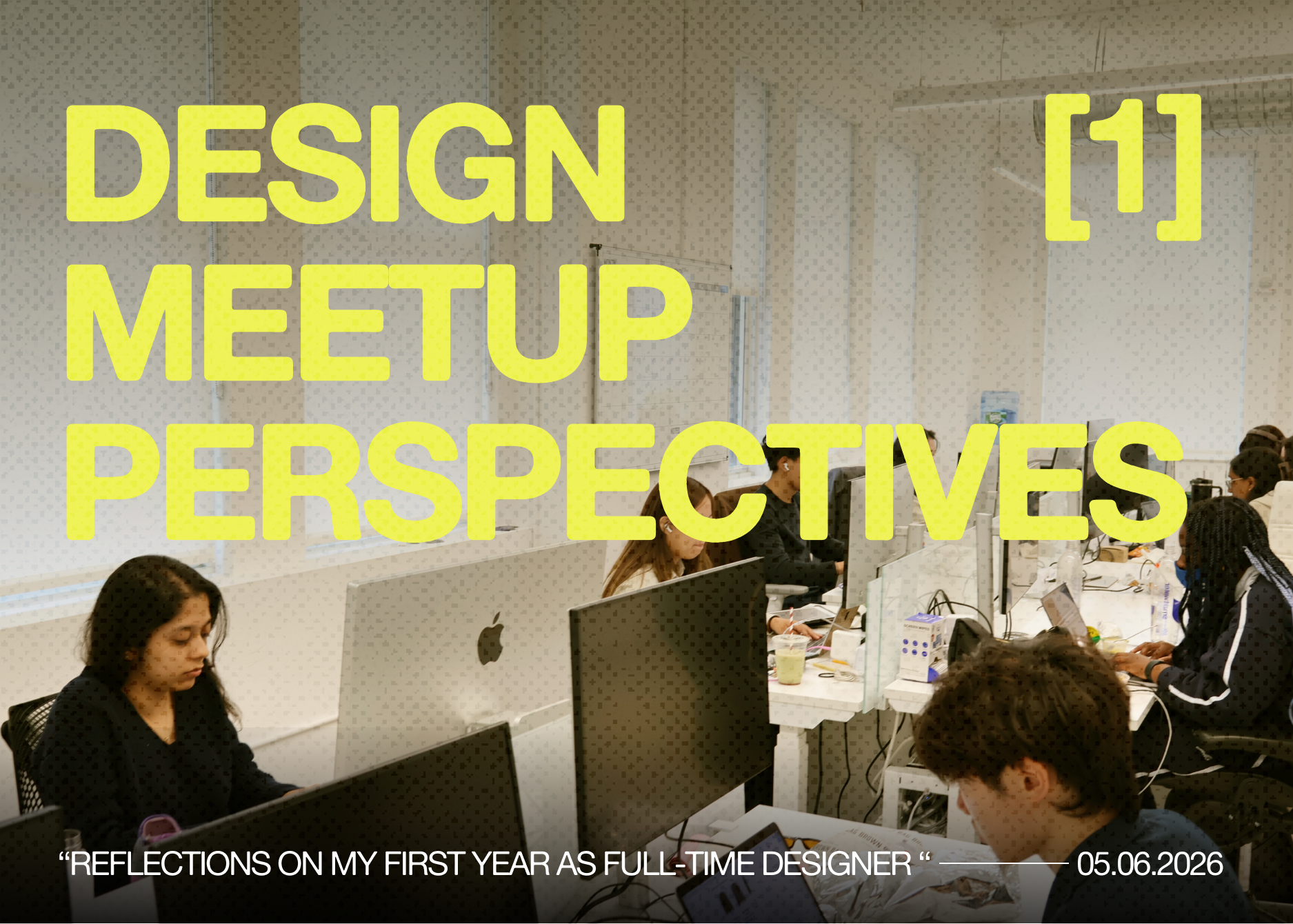
Perspectives is our space for honest, first-person writing from designers in our community. The views shared are the author's, not Design Meetup's.
Want to write the next one? Submit your idea here.
From an Anonymous New Grad + Product Designer @ Tech Company
Up until last year, I had successfully evaded imposter syndrome — or more accurately, convinced myself it wasn’t something that applied to me — to the point of near ignorance. A combination of hard work, a handful of smart decisions, and a butt load of privilege and fortunate circumstances had insulated me from it for most of my life. Having grown up in an affluent area, my well-resourced, mildly competitive middle school experience prepared me for high school, which in turn prepared me for a top-ranked university. Aside from the occasional difficult math class (pre-calc, for some reason, absolutely kicked my ass!), I moved through “academically rigorous” schools with relatively little friction, and came to believe that my decent grades and successful outcomes were the result of being, frankly, a bit better than the people around me. The fundamentals of product design came relatively naturally to me, and when I landed my full-time corporate job offer at the beginning of my senior year of college, while I had some anxieties about entering the real world, I was also confident that I’d be able to handle it easily, like I always had.
What I’m about to write won’t be anything profound or life-changing. It’s merely an honest account of my first sustained experience with being out of my depth, and perhaps other junior designers will recognize themselves in it. I currently work at a large tech company on a team in a complex domain that uses terms like “Kubernetes clusters” and “container orchestration”, phrases that were notably absent from my CS-adjacent-but-not-CS degree.
Within my first week, I knew I was in over my head. As the only new-grad (or even junior) designer on a team of senior designers with years (sometimes decades) of experience, comparison is inevitable but completely unproductive. Their understanding of the space goes beyond design craft and into product domain, the historical context behind design decisions, the company’s business goals at multiple levels of the organization, the politics between teams, and the invisible network of who to talk to in order to get anything done. Saying I was overwhelmed would be an understatement.
I was really struggling to cope with the fact that I am never and will likely never be the most talented or knowledgeable person in the room — in fact, I might be the least, practically speaking, when the rest of my coworkers are people who have been working at the company or in the industry for 5, 10, 20, or even 35 years. But to me, I’ve learned to see that the gaps in domain knowledge and organizational awareness are, at least in theory, learnable. I’m admittedly not too concerned about that. I’m sure almost every other new grad working in corporate, across industries, experiences some version of this, and it improves with time and exposure. What I am more concerned about, however, is the development of my own design skills as a junior designer.
We have entered the tech industry during one of the most significant paradigm shifts in the design. Historically, the junior role has been the chance to perfect your visual and interaction craft, and as you become more senior, you begin taking on more complex and strategic responsibilities. But AI is rapidly taking on these execution-level tasks. We all know that one PM who’s scarily good at creating their own prototypes (although for every one of those PMs, there are about 10 others churning out what could be considered, somewhat harshly, design-slop) — and senior leadership is beginning to require all designers to lean more into higher-level product thinking to justify the role of designers in the product development process (and rightfully so! I strongly believe that thoughtful UX is essential, and any oversight will lead to very poor user experiences and eventually backfire). But the main point is: the space where juniors used to grow is shrinking, while the expectations placed on them are expanding.
And this is where my newly acquired imposter syndrome comes into play. Now, I won’t go so far as to say that AI is creating prettier user interfaces than I am (I’d like to believe I still have the upper hand there… for now). What’s really terrifying to me is the reasoning. When I ask very targeted design decision questions — or even broader more contextual ones — especially when I provide full context and go back and forth with it, the responses are scarily impressive. Sometimes I find myself wondering if it might actually be better than what I would’ve come up with on my own. I mean, how can any human who just joined a team compete with a system that can pull from patterns across the industry and internal documentation, and synthesize it all instantly — let alone a fresh new grad who spent much of their college years learning auto-layout and prototyping in Figma?
My imposter syndrome is no longer just feeling less adequate than my senior teammates. It has started to surface in my relationship with the AI chatbot that aids me in my workflows, that helps me make more decisions than I’m proud of admitting, that I’ve found myself increasingly over-reliant on. Who am I to provide my own opinion, expertise, or design decisions to stakeholders when I don’t have the most subject-matter expertise compared to my human teammates, and I’m not even fully confident I could outperform my AI counterpart on certain tasks? And it feels like companies are thinking along similar lines, which maybe explains the lack of new-grad roles and the general unwillingness to train juniors right now. I feel lucky to be employed, but I also live in a somewhat constant, low-grade fear that my role (or roles like mine) will eventually be seen as expendable in the next round of layoffs.
The field of product design is evolving daily (I think I’m the first person to say that, ever), and it’s arguably never been harder to be a junior designer trying to break into or simply grow within the industry. Overreliance on AI and the potential erosion of critical thinking skills development (along with the undermining of design as a discipline) is arguably one of the largest issues we junior designers will face, and that humanity in general will face in the coming generations. But it is also impossible to meaningfully “fight back” against AI; anyone who refuses to engage with these tools will eventually be left behind.
But while I can’t control the direction of the tech industry, the job market, or the field of product design, I can take small steps in my day-to-day work to become better, or at the very least, more intentional:
AI is the path of least resistance, so I’ve been trying to add friction back in myself when I can. I try not to just accept the UI or proposals it generates: I critique it, ask questions, doubt it.
As the industry shifts toward product thinking, strategy and judgment feel less like senior tasks and more like skills I’m expected to start practicing now. I’ve been paying more attention to the specific nuances of my company’s users, business goals, and constraints.
I’ve also started documenting my reasoning more deliberately. I kept running into the problem of losing track of hundreds of AI chats — the helpful/useful information is often buried beneath heaps and heaps of repetition. Writing down what I decided, but more importantly how I got there, has helped build my confidence in my ideas and makes the thinking legible to both myself and others.
And I’m learning to accept that I won’t ever fully know what I’m doing (easier said than done). The role is changing faster than anyone can keep up with, which means ambiguity is here to stay. I’ve noticed senior designers are feeling many of the same things as juniors — anxiety about uncertainty and a lack of clear precedent. If anything, one of the few advantages of being a junior is that I haven’t been in the field long enough to be too attached to a “correct” way of doing things, which makes it easier to adapt when those expectations shift.
I don’t have much else to say or much advice to give. But I refuse to keep letting my inexperience make me feel helpless. I’m mostly just trying to get better at operating in uncertainty, and still making decisions anyway, even when I don’t always feel qualified to.
If this resonated, forward it to the junior designer in your life who needs to read it. And if you've got a perspective of your own, we're always reading pitches. Submit your idea here.
No posts
Comments
Nothing yet. Say the first thing.
Sign in to join the conversation.