
Unless you’re willing to get your hands dirty, your imagination will remain unrealized and uninformed. - Marty Neumeier
Design is a participation sport. To invoke the spirit of the World Cup (on at the time of this writing): design means getting on the pitch, not sitting in the stands.
Design is the discipline of innovation, and discipline requires practice to achive it. We can commission design, but that still requires that we understand what we’re making.
Some of this has come into question with the rise and proliferation of artificial intelligence-enabled tools. The ability to create text, video, images and myriad combinations of artifacts has the appearance of creativity, yet if the person(s) initiating the creations with their prompts aren’t invested in the actual making of the product, are they creative? Or perhaps a better question is: are people benenfitting from what creative acts bring in deferring to these tools?
There is a middle way, and creativity isn’t a binary tech in/tech out thing. This post was written with a host of digital tools, and it’s enabled enormous creativity. But it was created by me, not an AI.
Design leader and multi-media digital artist Kirk Clyne knows the potential of AI to create, and where its limits lie. Kirk has been creating AI-supported art long before the various generative tools like Chat GPT and Midjourney became widely used and popular. He’s been at the forefront of understanding what these tools can do, and what is required for human imagination. His visual art, music, and commercial client creations reflect a craftsmanship that comes from someone who knows what tools do and what the skill of creation (human-driven imagination, productions, and craft) can achieve.
His art is made with AI, not because it can create things, but because he can. He knows that the art is as much about the making as it is the end product. It’s about the artist and the art. Or, as I’ve often said:
Design isn’t just about what we make, but what we become in the process of making things that matter.
Kirk’s work as a product development and design leader is shaped by his use of technology to bring to life his creative visions and that of his teams. It’s not meant to do the creation, otherwise, his craft would suffer, as would his judgement as a design leader.
Not everyone realizes this, and it’s certainly one of the fears I have as a designer working in health, but also one of the reasons The Design Loft exists.
Creativity requires we exercise the cognitive, perceptive, physiological, and emotional aspects of our being to bring an idea into the being. This is the essential quality of design: giving form to ideas.
It involves us having a stake in what we put into the world, because it requires our focus, attention, and energy directed into making something. It’s why commanding something into being through AI is hollow, no matter what is produced. It’s what separates the use of AI in the manner that Kirk Clyne has used from simplistic prompt engineering.
Marty Neumeier, quoted above, knows this as well. Marty is no stranger to digital creation and marketing, but he’s also aware of the limits of what these tools do, and what the human-powered creativity behind their use mean for good design. As he notes:
Creativity is more than imagination. It’s imagination coupled with craft. It’s the metaskill of making. It envisions, embodies, elaborates. It develops, shapes, solves. It advances, iterates, proves. Note the lack of passive verbs in this list. Making is action. Unless you’re willing to get your hands dirty, your imagination will remain unrealized and uninformed.
Marty says we need to get our hands dirty. We need to participate in the sport that is creating, designing, and putting things into the world.
At an insitutional level, this means creating spaces for you and your teams to explore, create, ask questions, and consider the answers. (For more on this starting point, see the earlier article. )
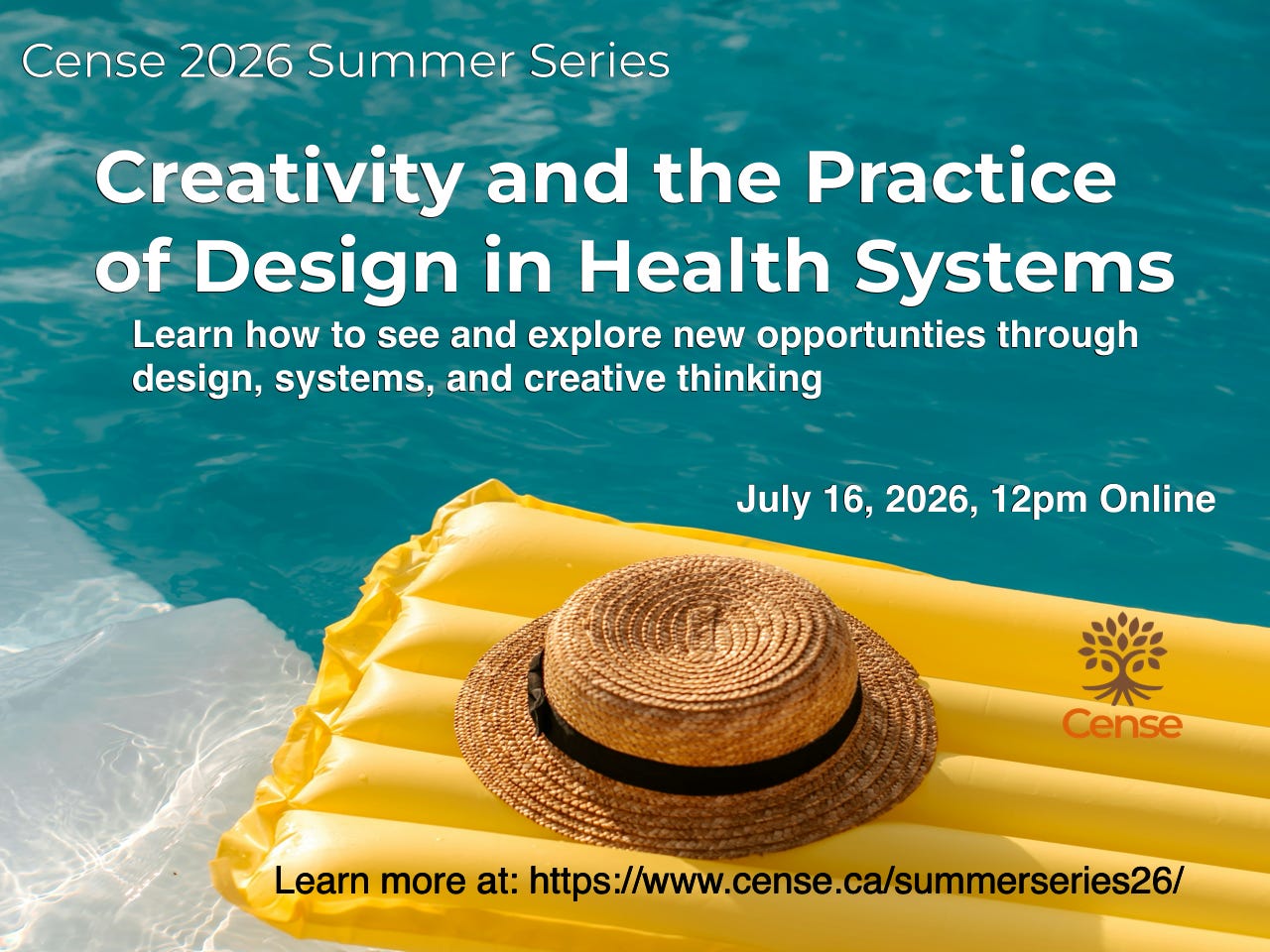
Creativity, it’s practice, and the organizational, institutional and behavioural factors that nurture it will be the focus of the next iteration of the Cense Summer Series, which provides an introduction into the fundamentals of design for health in the age of complexity. See the link for registration and information below.
We’ll be looking at this issue and the way that creativity intersects with design and the what it means for designing for and within the health context in our future issues. So please subscribe to keep learning, and we’ll see you soon.
No posts
Comments
Nothing yet. Say the first thing.
Sign in to join the conversation.