

Hi designers — Welcome to the Design Loft #37. Today, we’re looking at the concept of complexity, and how it’s often misunderstood in how it plays a role in design.
The term complexity is being used more than ever — or at least it seems that way. Dave Snowden, one of complexity practice’s great champions and a prolific author, recently published a polemic on the ways in which the term and the ideas surrounding complexity are misunderstood and mis-represented in discussions, articles, and the overall discourse on systems.
The concept of complexity matters greatly for design in the health context.
Complex phenomena, systems, and situations are what much of health services, policy, promotion, and care deal with on a daily basis. Complexity is all about relationships and the interaction between different agents, working within the constraints of a particular context.
These interactions are what make every day at the clinic a little different from another.
Dave notes the inherent laziness in how we treat something as complex. I agree fully and see this over and again in my work.
It’s complex, so who can say what will work; best not to intervene. It’s complex, so management is basically impossible; don’t hold me accountable for an outcome. It’s all emergent, as if naming a phenomenon settles the matter and no further judgement, decision, or action is required. This is a convenient inversion of what the field actually argues. Complex systems aren’t unknowable, and they aren’t unmanageable: they have propensities and dispositions, tendencies that can be understood, worked with, and shifted, even without a predictive model of the whole. Acknowledging that a system is complex doesn’t mean you can’t act on it; it means you act differently: smaller probes, faster feedback, safe-to-fail experiments, adjusting actants, changing interactions. “It’s complex” is the start of a different kind of discipline, not a permission slip to abandon one. Used as an excuse, it’s just fatalism wearing a lab coat.
One of the simpler ways to understand complexity comes from Dave Gray, who describes it this way in his book The Connected Company:
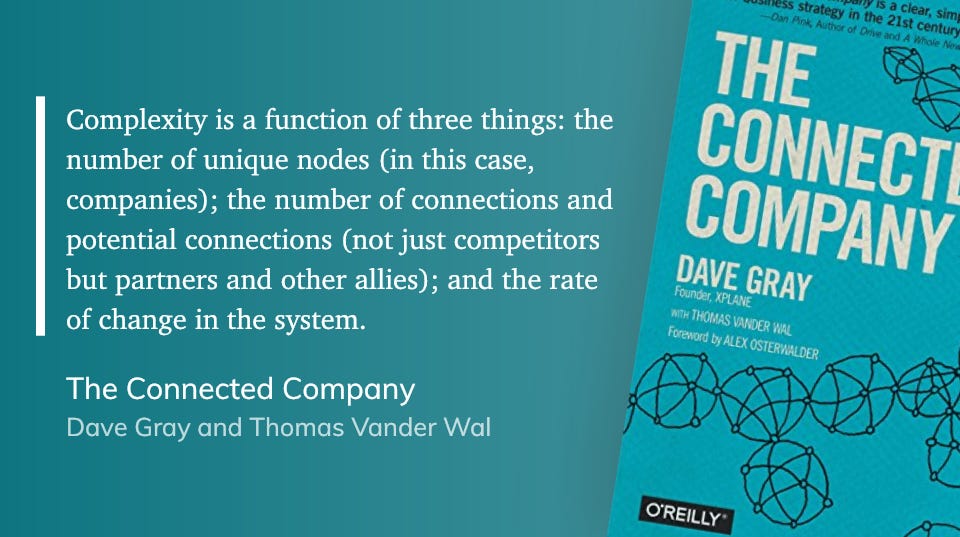
This three things, taken together, describe what makes something complex, it doesn’t provide the fullest description of all of the properties of complexity. But that’s not the point — because we can drown ourselves in technical descriptions and phrases and forget that we design for complexity every day. Our lives are filled with complexity, and seeing it throught the lens of these three qualities is a starting point to be able to understand what it might mean to design for it.
Within this definition using health systems, we might supplant companies for many things: symptoms, conditions, clinical specialties involved in care, care facilities involved, etc.. For connections, we might consider those referral patterns, aligned service groups, or the number of caregivers as examples.
Complexity concerns the many different connections and relationships involved in a system (as it pertains to a purpose, condition, or situation) and how they affect different things at different frequencies, intensities, and overall rates. This is what makes health systems complex.
Just like the knot in the cover image above, we often stare at complexity unsure what all is involved. Like the knot, we might wonder how many strands are there? Is it one rope that’s frayed? Is it many? How are they put together? And what, if anything, can help us to untie or untangle it?
But while there is much in complexity that makes it difficult, it’s not beyond our comprehension, even if it often outside our direct control. We still have influence within complexity, which is what has Dave Snowden so motivated to write on it, because he sees complexity as an excuse not to act, not to design (my term, not his), and to throw our hands up.
In design terms, this means designing for motion. Recognizing that we need methods and approaches that allow us to appreciate complexity as it exists, make sense of it, create with the aim of promoting adaptive capacities, mixed uses, and embedding a process of learning into it. We’ll get more into the specific in a future post (stay tuned).
Underneath the vocabulary problem of complexity sits a set of recurring reasoning errors which show up constantly, often from people who’d tell you they know better. Snowden goes on to point out these errors:
Retrospective coherence is probably the most common. This is the habit of looking back at how something unfolded and narrating it as though it had always been heading there, as though the actors involved could have seen it coming, or as though there was a hidden logic waiting to be discovered. Complex systems don’t work that way. Outcomes emerge from countless local interactions, and the story only looks inevitable after the fact because we’re pattern-matching backwards from a known result.
Premature convergence runs alongside it. This is the rush to lock in an explanation, a strategy, or a solution before the situation has been allowed to reveal enough of itself.
Causality is the third recurring habit, and maybe the most stubborn, because it’s baked into how most management training works. There’s a persistent instinct to find the cause: the root cause, the lever, the intervention that explains the outcome, even in situations that are constituted by dense, entangled interaction effects with no single point of leverage. Complex systems don’t have root causes in the ordered-system sense. They have propensities, dispositions, constraints, and enabling conditions that can be understood and managed, along with effects that loop back onto their own causes. Insisting on a linear causal story in that setting isn’t just imprecise; it actively points people toward interventions that address a symptom mistaken for a source.
Snowden wraps up his polemic with a focus on the many ways in which people “sell” complexity to others, offering designs that aren’t fit for purpose and violate the very things that make something complex:
If you are selling a roadmap, you are not doing complexity work. If you are selling a plan you would stake your reputation on regardless of what the system does next, you are not doing complexity work. Complexity is not a label for what you were already going to do. It is a different kind of discipline, or it is nothing.
What it means is designing for complexity, not ignoring it. That means of addressing it directly and with technique, will be the subject of a future post.
Thanks for reading. For paid subscribers, read on to get into the key errors that Snowden gets into and how to spot them.
For more on complexity, design, and creativity, I encourage you to go back a few issues to read this post from July 8, 2026:
Unrealized Imagination
·
Jul 8

Unless you’re willing to get your hands dirty, your imagination will remain unrealized and uninformed. - Marty Neumeier
A shortlist of the errors that follow from these habits, roughly in order of how often I see them:
1. Treating “complex” and “complicated” as synonyms: using the label of one to justify the method of the other. This is reducing in frequency mind you.
2. Narrating outcomes as inevitable after the fact: (retrospective coherence) and then presenting that narrative as evidence of foresight.
3. Converging on a solution before the system has been probed: skipping straight to a fix because ambiguity is uncomfortable for the client or the consultant.
4. Hunting for root causes: in a system whose behaviour comes from interaction effects, not a linear chain.
5. Front-loading a comprehensive plan: the assumption that enough analysis up front can substitute for iterative, real-time sensing.
6. Mistaking agreement for validity: a workshop full of consensus doesn’t mean the model of the system is correct; it often just means the room was primed to agree.
7. Context-free practice transfer: importing what worked in one context wholesale, on the assumption that success elsewhere implies success here, when context is precisely what complexity theory says you can’t abstract away.
8. Static framework fetishism: plotting a system on a 2x2, a quadrant, or something like Cynefin, once, and treating that placement as fixed. Complex systems shift domain constantly, so the exercise needs to be repeated, not filed away, and flattening a framework like Cynefin into four static boxes loses exactly the boundary dynamics it was built to capture.
9. Confusing complicated tools with complexity method: dashboards, network diagrams, and system maps that describe complicatedness while the actual sales pitch is complexity.
10. Locating emergence in “the whole” rather than in interactions: systems-thinking holism (parts and wholes) standing in for complexity science’s actual claim, which is about the properties of interaction between actants.
11. Ideological misappropriation: treating complexity as a synonym for niceness, openness, and flat consensus, as though self-organisation were a moral stance rather than a description of behaviour, and constraint were the enemy rather than part of the vocabulary. Making complexity into the good aspects of a Manichæian dichotomy, or dichotomies often with a religious overlay.
12. Complexity as an excuse for inaction: “it’s complex, so nothing can be done” or “it’s all emergent,” used to abdicate judgement and accountability rather than to justify a different, more iterative kind of action.
13. Uncredited borrowing: stripping ideas, diagrams, even cartoons, of their origin until the source is lost and the idea gets treated as generic wisdom rather than someone’s specific, hard-won insight.
No posts
Comments
Nothing yet. Say the first thing.
Sign in to join the conversation.