
Have you ever sat across from a therapist and realized the hardest thing to explain was the very thing you came to talk about? That’s exactly what one participant told me about her reason to trust AI, because, coming from a South Asian background, it is hard for her to explain to the therapist why she felt that way and why it mattered to her.
When I was researching for a mental health app design, I heard similar stories over and over. Underneath the hesitation before booking an appointment with a therapist, the reason remained that they want to try something on their own. I talked with 12 people, and almost all of them said that before talking to a human therapist, they would try chatting with AI. The reasons looked different from person to person. The goal was always the same.
Let me back up.
I was designing Bloom and Heal — a mental health app for people who are stressed. Not clinically depressed. Just stretched thin by ordinary life. I drew that line on purpose. The app reads stress through HRV on an Apple Watch, and HRV can catch a spike — but it can’t trace clinical depression. So, I scoped to the users the signal could honestly serve.
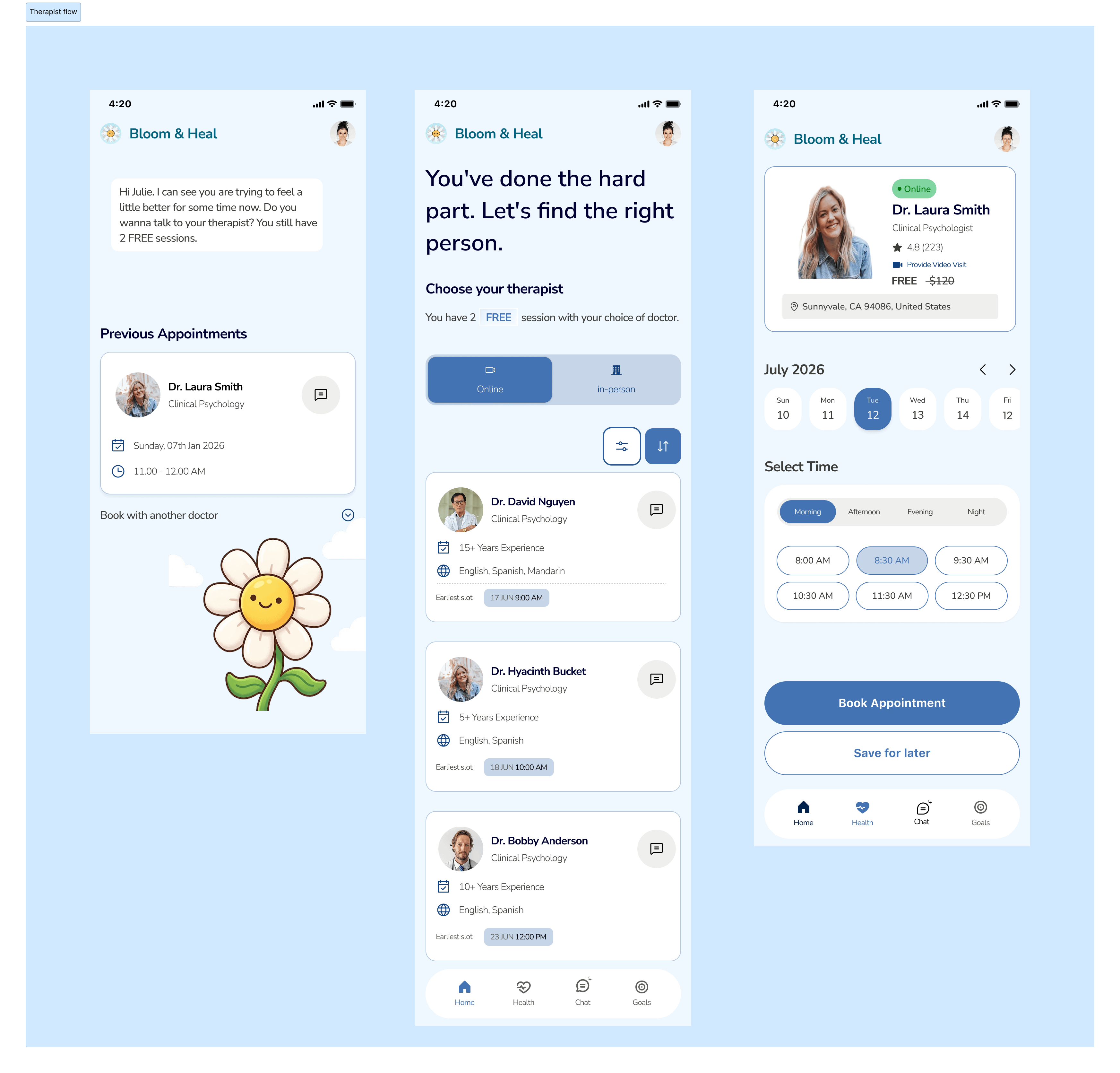
The bet was simple: catch the stress spike the moment it happens and break the spiral before it takes hold. I called it in-the-moment rescue. The plan was straightforward. The moment the watch caught a spike, it would offer three ways to reset — a walk, a friend, a short meditation. Fail all three, and it books you a therapist.
To my surprise, most of the participants with whom I ran my first usability test expressed that they expected to chat with an AI bot before they would talk to a therapist. These users said that they used AI as a thought partner, so they are expecting the same assistance from the app. They find it very natural because talking to an AI is an existing habit for them. Users also mentioned that they already turn to ChatGPT or other AI chatbots when they feel upset, so an in-app AI isn’t a new behavior they have to learn, but it maps onto something they do anyway.
Their own experience had taught them the result is usually good. They’d typed something raw into an AI late at night, lonely or wrung out, and come away lighter.
One user told me she was spiraling before hosting a big group. She opened Gemini, turned on dictation, and just talked it out. By the end, she was calm.
No one designed that moment for her. She made it herself, from a tool that happened to be within reach.
That’s when I realized how important it is for them to have a AI companion inside the app.
The question was never “Should there be AI here?” It was “why are people reaching for it before I’ve offered them anything at all?” The why is the real find, and it changed how I think as a designer: AI is the only option that’s immediate, receptive, and non-judging at once. A receiver who listens instantly and won’t judge, so they can unburden. They might use walking, but they will definitely use AI.
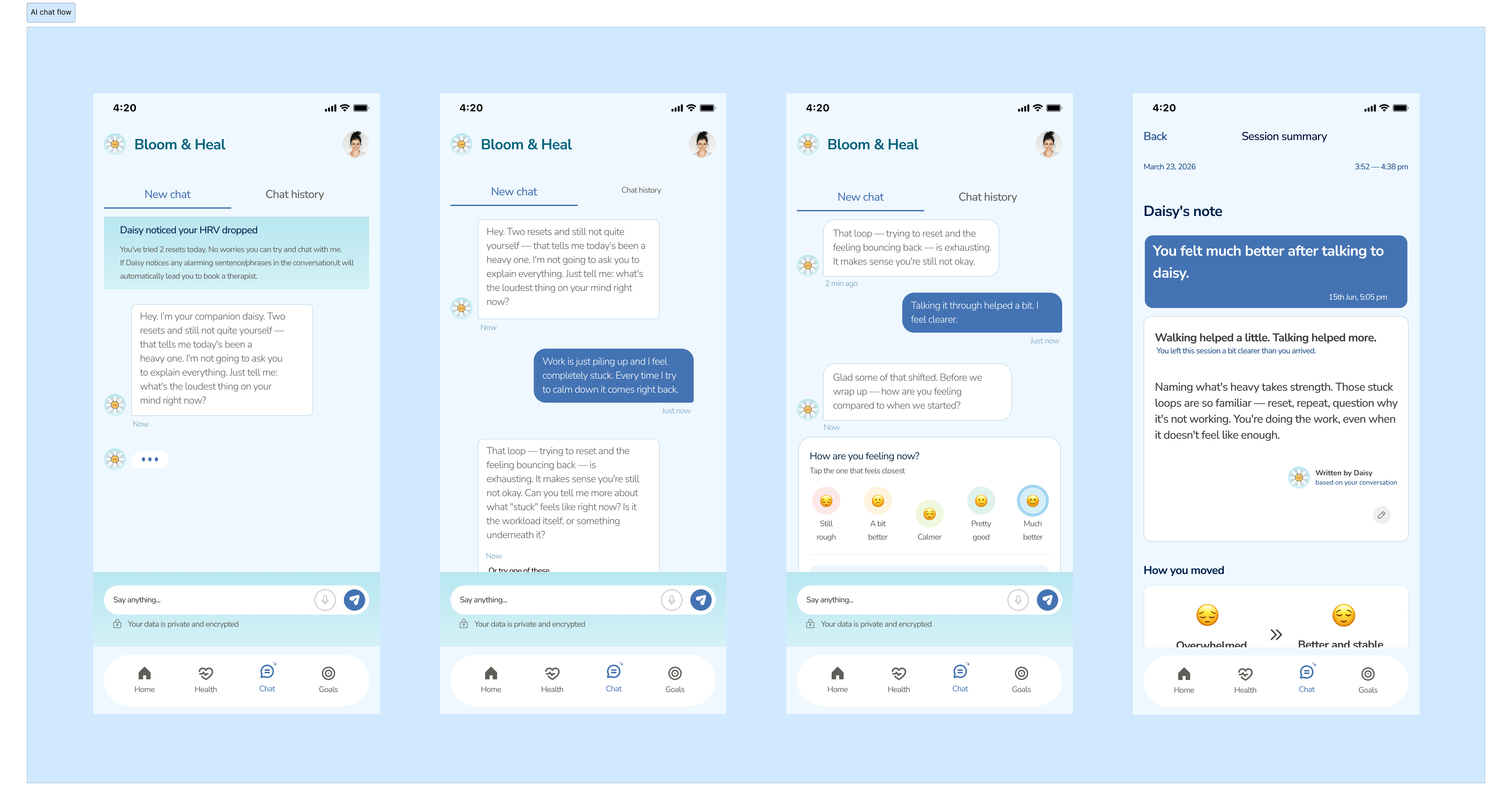
However, after I chose the receiver that never judges, it took me a while to notice that’s the same thing as a receiver that never pushes back. Non-judgment and instant availability were the reasons users reached for it, and it’s also the mechanism that makes an AI agree with you at the exact moment agreement is the last thing you need.
A friend interrupts. A therapist asks the uncomfortable question.
A model trained to be helpful tells you that you’re right, and you feel better, and nothing changes.
The quality that made it trustworthy is the same quality that makes it risky. That’s not a flaw I get to design around. It’s the thing I chose. And I did choose it as a design solution.
HRV catches a spike in about five minutes. Nothing human-shaped is reliably available in five minutes. Not a friend at 11 pm. Not a therapist until Tuesday. The finding from my research wasn’t that users want AI — it was that users want a receiver that is instant, receptive, and non-judging. AI was the only implementation that could be all three inside the window I was designing for.
So I took the tradeoff knowingly. Instant and non-judging, with sycophancy attached. Then I reached for a UI fix. I put a notice at the top of the chat: “Daisy will surface emergency support if the conversation turns toward harm”. It’s a patch. I know it’s a patch.
A banner is a UI answer to a model problem. The real fix is how the thing is trained — what it’s rewarded for, when it’s allowed to disagree, whether “helpful” is defined as agreeable. That’s not on my side of the wall. That’s the uncomfortable part I’m still sitting with. I designed a receiver whose defining virtue I can’t fully control.
So, my work isn’t finished yet. Before I can ship this, I need guardrails — a bot that knows when to stop reflecting feelings back and start redirecting. That flags harmful language. That surfaces an emergency number without hesitation.
Takeaway: As AI trends accelerate and new models keep arriving, AI products are constantly reshaping what users expect — and it’s now our job as designers to understand those shifting expectations and meet them responsibly. But designing intuitive, engaging experiences is only half of it. LLMs bring real risks, like sycophancy, where a model favors agreement over accurate, helpful guidance — a risk that turns serious the moment users lean on AI in sensitive areas like mental health.
So, we, the builders, can’t treat guardrails as someone else’s problem downstream. We have to understand how they work and design them into the experience before our solution touches the users. Responsible AI design isn’t an add-on to our role anymore. It’s the role.
________________________
About the Builder: Lumbini Sharma is a Product Designer based in the SF Bay Area with 3+ years of experience across enterprise B2B, EdTech, and nonprofit platforms. She specializes in translating user insights and business goals into intuitive interfaces, scalable design systems, and accessible experiences. Currently a Designlab student, she works fluently with AI-assisted design workflows (Figma Make, Claude) to move from ideation to prototype faster.
https://www.linkedin.com/in/lumbini-sharma/
Comments
Nothing yet. Say the first thing.
Sign in to join the conversation.