
The Honest Answer First
----------------------------------------
Retatrutide burns more fat. It is not close and it is not debatable. Five positive Phase 3 trials, thousands of participants, and hard body weight endpoints put it in a category MOTS-c has never been tested in. If the only question is total pounds of fat removed, stop reading, the answer is retatrutide.
But which burns more fat is almost never the actual question a researcher is trying to answer. The real question is which compound solves the specific thing that is currently limiting a specific person. Those are different problems, and this is where MOTS-c earns a legitimate place rather than a consolation prize.
----------------------------------------
What Each One Actually Does
----------------------------------------
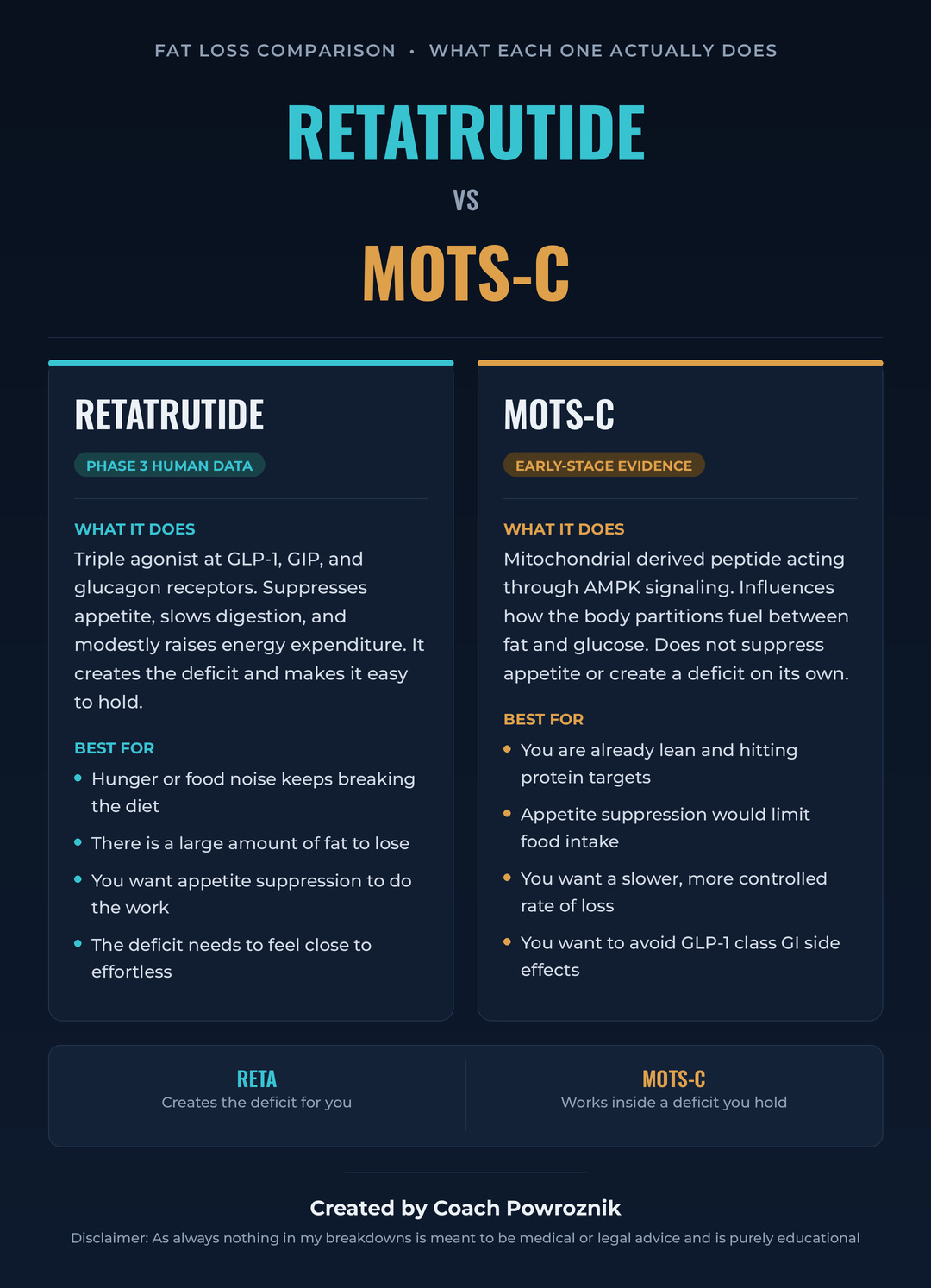
Retatrutide is a triple agonist at GIP, GLP-1, and glucagon receptors. GLP-1 and GIP signaling slow gastric emptying and act centrally to reduce appetite and food reward. The glucagon arm is the differentiator and adds hepatic fat mobilization and a modest increase in energy expenditure. Net effect: intake falls hard, expenditure rises somewhat, and the deficit becomes easy to maintain almost passively.
MOTS-c is a mitochondrial derived peptide encoded in mitochondrial DNA rather than nuclear DNA. It acts primarily through AMPK signaling and influences substrate handling, meaning how readily the body oxidizes fat versus glucose for fuel. It does not meaningfully suppress appetite. It does not create a deficit. It changes what happens inside the deficit you already have.
That distinction is the entire decision tree. One tool creates the deficit. The other tool works on how the body handles a deficit that already exists.
----------------------------------------
The Evidence Gap, Stated Plainly
----------------------------------------
TRIUMPH-1 reported 70.3 lbs (28.3 percent) at 12 mg over 80 weeks, with 45.3 percent of participants reaching at least 30 percent loss. A blinded extension in completers with baseline BMI at or above 35 reached 85.0 lbs (30.3 percent) at 104 weeks. TRIUMPH-4 reported up to 71.2 lbs (28.7 percent) from a baseline near 248.5 lbs. TRIUMPH-3 reported up to 55.8 lbs (22.6 percent) in a cardiovascular disease population. Every one of these trials was run as an adjunct to a reduced calorie diet and increased physical activity.
MOTS-c has nothing remotely comparable. The strongest recent work is a January 2026 University of Copenhagen paper in Free Radical Biology and Medicine showing improved intrinsic mitochondrial bioenergetics, reduced reactive oxygen species emission, and reduced oxidative protein damage in transgenic mice, dependent on PGC-1alpha and AMPK. The human portion of that study measured arteriovenous MOTS-c differences during one legged knee extensor exercise and found no change, suggesting skeletal muscle is not the source of circulating MOTS-c. Good mechanistic work. Not a fat loss trial.
The only human administration data on this pathway is CB4211, a MOTS-c analog. Phase 1b was 20 obese subjects with fatty liver, four weeks, inpatient, standardized diet. ALT, AST, and glucose fell significantly. Body weight showed a trend but did not reach significance. No Phase 2 followed.
So the comparison is Phase 3 registrational data against preclinical mechanism plus one small early human study on an analog. Anyone treating these as equivalent options is not reading the literature accurately.
----------------------------------------
The Decision Tree
----------------------------------------
Step one, before either compound. Confirm a deficit exists using two to three week rolling average body weight. Confirm protein is at 1.6 to 2.2 g/kg. Confirm resistance training load is being maintained. Confirm sleep and daily step count are stable. If any of these are broken, neither compound is the answer, because both are being asked to compensate for a variable that is cheaper and more effective to fix directly.
Step two, identify the limiting factor. This is the branch point, and it has three common answers.
If the limiting factor is intake control, meaning the deficit cannot be sustained because hunger, food noise, or appetite volume keeps overriding it, retatrutide is the correct tool and nothing else in the current pipeline is close. This is the largest group by a wide margin.
If the limiting factor is metabolic flexibility or substrate handling, meaning the deficit is being held consistently but fat mobilization, fasting energy, or glucose handling looks poor, MOTS-c is the more logically matched intervention. The evidence supporting it is mechanistic rather than clinical, and that has to be stated honestly, but it is at least aimed at the right problem.
If the limiting factor is neither, meaning intake is controlled and metabolic markers are clean and progress is still stalled, the answer is usually in tier one and not in pharmacology at all. Underreported intake and collapsed daily movement account for most of this category.
----------------------------------------
Where Mots-c Is Genuinely The Better Choice
----------------------------------------
There is a real population for whom appetite suppression is a liability, not a benefit, and this gets almost no coverage.
The lean researcher already hitting 200 g of protein daily. Aggressive appetite suppression makes that intake physically difficult. If protein falls because food volume becomes intolerable, the retention side of the equation degrades and the compound has traded fat loss for lean tissue loss. This is the single most common reason a lean, trained individual has a worse experience on incretin agonists than an untrained population does.
Anyone whose training quality is the priority. Reduced intake, slowed gastric emptying, and lower carbohydrate availability affect glycogen, training performance, and recovery. If the objective includes maintaining strength and work capacity rather than simply reducing scale weight, aggressive appetite suppression works against the goal.
Anyone who cannot tolerate the side effect profile. Nausea, delayed gastric emptying, and GI disruption are the primary discontinuation drivers across the class. MOTS-c has no comparable profile in the available human safety data.
Anyone who needs a slower rate of loss. Faster loss partitions worse in leaner individuals. A compound that makes the deficit enormous and effortless is not an advantage when the target rate is 0.5 to 1.0 percent of body weight per week.
Anyone with a short intervention window. Retatrutide requires a long dose escalation before reaching effective exposure. A four to eight week block does not fit that timeline.
Cost and access also matter and should not be pretended away. There is a large difference in expense and availability between the two, and for many researchers that determines the decision before physiology does.
----------------------------------------
What To Track To Decide
----------------------------------------
Rolling average body weight over two to three weeks separates a real plateau from normal fluctuation. Waist measurement and consistent photos separate fat loss from scale weight change. A strength log is the retention signal, because losing more than roughly 5 to 10 percent on consistent volume points to a tier one problem regardless of what compound is running.
On bloodwork, fasting glucose, fasting insulin, HbA1c, and a lipid panel give the metabolic flexibility picture. Elevated fasting insulin with poor fasting energy and heavy post meal fatigue points toward the substrate handling branch. Clean metabolic markers with consistently blown intake points toward the appetite branch.
The observational tell is simpler than any lab value. If someone knows exactly what to do and cannot stop eating, that is an appetite problem. If someone executes the plan perfectly and the body composition response is disproportionately poor, that is a partitioning or substrate problem.
----------------------------------------
Common Mistakes
----------------------------------------
Choosing based on headline efficacy rather than personal limiting factor. The largest published weight loss figures came from a population with an average baseline weight near 248 lbs. It does not transfer to a lean researcher, and expecting it to produces disappointment with a compound that performed exactly as designed.
Assuming mechanism equals outcome. MOTS-c improving mitochondrial bioenergetics in mice is a real finding and does not establish a human body composition effect.
Running both because the mechanisms differ. No human study has tested this combination. Non overlapping mechanisms make it a reasonable research question, not a demonstrated result.
Letting appetite suppression compromise protein intake. This is the fastest way to convert an excellent fat loss compound into a mediocre body composition outcome.
Reaching for either one before confirming the deficit, the protein target, and the training stimulus are actually in place.
----------------------------------------
Practical Summary
----------------------------------------
Retatrutide is the most effective fat loss compound in the current pipeline and the data supporting it is not overstated. If the problem is that the deficit will not hold, it is the correct answer and MOTS-c is not a substitute for it.
MOTS-c is not a smaller version of retatrutide. It is a tool for a different problem, aimed at how the body handles fuel rather than how much fuel goes in. Its evidence base is early and should be described that way. But for the researcher who is already disciplined, already lean, already hitting protein, and specifically does not want appetite suppression sitting on top of an intake they have deliberately structured, it is aimed at the right target while retatrutide would be solving a problem they do not have.
Pick the tool that matches the constraint, not the tool with the biggest headline number.
Disclaimer: As always nothing in my breakdowns is meant to be medical or legal advice and is purely educational
No posts
Comments
Nothing yet. Say the first thing.
Sign in to join the conversation.