
There are three different tests that can show up on a COA under the umbrella of “microbial testing,” and they each work differently, tell you different things, and have different tradeoffs. I’ll be honest, I only learned the full context on all three of these tests recently. We’re always learning something new in the research space, and we push the standards forward. My goal here isn’t to tell you which one is “right,” it’s to give you the actual information so you can look at a COA and understand exactly what you’re looking at.
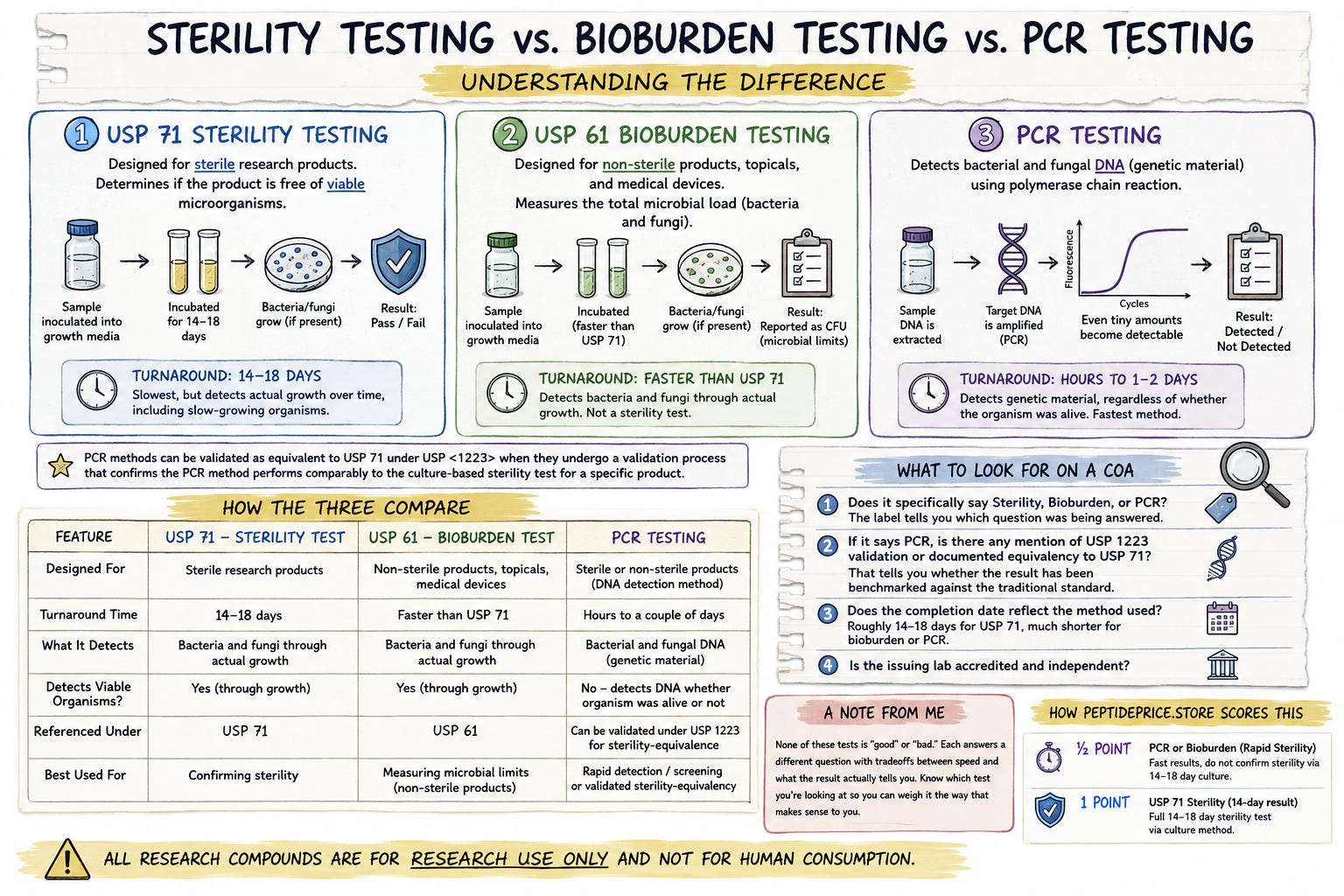
USP 71 is the compendial standard for testing whether a sterile research product is free of viable microorganisms. It requires 14–18 days to complete. That timeline exists because the test has to incubate long enough for slow-growing organisms to actually show up, so the result reflects a genuine attempt to let anything present reveal itself over time.
The tradeoff is time. It’s the slowest of the three methods by a wide margin.
USP 61 is a microbial limits test built for non-sterile products, think medical devices, topicals, and products meant for external use. It identifies bacteria and fungi through actual growth, and it comes back faster than USP 71.
It’s a different tool built for a different purpose: products that don’t need to be sterile in the first place. It wasn’t designed as a sterility test, so it’s worth knowing which one you’re looking at on a COA.
This is the one I want to add into the conversation, because it’s showing up more and more on COAs.
PCR (polymerase chain reaction) testing works completely differently from USP 71 and USP 61. Instead of growing a sample in media and watching for visible colonies over days or weeks, PCR looks for genetic material, actual DNA fragments from bacteria or fungi, and amplifies it so even a tiny amount becomes detectable. That’s why it can return results in hours to a day or two instead of weeks.
The speed is real, and it’s a legitimate, widely used tool in the pharmaceutical world. The tradeoff to understand: PCR detects DNA, not whether the organism was actually alive. It can pick up genetic material from bacteria or fungi that are already dead, meaning a “detected” result doesn’t automatically mean active contamination, and a “not detected” result doesn’t automatically mean the same thing as a USP 71 pass.
Because of that, PCR-based methods are formally recognized as equivalent to USP 71 when they go through a validation process laid out under USP <1223>, which confirms that a specific PCR method performs comparably to the culture-based method for a specific product. That’s useful context to have when you see a PCR result on a COA, it tells you whether that particular result has been benchmarked against the traditional method or not.
USP 71 — Sterility Test
Designed for sterile research products
14–18 day turnaround
Detects bacteria and fungi through actual growth over time
Referenced under USP 71
USP 61 — Bioburden / Microbial Limits Test
Designed for non-sterile products, topicals, and medical devices
Faster turnaround than USP 71
Detects bacteria and fungi through actual growth
Referenced under USP 61
PCR Testing — Genetic Detection Method
Detects bacterial and fungal DNA
Fastest turnaround of the three, hours to a couple of days
Detects genetic material regardless of whether the organism was alive
Can be validated for sterility-equivalence under USP 1223
Each one answers a slightly different question, and each has a real tradeoff between speed and what the result actually tells you. None of them is automatically the “wrong” choice, it depends on what the product is, and what the COA is actually claiming.
When you’re reviewing a COA, it helps to just know what you’re reading:
Does it specifically say Sterility, Bioburden, or PCR? The label tells you which question was being answered.
If it says PCR, is there any mention of USP 1223 validation or documented equivalency to USP 71? That tells you whether the result has been benchmarked against the traditional standard.
Does the completion date reflect the method used, roughly 14–18 days for USP 71, and a much shorter window for bioburden or PCR?
Is the issuing lab accredited and independent?
None of this is about one test being “good” and another being “bad.” It’s about knowing which test you’re looking at so you can weigh it the way that makes sense to you.
We learn more about this space every day. That’s exactly why posts like this matter, the more the RUO community understands what’s actually on a COA, the better equipped everyone is to make their own informed calls.
That’s also why PeptidePrice.store scores this the way it does: PCR and bioburden are grouped together under rapid sterility and count for a half point, while a full 14-day USP 71 sterility result counts for a full point, so you can see the distinction reflected in a vendor’s score.
All research compounds are for research use only and not for human consumption.
No posts
Comments
Nothing yet. Say the first thing.
Sign in to join the conversation.