
Cycling advice gets copy-pasted across every peptide without anyone checking whether the reasoning fits the compound.
KPV is a good place to test that. We understand how it works better than most research peptides. And when you look at how it actually works, the usual reason for cycling may not apply at all.
This piece focuses on the systemic side, meaning whole-body inflammation rather than one patch of skin. That is where most of the interesting research lives and where most of the cycling questions come from. Skin gets its own section near the end.
Every study is broken down below in plain English.
This post is for research and educational purposes only. It is a review of published literature, nothing more.
Nothing here is medical advice. Nothing here is a protocol, a recommendation, or a suggestion that anyone use anything. I am not a physician and this is not a substitute for one.
Every study cited below was conducted in cell cultures or animal models. There is not a single published human study on KPV, which I cover in detail further down.
If you are dealing with an inflammatory condition, that is a conversation for a qualified physician who can evaluate your actual situation, run appropriate labs, and account for your medications and history. Please do that instead of reading a newsletter and drawing conclusions.
Research use only. Not for human consumption.
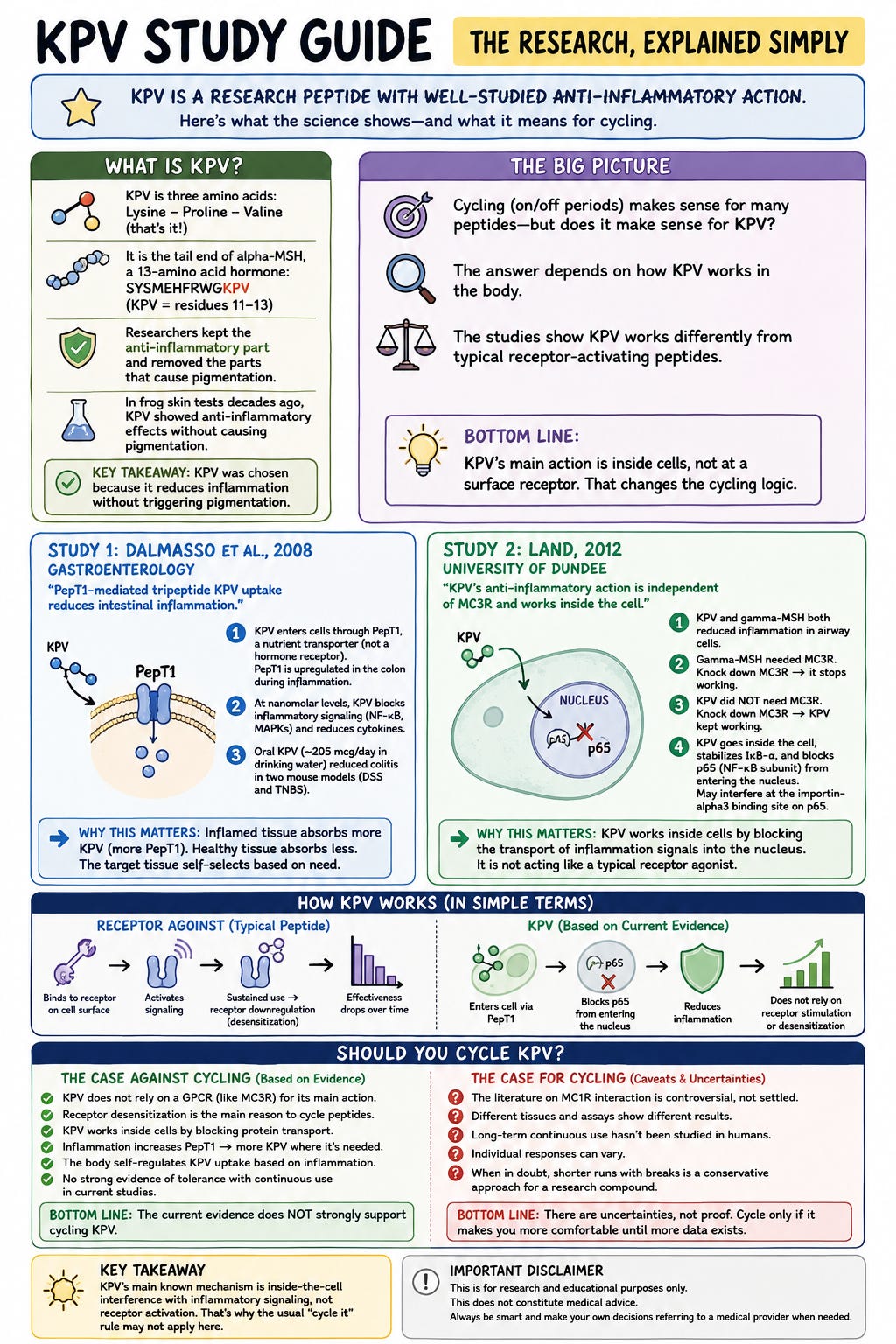
KPV is three amino acids: lysine, proline, valine. It is the tail end of a hormone called alpha-MSH.
Alpha-MSH is one of the body’s own anti-inflammatory hormones. It also darkens skin and breaks down fast. Researchers snipped off the last three amino acids to see if they could keep the anti-inflammatory part and lose the rest. It worked. That fragment is KPV.
Most peptides get cycled because of receptor burnout. You hit a receptor over and over, the cell gets tired of hearing it, and turns the volume down. That is real, and for some compounds cycling makes sense.
KPV does not appear to work that way at all.
Two things, both simple.
First: Inflammation runs through a master switch inside your cells called NF-kB. When something goes wrong, that switch flips on and activates hundreds of inflammatory genes. KPV interferes with that switch.
Second: KPV gets into cells through a doorway called PepT1. This is a nutrient transporter, the same one your gut uses to absorb small protein fragments from food. It is not a hormone receptor.
Here is the part people miss, and it is the key to the systemic conversation:
PepT1 doorways are not just in your gut. Your immune cells have them too. T cells and macrophages both build them, and they build more of them when they are activated.
So a compound that rides in on PepT1 can reach immune cells traveling anywhere in the body, not just the gut lining. That is the bridge from “gut peptide” to “systemic anti-inflammatory.”
The landmark study. If you read one, read this.
What they did: Tested KPV in gut cells and in human T cells in a dish, then in mice with induced colitis.
What they found:
KPV enters cells through the PepT1 doorway
In human T cells hit with TNF-alpha, a tiny dose of KPV (10 nanomolar) blocked the inflammatory cascade before it could get going
Same result in gut cells
Mice drinking KPV in their water had significantly less gut inflammation
Two details matter more than the headline.
One, a healthy colon barely has any PepT1 doorways. An inflamed colon builds a lot of them. Inflamed tissue absorbs more KPV, healthy tissue absorbs less. The compound sorts itself toward the problem automatically.
Two, they checked whether KPV was raising cAMP in the T cells, which is what a melanocortin receptor would do. Alpha-MSH raised it. KPV did not. Same anti-inflammatory outcome, completely different route.
The most directly systemic study on the list, and almost nobody talks about it.
What they did: Gave mice a systemic injection of KPV, then triggered inflammation inside the abdominal cavity. Counted how many immune cells piled into the inflamed area. They ran several related compounds side by side and used a receptor blocker to test whether receptors were involved.
What they found:
Systemically injected KPV significantly reduced immune cell accumulation at the inflamed site
A drug that blocks melanocortin receptors did not stop KPV from working
A compound that selectively activates the MC1 receptor did not reproduce KPV’s effect
KPV did not raise cAMP in macrophages, and unlike alpha-MSH, it did not shut down macrophage cytokine output
This matters two ways.
First, systemic administration with a systemic result. KPV went into the body generally and reduced inflammatory traffic at a distant site.
Second, that last bullet is an important nuance and I am not going to bury it. KPV is not a blanket immune shutdown. Alpha-MSH suppressed macrophage activation. KPV did not. What KPV appears to do is reduce how many inflammatory cells show up at the site.
That is a narrower action than a steroid. Narrower is arguably better for prolonged exposure, but it also means a lower ceiling.
The study that answers the cycling question cleanly.
What they did: Took human airway cells (lung, not gut, not skin) and provoked inflammation. Compared KPV against gamma-MSH, which works through a receptor called MC3R. Then deleted that receptor and ran it again.
What they found:
Both compounds calmed inflammation
With the receptor deleted, gamma-MSH stopped working completely
With the receptor deleted, KPV worked exactly the same
So what is KPV doing instead? It walks into the cell and physically blocks the messenger that carries the inflammation signal into the cell’s control center. It gets in the way. It does not ring a doorbell.
Why this matters: You cycle a compound to let a receptor recover. If the compound is not leaning on a receptor, there is nothing to recover.
Honest caveat: whether KPV touches a melanocortin receptor at all is still described in the literature as debated. Three separate studies now point the same direction, but it is not formally closed.
What they did: Mice with a controlled head injury got one single injection into the abdominal cavity, 1 mg/kg, thirty minutes after the injury. Controls got saline.
What they found:
Noticeably smaller injury area compared to saline
Lower TNF-alpha and IL-1beta in brain tissue
Fewer activated immune cells in the brain
Why this matters: This is the strongest proof that systemically administered KPV produces effects in tissue far from the injection site, including behind the blood-brain barrier. One dose, measurable structural outcome.
It also shows not every research model is a long protocol. Sometimes it is a single hit at the right moment.
Our longest continuous-exposure data point.
What they did: Ran mice through a roughly two-month protocol combining a tumor-causing compound with repeated rounds of gut inflammation. Some mice were bred with extra PepT1 doorways, some with none at all. KPV was given continuously throughout.
What they found:
More PepT1 doorways meant more tumors and more inflammation
No PepT1 doorways meant fewer tumors and less inflammation
Human colon cancer samples also showed elevated PepT1
KPV given continuously across the whole protocol reduced tumor count and size
In mice with no PepT1 doorways, KPV did nothing at all
This matters two ways.
One, KPV ran continuously for about two months and was still working at the end. No fade. That is the single best piece of evidence against “it stops working.”
Two, doing nothing without the doorway confirms the mechanism cleanly. No transporter, no effect.
The one that pushes back on the biggest safety concern with systemic exposure.
What they did: Tested KPV against staph bacteria and candida yeast.
What they found:
KPV killed both, even at extremely low concentrations
It did not weaken white blood cells’ ability to kill germs. It made them slightly better at it
Why this matters: The standard fear with any systemic anti-inflammatory is that you blunt host defense. That is a real problem with steroids and NSAIDs and a legitimate reason to build in breaks.
Combine this with the peritonitis finding that KPV did not suppress macrophage output, and the picture is a compound that reduces inflammatory traffic without turning off the defenses.
Caveat: in a dish, and partly on the parent hormone. Do not overread it.
A huge chunk of KPV research is not about biology at all. It is about getting the molecule to arrive intact. This is probably the most under-appreciated thing in the entire KPV conversation.
Skin, 2017. Researchers measured how much KPV actually crosses human skin. Applied to intact skin, penetration was below the limit of detection. Not low. Undetectable. Microneedling finally got it through. Adding an electrical current pushed it 8 times higher. Both together, 35 times higher.
KPV loves water and hates fat, and skin is a fat barrier. A plain topical preparation on unbroken skin is not getting through. So when a claim circulates that a topical faded after a few weeks, tolerance is not the leading explanation.
Skin cells, 2025. When KPV is actually delivered to skin cells in a dish, it works. Cells exposed to fine particulate air pollution recovered survival, inflammatory markers came back toward normal, and cell-death machinery was reduced. Same NF-kB mechanism as everywhere else. The biology is fine. The delivery is the problem.
Gut, 2017. Researchers packed KPV into targeted delivery particles and got it directly to inflamed gut cells and immune cells. Inflammation dropped and the gut lining healed faster than with plain KPV.
The takeaway across all three: a lot of what gets read as “it stopped working” may actually be “it never got there.”
I am not going to oversell this.
The deepest in vivo evidence is gut evidence. The systemic in vivo evidence is thinner: one peritonitis model and one brain injury model, both short-duration.
PepT1 is primarily a gut transporter. It is on immune cells too, which is the mechanistic bridge, but nobody has mapped what happens to KPV systemically in a living body over weeks. There is no distribution data. No half-life data worth citing in humans.
And KPV is three amino acids, which means enzymes chew it up fast. That is exactly why the entire delivery research field exists.
So the systemic case is mechanistically coherent and supported by two animal studies. It is not proven at depth. Anyone telling you otherwise is filling a gap with confidence.
There is none.
ClinicalTrials.gov returns zero registered KPV studies in any indication. When the FDA reviewed KPV, they stated they found no published study where KPV was given to a human, in any form.
No human dosing data. No human safety follow-up. No human anything.
That is not a knock on the research. Repeated animal results are how a compound earns a human trial. But it is a hard ceiling on every claim, including claims about cycling.
It is also worth saying plainly: an absence of human data is not the same thing as a clean safety record. It means nobody has looked. Anyone weighing this in a real-world context should be doing that with a physician, not with a forum consensus.
No long-term safety data at the durations discussed in most online protocols. The longest continuous animal exposure on record is about two months, oral, in a gut model. That is the entire ceiling.
NF-kB is not a villain. It is how you fight infection and clear damaged cells. Dampening something that fundamental body-wide for months deserves caution even without a documented problem.
Interruption has diagnostic value. Continuous administration with no washout makes it impossible to separate a real effect from the natural course of the condition being studied. Washout periods are how researchers isolate a signal.
Inflammation is often the correct response. Quieting it indefinitely can hide a problem that needs identifying instead of silencing.
The mechanism self-limits anyway. As inflammation resolves, PepT1 doorways disappear and less KPV gets absorbed. Mechanically, it becomes less relevant as it succeeds.
Indefinite administration muddies interpretation. The longer a single variable runs uninterrupted, the harder it becomes to attribute any observed change to it.
The main reason to cycle does not apply. Receptor burnout requires a receptor being pounded. Land deleted the receptor and KPV kept working. The peritonitis study blocked the receptors and KPV kept working. Dalmasso checked for the receptor signal in immune cells and did not find it. Three studies, same answer.
Nobody has ever reported it fading. Not in cell studies, not in two colitis models, not across a two-month protocol, not in airway cells, not in immune cells. Nowhere in the literature.
Nothing builds up. Three amino acids, degraded fast. There is no reservoir sitting in tissue that a two-week break flushes out.
The immune suppression worry has evidence against it. White blood cells kept working. Macrophage output was not suppressed. KPV killed bacteria on its own.
It self-limits. More uptake in activated immune cells and inflamed tissue, less everywhere else.
Wrong comparison. People apply muscle-building cycling logic to an anti-inflammatory. Nobody cycles a chronic anti-inflammatory drug for receptor recovery. If the underlying driver is chronic, this category looks more like maintenance than like a stimulus needing a recovery window.
No study, in any species, has ever compared running KPV continuously against cycling it. Zero.
Every protocol you have seen online (4 on 2 off, 8 on 4 off, 12 on 4 off) is a convention that got repeated until it sounded like data. Most sites publishing those numbers admit it if you scroll far enough.
What the evidence actually supports:
The argument for cycling KPV to restore receptor sensitivity is weak. Three separate studies show the effect survives with melanocortin receptors deleted or blocked, and no fade has been reported anywhere.
The best reason to stop KPV is not receptor recovery. It is that the inflammation being targeted has resolved, or that a clean break is needed to figure out whether it was doing anything at all.
And the biggest confounder behind claims that it stopped working is delivery, not biology. Topical on intact skin does not penetrate. Oral without a carrier gets degraded. Compound purity varies widely between sources. Before concluding a receptor adapted, the first thing to rule out is whether the molecule ever arrived.
Three things worth flagging:
Route changes everything. The deepest evidence is gut-specific and oral. The systemic evidence is real but thin. Stretching either one too far is a leap.
Purity is not optional. All of this assumes what is in the vial is actually KPV at the stated amount. Third-party testing is the only way to know.
An endpoint beats a calendar. “Until it resolves” carries more information than “eight weeks because someone said so.”
If I got a study wrong, say so and show me. I would rather fix the piece than defend it.
This post is provided for research and educational purposes only. It summarizes published preclinical literature and is not medical advice, diagnosis, or treatment guidance.
KPV is not an FDA-approved drug. It has never been studied in humans in any published trial. Nothing here should be interpreted as a recommendation to obtain, administer, or use KPV in any form.
Anyone with an inflammatory condition, an autoimmune condition, or any health concern should consult a qualified physician. That is especially true for anyone taking prescription medication, managing a diagnosed condition, immunocompromised, pregnant, or nursing, since an anti-inflammatory compound can interact with existing treatment in ways a research summary cannot anticipate.
Research use only. Not for human consumption.
Dalmasso G, et al. PepT1-mediated tripeptide KPV uptake reduces intestinal inflammation. Gastroenterology. 2008;134:166-178. PMID 18061177.
Dissection of the anti-inflammatory effect of the core and C-terminal (KPV) alpha-melanocyte-stimulating hormone peptides. 2003. PMID 12750433.
Land SC. Inhibition of cellular and systemic inflammation cues in human bronchial epithelial cells by melanocortin-related peptides. Int J Physiol Pathophysiol Pharmacol. 2012;4(2):59-73.
Schaible EV, et al. Single administration of tripeptide alpha-MSH(11-13) attenuates brain damage by reduced inflammation and apoptosis after experimental traumatic brain injury in mice. PLoS One. 2013;8(8):e71056.
Viennois E, et al. Critical role of PepT1 in promoting colitis-associated cancer and therapeutic benefits of the anti-inflammatory PepT1-mediated tripeptide KPV in a murine model. Cell Mol Gastroenterol Hepatol. 2016.
Cutuli M, et al. Antimicrobial effects of alpha-MSH peptides. J Leukoc Biol. 2000. PMID 10670585.
Xiao B, et al. Orally targeted delivery of tripeptide KPV via hyaluronic acid-functionalized nanoparticles efficiently alleviates ulcerative colitis. Mol Ther. 2017;25(7):1628-1640.
Transdermal iontophoretic delivery of lysine-proline-valine (KPV) peptide across microporated human skin. J Pharm Sci. 2017.
Lysine-Proline-Valine peptide mitigates fine dust-induced keratinocyte apoptosis and inflammation. 2025.
Brzoska T, et al. Alpha-melanocyte-stimulating hormone and related tripeptides. Endocr Rev. 2008;29:581-602.
No posts
Comments
Nothing yet. Say the first thing.
Sign in to join the conversation.