
Where This Claim Comes From
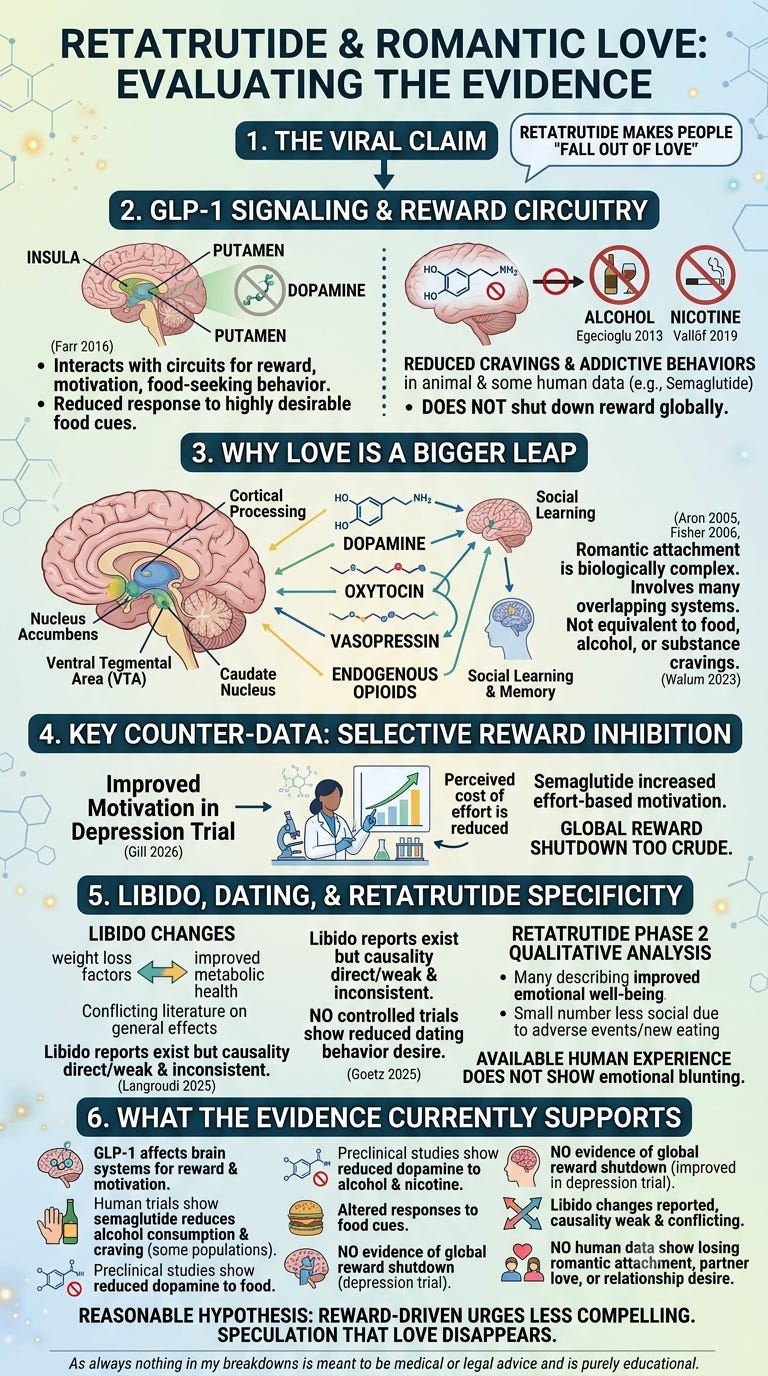
There is a real biological idea underneath the viral claim, but the jump from “GLP-1 signaling changes reward processing” to “retatrutide makes people fall out of love” goes much further than the human evidence. Retatrutide activates GLP-1, GIP, and glucagon receptors. Of those three pathways, GLP-1 has the clearest connection to appetite, motivation, and reward circuitry, so most of the argument being made about R3TA is being extrapolated from GLP-1 receptor agonist research rather than studies that measured romantic attachment during retatrutide treatment.
————————
The retatrutide phase 2 obesity trial was designed around body weight and metabolic outcomes, not romantic relationships, sexual attraction, attachment, or dating behavior. The trial produced very large weight reductions, but there was no signal in the published safety data showing that retatrutide was causing broad emotional shutdown. One case categorized as major depressive disorder or suicidal ideation occurred in the placebo group and none occurred in the retatrutide groups. That does not prove retatrutide has zero effect on emotion, because the study was not designed to answer that question, but it is very different from having evidence that the compound removes feelings of love.
Jastreboff et al., New England Journal of Medicine, 2023.
PMID: 37366315
————————
What GLP-1 Signaling Does To Reward
GLP-1 signaling reaches farther than hunger. Human brain studies and a much larger preclinical literature show that GLP-1 receptors interact with neural circuits involved in reward, motivation, and food-seeking behavior. In a randomized human study using liraglutide, researchers found changes in brain responses to highly desirable food cues, including reduced activity in regions such as the insula and putamen during short-term treatment. Those regions participate in reward valuation and motivated behavior.
Farr et al., Diabetologia, 2016.
PMID: 26831302
Another human fMRI study using exenatide found that GLP-1 receptor activation changed both anticipation and receipt of palatable food. Activation related to anticipating chocolate milk decreased while responses to receiving it changed in the opposite direction. This matters because GLP-1 pharmacology does not appear to function as a general switch that turns the entire reward system down. Different parts of reward processing can move differently depending on whether researchers are measuring anticipation, consumption, food, drugs, or another type of reward.
Animal studies add mechanistic evidence. GLP-1 receptor activation in areas including the nucleus accumbens and other reward-related regions can reduce alcohol-induced dopamine release and decrease alcohol-seeking behavior. Similar findings have been reported with nicotine. These experiments are one reason researchers began testing GLP-1 receptor agonists for substance use disorders in humans.
Egecioglu et al., PLoS One, 2013.
PMID: 24204788
Vallöf et al., Psychoneuroendocrinology, 2019.
PMID: 30772374
————————
The Addiction Data Is Becoming Real Human Data
The idea that GLP-1 receptor agonists can reduce cravings outside food is no longer based only on rodent work or social media anecdotes. A randomized phase 2 study published in 2025 tested once-weekly semaglutide in 48 adults with alcohol use disorder. Semaglutide reduced alcohol consumed during a laboratory self-administration test, reduced drinks per drinking day, lowered weekly alcohol craving, and predicted greater reductions in heavy drinking over time. In the subgroup who smoked cigarettes, cigarette consumption also decreased.
Hendershot et al., JAMA Psychiatry, 2025.
PMID: 39937469
The evidence grew stronger in 2026. A 26-week randomized trial enrolled 108 treatment-seeking adults with alcohol use disorder and obesity. Heavy drinking days decreased by 41.1 percentage points from baseline with semaglutide compared with 26.4 percentage points with placebo. Another randomized trial of oral semaglutide found reductions in heavy drinking days, drinks per drinking day, naturalistic alcohol craving, and cannabis-use days, although its primary laboratory craving endpoint was not significantly different.
PMID: 42070571
Schacht et al., American Journal of Psychiatry, 2026.
PMID: 42522065
This supports part of what the screenshots are saying. GLP-1 receptor agonism can influence reward-driven behaviors extending beyond food. It does not establish that every rewarding experience becomes weaker.
————————
Why Love Is A Much Bigger Leap
Romantic attachment involves reward signaling, but dopamine is only one part of the biology. Human imaging studies show activity in dopamine-rich regions such as the ventral tegmental area and caudate when people view someone they are intensely in love with. Later attachment and long-term bonding involve overlapping systems that include dopamine, oxytocin, vasopressin, endogenous opioid signaling, memory, social learning, and cortical processing.
Aron et al., Journal of Neurophysiology, 2005.
PMID: 15928068
Fisher et al., Philosophical Transactions of the Royal Society B, 2006.
PMID: 17118931
Walum and Young, Current Opinion in Neurobiology, 2023.
PMID: 37372130
That creates a major problem with the theory that reducing GLP-1-related reward automatically reduces love. GLP-1 drugs can change the motivational value of alcohol without erasing motivation generally. They can reduce food cue responses without making every enjoyable activity emotionally flat. Romantic attraction shares some neural territory with other rewards, but it is not biologically equivalent to a cigarette craving or wanting a piece of cake.
The strongest direct evidence against the idea of universal reward suppression came out recently. In a 2026 randomized trial involving 72 people with major depressive disorder, semaglutide did not reduce willingness to work for rewards. Participants receiving semaglutide showed increased willingness to exert physical effort when the expected reward was higher, and modeling suggested that semaglutide reduced the perceived cost of effort.
Gill et al., JAMA Psychiatry, 2026.
PMID: 42054055
A drug producing a global dopamine shutdown should move motivation in the opposite direction. That study does not tell us what happens to romantic love, but it shows why “GLP-1 equals less dopamine equals less motivation for everything” is too crude.
What About Sex Drive And Dating?
This is where the argument becomes more plausible, but the data is messy. Sexual desire can change during large weight loss for many reasons. Energy intake can fall substantially, body composition changes, hormones can shift, gastrointestinal adverse effects can reduce interest in sex temporarily, and psychological changes associated with weight loss can move libido in either direction.
A 2025 analysis of the FDA Adverse Event Reporting System identified reports of erectile dysfunction, orgasmic dysfunction, and reduced libido among men using GLP-1 receptor agonists. There were 182 cases in the analysis, but the overall reporting signal was weak, and the authors did not establish causality. FAERS data also cannot determine how common an event is because there is no reliable untreated denominator and reporting is voluntary.
Langroudi et al., International Journal of Impotence Research, 2025.
PMID: 4024053
The sexual-health literature is also conflicting because weight loss and improved metabolic health can improve erectile function in some populations. That means “GLP-1s destroy libido” is not supported as a general statement. A specific researcher experiencing reduced appetite, lower calorie intake, fatigue, nausea, or major changes in energy availability could notice a temporary drop in sexual interest without that being evidence that their ability to form attachment has changed.
Dating behavior has even less evidence. I could not find controlled human trials showing that semaglutide, tirzepatide, or retatrutide reduces the desire to form romantic relationships. Anecdotal reports about people becoming less interested in dating are interesting enough to generate a research question, but they are not evidence of a pharmacological relationship effect.
————————
Retatrutide Specifically
There is even less reason to speak confidently about retatrutide than semaglutide because direct human research on retatrutide and reward behavior is sparse. Retatrutide is a triple agonist, so researchers cannot assume every CNS observation from a pure GLP-1 receptor agonist transfers unchanged. Its GIP and glucagon receptor activity may alter the overall physiological response.
One useful piece of evidence came from follow-up interviews with participants from the retatrutide phase 2 program. Among 36 retatrutide-treated participants included in the qualitative analysis, many described positive changes in emotional well-being, confidence, energy, and social activities. A small number reported participating less in social activities because of adverse effects or new eating habits. The study was sponsored by Eli Lilly and was not designed to investigate romantic attachment, so it should not be treated as proof that retatrutide improves relationships. It does show that the available human experience does not resemble a clear pattern of widespread emotional blunting.
Goetz et al., Obesity Pillars, 2025.
PMID: 41216380
————————
What The Evidence Supports
The research currently supports a narrower interpretation than the viral post.
GLP-1 signaling affects brain systems involved in reward and motivation.
Human trials now show that semaglutide can reduce alcohol consumption and craving in some populations.
Preclinical studies show reduced dopamine responses to alcohol and nicotine after GLP-1 receptor activation.
Human imaging shows altered responses to highly desirable food cues.
GLP-1 receptor agonists do not appear to shut down reward and motivation globally. A 2026 randomized trial found improved effort-based motivation with semaglutide in people with depression.
Decreased libido has been reported, but evidence for a direct causal GLP-1 effect remains weak and inconsistent.
There are currently no controlled human data showing that retatrutide causes people to lose romantic attachment, stop loving a partner, or lose the desire to form relationships.
The reasonable hypothesis is that certain highly reward-driven urges can become less compelling in some researchers. Extending that into the claim that love itself disappears requires evidence that does not exist yet.
————————
The Simple Explanation
Retatrutide and other GLP-1-related drugs can influence reward processing, and human studies now show that this can extend beyond food into alcohol craving and some addictive behaviors. That does not mean the brain’s entire reward system gets turned down. Romantic love involves dopamine, but it also depends on oxytocin, vasopressin, memory, social attachment, sexual signaling, and years of learned connection with another person. There is currently no human study showing that retatrutide makes people fall out of love. Some researchers could experience less impulsive reward-seeking, lower libido, or less interest in certain habits while using GLP-1-based compounds. Those are plausible and partially supported effects. Losing emotional attachment to a partner is still speculation.
Disclaimer: As always nothing in my breakdowns is meant to be medical or legal advice and is purely educational
No posts
Comments
Nothing yet. Say the first thing.
Sign in to join the conversation.