
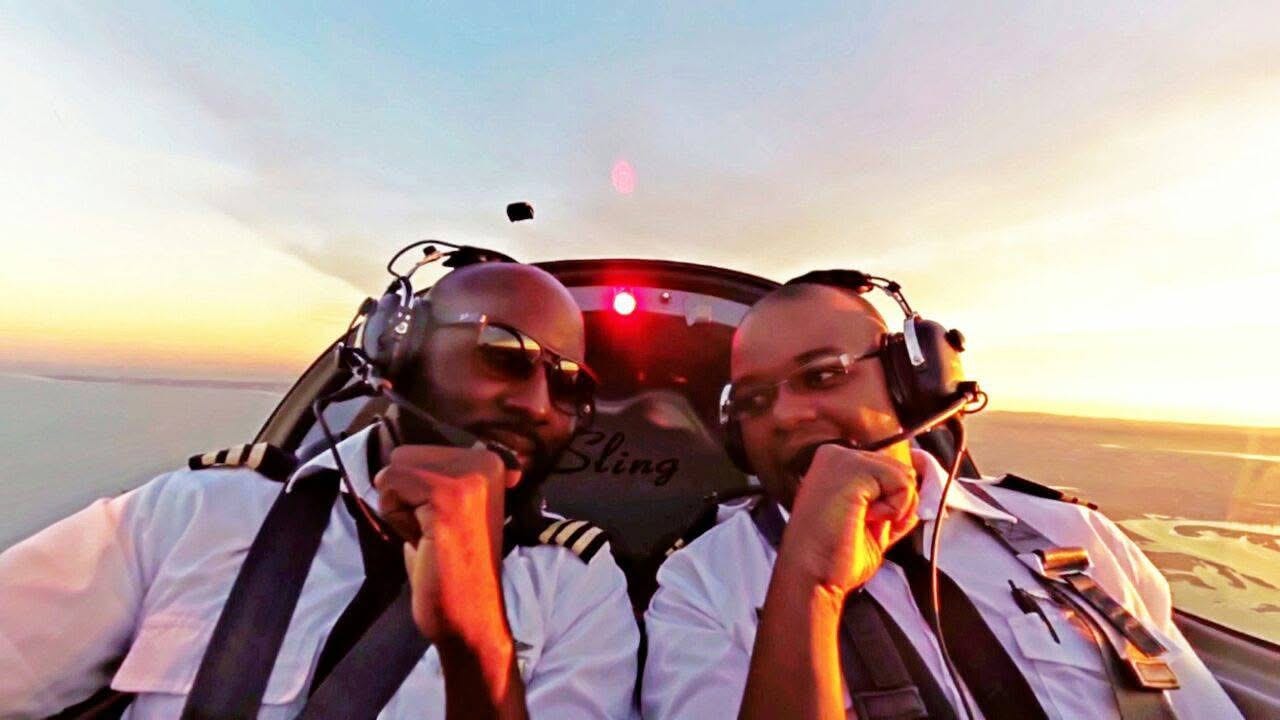
By the time I earned my commercial pilot licence in South Africa, I had already flown countless friends and family members with my Private Pilot Licence. Looking back, I realise those flights taught me something far more valuable than navigation, meteorology or aircraft performance.
They taught me what a healthy aviation culture looks like.
Some weekends, a group of us would organise what pilots simply called a fly-in. Someone owned an aircraft. Someone else hired one from the flying club. Others were still students building hours toward their commercial licences. We’d agree on a destination, launch from different airfields and spend the weekend doing what aviators everywhere have done for a long time. Flying, learning and sharing stories over a `braai´ after sunset.
That was simply how aviation was introduced to me. And it almost felt like there was nothing remarkable about it.
What struck me most was not the aircraft themselves - and South Africa did serve up an interesting diversity of planes, but the world built around them. Every hour or so there seemed to be another airstrip. Some were attached to farms, others to small towns, lodges or flying clubs. There was almost always somewhere to land, somewhere to refuel and someone waiting to talk about aeroplanes.
Flying was not confined to international airports behind security fences. It belonged to communities.
Only after leaving South Africa did I realise how unusual that experience was.
Across much of Africa, we celebrate every new terminal, every aircraft delivery and every international route announcement. Governments proudly unveil airport expansion plans. National airlines dominate headlines. Aviation success is often measured by wide-body fleets and glossy infrastructure projects.
Yet the ecosystem that first makes people fall in love with flying is largely absent. And I have come to believe that this is one of the biggest reasons African aviation continues to struggle.
We have spent decades trying to build the top of the pyramid. We forgot the foundation.
When people think about aviation, they almost always think about airlines. That is understandable. Airlines are visible. They carry millions of passengers, attract political attention and become symbols of national pride.
But airlines represent only one part of aviation. The United States did not become the world’s largest aviation nation because it built the biggest airlines. It became one because it built an extraordinary general aviation ecosystem. Just this week, over 700,000 aviation enthusiasts are celebrating aviation together in Oshkosh with more than 10,000 aircraft.
Australia, Canada and a few others and followed a similar path. Long before their citizens boarded international flights, they were flying light aircraft between rural towns, learning at local aero clubs, restoring vintage aeroplanes in community hangars and spending weekends at small airfields.
General aviation became the nursery of the entire industry.Private pilots became airline captains. Flying clubs became talent pipelines. Weekend hobbyists became entrepreneurs, aircraft engineers, maintenance businesses and aviation innovators.
The world’s strongest aviation industries were not built in airline boardrooms. They were built on grass strips.
General aviation is often misunderstood as aviation for the wealthy. In reality, it encompasses almost everything outside scheduled airline operations.
It includes flight training, agricultural aviation, air ambulances, firefighting, aerial surveying, conservation flying, business aviation, gliders, helicopters, recreational flying, parachuting, flight instruction and countless other activities that quietly support modern economies.
According to the Aircraft Owners and Pilots Association, the United States is home to more than 220,000 general aviation aircraft and over 5,000 public-use airports, the overwhelming majority serving general aviation rather than airline traffic. The sector supports hundreds of thousands of jobs and contributes billions of dollars annually to the American economy through manufacturing, maintenance, tourism, training and business activity.
It is difficult to imagine such an ecosystem without first imagining the culture that sustains it. Children visit local airports on weekends. Parents and their children take discovery flights. Retired airline captains volunteer at flying clubs. Communities gather for fly-ins and airshows.Young engineers learn by restoring aircraft. Flying becomes part of ordinary life.
That culture creates demand. Demand creates businesses. Businesses create jobs. Jobs sustain aviation.
Much of Africa has approached aviation from the opposite direction. We have invested enormous political capital in building national airlines and international airports. We celebrate fleet announcements as milestones of national progress. Airport terminals have become architectural statements. Every new international route is treated as evidence that our aviation sector is moving forward.
Those investments do matter. Africa needs stronger airlines. It needs better airports. It needs greater connectivity. But we have concentrated almost exclusively on the visible symbols of aviation while neglecting the ecosystem beneath them.
In too many countries, aviation begins and ends at the airline terminal. Small airfields have deteriorated. Flying clubs have disappeared if ever they existed. Aircraft ownership remains prohibitively expensive. Recreational flying is rare.
Young people can spend their entire childhood dreaming of aviation without ever touching an aeroplane. The result is an aviation industry that often feels distant from the society it is meant to serve. People admire aviation. Few participate in it.
General aviation does something airlines cannot. It creates aviation communities and it increases access.
A young student who spends weekends washing aircraft at a flying club is far more likely to become an engineer than someone who only watches aircraft depart through an airport window. A teenager who takes a discovery flight may become tomorrow’s air traffic controller. A retired airline captain mentoring students preserves decades of experience that would otherwise disappear. Flying clubs create relationships. Airlines simply move passengers.
The two perform different functions, but one feeds the other. The economic argument is equally compelling. General aviation supports industries that rarely receive political attention.
Agricultural aircraft protect crops. Air ambulances save lives. Bush pilots connect remote communities. Conservation organisations monitor wildlife from the air. Survey aircraft support mining and infrastructure projects. Business aviation enables investment. Maintenance organisations employ skilled technicians. Flight schools train future airline pilots.
None of these activities require a Boeing 787. Most require something much smaller. And together they create an aviation economy that is far broader than commercial airlines alone.
There is another reason Africa should care. The continent’s pilot shortage has become a recurring concern as airlines expand fleets and compete for talent. The conversation usually begins with airlines recruiting abroad or governments funding cadet programs.
But perhaps we are asking the wrong question. Where will the next generation of pilots first discover aviation? Not in an airline cockpit. In a Cessna, Piper, a glider or at a flying club.
The airline industry ultimately depends on an ecosystem it does not directly control.
South Africa demonstrates what is possible. Its network of flying schools, recreational pilots, private airfields, fly-ins and aviation organisations has created one of the continent’s richest aviation cultures.
It is no coincidence that South Africa has also produced internationally respected pilots, engineers, maintenance organisations and aircraft manufacturers. The culture came first. The industry followed.
Across much of the rest of Africa, we have attempted to reverse that sequence. We built airlines first. We assumed the culture would follow. It rarely has.
This is not an argument against national airlines or airport expansion. It is an argument for balance. Imagine an Africa where every region had an active flying club. Where neglected airstrips became centres for flight training, drone operations and emergency medical services. Where schools regularly organised airport visits. Where airshows inspired children to pursue engineering. Where private aircraft ownership became more accessible. Where local businesses invested in hangars, maintenance workshops and aviation tourism.
Where a weekend fly-in was no longer an exception but part of the rhythm of aviation life. None of this requires billion-dollar investments. Most of it requires something far simpler. A recognition that aviation is not merely an industry. It is a community.
One of my happiest memories in aviation was not flying a sophisticated aircraft across international airspace.
It was sitting beside a small grass runway with friends after another fly-in, watching light aircraft arrive one by one as the afternoon sun settled over the horizon. Nobody was discussing market share. Nobody was debating aircraft orders. Nobody was calculating passenger yields. People were simply flying because they loved aviation.
Looking back, I realise those weekends were building something much larger than flight hours. They were building an aviation culture.
That may be the foundation Africa has been missing all along. Because the world’s strongest aviation nations were never built from the top down. They were built from the grassroots up.
And perhaps Africa’s next aviation breakthrough will begin not with another wide-body delivery or another gleaming terminal, but with a small aircraft lifting off from a local airstrip, carrying a young pilot who has just discovered the joy of flight.
If you value independent, in-depth analysis of African aviation, consider subscribing to support this work. Your subscription helps make it possible to continue researching and producing long-form analysis that goes beyond the headlines.
No posts
Comments
Nothing yet. Say the first thing.
Sign in to join the conversation.