
A few weeks ago I did something I should have done years ago. I picked six “Best AI Companion Apps of 2026” articles from the top of Google. The kind of articles that rank for buyer-intent keywords, the ones that drive real affiliate revenue. Then I tried to actually use the apps they recommended.
Three of them were shut down. One had changed its pricing model months ago, with a feature breakdown the article got completely wrong. One had rebranded under a different company. The sixth was still running, but the article’s screenshots were from a UI that hadn’t existed for over a year.
This is the affiliate publishing industry as it actually operates in 2026. Not the version we tell ourselves about, not the version the SEO conferences talk about. The real thing.
I’ve been part of this industry for fifteen years. I’ve built sites in niches I’m not going to name here, and I’ve watched the same pattern repeat in every single one of them. The article that ranks first is rarely the article that helps. It’s the article that is most efficient at being an article. There’s a difference, and the difference is the entire reason this newsletter exists.
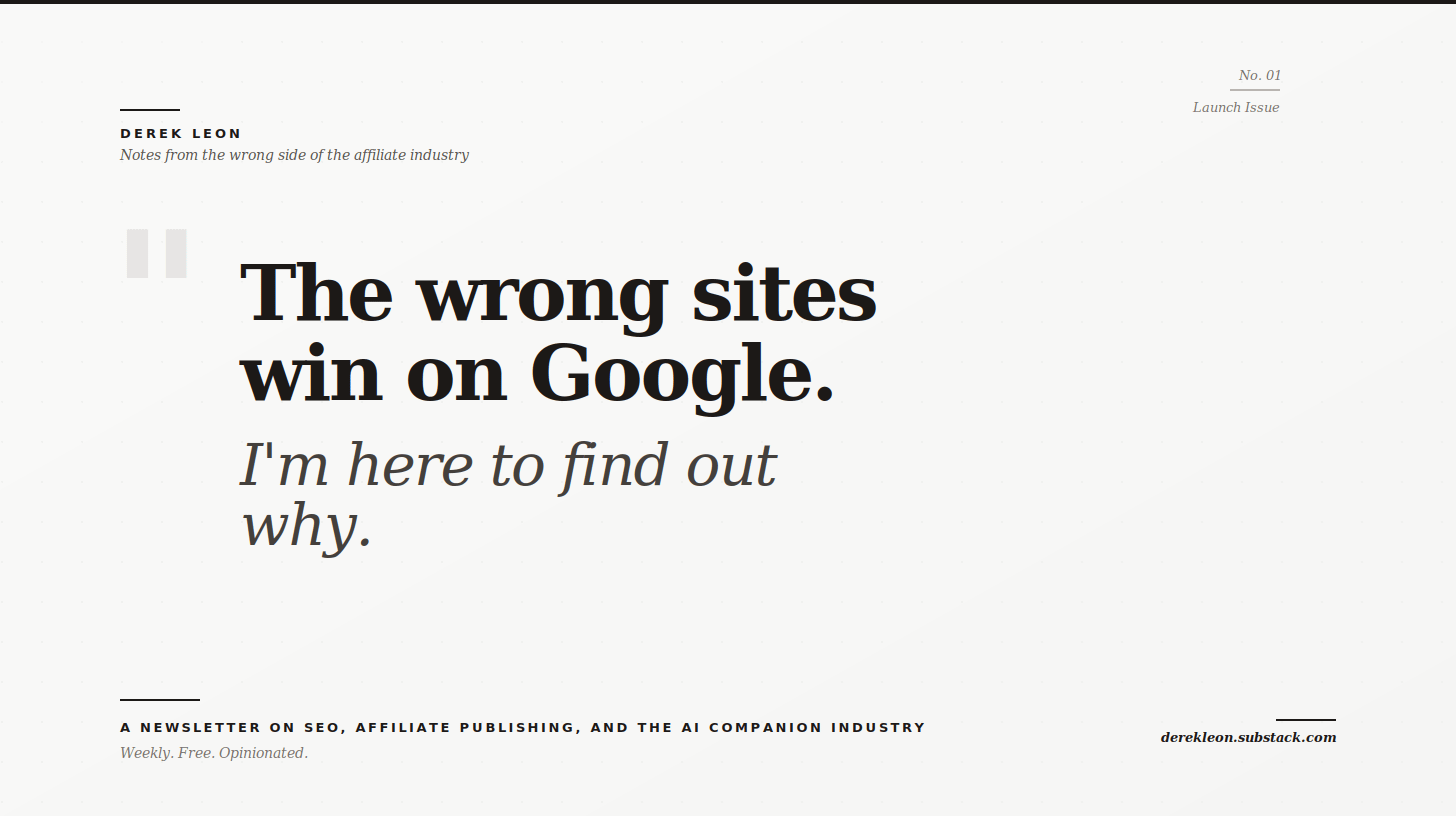
So, hi. I’m Derek Leon, and this is a newsletter about what’s actually happening inside affiliate publishing, what’s broken, and what one person trying to do it differently looks like in practice.
There’s a moment in every long career when you realize the thing you’ve been doing has been quietly drifting. For me that moment came in late 2025, when I was researching the AI companion app niche for a possible new project. I’m a software person, I like to test before I write, so I started subscribing to apps and using them.
What I found wasn’t surprising in itself. The apps I tried were a mix — some genuinely interesting, some marketing-driven, some clearly built to extract subscriptions from lonely people. The category had real complexity to it. What was surprising was how badly the existing review layer captured any of it.
The top-ranking sites were not bad in obvious ways. They had professional design, real authors with photos, schema markup, the works. They followed every E-E-A-T best practice you’d find in a Yoast tutorial. But the actual content was thin in a way I could only really see because I’d just been through the apps myself. Pricing was wrong. Features described didn’t exist. Apps that had pivoted hard in the last six months were still being reviewed as their old selves.
I’ve seen this pattern before. The mechanics are not mysterious. Affiliate review sites are businesses, and like all businesses they optimize for what makes money. What makes money in affiliate publishing is producing a lot of content quickly, ranking it on Google, and keeping it ranking by minimizing the marginal cost of updates. The marginal cost of updating an app review the right way — actually re-subscribing, actually testing the new features, actually rewriting the conclusion — is high. The marginal cost of swapping the date in the URL and changing the year is zero.
So you get the second one. At scale. For years.
I don’t think anyone working in affiliate is sitting at their desk feeling great about this. I think it just happens, the way most quiet damage happens, because the incentives line up and nobody pushes back hard enough to change them.
I’m starting this newsletter because I’d like to push back, even if it’s just from one corner of one niche.
The new project is called AI Freands. The spelling is intentional — Freands is a transliteration of the Hindi word for friends, which fits a niche about AI companions, and which also gives me a brand name that’s slightly distinctive in a category where every site is called some-variation-of-AICompanionGuides.
The site reviews AI companion apps. That’s a sentence you’ve read on a hundred other sites. What I’d like AI Freands to be different about, in concrete terms, is this:
Pricing gets verified monthly. Not the “Updated 2026” trick — actually verified, by checking the live pricing page and updating the meta. When pricing changes, the article notes what changed and when. When an app shuts down, the review gets a banner at the top instead of being silently delisted from rankings.
Apps that pay better commission don’t automatically rank higher. The ranking factor is what the app actually does for the user, not what it does for me. If a high-paying partner has a worse product than a low-paying one, the low-paying one wins. This is the part that makes affiliate publishing economically harder, and it’s the part most sites quietly skip. I’d like to find out whether you can build something sustainable while keeping it.
Reviews include the things reviewers usually leave out. The bad memory. The pricing tier where you suddenly hit a wall. The customer support that doesn’t respond. The features that are advertised on the homepage but quietly broken inside the app. These things are what users actually run into. They should be in the reviews.
I’m one person. I have no editorial team, no contractor pool, no AI-generated content farm running underneath. The reviews will go up slower than the competitors’ reviews. There will be apps the site doesn’t cover, because I haven’t tested them yet. The trade-off is that what’s there will be real.
This newsletter is the place where I’ll write about what I’m learning while doing this — the SEO side, the affiliate side, the niche side, and the strategic questions I’m still trying to answer.
Three rough categories of post.
The first is what I’m seeing inside the AI companion industry. This is the most current of the three. The category moves every month. Companies pivot, models get swapped, pricing changes, regulators step in. Most of what gets written about it is breathless reaction or boring summary. I’d like to write the version a strategy person needs — what changed, what it means for users, what it signals for where the category is going.
The second is what I’m relearning about SEO and affiliate publishing now that AI search is reshaping the territory. Google is not what it was in 2018. Reddit threads outrank long-form guides. AI Overviews steal commercial intent traffic before users ever reach a result. E-E-A-T means something different than it did before AI generated content broke its original assumptions. I’d rather work through opinions on this in writing than keep them as private rants.
The third is the meta layer — what it’s actually like to build an independent publication in 2026. Where the costs come from. Why some tactics work and most don’t. What the calendar of a solo operator looks like when there’s no team. This is the most personal of the three, and probably the slowest to come together, but I think it’s also the most useful.
A few things this newsletter is not going to be, in case the framing above made any of these unclear.
It’s not going to be a “build in public” hype reel. I’m not going to post weekly screenshot of MRR or user counts and pretend it’s content. The numbers will be in the analysis where they’re relevant; they’re not the show.
It’s not going to be tutorials on how to build affiliate sites yourself. There are dozens of newsletters and YouTube channels for that, and most of them are better at it than I would be. My take on the industry is critical, and turning around and selling “how to do affiliate” courses would feel hollow. If you want to learn how to do this, the existing teachers are more than enough.
It’s not going to be balanced takes on every issue. I have opinions, often strong ones, and I’m going to share them. I’ll be wrong sometimes. When I am, I’ll publish the correction in the next post rather than quietly editing the original. The corrections themselves are a form of content I find more interesting than most takes.
It’s not going to be sponsored. This newsletter is free, and it’s going to stay free for as long as I can manage it. The site has affiliate revenue. The newsletter is the thing I do because I want to write, not because I want to monetize the writing. If that ever changes, I’ll be upfront about it.
A few things I should put on the table at the start, because they affect how you should read what I write here.
I’m new at this. Not at SEO or affiliate — I’ve been doing those for fifteen years. New at writing publicly under my own name, new at the newsletter format, new at having a face attached to the work. The voice will probably take a few posts to settle. Some early posts will probably be wordy, or too long, or too short, or fail to land. That’s how this format works.
I’m pseudonymous, by choice. Derek Leon is the name I’m using publicly for this work; my legal name is somewhere else, attached to other things. The decision to go pseudonymous wasn’t ideological — it’s that I’d like to do this work without it being attached to my prior career, and without my prior career being attached to a niche category that, fairly or not, gets reduced to its tabloid descriptions in some circles. Some of you will find this annoying. I understand. The work itself will be honest, even if the byline isn’t a legal one.
I’m working in a niche that has reasonable critics. AI companion apps are not without legitimate concerns — mental health, attachment dynamics, the regulatory questions around the Character.AI lawsuits. I’d like to take all of that seriously and write about it honestly. I’m not going to pretend the category is uncomplicated, and I’m not going to pretend the better incentives wash away the harder questions. The newsletter will spend time on the complications, not just the marketing surface.
I’m going to get things wrong. The corrections will be published.
I’ll publish roughly once a week. Sometimes two posts in a week if something breaks open. Occasionally a quiet stretch when I’m heads-down on the site. I’ll try to keep the posts long enough to be worth your time and short enough to actually read in one sitting. We’ll see how that calibration goes.
If you’ve subscribed already — thank you. The first hundred subscribers to a newsletter from a stranger are doing real work, and I appreciate it.
If you found this through Twitter, the AI Freands site, or a search result, and you’re trying to decide whether the thing is for you: read the next two or three posts. If you like the angle, the rhythm, or the takes, stay. If not, no hard feelings. There are good newsletters covering nearby topics that might fit you better.
I’m glad to be writing again.
— Dere
k
No posts
Comments
Nothing yet. Say the first thing.
Sign in to join the conversation.