
The first thing you notice shopping for an AI companion app in 2026 is that almost every one advertises itself as cheap. The second thing you notice, usually a month later on your bank statement, is that it wasn’t.
That gap is the whole story. The number on the pricing button is a floor, not the running cost, and the real monthly figure sits somewhere above it, hidden inside token meters, renewal jumps, and annual commitments the checkout only shows you after you’ve entered a card. I spent the past few months sitting at those checkouts, from a live EU IP, on the apps we rank. Not reading the marketing pages. Reading what the payment screen actually charges on the first cycle versus every cycle after. A small set of tricks shows up again and again, and once you can name them, the whole market gets easier to read.
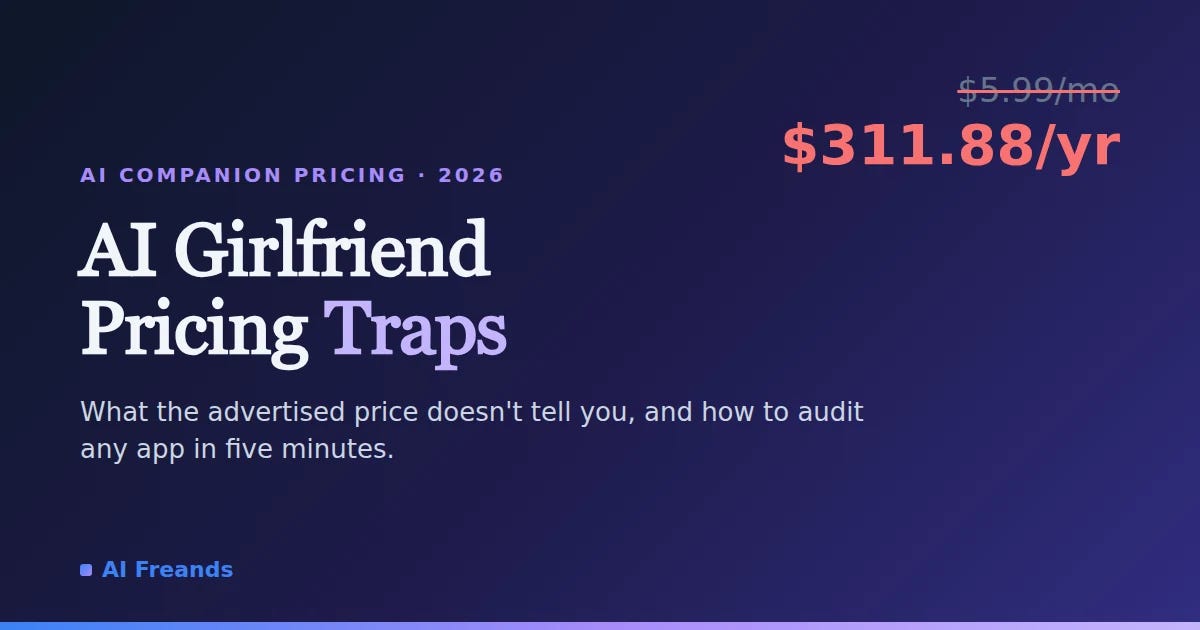
The intro price that only exists once. This is the expensive one, and it’s designed so you don’t notice it. The app shows a discounted rate with the “standard” price struck through next to it. That struck-through number isn’t decoration. It’s what you pay on renewal. DreamBF advertises $5.99 a month. It bills $71.88 for the first year, and then, unless you cancel, it takes $311.88 twelve months later, when you’ve long forgotten you signed up. The monthly plan runs the same pattern: $12.99 as a first payment, $25.99 as the recurring rate. The headline is the first cycle only.
Tokens stacked on top of the subscription. The subscription isn’t your cost, it’s the entry fee. Six of the seven main apps I audited charge a monthly fee to lift the text limit, then meter the features people actually came for, photos, voice, video, on a separate token balance the plan barely refills. You’re not buying access, you’re buying an allowance. Clear it, which an active user does in the first week, and the “cheap” $6 app is quietly a $30 to $80 app.
The annual price that’s really a year paid up front. The lowest monthly figure an app shows almost always requires annual billing. “$3.99 a month” is an annual plan divided by twelve for the ad, and at checkout you pay the whole year at once, on a product you’ve used for a few minutes. Worse, that annual rate is often the intro rate from the first trick, so the low number is doubly conditional.
Four “different” apps run by one company. This is the one no other review site will tell you, and it’s the one that quietly wastes the most comparison effort. DreamGF, DreamBF, and eHentai AI run the same checkout, the same prices, the same token allowance, byte for byte. JustPorn.ai uses the same template at a lower tier. All four are operated by DreamAI SRL, out of Bucharest. When you compare DreamGF against DreamBF to find the better deal, you’re comparing a company against itself, and the renewal trap is identical because it’s literally the same billing system.
Refunds that vanish the moment you use the product. Read the refund clause before the price. On several apps, using the product removes refund eligibility. You buy an annual plan, generate a few images to see if it’s any good, and in doing so you’ve consumed credits, which voids the refund. The test is exactly what removes the option, which makes an annual commitment a real one.
And the number the listicles quote. This one implicates my own corner of the internet, so I’ll be direct. A lot of AI companion review sites quote the lowest number an app can produce, the annual-plan monthly-equivalent, as if it were the price you’d pay. It’s annual-only, it’s before tokens, and it makes the affiliate site’s pick look better. When you see a price dramatically lower than the rest of the category, assume it’s a best-case figure, and the site presenting it as the everyday price earns a commission when you click.
None of this makes these apps a bad deal. Plenty of people get real value from them, and a flat $15 app you use every day is cheaper than subscriptions nobody thinks twice about. The problem isn’t the price. It’s that the price is engineered to look lower than it is, and most of the sites ranking these apps have a reason to leave that engineering unexplained.
So the honest recommendation isn’t an app, it’s a habit. Before you pay: find the recurring rate in writing, price the tokens for how you’d actually use the app, confirm a real monthly or free option exists, read the refund clause for a usage trigger, and check who operates it so you don’t switch to its own sibling. Five minutes of that beats any ranking, mine included.
I wrote the whole thing up with the app-by-app numbers, the token math, and the five-minute audit as a checklist you can run on any pricing page:
AI Girlfriend Pricing Traps: What the Advertised Price Doesn’t Tell You →
Read the checkout, not the ad.
Derek
No posts
Comments
Nothing yet. Say the first thing.
Sign in to join the conversation.