
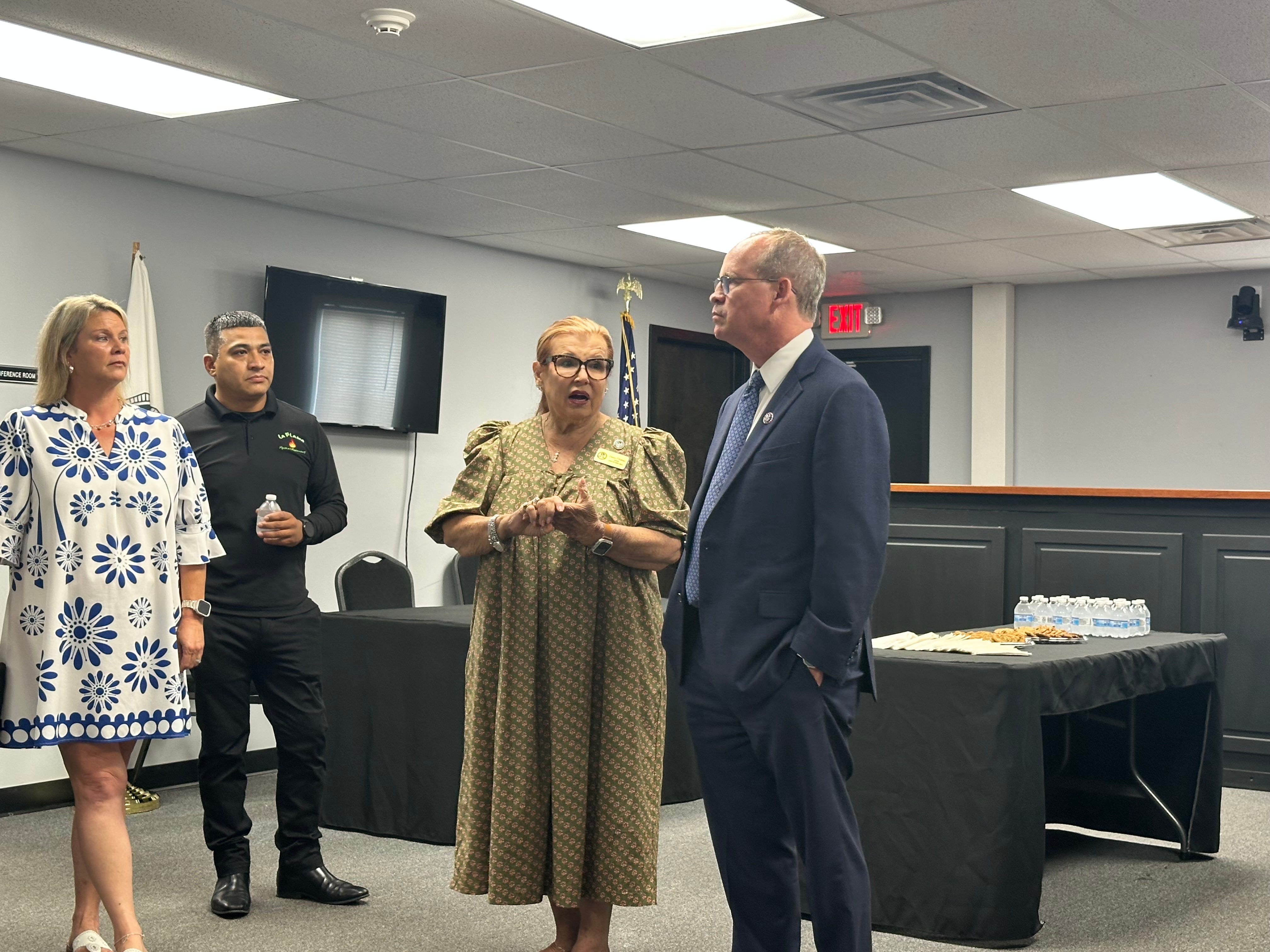
Inside a packed room in the Town of Snow Hill, the conversation moved quickly past pleasantries. Within minutes of a meet-and-greet with U.S. Rep. Greg Murphy, R-N.C., residents were pressing him on grocery bills, farmland disappearing under solar panels, and news that had reached them only hours earlier: a data center might be coming to Greene County.
Snow Hill Mayor Dianne Andrews and Town Administrator April Vinson helped lead the gathering, which also drew staff from Greene County Social Services, town commissioners, small business owners, officials from the neighboring Town of Hookerton, and local law enforcement officials.
Murphy, a urologist who has practiced medicine in Greenville for about 35 years, has represented Eastern North Carolina in Congress since being sworn in on September 15, 2019. He opened by noting how often the state’s congressional maps have been redrawn in recent years, moving Greene County in and out of his district multiple times. “We just kind of play musical chairs, and we just change counties about every couple of years now,” he said.
He serves on the House Ways and Means Committee, which handles trade, tax and health care policy, and on the House Veterans’ Affairs Committee, where he focuses on veteran suicide prevention, post-traumatic stress disorder and traumatic brain injury. He also sits on the Committee on House Administration, which oversees the operations of Congress and federal elections, and on the Helsinki Commission, a body established in 1976 that manages congressional engagement with Europe. He said he had recently traveled to the Netherlands to meet with counterparts from 79 other countries.
Murphy told the room his central focus remains health care that is affordable, accessible and high quality. Medical debt, he said, remains the leading cause of bankruptcy in the country. He pointed to a tax package passed the previous year that eliminated federal taxes on tips, overtime pay and Social Security income for seniors earning under $75,000 a year, describing it as the largest tax cut in American history for lower and lower-middle income households. On trade, he said farmers have faced more than six years of rising fuel, fertilizer, input and labor costs while competing against exporters such as Brazil and Egypt. His goal on the trade subcommittee, he said, is to defend traditional American agricultural export markets while opening new ones.
He also raised the topic of the war on Iran, saying the United States cannot allow what he called Islamic radicals who hate the country to obtain a nuclear weapon because they would use it. He invoked the 1979 hostage crisis and said Gulf states including Saudi Arabia and Qatar have grown more aligned with American efforts to contain Iran after years of Iranian-linked attacks in the region.
Introductions and a Coming Political Event
After finishing his opening remarks, Murphy invited those in the room to introduce themselves so he could put faces with names. Residents, commissioners, business owners and county staff took turns sharing who they were and what brought them to the gathering.
David Emory, a screen-printing business owner, artist and chairman of the Greene County Republican Party, used the moment to promote a multi-county political event planned for Monday, October 5. He said Turning Point USA and College Republicans were expected to attend, along with Murphy, and that North Carolina Supreme Court Chief Justice Paul Newby might also make an appearance. Emory described Snow Hill and Greene County as a natural gathering point for surrounding larger counties and encouraged residents to mark the date on their calendars.
Data Centers and the AI Race with China
Murphy raised artificial intelligence and data centers on his own, framing the issue as a matter of national competition with China. “We’re in a battle with artificial intelligence. Fortunately, we’re ahead right now. But if they ever get ahead, our world changes completely,” he said. “And data centers are the boogeyman. But if we don’t have some way of computing all that artificial intelligence, we can’t compete with them.”
He argued that China is spreading misleading and divisive information about data centers to slow American progress while advancing its own capabilities. “It’s up to us really to look past all that nonsense,” he said, adding that despite the country’s challenges, the United States remains the best place on earth.
Emory returned to the subject later, telling Murphy he had heard comparisons between data center water use and the water use of golf courses. He said he generally supports building the infrastructure needed to compete with China. “You can’t avoid AI. It’s here. You can’t put the toothpaste back in the tube,” Emory said, asking what is being done to address community concerns about water and energy.
Murphy drew a sharp distinction between older data center technology and the facilities being built today. “Let me tell you what used to be and what is now. It used to be when a data center came in, it sucked a lot of water to cool it. It sucked a lot of energy, and it was really disruptive. It is absolutely different now,” he said. Most modern facilities are self-contained and use roughly the same amount of water as a car wash. Operators have pledged not to raise community energy rates, and some companies are building their own power sources rather than drawing heavily on local grids.
“The concerns I think were valid 15 years ago, entirely different from what we’re doing now,” Murphy said. “And it’s up to us to really get in communities and explain that to people.”
He compared Chinese messaging campaigns against data centers to a hypothetical in which China urged the United States not to build planes, weapons, bullets or drones because they are “bad,” only to surge ahead once America stood down. He said he had attended three separate briefings on artificial intelligence with technical experts in recent months, each lasting roughly 90 minutes to two hours. Constituent concerns about water and energy use were raised in those sessions and, according to Murphy, were characterized by the briefers as outdated or as Chinese disinformation.
He warned that if China achieves what he called “agentic AI,” or self-learning artificial intelligence, before the United States does, the consequences would be severe. An adversary with that advantage could disable the national power grid, leaving the country “walking… in candles.” He drew a historical comparison to the rapid transformation of Germany from the pre-1930s through the 1940s as an example of how quickly conditions can change. “This is an arms race. We cannot lose,” he said.
The local alarm over a possible data center began with Dylan Potter, a Snow Hill resident. Potter watched a YouTube recording of the previous night’s Farmville Board of Commissioners meeting in neighboring Pitt County. During that meeting, officials discussed a proposed data center site that straddles the Farmville and Greene County line, leaving open the question of exactly where such a facility could be built. Potter posted about what he heard on social media. The post spread rapidly through Greene County, and by the next morning many residents were learning for the first time that county officials had been in talks about a data center. The news reached people just hours before Murphy arrived in Snow Hill, turning the meet and greet into an early public airing of the issue.
Small Businesses and the Legacy of COVID-19 Restrictions
Salvador Aberego, of La Flama Mexican restaurant, told Murphy he had three thriving businesses in 2019. Two never reopened after COVID-19 restrictions ended. He said roughly 60 percent of local small businesses did not survive the shutdowns and distancing rules, and he raised lingering concerns about Dr. Anthony Fauci’s public statements during the pandemic.
Murphy described the early pandemic response as “building a plane while we were flying it.” He said there was significant uncertainty and, in his account, a lack of candor from Chinese authorities about the virus’s origins. He recalled meeting Fauci shortly after joining Congress on the Science and Technology Committee, thanking him for his earlier work on HIV and AIDS research while telling him he disagreed that vaccines carry no risk. Murphy said a surgical partner lost his eyesight after receiving a flu vaccine and later developed polio-like symptoms following a subsequent vaccination.
“The purpose of a vaccine has always, always been, is to decrease the severity of a disease. It doesn’t change the transmission to it,” Murphy said. He criticized Fauci for what he characterized as retreating from early openness about a possible laboratory origin of the virus after learning he had funded related research, and for broader pandemic policies that closed businesses, churches and schools. He compared American outcomes to Sweden’s, saying Sweden protected its older and at-risk residents while keeping schools open and recorded a lower mortality rate than the United States.
“It destroyed businesses, it destroyed churches, it destroyed kids’ educations,” Murphy said. He added that he believes the public would have responded better to honest uncertainty from officials than to strict mandates. He pointed to tax provisions including the Section 199A pass-through deduction, immediate depreciation for business equipment purchases, and the elimination of taxes on tips as measures meant to help small businesses recover. He said the backlash from that era has left some people rejecting vaccines altogether, a position he opposes for vaccines with long, well-established track records. He cited the shingles vaccine and research he said links it to a meaningful reduction in dementia risk among older adults.
Food and Energy Costs, Inflation and Iran
WessSchaefer, with Ace Hardware, told Murphy that food and energy costs weigh on residents more than almost anything else. “Food and energy cost the average citizen. It’s killing them, and that’s forefront in their minds with voting,” he said. Many people, he added, do not realize how long tensions with Iran have simmered while fuel and shipping costs strain household budgets and make it hard simply to get to work.
Murphy addressed both issues together. On Iran, he cited past attacks linked to Iranian proxies, including the USS Cole bombing and the 1983 Beirut barracks bombing. He criticized a cash payment made to Iran under the Obama administration that he said was used to fund groups including Hezbollah, Hamas and the Houthis. He said he had visited a kibbutz near the Gaza border about nine months before the October 7, 2023, attack on Israel and later learned that roughly 80 percent of the people he met that day had been killed. A major American military strike on Iran had reportedly been under consideration in the days before the Snow Hill meeting but was scaled back after regional partners, including Saudi Arabia and Qatar, urged negotiation instead.
On inflation, Murphy said prices rose roughly 9 percent under the prior administration. He attributed the surge to pandemic-era production limits combined with roughly $3 trillion in federal spending entering the economy. “If you have more money after fewer goods, guess what happens?” he said. He also pointed to recent tariff policy, framed as an effort to correct long-standing trade imbalances, as a contributing factor to price pressure.
As a concrete example of unbalanced trade, Murphy pointed to Harley-Davidson motorcycles. “You won’t find a single one in the country of India. Why? Because they tariff our motorcycles 250 percent, so nobody in India could afford it. So they protect their own industry,” he said. Other countries have long imposed high tariffs on American goods while facing lower barriers in the other direction, he argued, contributing to a large trade deficit that has built up since the end of World War II. The current tariff approach, he said, is an attempt to rebalance that relationship, though it has added some short-term price pressure as the market adjusts.
He said the United States has become largely energy independent, though gasoline prices have not fallen as much as expected, and that the Strategic Petroleum Reserve had been significantly drawn down under the prior administration. “I am not immune to the fact things cost a lot more,” Murphy said. “But I have to say, for the sake of our kids and our grandkids, these are challenging times that we have to face.”
Food Pantry Strain
Mayor Dianne Andrews, who also directs the local food pantry, said the organization serves more than 1,000 people a month. She described steep cuts to canned goods supplied through the federal TEFAP program, saying boxes that once held 10 to 12 cans now typically hold about four. Roughly 68 boxes of food go home with schoolchildren each day, selected by guidance counselors. Many recipients are elderly residents living on fixed incomes as low as $500 to $600 a month, including farm widows who never paid into Social Security because they stayed home to raise families.
“We screen people because my thing is we’re here to serve the needy, not the greedy,” Andrews said. Murphy offered to have his staff follow up directly with the pantry to see what support his office could provide.
Medicare and Social Security Solvency
Murphy walked the room through the long-term financial pressure facing Medicare and Social Security. He cited a national fertility rate of about 1.6 births per woman, well below the roughly 2.2 needed to sustain the population. The ratio of workers paying into Medicare per beneficiary has fallen from about 4.6 to 1 when the program began in 1965 to roughly 2.5 to 1 today, as life expectancy has risen substantially. Men’s life expectancy in 1965 was under 65; it is now higher, and women’s is near 80. About 3 percent of people live to 90. Murphy noted that his own mother-in-law, a nurse, still works several days a week at age 93, providing lunch relief in an operating room.
He described major advances in cancer treatment over the course of his own career. When he began practicing, advanced prostate cancer patients typically gained about 18 additional months of life with treatment. Patients today have access to multiple sequential treatment lines, and five-year survival rates for cancers that have spread have roughly doubled over the past 25 years. American patients often pay far more than patients abroad for the same medications, a gap he attributed in part to pharmacy benefit managers. The current administration has pressed pharmaceutical companies and other countries to rebalance those prices.
On potential fixes, Murphy said lawmakers will likely need to consider raising the retirement age for younger workers who will live longer and means-testing benefits so higher earners receive less relative to what they paid in. The current full retirement age is 67, with reduced benefits available starting at 62 and bonus benefits for those who delay claiming until 70. He described a recent trip to England, Scotland and Ireland, where a friend with a leg infection was transferred among three public hospitals in four days without receiving needed medication, and said he has heard of similar delays in Canada. “Nowhere is perfect. We have a lot of work to do here in the U.S., but it still is the best system in the world,” he said.
Medicaid Eligibility Changes and Provider Communication
Rachel Thornton, Greene County’s Medicaid supervisor, raised detailed concerns about Medicaid eligibility changes tied to recent federal legislation. She noted the county’s significant farming and Hispanic population and its federally qualified health clinics. Her central question was whether hospitals and health care providers are being formally notified that some patients will lose Medicaid eligibility, since her office is typically the first point of contact when claims are rejected.
“DSS seems to be the focal point of all community partners,” Thornton said. “Is anybody telling the hospital that I’m about to terminate all these people?” She explained that when billing disputes arise, providers call her office repeatedly to sort them out, taking time away from other work.
Murphy said the changes primarily affect people in the country illegally and people improperly enrolled in Medicaid in more than one state at the same time, which he said is against the law. He cited a figure of roughly 3 million people he said were dually enrolled in Medicaid across two states, and noted that hospitals recently received a 3.2 percent increase in Medicare payments. He referenced the federal 340B drug pricing program’s effect on hospital finances and argued that an estimated 15 million to 20 million people entered the country without documentation under the prior administration, placing significant strain on hospital systems, particularly in border states. “Our first obligation is to United States citizens,” he said. He added that he is working with the North Carolina Department of Health and Human Services, which administers the state’s Medicaid program, to adjust funding formulas toward areas of greatest need. Thornton clarified that her concern centered on provider notification rather than the underlying eligibility policy itself.
Solar Farms, Agricultural Land and Energy Policy
Jim Davenport, a retired USDA Farm Service Agency employee who grew up on a farm in Martin County, raised concerns about solar companies and developers acquiring prime agricultural land. Wess Schaefer added that the tension between short-term financial incentives for landowners and long-term food security is significant, framing agricultural capacity as a matter of national security.
Murphy said he cannot dictate how private landowners use their property, particularly as farming has become less profitable and some families choose not to continue after a generational transition. “I can’t tell a farmer what to do with his land,” he said. “We need to be able to have farming to have our food. It’s a hard decision.” He noted North Carolina had ranked second nationally in solar farm development for years before Texas recently overtook it, and that changes to federal tax incentives appear to have slowed new solar projects. Farmers received $12 billion in federal relief the previous year and another $13 billion through a recent reconciliation package, he said.
On energy policy more broadly, Murphy said he supports an all-of-the-above approach that includes solar and wind, but that he considers nuclear power essential for future reliability and for powering data centers. He pointed to small modular reactors, which he said can be brought online in about five years compared with 25 to 30 years for traditional nuclear plants. He identified himself as vice chair of the Conservative Climate Caucus and said he cares about the environment. Nuclear fusion, whose primary byproduct is water, remains the long-term goal of clean energy research, he added.
Town Infrastructure Needs
Town Administrator April Vinson described the financial strain of aging infrastructure. Because Snow Hill does not generate its own electricity and relies on Duke Energy, rising wholesale power costs and increasing prices for water treatment chemicals and supplies are passed on to residents through higher rates. Staff currently lack equipment to detect certain gas leaks at town well sites. The town’s wastewater treatment plant, built in the early 2000s, is being kept running through a series of patchwork repairs.
She pointed to two specific projects: a well rehabilitation effort that began around 2021 with an estimated cost of roughly $400,000, which has since risen to more than $800,000 because of inflation and pandemic-related cost increases, and a wastewater project that remains about $386,000 short of full funding despite a state grant. “A small town doesn’t have that kind of money sitting in our fund balances to try to offset that,” Vinson said. Officials are forced to prioritize only the most essential work, she added, knowing that short-term fixes will eventually require larger investments later.
Murphy directed the town to apply for congressional community project funding, sometimes called congressionally directed spending, through his office. He said his office has secured more than a billion dollars in funding for the district over six and a half years, including smaller grants for local sheriff’s offices and similar community needs. Staff noted that this year’s application cycle had already closed but expressed hope that funding would be available again in the next cycle. They directed residents to murphy.house.gov for details on applying and on other constituent services, including passport and IRS assistance.
Closing Remarks
Murphy closed by reflecting on the difficulty of casting votes in Congress. “There’s not a maybe button,” he said. “You either got to push yes or no, and you could be 51 percent yes and 49 percent no, but you got to push yes, so that makes you 100 percent. Even though you can see both sides of the argument, I don’t get a chance to. I don’t get a maybe button.”
He thanked residents for their time and encouraged continued contact with his office. “I study hard. I’m honored to serve, and so look forward to serving you guys again,” he said.
Editor’s Note
The author of this article is a Greene County commissioner and is fully aware of the Farmville Board of Commissioners meeting video. Under North Carolina law, certain discussions, negotiations and information related to economic development projects and other county matters are considered confidential and protected. The author is not able to answer questions about any issues that fall under those legal protections.
Questions regarding potential economic development matters, including any discussions involving data centers or related projects, should be directed to the Greene County Manager’s Office.
The statements made by U.S. Rep. Greg Murphy during the Snow Hill meet and greet are reported as he delivered them. Claims regarding data center water and energy use, Chinese disinformation, artificial intelligence capabilities, inflation figures, trade practices, Medicaid enrollment numbers, pandemic policy outcomes and other topics have not been independently verified by this publication and are presented solely as the congressman’s remarks.
Comments
Nothing yet. Say the first thing.
Sign in to join the conversation.