
I’m out on Long Island all week, packing camp lunches, doing pick-up and drop-offs—and wondering how on earth this became my life. (Positive.)
Something about this slower pace has given me time to think, and one question keeps popping into my head:
Not just the clothes. The whole era.
For most of my life, “vintage” meant decades ago. The 1980s borrowed from the 1940s. The 1970s were inspired by the 1930s. Fashion needed distance before it could reinterpret its past. Now, apparently, fifteen years is enough.
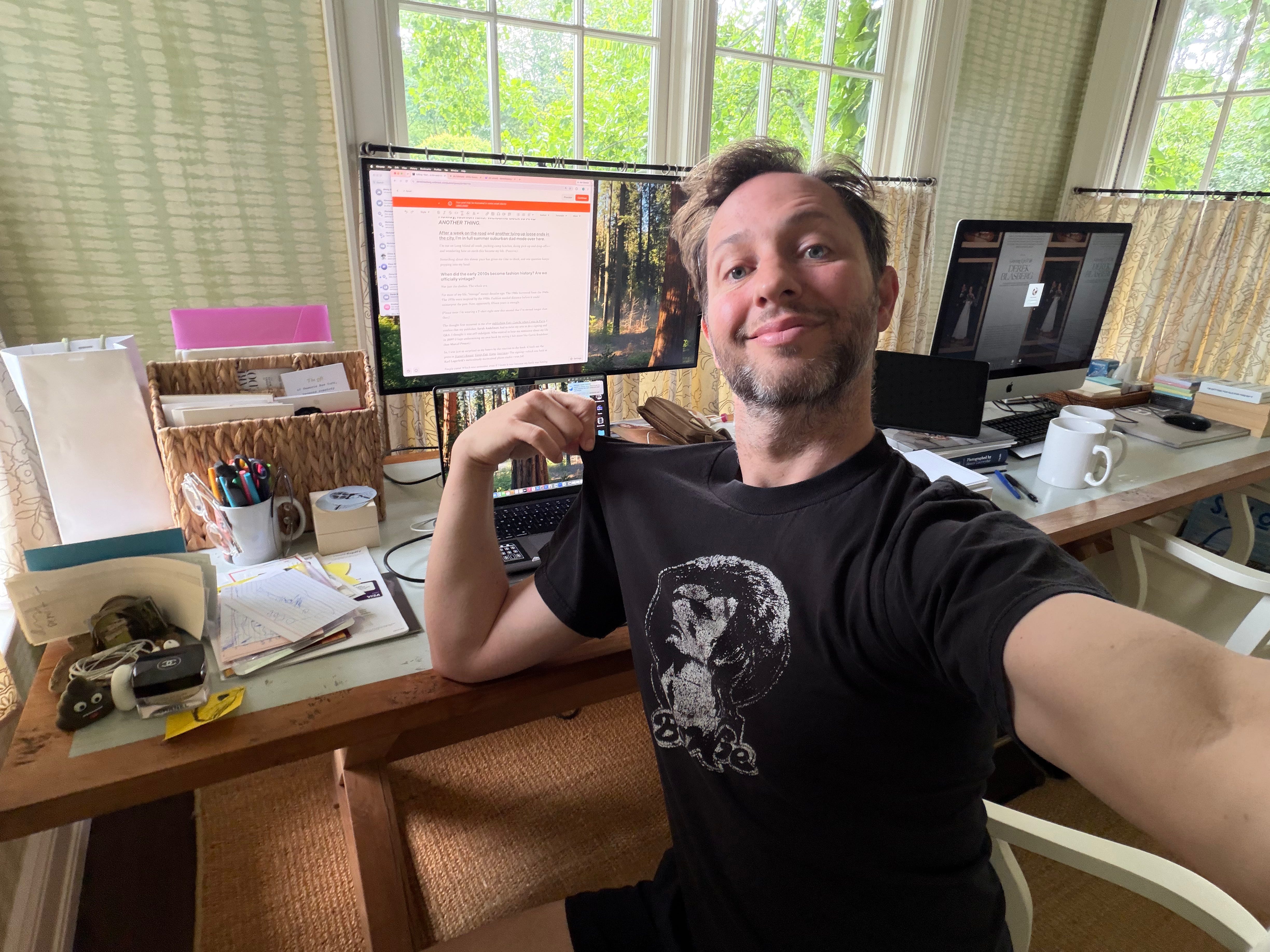
Wait. I just realized right now, as I’m writing this, I’m wearing a T-shirt I’ve owned longer than fifteen years:
The thought first occurred to me after publishing Fast + Louche when I was in Paris. I confess that my publisher, Sarah Andelman, had to twist my arm to do a signing and Q&A. I worried it was too self-indulgent. Would people really want to take time out of their hot, sweaty day to hear me reminisce about my life in 2009? (I kept undermining my own book by saying I felt more like Carrie Bradshaw than Marcel Proust.)
I was just as surprised as my haters and nasty commentors by the positive reaction to the book. (Check out some press in Harper’s Bazaar, Vanity Fair, Vogue, Interview.) Even Puck’s Lauren Sherman told me when I did her podcast that the book was an unexpectedly inspiring totem of a beloved bygone era.
The signing—which was held in Karl Lagerfeld’s meticulously maintained photo studio—was full. People came out! And I was grateful.
Friends, strangers, Substack commentators—I kept hearing some version of the same thing: I miss that world.
Now, I’m self-aware enough to know that Fast + Louche struck a nerve not only because so many people had developed an interest in the hustle of my 27-year-old self, impressive as it may have been.
The book is fantastic, of course. (Humor me.) But those pages capture something much bigger than I realized at the time:
And they’re buying CDs. Yes, compact discs. They’re outselling vinyl.
People are carrying digital point-and-shoot cameras again, just like the ones I carried to capture the images in Fast + Louche.
They’re wearing wired headphones because they’re “same as ever.” (For the record, I never switched to wireless, as anyone who saw my J.Crew campaign can attest.)
They’re keeping journals and using old-school daily planners.
Enjoying reading actual books.
Going back to movie theaters—something we were assured would never recover after Covid. In fact, last weekend they were lining up to see The Odyssey, a three-thousand-year-old story that some of us were forced to read in high school.
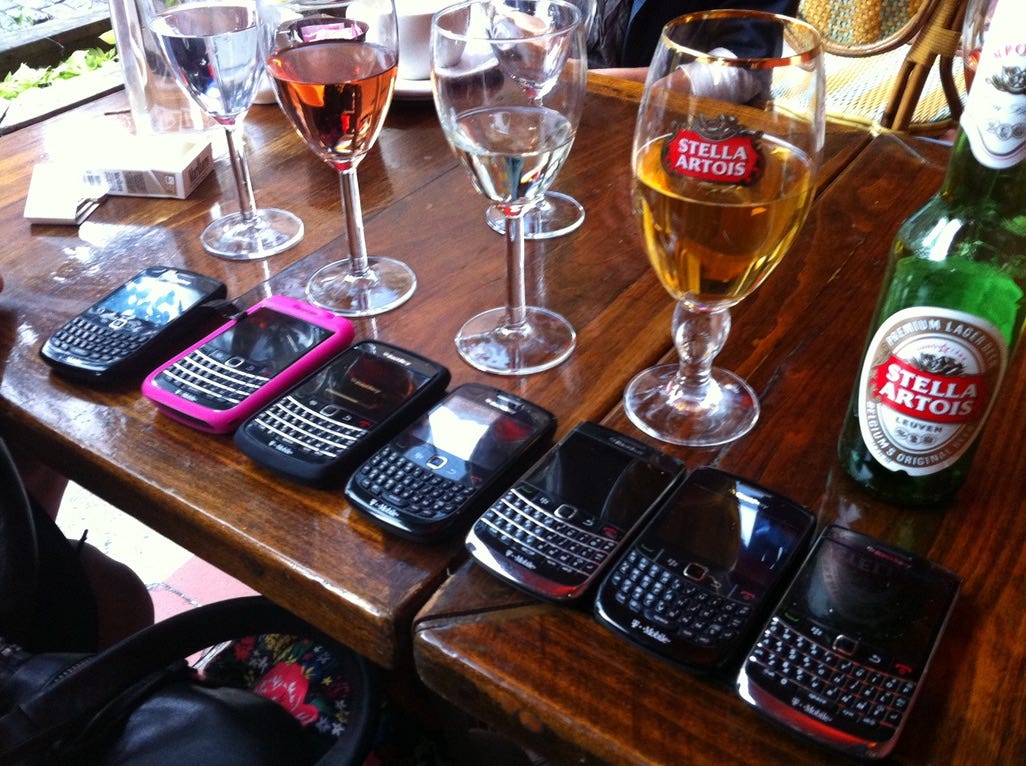
We’re nostalgic for what those objects represent: An iPod only plays music, a camera only takes pictures, a book doesn’t interrupt you with notifications.
Every one of those things asks for your attention—and then gives it back.
Yesterday, Scott Galloway talked about what he calls the “Connection Economy”: the idea that after years of optimizing our lives for convenience and efficiency, we’re beginning to value real human connection again.
Sure, Galloway does my head in. (Negative.) But he often makes a point I’m trying to make in a much clearer way: He’s saying that there’s an investment opportunity for people, like me, like those who were seduced by my book, who are nostalgic for a recent past when our societal interconnectivity felt more real.
If there’s one thing I remember about my 2009 to 2012 existence, it’s that we really were connected.
Just not in the way we use that word today—my friends weren’t monitoring whether I’d watched their Stories or counting likes, or dissecting comments, or wondering why someone hadn’t responded within six minutes.
We were connected because we were actually together. The parties were real. The conversations were longer. The photographs came later.
We lived first. And then we posted, obviously.
Early in my style education, I heard the expression, “The 1980s were just the 1940s on cocaine,” which I loved. It meant that the ‘80s revived the strong shoulders, nipped waists, and rigorous tailoring of the wartime era—then supercharged them with bigger hair, brighter colors, sharper silhouettes, and the decade’s characteristic excess. Postwar optimism mixed with narcotics. The dream!
That’s how fashion used to work: a generation would pass before an era could be rediscovered, reinterpreted, and made to feel new again.
Today, apparently, our cycles are so fast that it can come and go and come back much more quickly.
Phoebe Philo’s Céline is collected the way vintage Chanel once was. Alber Elbaz’s Lanvin is back on everyone’s mood boards. Nicolas Ghesquière’s Balenciaga motorcycle bags were back and re-interpreted for Pierpaolo Piccioli’s recent couture show. They’re no longer “old collections.” They’re archive.
The designers who were being incubated in that era are also defining this one. Phoebe Philo is back, of course. Matthieu Blazy, whom many of us first met quietly working in the Bottega Veneta studio, now occupies one of fashion’s most coveted offices at Chanel on rue Cambon. His Métiers d'Art show, which was staged on a decommissioned platform at New York's Bowery subway station (above), was a cut-and-paste fantasy from my formative New York years—all that was missing was white Apple cords in the models’ ears.
Jonathan Anderson, whom I first met in 2009, the year after he started womenswear for JW Anderson, has taken the reins of Dior, becoming the first designer since Monsieur Dior himself to oversee every collection across the house. Jack McCollough and Lazaro Hernandez, the wunderkinds behind Proenza Schouler in New York, have begun a new chapter at Loewe. Haider Ackermann launched his full womenswear in 2010 to much fanfare, which eventually closed, and started a new rein at Tom Ford.
I'm sure everyone saw the recent news that Olivier Rousteing, who reigned as one of the princes of Paris fashion during his celebrated run at Balmain in the early 2010s, has been hired to revive Paco Rabanne.
The industry isn't just looking for new ideas; it's looking to recapture the magic of that era.
(To be clear, I’m not saying designer churn is good! I’m just saying I’m seeing more of my 2010s fantasies come true.)
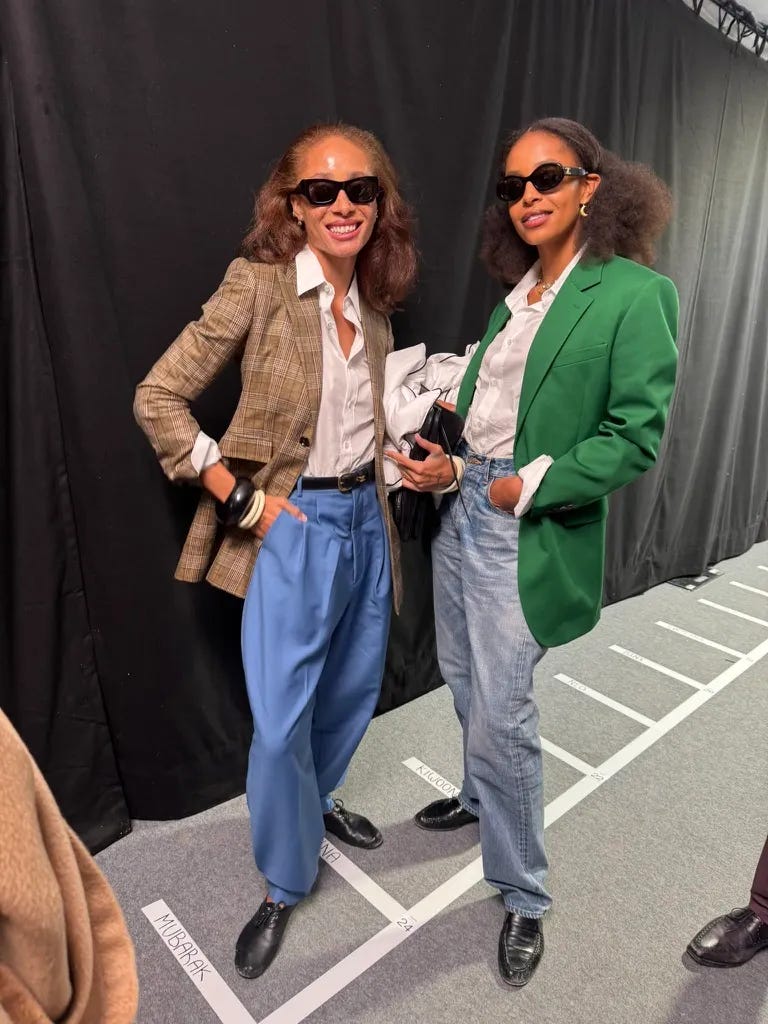
Special shoutout to Michael Rider’s tenure at Celine. His reluctance to be public on social media—imagine, a designer not on Instagram!—has had no negative impact on his design’s desirability. His collections have a buoyant optimism that feels distinctly American—yet perfectly at home in Paris—and somehow remind me of these years.
Even people in Rider’s front row feel like a throwback: editors, writers, artists, and actors, rather than whoever happened to go viral that season. (Yes, that was former French Vogue editor—and Substacker—Joan Juliet Buck I was sitting across from last year.)
Maybe that’s what makes this moment so interesting. We’re no longer borrowing from the 1980s or the 1990s.
We’re already borrowing from ourselves.
Check out this recent article by Cathy Horyn that says the three most influential brands right now are Phoebe Philo, Chanel, and Celine.
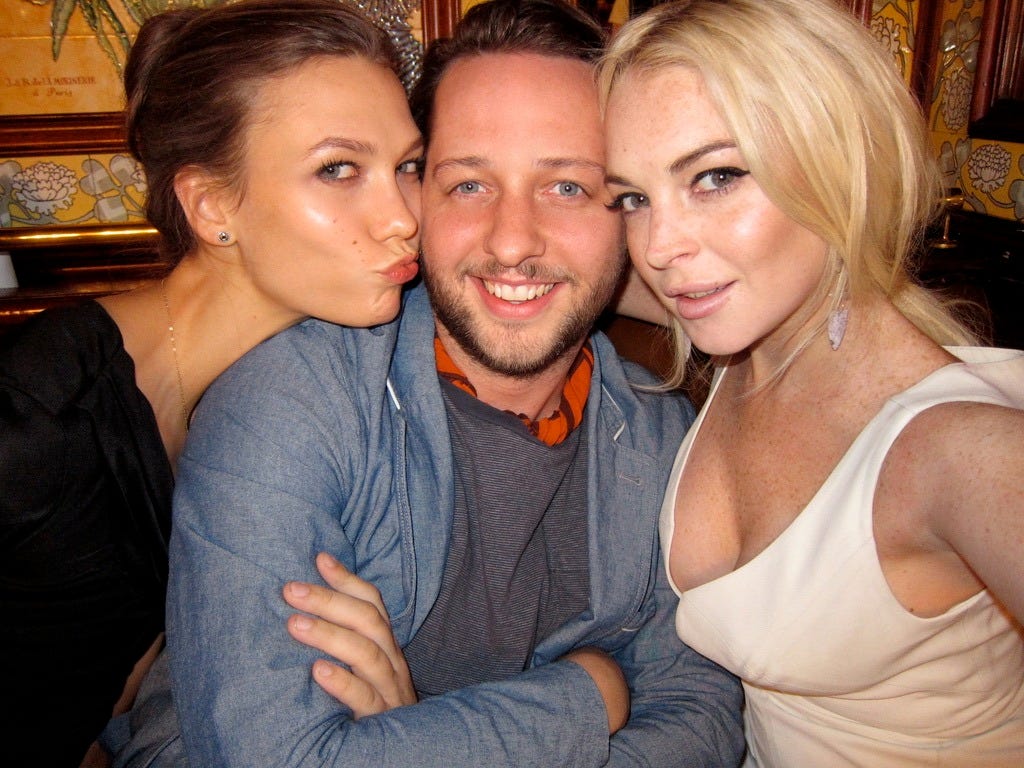
Look around! Lindsay Lohan is back—and better than ever. (Happy 40th birthday, Linz.)
The Devil Wears Prada is back, too. Nearly twenty years after the original became required viewing for anyone who ever dreamed of working in fashion, the sequel became one of the year’s biggest movies.
And music? Two weekends ago, I was desperate to get into one of the gay raves Madonna threw to promote her new album. (Instead, I was watching Shrek with my five-year-olds. People change!)
Would I have waited three hours to see Jay-Z at Yankee Stadium? Sure. Especially if I'd known he was going to bring out the millennial goddesses Beyoncé and Rihanna.
Television has entered its own nostalgia cycle. People are rediscovering Girls and Gossip Girl—let’s pretend the reboot never happened.
In fact, my new Substack friend Lena Dunham is back and better than ever and just turned 40 too.
The Social Network is getting its sequel, although Jesse Eisenberg won’t be returning as Mark Zuckerberg. He recently said he doesn’t want to be “associated with somebody like that.” In 2010, Zuckerberg was Silicon Valley’s wunderkind. In 2026, he’s become a sort of villain in his own origin story. (Jeremy Strong will play him instead.)
According to the Wall Street Journal, IKEA furniture that furnished my first decade and a half in New York is suddenly fetching serious money on resale sites.
And the New York Times is reporting on the trend of “grandma hobbies.”
None of these things are objectively better than what replaced them. They’re just... slower?
My friend Emily Sundberg recently joked that the explosion of AI millionaires has made her “genuinely nostalgic for rich people of yore.”
She predicted that the Tyrannosaurus rex skeleton at Sotheby’s would sell for a fortune—nerds love fossils, duh—and, naturally, it did, setting a new record at more than $50 million.
The wealthy people who populated Fast + Louche weren’t saints, but their excess revolved around restaurants, magazines, galleries, fashion houses, books, museums, and parties. Culture! They funded magazines. They opened galleries. They collected art. They argued over dinner—not in comments sections.
Today’s fortunes are increasingly built on platforms, code, and artificial intelligence. It’s a different kind of glamour.
Remember the early era of social media? Avocado toast and sunsets.
I used to open Instagram while I was waiting for the subway to see what my friends were doing. Someone was on vacation. Someone had a baby. Someone adopted a puppy. I’d leave a couple of heart emojis, maybe make a joke, and move on with my day.
Now I have to take a deep breath before I unlock my phone because I have no idea what apocalypse is waiting for me. War. AI slop. Someone screaming into the algorithm. A collagen ad. A conspiracy theory. Have I waited too long to get my first facelift?
I miss chronological feeds. I miss seeing people I know.
I miss when people, myself included, were not worried about optimizing every moment for engagement.
It was intent.
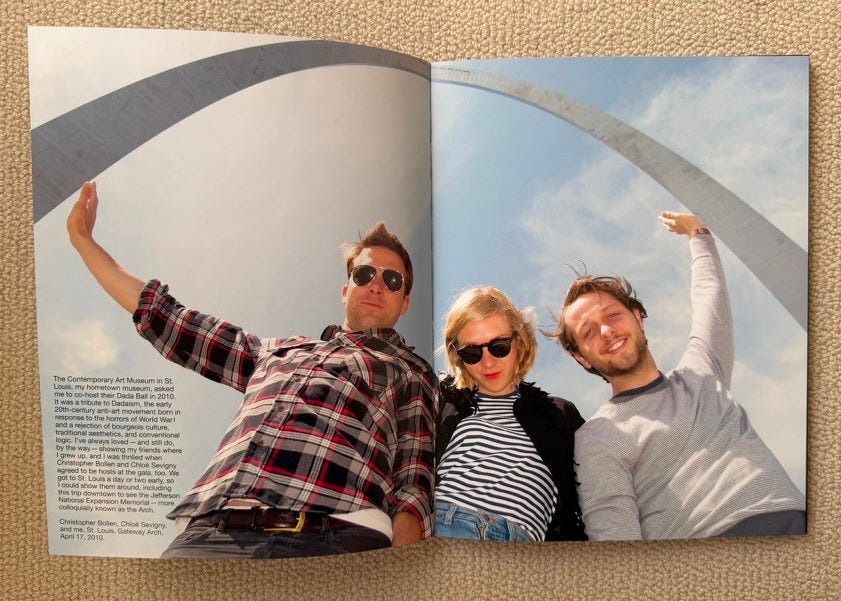
We took photographs because we wanted to remember the night. Now we take them because we want strangers to know we were there.
By the way, no judgment—I do this too, obviously!
Of course, memory has a funny way of editing out reality. Nostalgia softens the edges of our memories. Those years weren’t perfect. They had plenty of problems.
But maybe that’s exactly what being vintage is all about. Memories—but make them better.
Maybe, in addition to Balenciaga motorcycle bags and Michelle Obama’s J.Crew, that’s what feels so chic right now.
If you could bring back one thing from this marvelous little window between the digital revolution and the social media revolution—from roughly 2009 to 2012—what would it be? (Or who would it be?)
One last plug: Click here to buy Fast + Louche.
Stay safe and chic,
Derek C. Blasberg
PS. You know what to do down here:
No posts
Comments
Nothing yet. Say the first thing.
Sign in to join the conversation.