
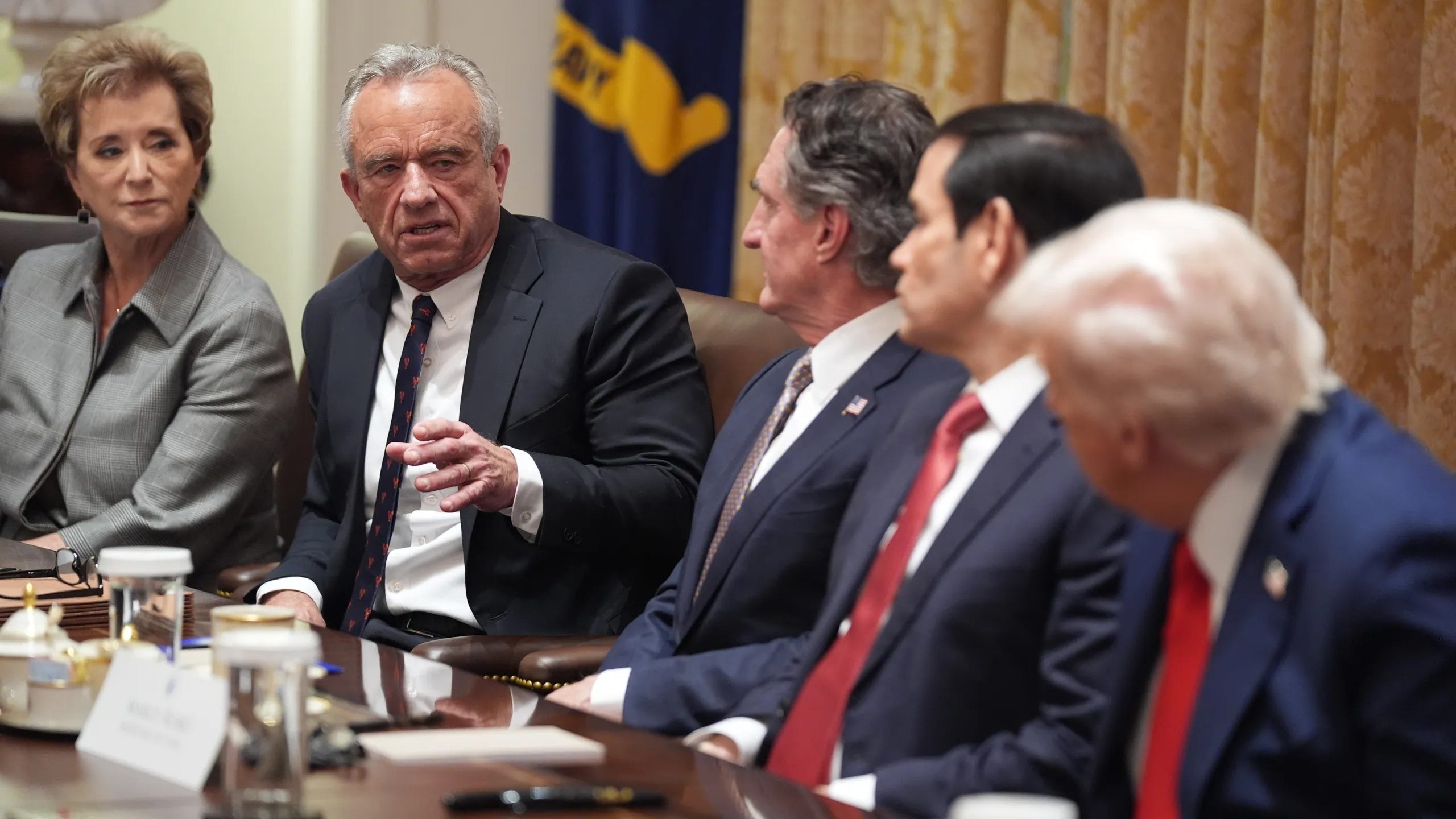
I’ve covered RFK Jr for years, long before a presidential run was a thought in his mind. I’ve reported incessantly on the MAHA movement since Kennedy stole the term and co-opted it for himself two years ago. I’ve looked at the various ways the Trump administration broadly (and Kennedy specifically) has damaged public health and science—so much so, I’m sad to write, that the public has grown a bit accustomed to it, to the point of letting it fade as background noise, just as many people reacted to Trump grifting $2.2 billion since assuming the presidency.
In both cases, we simply cannot do that.
On May 29, the Office of Management of Budget (OMB) published a 412-page policy proposal that could end scientific research as we know it in America (and have devastating effects on global science). The Verge offers a solid 30,000-foot view on the document:
The rule change would require political oversight of more than $1 trillion of federal grants across 42 different agencies. Federal grants are what pay for most of the scientific research, and the researchers, at universities across the country, from research into new vaccines to studies on natural hazards. If the rule passes, political appointees could look over and veto any grant, for any reason, at any time. Scientists could not collaborate with colleagues in many other countries. They could not go to conferences without preapproval, and would be prevented from using their research money to publish their work so the public could access it. All federal grants must align with “the President’s policy priorities,” and all mentions of “DEI” (diversity, equity, and inclusion) or “gender ideology” are immediately off the table. People applying for research funding who can’t fulfill these demands, the rule change says, are welcome to get funding elsewhere. If you don’t like it, the document implies, leave.
The proposal was written by OMB together with roughly 40 federal grant-making agencies, including many that fall under Kennedy’s purview. It rewrites the Guidance for Federal Financial Assistance, which governs the management of grants, cooperative agreements, and other forms of federal assistance across the government.
Currently, there are more than 320 individual changes—the largest in that program’s history. Public comments close on July 13; OMB wants a final rule by October 1. So it’s still a living document, though I’m not sure how seriously this administration will consider public criticism. As of this writing, there are over 93,000 comments.
Here are the main structural changes to how grants would be awarded if this bill passes:
OMB would be given centralized power in grant making while stripping individual agencies (like the NIH, NASA, and DOE) of the discretion they’ve historically used to tailor rules to their own scientific communities
The proposal explicitly blames the prior administration for using grants to fund a “woke” policy agenda, which OMB would not be allowed to do moving forward
If finalized, this rule would restructure federal science funding around three axes:
Political oversight of who gets funded
Restricted allowable activities, such as no DEI-linked criteria and oversight on publication and conference costs; politicians would be able to reject requests by scientists who want to attend conferences or publish their work
Restricted foreign engagement, with a blanket presumption against collaboration with China, Russia, Iran, Cuba, and “covered foreign entities” across nearly all federal science agencies
Let’s get into the nitty gritty. Here are the direct consequences for grant funding:
Discretionary awards would require political review before issuance. Senior political appointees decide which grants get funded, with peer review used only in an advisory capacity. Trump-appointed lackeys would be in charge of what used to be independent agency decisions.
Agencies will gain expanded authority to terminate awards if a grant no longer aligns with agency priorities, program goals, or “national interest.” Awards could now be ended at any time for convenience, which would create funding instability for multi-year research programs, longitudinal studies, and PhD-student-dependent labs.
Federal awards may not fund, promote, encourage, subsidize, or facilitate DEI policies that violate anti-discrimination law, “gender ideology,” or pediatric gender transition procedures for people under 19.
Federal awards would be prohibited from supporting theories of disparate-impact liability. Politicians could stop funding research on health disparities among races, gender, or communities. Want to know what living near a data center will do to your health? We’re won’t fund that.
A prohibition on funding “issue advocacy or public messaging” on policy positions. A climate scientist showing how fossil fuels affect climate? Fuck no, you can’t talk about that.
Most costs associated with publishing federally funded research results would become unallowable and subject to political oversight.
Subscriptions to professional, academic, and technical journals necessary for research would become categorically unallowable.
Conference travel would require express agency pre-approval.
Professional membership fees would only be covered if strictly necessary to meet award requirements.
Risk-review criteria for applicants would expand to include “history of questionable practices.” This lets the government search your affiliations with organizations deemed to “undermine public safety or national security.”
Gain-of-function research is singled out as an example of wasteful spending, as are “highly misleading studies.” Such as the study that showed Covid vaccines are not only effective, but help strengthen your immune system for fighting of other diseases, which Kennedy squashed.
Now here are the global consequences of this proposal. Remember, the US pulled out of the World Health Organization earlier this year and no longer shares data with the rest of the world, which makes navigating things like a pandemic pretty difficult.
This big one is a sweeping restriction on foreign scientific collaboration. There will be a government-wide prohibition on using federal funds for bilateral or multilateral collaborations, agreements, programs, or activities with “covered foreign countries,” including China, Russia, Iran, and Cuba unless expressly authorized by statute or approved by the agency.
The document specifically criticizes PEPFAR (the U.S. global AIDS relief program) as having been “hijacked” by activists and turned into a “left-wing foreign aid entitlement” promoting abortion and gender ideology. It cites a Heritage Foundation report alleging billions in PEPFAR-related funds went to NGO/contractor overhead rather than direct aid. This framing points toward tighter conditions and likely funding cuts for global-health and development research, with knock-on effects for research institutions and health systems in partner countries.
Elective abortions costs would now be unallowable, which would affect global health and reproductive health research programs specifically.
Finally, the combination of restricted foreign collaboration, political review of awards, termination risk, and “questionable affiliation” risk screening would likely make US institutions less reliable or attractive partners for international researchers and consortia, pushing collaborative science toward other funding hubs. McGill University has picked up a number of great scientists since Kennedy took office, and more talent would flee overseas, while fewer foreign students would consider coming here to study.
American science, by way of MAHA, has been reverting to 19th century beliefs and practices for a while. This proposal, if passed, would bring us closer to that era than ever before.
While we’re already feeling the effects of this administration’s anti-science agenda, these changes would generationally cripple public health and research because.
Plus, who’s going to rush back to a country that either booted them out or said we don’t want you to begin with? The next Democratic administration will not be able to magically heal those wounds—and there’s no guarantee Democrats in 2028.
Sometimes, the most dangerous legislation hides in bureaucratic documents quietly published with little fanfare. And this is certainly dangerous.
No posts
Comments
Nothing yet. Say the first thing.
Sign in to join the conversation.