
This is the first of a collection of bonus posts related to the group theory notes: they are meant to illustrate other directions/applications involving groups. They are meant to be standalone articles—you don’t have to have read through the group theory notes to follow them—but I will be assuming basic familiarity with group theory.
If you don’t have that, well, I can offer you one possible resource.
Let’s talk about what is probably the single greatest mathematical problem that humanity has solved: the classification of finite simple groups. The full proof of it takes tens of thousands of pages from hundreds of different articles published by a plethora of mathematicians between 1955 and 1985. There’s been an effort to write up a simpler and more streamlined proof since 1994, which is still ongoing—it is expected that this will still be over 5000 pages long.
What is this monstrous result, and why has so much effort been poured into it?
At the very end of the group theory notes, we observed that getting a classification of, say, finite groups would potentially be exceedingly valuable. Unfortunately, I don’t think we are ready to tackle a problem like that as a species. In some sense, the classification of finite, simple groups is the closest that we can get to that herculean labor.
Before we define simple groups, let’s talk about composition series.
Let’s say that you have a big, complicated group G. How could you try to reduce it to something a bit simpler, so that you could study that, and hopefully get some insight into the original? Here’s one approach: find a normal subgroup N and consider the quotient group G/N. For instance, if I have a product group G1×G2, then it has a normal subgroup G1×{1} (this is the collection of all elements (g,1) where g is in G1)—if I quotient out, I get (an isomorphic copy of) G2. Or one could consider the integers ℤ — if I choose some positive integer N, I can take the quotient ℤ/Nℤ, which is (for many purposes) easier to use than ℤ itself. (It is, for one thing, finite.)
The quotient retains many properties of the original. For example, there is a bijective correspondence between the subgroups H of G that contain N and the subgroups of G/N. Any group homomorphism K→G induces a group homomorphism K→G/N; similarly, if I have a group homomorphism G/N→K, I can always lift it to a group homomorphism G→K. But studying homomorphisms to/from the quotient group might be a lot easier.
Of course, if we want to leverage that information, we really need to understand the normal subgroup N that we quotiented out by. For instance, in the case of the product G1×G2, we really want to understand both the quotient G2 and the normal subgroup G1×{1} (which is isomorphic to G1). But now we are faced with the same problem as before: N might be a big, complicated group, so how can we understand it?
Well, we can just apply our same technique to N again! Find a normal subgroup N’ of N, and consider the quotient. Of course, we’ll then want to study N’; we might try to find a normal subgroup…
Repeat this, over and over again. If G is a finite group, for instance, this process cannot go on forever — the subgroups get smaller and smaller, so at some point we will be forced to take the subgroup {1}. The result will be a chain of subgroups G=N0⊃N1⊃N2⊃…⊃Nk={1}, where Ni+1 is a proper normal subgroup of Ni for all i. This is called a subnormal series.
Let’s look at an example: consider G=D8, the isometry group of the square, generated by a rotation R of 90 degrees, and a reflection T. The subgroup generated by R, ⟨R⟩={1, R, R2, R3}, can be checked to be a normal subgroup of D8. So we have a subnormal series D8⊃⟨R⟩⊃{1}.
But we could create a longer subnormal series, too: ⟨R⟩ has a non-trivial normal subgroup ⟨R2⟩={1, R2}. So we could extend our subnormal series to D8⊃⟨R⟩⊃⟨R2⟩⊃{1}.
Can we extend this even further by adding additional subgroups? No. We cannot insert a new subgroup between ⟨R2⟩ and {1}—⟨R2⟩ is isomorphic to the cyclic group of order 2, ℤ/2ℤ, which doesn’t have any proper subgroups. We cannot insert a new subgroup between ⟨R⟩ and ⟨R2⟩—such a subgroup would have to correspond to a subgroup of ⟨R⟩/⟨R2⟩, which is also isomorphic to ℤ/2ℤ. And we cannot insert a new subgroup between D8 and ⟨R⟩—this would have to correspond to a subgroup of D8/⟨R⟩, which is also isomorphic to ℤ/2ℤ.
In short, we have produced a maximal subnormal series for D8—a subnormal series that cannot be further extended. This is called a composition series.
The wonderful thing is that the composition series of a group is (almost) uniquely determined by the group—the Jordan–Hölder theorem tells you that the length of the composition series is fixed, and the quotients Ni/Ni+1 must all be the same, up to permutation.
There are various useful things that one can pull out from the composition series. For instance, if we have a composition series G=N0⊃N1⊃…⊃Nk={1} and all of the quotients Ni/Ni+1 are cyclic groups, then we say that G is a solvable group. Why that name? It comes from Galois theory. In Galois theory, given, say, a rational polynomial a0+a1X+…+anXn, we can define its Galois group—roughly speaking, the collection of permutations of the roots that preserve basic algebraic identities. Here’s the amazing thing: the roots of this polynomial will all be expressible as a combination of adding and multiplying rational numbers and taking n-th roots if and only if the Galois group is solvable! This fact is precisely why there is a quadratic, cubic, and quartic formula, but no quintic formula—the symmetric groups on 2, 3, and 4 elements are all solvable, but the symmetric group on 5 elements is not.
Right. Given this, it might be a good idea to figure out how we can tell if a subnormal series is a composition series or not. We already gave the blueprint in our example: you just need to examine the subgroups of the quotients Ni/Ni+1. Except, what are we looking for? Looking at our example, you might guess that we should ask that Ni/Ni+1 has no proper subgroups. But this is actually too stringent a condition: the subnormal series is a chain of normal subgroups specifically, so what we actually want is that Ni/Ni+1 has no proper normal subgroups.
This motivates the following definition.
Definition: A non-trivial group G is simple if its only normal subgroups are {1} and G itself.
In what sense are these groups “simple”? They are the basic building blocks of composition series! Equivalently, they are the groups for which their composition series is trivial: it just looks like G⊃{1}. Equivalently, these are the groups for which if there is a group homomorphism G→K, either this homomorphism is injective, or it sends everything to the identity. (Think about why—you’ll need the first isomorphism theorem.)
What are examples of simple groups? We have already seen that ℤ/2ℤ is. This can be generalized: for any prime p, ℤ/pℤ is a cyclic group. This is because, just like ℤ/2ℤ, it will lack any proper subgroups at all, normal or not. (Although, since they are abelian, all subgroups are normal subgroups.) From the classification of finite abelian groups, we can deduce that these are the only examples of finite, abelian, simple groups. But what about non-abelian ones?
We mentioned the symmetric group Sn on n elements above—this is the group of all permutations of n elements. This is not a simple group if n>2, because it has a non-trivial, normal subgroup An—this consists of all permutations that can be obtained via an even number of swaps. (Alternatively, if you take the presentation of Sn that uses permutation matrices, An will be the subgroup consisting of all elements whose permutation matrix has determinant 1.)
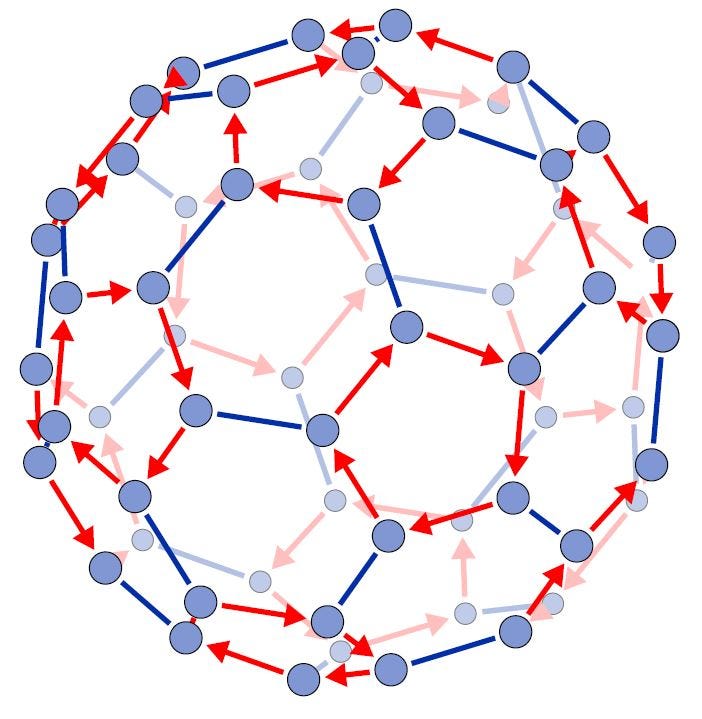
As for this subgroup An, A3 is isomorphic to ℤ/3ℤ so it is simple; A4 has a normal subgroup isomorphic to ℤ/2ℤ×ℤ/2ℤ, so it is not simple; however, for n>4, An is simple! (Keith Conrad has a nice list of proofs of this fact.)
Thus, we have found one class of nonabelian, finite, simple groups. Are there others?
Yes. Choose any prime p and any integer n>1. We can consider the group SL(n, ℤ/pℤ) consisting of all n×n matrices with coefficients in ℤ/pℤ, and determinant 1. This is not simple: it has the normal subgroup {±I}. However, if we quotient out by this subgroup and consider the projective linear group PSL(n, ℤ/pℤ)=SL(n, ℤ/pℤ)/{±I}, then this is simple, except in two cases: when n=2 and p=2 or 3.
How many more are there?
This is precisely the question that the classification of finite simple groups answers. And, in total, there are
the cyclic groups ℤ/pℤ,
the alternating groups An with n>4,
16 different infinite families of matrix groups (called groups of Lie type1), of which PSL(n, ℤ/pℤ) is one, and
26 sporadic groups, which don’t fit anywhere else in this classification.
Quite a few of these groups are fairly old—Galois worked out that PSL(2, ℤ/pℤ) is a simple group (for p>3) in 1832. The other groups of Lie type are newer, but their number was essentially filled out in the 1950s.
The real troublemakers are the sporadic groups. The largest of them all is the monster group, of order
\(\begin{align*} 2^{46} &\cdot 3^{20} \cdot 5^9 \cdot 7^6 \cdot 11^2 \cdot 13^3 \cdot 17 \cdot 19 \cdot 23 \cdot 29 \\ &\cdot 31 \cdot 41 \cdot 47 \cdot 59 \cdot 71 \\ &\approx 8.0802 × 10^{53}. \end{align*}\)
It was predicted to exist around 1973, but it was only proven to exist in 1982. It can be described abstractly as the automorphism group of the Griess algebra—I don’t know of any easy-to-understand description for it. (In principle, there exists a pair of 196,883×196,883 matrices with real coefficients such that the monster group is the group generated by those two matrices. But this description is as clear as mud.)
The monster group has a truly fascinating connection to number theory (and modular forms, in particular) via monstrous moonshine, but this is maybe a topic for another time.
In short, it is almost something of a miracle that the classification of finite, simple groups was ever finished at all.2 Since then, it’s been used to prove a variety of interesting results—for example, I mentioned in the last group theory lecture that the precise asymptotic count for the number of groups of given size was proved using the classification. There is a nice MathOverflow thread on various other results that were proved this way. (The result about indecomposable polynomials is absolutely wild to me—it almost looks like a problem that you might encounter on the IMO!)
I want to end with one final note: what is the great difficulty going from the classification of finite simple groups to a classification of all finite groups? After all, we have already discussed how every finite group has an essentially unique composition series, and the quotients in the composition series must be finite simple groups, which we have classified.
Here’s a basic example that illustrates that all is not so simple. There are two groups of order 4: ℤ/2ℤ×ℤ/2ℤ and ℤ/4ℤ. Their composition series are as follows.
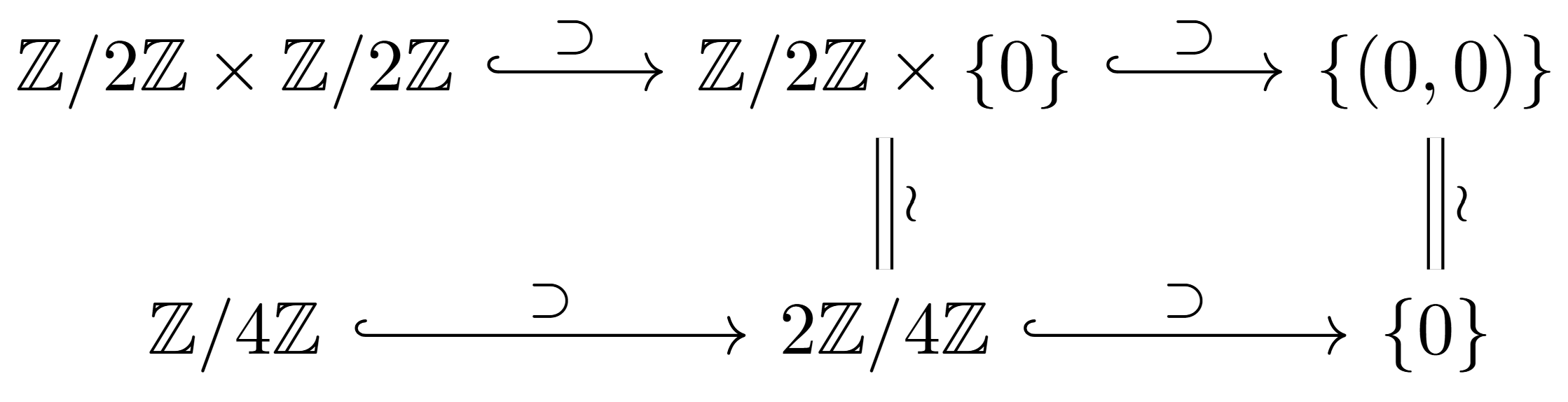
Observe that the composition series are the same length, each subgroup is isomorphic to its corresponding neighbor, the quotient groups produced by consecutive terms in the composition series are isomorphic… and yet the final groups are decidedly not isomorphic.
What can you do?
Why exactly are they called groups of Lie type? There is a MathOverflow thread about this very question, started by Jim Humphreys. Amusingly, Humphreys was himself an eminent authority on the subject.
Indeed, I have come across mathematicians who dispute that it has been proved—their contention is that since it is spread over such a long series of papers, it is hard to have confidence that there are no critical mistakes anywhere. Admittedly, this is definitely a theorem where it would be quite nice to get a machine verification.
Comments
Nothing yet. Say the first thing.
Sign in to join the conversation.