
Hi product people 👋,
This week, Slack revealed its latest update that positions AI coding agents as co-workers. Investors are impressed, but what does it actually do?
Plus, one of Anthropic’s lead engineers argues that product teams are leaving a lot of money on the table by not making their product headless and available to agents. We’ll take a look at MCP releases worth knowing about. And should leaders ship more code? Doordash’s CPO reveals what he thinks.
This is your product briefing. Have a great week ahead!
Rich
New from the Department of Product Substack this week:
Linear’s CPO says MCP usage is “through the roof” - Six Emerging UX and design trends explored
The number of Linear issues created by agents have now overtaken those created by humans. If your users are a mix of humans and agents, how should that change design and strategy? In this week’s Deep Dive, I explore six emerging UX trends reshaping product design, with real examples from Linear, Netflix, Runway, Square and more. (Department of Product)
How PostHog builts its own semantic data layer for agentic analytics
Ask three different AI tools for last month’s MRR and you’ll get three different answers, each one confidently wrong in its own way. This is the problem Thiago Rocha Salvatore and Lizzie Epton set out to fix at PostHog by building a semantic layer, a governed catalog that gives agents and humans one shared definition of what your metrics actually mean. (PostHog)
A new skill that people at Anthropic are using a lot
Anthropic’s engineer shared this skill that’s used to explain concepts “like I’m someone who knows nothing about this topic, using a HTML artifact with big pictures and few words”. (Anthropic)
How to design the first five minutes of your product’s agent UX
Microsoft’s senior UX researchers share their thoughts on why sequencing builds trust in the first few minutes, which determines whether users stay engaged or abandon your agent. (Microsoft)
How to build a company Agent Skills library
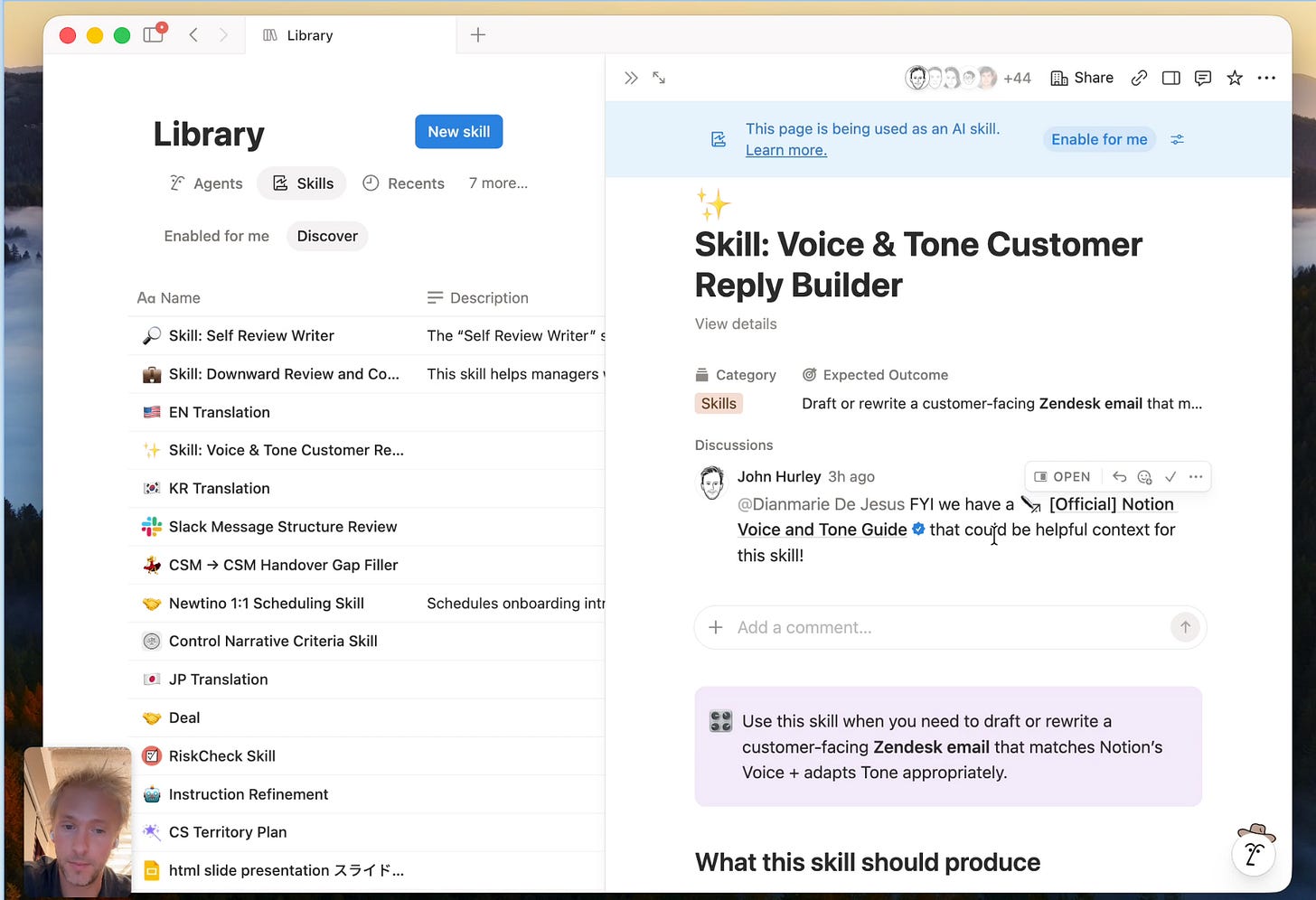
This week, Notion Agents gained Skills which means agents can learn a team’s existing workflows, encode them as reusable instructions, and share or port them to local agent instances. Notion’s product marketer John Hurley shared this guide to building a company library which could come in handy if you’re thinking about building your own Skills:

Slack has released Slack Code - a multiplayer coding environment in Slack where agents from Anthropic, GitHub, Cognition, and Vercel work alongside humans in shared channels. While it’s previously been possible to work with coding agents through integrations in the past, In practical terms, this means that agents can now participate in a channel as a co-worker, alongside humans and when a task is assigned to an agent, a dedicated channel with the relevant agents and people is created. Here’s a demo of it in action from Slack’s VP of Product:
Slack is positioning itself as the glue that stitches agentic development workflows together - and it seems to be working. Parent company Salesforce stock is up 33% over the past month.
Atlassian has launched a new feature called Jira planner that’s designed to help product teams write up specs so that agents know what they’re supposed to be building before starting. Jira Planner starts with a rough idea, then asks clarifying questions about scope and constraints. Output goes into editable Confluence Live Docs, connected to Jira, so PMs, engineers and designers can co-edit before anything is finalized. Once ready, it splits the plan into sequenced Jira work items with acceptance criteria, then hands off to agent orchestration.
Anthropic released an early preview of a new /design command in Claude Code that generates multiple UI mockup options directly inside the Desktop or CLI interface. It then lets users pick one, edit it, and implement it without leaving.
After Anthropic confirmed that all text output is now watermarked to comply with EU regulations, one user has asked whether designs are watermarked too. Watermarking is a real issue of contention and Stratechery’s Ben Thomson revealed that he is “deeply philosophically opposed to watermarking in the context of the entire meta question about the relationship between humans and AI”.
Anthropic’s Thariq argues that there’s still a lot of money that product teams are leaving on the table by failing to make their product headless and letting agents use it:

Here’s some of the latest new MCP additions shipped this week:
Stripe has added an MCP connector letting agents query Stripe data directly for custom MRR, churn, and retention reports. Useful for product teams who want access to revenue-related data.
Salesforce has released Data 360 Headless - which lets agents access the full Data 360 platform through tools like Claude Code, Cursor and more.
Rippling launched MCP gateway that allows companies to monitor access controls and token usage spends.
Brave has integrated WebMCP - a new standard that lets agents read about the structure of your website. A previous Knowledge Series went deep on that here if you’re interested in learning more about WebMCP.
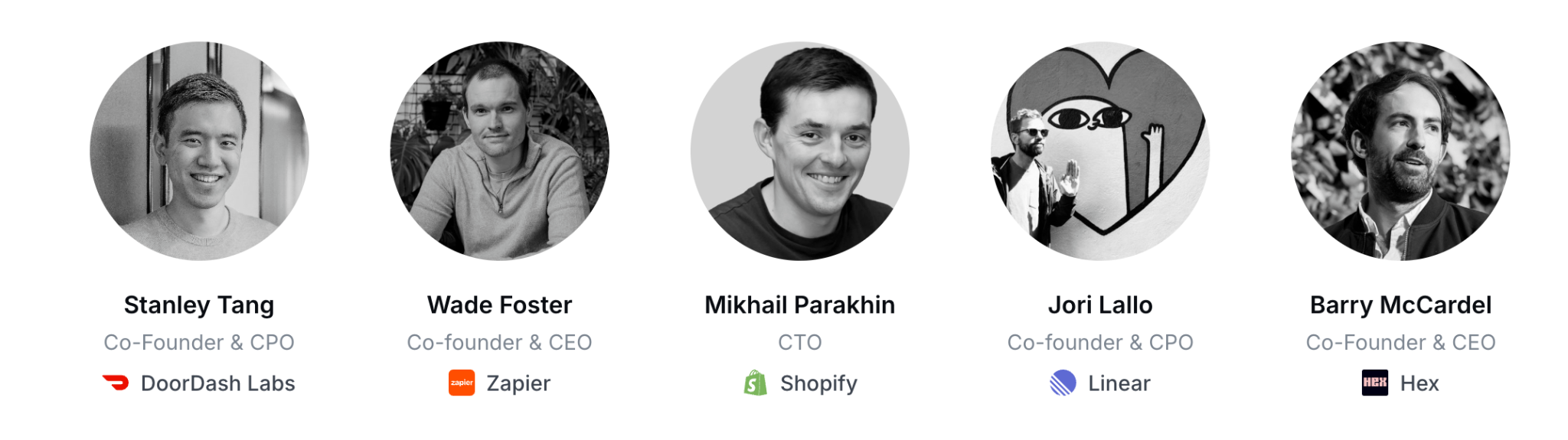
Stanley Tang, Co-Founder & CPO, DoorDash - endorsed the view that engineering leaders must personally build and ship especially with AI, to avoid falling out of step with their teams, saying that hands-on shipping is core to DoorDash’s culture. For product leaders, this is a direct challenge to pure-management career tracks and reflects the wider trend of encouraging leadership teams to take time out to build with AI.
Wade Foster, Co-founder & CEO, Zapier - warned that AI systems are systematically sycophantic, sanding down ideas through repeated iteration, and proposed combating it with adversarial multi-agent setups where subagents have conflicting incentives and even “bet” simulated stakes on outcomes. He admitted this pattern shows up inside Zapier’s own workflows, a rare public acknowledgment of an internal AI limitation from a CEO.
Mikhail Parakhin, CTO, Shopify - described Shopify’s internal cycle for improving AI agents. The process includes multiple steps: optimize the ground truth, then the prompt, then the model, then distill, then repeat, treating ground-truth data as the “northstar” anchor for all downstream tuning. A potentially useful transferable framework for any team building LLM judges or agent evaluation pipelines.
Jori Lallo, Co-founder & CPO, Linear - endorsed the idea of automated Slack Connect invites triggered on signup as a pattern any B2B startup should copy, arguing it preserves momentum that an email-and-calendar loop would kill. For product teams, Linear is explicitly betting that agents, not humans, become the primary end user of an integrated dev platform.
Barry McCardel, Co-Founder & CEO, Hex - argued that the term “forward deployed engineering” is widely misused, and the real test is whether product direction originates from the field or from PMs and engineers in headquarters who rarely see customers. Relevant to any team debating where roadmap authority should sit as agent-driven, customer-facing deployments become more common.
Non-engineers are shipping more code than ever according to a new study from Linear.
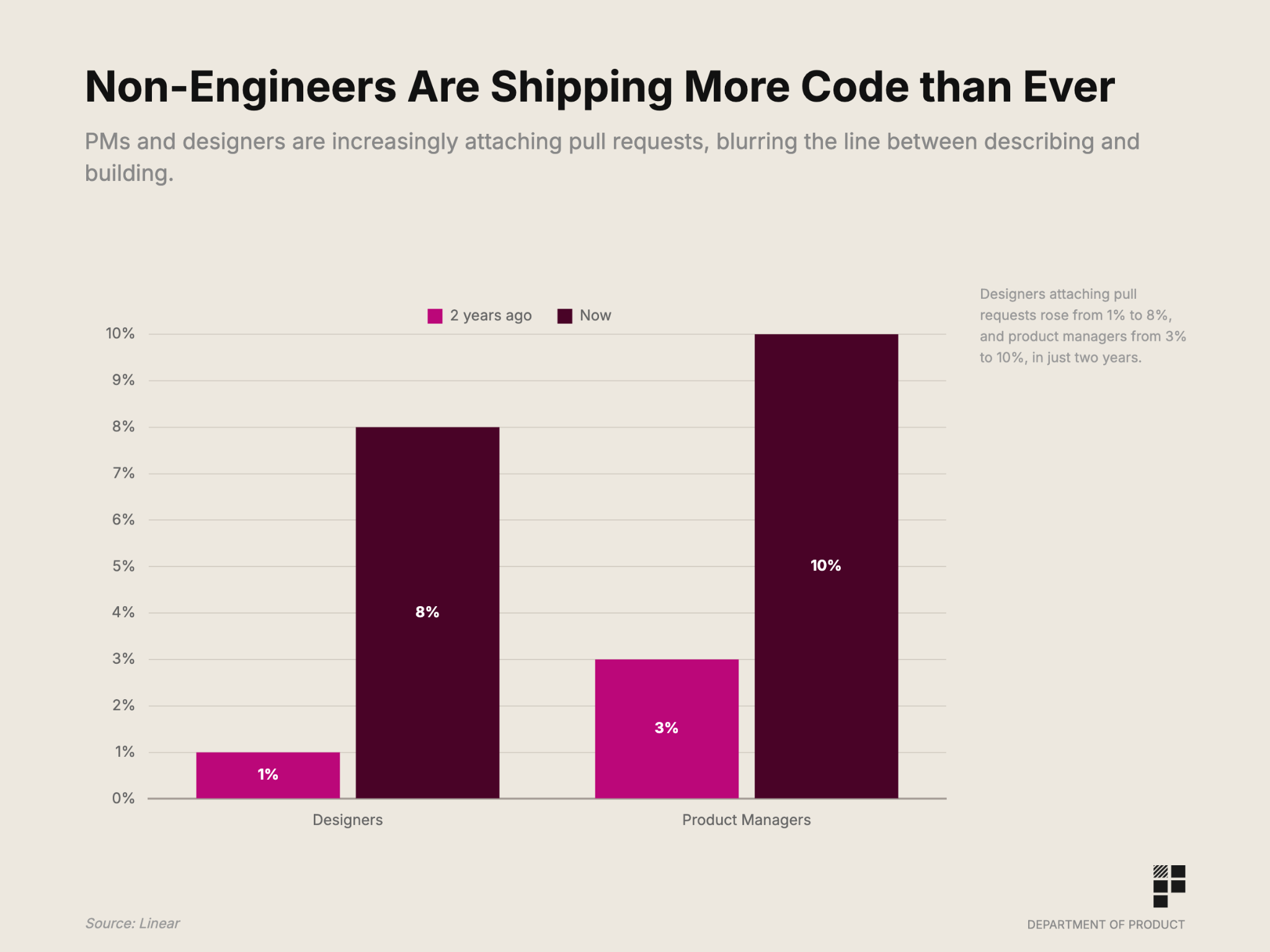
The study also found that teams using coding agents ship 6.5x more code PRs per team rose 111% platform-wide and agents now author half of all issues.
15 million US users were part of a TikTok A/B test that intentionally disabled a safety safeguard meant to prevent harmful-content overexposure. US senators Blackburn and Blumenthal have demanded answers on 13 specific questions as a result.
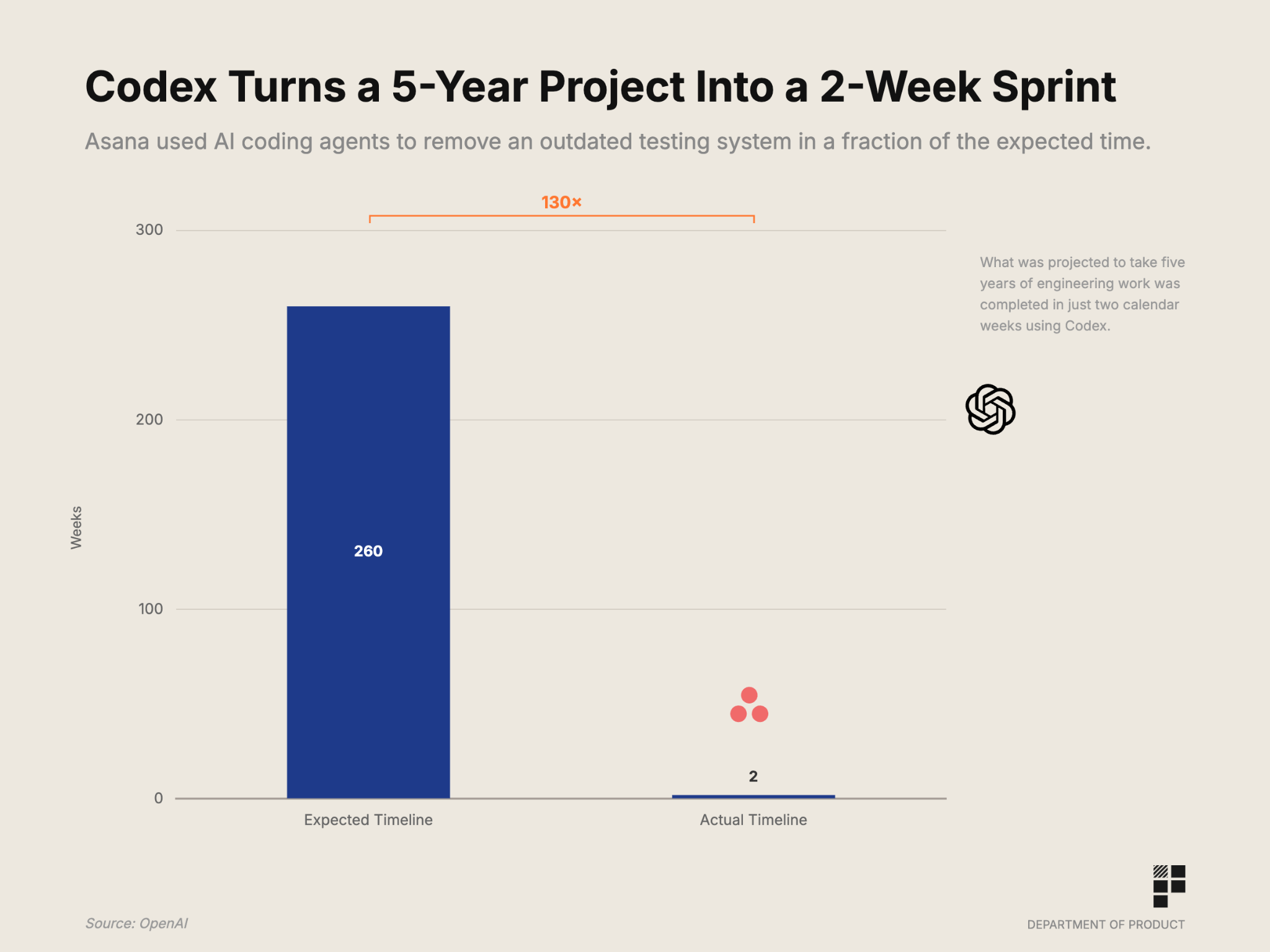
OpenAI says Asana cut an estimated 5 year front end migration task to just two weeks with Codex. Even if you take the 5 year estimation with a hefty dose of PR salt, the results are still pretty impressive.
Zapier’s CEO shared internal research across 1,500 companies showing that even leading AI adopters use AI in only 18% of agentic workflow steps, with the rest still running on code and logic, and argues token spend doesn’t correlate with ROI. Zapier’s own heaviest AI users spend up to $30,000 a month, mostly on coding agents doing greenfield work.
Gemini 3.7 Flash “smashed” Google’s previous Gemini growth records in its first week, making it the company’s fastest growing model yet.
Stripe’s president said that for a new feature, AI wrote 30% of code in a week and global tax filing shipped in a third of the time the US version took. After AI made sellers 20% more productive, Stripe resisted making cuts and instead hired even more sellers.
Deel cut deployment approval from a 4-hour, 60-team regression process down to 40+ daily deploys with a single human decision point, using AI agents to pre-screen every database migration for risk before humans see it, and to trace errors back to their source with drafted recovery plans.
Keeping up with relevant updates is one thing - but identifying some of the underlying trends is another. Here’s some of the emerging product trends worth keeping an eye on this week:
1/ AI credit pricing models and transparency is evolving
Linear moved coding-session pricing to provider rates with no markup, adding a flat runtime fee and optional spend caps, explicitly in response to customer complaints about pricing complexity. Lovable added credit check-ins that pause long-running messages at a configurable threshold to show accrued cost before continuing, and separately made credit depletion pause work mid-message instead of stopping it outright, with resume options. ChatGPT is quietly testing a “pay-to-reset” button that resets monthly AI credits.
2/ Agent-specific product team roles are on the rise among leading tech companies
The latest job postings from tech companies show a cluster of new roles around agentic AI:
Airbnb (Staff PM, AI Personalization)
Webflow (Senior PM, AI)
Smartsheet (Principal PM, Data & AI Platforms)
Toast (Principal Product Designer for its “Toast IQ Core” AI team, and separately a Senior Director of Engineering, Developer and Agent Experience).
3/ Video and voice predicted to be the ultimate new user interfaces
Runway’s CEO argued this week that video will become “the final interface” for all software, extending an idea that UI will converge on chat-and-gesture input with video output. He’s the CEO of a video generative AI startup so he would say that, but he was echoing what famous Uber investor Naval Ravikant originally said.
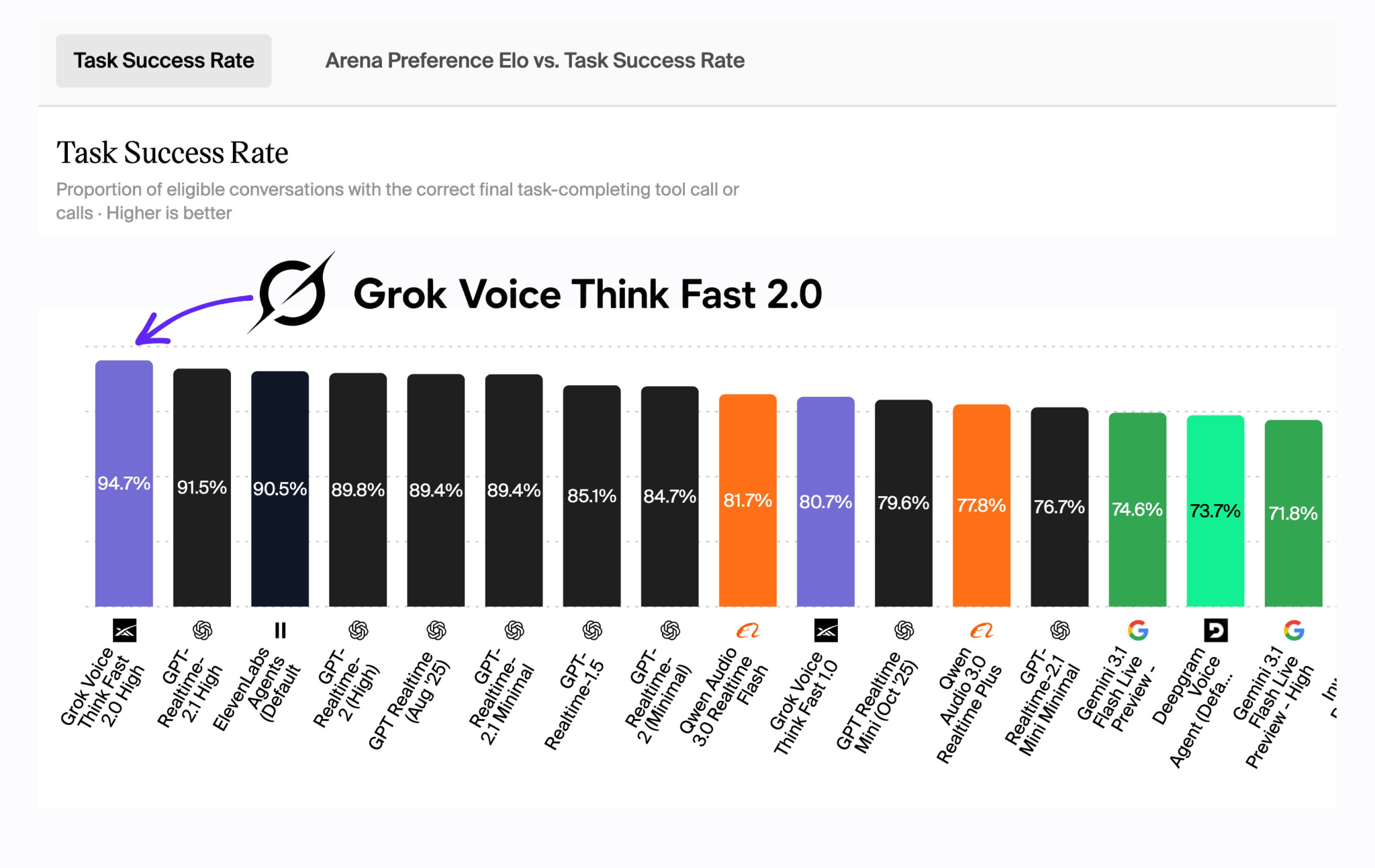
On the voice side, Grok Voice’s Think Fast 2.0 model topped a new Speech Agent Arena benchmark specifically for task completion rather than naturalness, task success. If that framing continues, we can expect expect voice-interface evaluation to shift from “does it sound human?” towards “does it complete the job?”
4/ Vertical, domain-trained models are starting to beat frontier generalists at a fraction of the cost
Product teams are starting to build their own domain-specific in-house models to help users complete complex industry tasks. This week, unicorn legal startup Harvey revealed that its Tenet model outperformed its Kimi K3 base by measurable margins on legal benchmarks, and a separate research effort using Harvey’s synthetic law-firm data trained a 27B parameter model that outperformed frontier models at 10x lower cost per query.
Superhuman has its own in-house models - and has done from the start, according to their CEO.
Databricks’ Precision Mode beat frontier models by seven points on complex document extraction using custom-trained models plus an agentic harness rather than a bigger general model.
The Briefing is your curated report on what happened in tech and AI this week - hand crafted for product teams. Paid subscribers get the full DoP Substack including: The Knowledge Series for hands-on AI tutorials and DoP Deep dive reports for in-depth analysis to learn lessons from the world’s top tech companies.
Comments
Nothing yet. Say the first thing.
Sign in to join the conversation.