
Reading Time: 8 minutes
This is a version of a post that was originally published on LinkedIn.
Agentic AI has a big problem. Not a model problem. Not a prompt engineering problem. Not an agent framework problem. But a data problem.
As organizations race to operationalize AI and deploy autonomous agents into critical business processes with the hope of realizing real business value, they are running head-first into a hard truth: AI is only as good as the data it can access. This data has to be trusted, well understood, available, and accessible when needed, to use it for critical business decisions. This is the bottleneck that most organizations are finding difficult to navigate.
In most enterprises, data is scattered across dozens — sometimes hundreds — of disconnected systems. From operational databases to analytical lakehouses, to on-premises systems to multiple cloud environments, to SaaS applications to unstructured documents, the data landscape for most large enterprises is heterogeneous, distributed, and increasingly complex. To reach its full potential, enterprise AI needs a real-time unified view of these distributed data sources, complete with all the relevant context that adds semantic meaning and definition, so that it is well understood by both business users and AI agents.
Consider a scenario that should be familiar to most working adults: A health insurance company needs to grant authorizations for vitally important medical procedures. We may not be familiar with all the ins and outs, decision points, and processes that comprise this scenario within the insurance company, but as health insurance customers, we’re familiar with the concept of a request for a procedure being submitted, then awaiting an approval or a denial. For insurers, reducing authorization approval times is a critical differentiator. With the promise of agentic AI to improve operational efficiencies, a critical question for healthcare industry leaders is, “How can agentic AI help reduce approval times and realize maximum value for our customers?” Beyond the choices of agentic frameworks, large language models (LLMs), and other critical decisions, the answer to this question lies in the data foundation for the agentic system.
The Healthcare Authorization Challenge
Now imagine a large national health insurance provider serving millions of members. Each day, physicians submit requests for various medical procedures for their patients (i.e. MRI scans, knee replacements, cancer treatments, prescription approvals, etc.). Historically, these requests have been reviewed by teams of people who gather information from multiple systems before making a decision. This process is costly and slow, often taking 7 to 14 days. Imagine having to wait over a week for approval for a life-saving procedure, all because the data wasn’t ready. This could quite literally be a life-or-death delay.
To improve efficiency and patient outcomes, the insurer decides to leverage the power of enterprise agentic AI and deploy an autonomous authorization platform. Their goal is to reduce authorization times from days to minutes.
Enter the Multi-Agent System
Rather than relying on a single monolithic enterprise application, the organization envisions a coordinated network of autonomous AI agents, each specializing in a specific step of the business process of approving or denying a request.
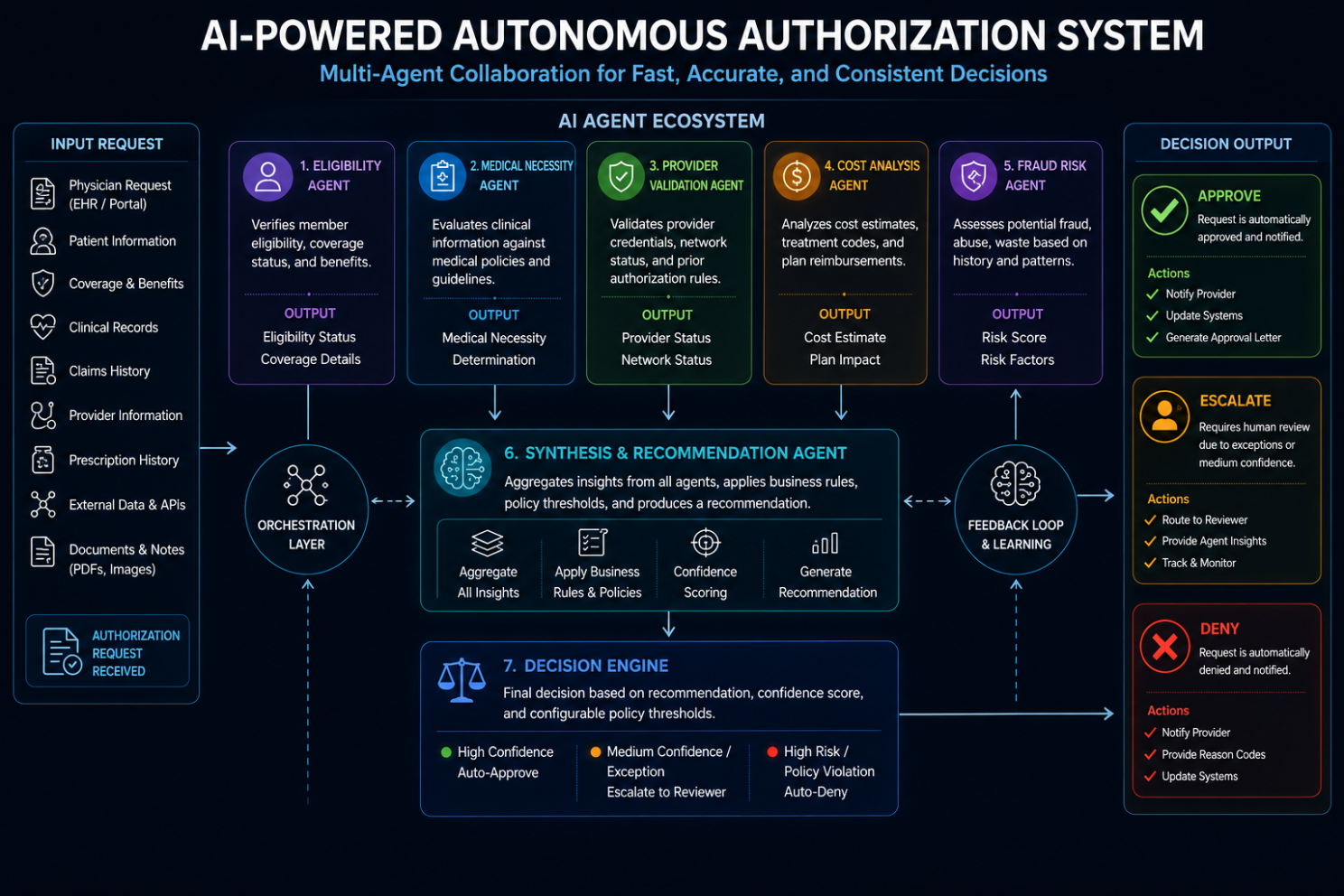
Multi-agent collaboration to improve operational efficiency
There would be agents for verifying patient eligibility, evaluating medical necessity, validating provider credentials, analyzing treatment costs, assessing fraud risk, and finally, for synthesizing all of the findings and recommend an approval or a denial. On paper, this reads like a perfect use case for agentic AI: Individual AI agents autonomously making critical decisions with minimal human interaction to simplify processing, reduce lag time, and greatly improve operational efficiencies. In reality, however, the complexity of the heterogeneous data landscape that supports these agents makes implementing this use case a monumental challenge.
The Data Mess
The first and most significant problem that the organization faces is that the data needed for this autonomous agentic system doesn’t exist in a single database or even in a single location. The data is, to put it frankly, all over the place.
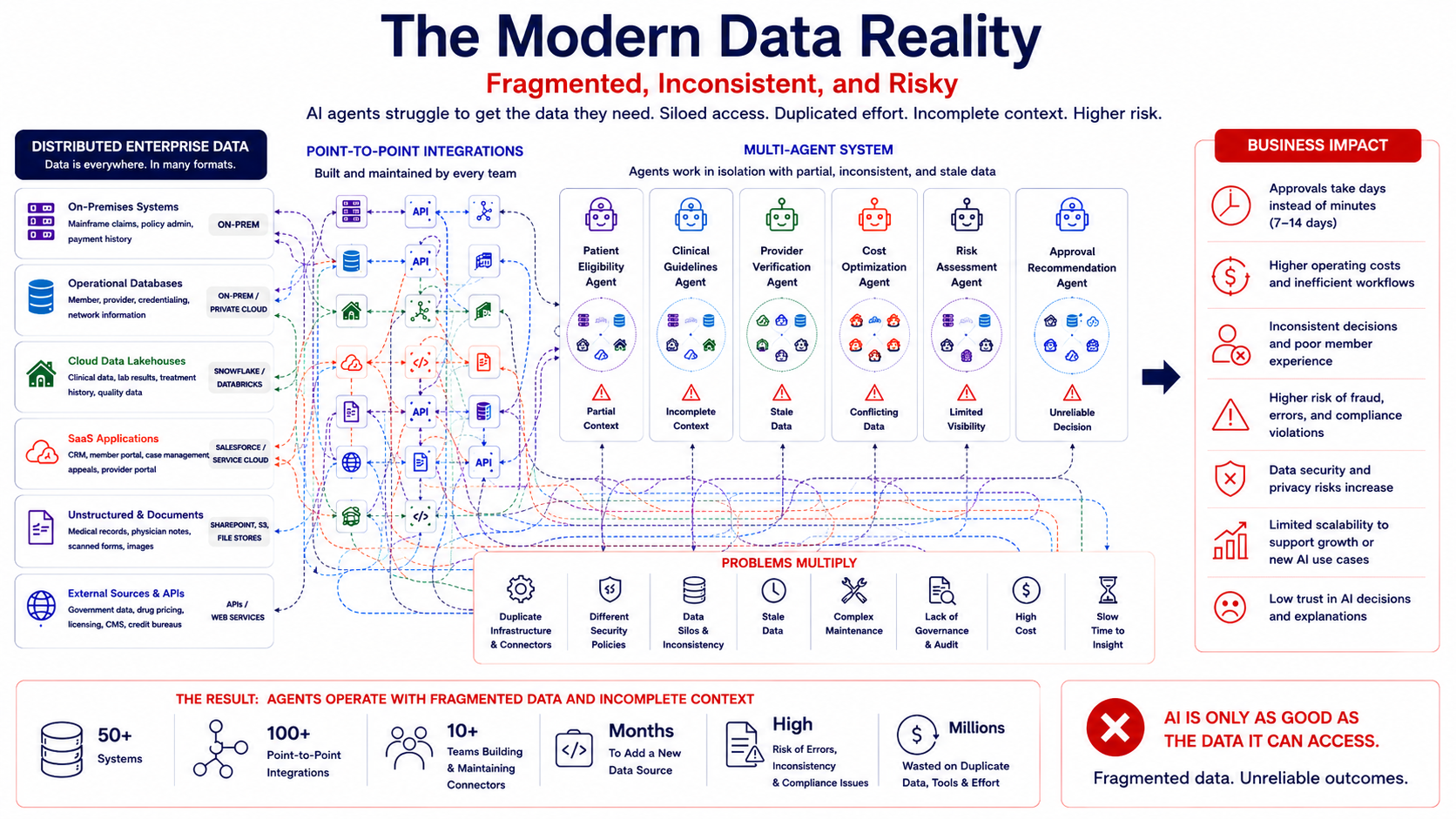
A data mess – fragmented and siloed data with point-to-point connections.
The patient’s coverage information might reside in an on-premises SQL Server environment, claims history in a legacy mainframe system, provider credentialing data in Oracle, on-premises, clinical records in Snowflake in AWS, prescription histories in Databricks in Google Cloud, customer interactions in Salesforce, medical records stored as PDFs in SharePoint and cloud object storage on Azure, and additional information exists in government databases, external APIs, licensing services, and fraud detection systems. Now multiply this by millions of members, thousands of providers, and decades of accumulated systems, and you have a true data mess. The complexity of this environment is emblematic of the physical data landscape of most large enterprises today. Unfortunately, this characteristic obstructs these enterprises in their effort to maximize on the opportunity that agentic AI presents.
What Happens with Agentic AI and a “Data Mess”?
Imagine being the enterprise architect tasked with designing this autonomous authorization system. This is where many AI initiatives begin to break down. Developing pilot agentic applications, that are narrow in scope and don’t take the full complexity of an organization’s data landscape into account, is simple to do. However, when these applications have to scale to account for an enterprise’s entire data infrastructure with its distributed nature and complex security requirements, this is where many AI initiatives simply fall apart. This is where an AI data layer becomes absolutely necessary for the success of agentic AI.
With a data infrastructure of this kind, every agent team starts building its own integrations, its own connectors, its own data pipelines, its own security controls, and its own business logic. Soon, what was intended to be a sophisticated AI system becomes a tangled web of point-to-point integrations. Each agent sees a different version of reality. The eligibility agent sees coverage information, the clinical agent sees treatment history, the fraud agent sees claims data, and the provider verification agent sees credentialing records. However, no agent is capable of seeing the complete picture because the data is scattered across multiple disconnected silos. As a result, every agent operates on partial truths because they are unable to receive a comprehensive view of the big picture. Among many other potential problems, such environments are often hindered by stale data, inconsistent semantics, hallucinations, and security risks.
Stale Data
To try to address these challenges, organizations often attempt a physical data centralization approach. Data replication jobs are run, copies are made, and pipelines are run daily. But what happens in the event of a major change to a patient’s policy that has not yet been replicated into the centralized data lakehouse by the time an authorization decision needs to be made? Simply put, the agent won’t know about it. That can lead to very wrong or very delayed decisions.
Inconsistent Semantics & Hallucinations
Another problem that plagues systems built on disconnected data is inconsistent semantics. Different systems define the same concepts differently. What exactly constitutes an ‘active member”? What is considered an “approved provider”? If each system has its own answer, what is the authoritative source for confidently answering these questions?
Without consistent semantics and a unified understanding of data across the data landscape, this can lead to hallucinations by AI systems that simply fill in the gaps where proper context is missing. For autonomous systems that can literally be involved in life-or-death decisions, the very last thing one would want them to do is hallucinate and fabricate a response due to a lack of understanding.
Security Risks
As data is replicated and copied into centralized data stores as a means of data integration, this introduces additional security vulnerabilities into critical data infrastructure. As protected health information flows through dozens of pipelines and workflows, more and more sources of data vulnerability surface which have to be secured. As confidential data gets replicated and copied into more locations, it becomes increasingly difficult to consistently secure these data assets.
The AI Data Layer
With the complexity of today’s data environments and the critical need for AI systems to have the most up-to-date and contextually relevant data, it has become abundantly clear that something critical is missing from the enterprise architectural stack. That missing piece is the AI data layer.
An AI data layer sits between distributed enterprise data and the AI systems that consume it. Envision the data landscape of the typical large enterprise with hundreds of disparate sources of data scattered throughout on-prem, cloud, and external environments. Now envision operational AI systems that require a real-time, unified, secure, and contextually relevant view of all this data to make critical decisions. The AI data layer is a logical component of a modern AI-ready enterprise infrastructure that provides a central point of access, security, and governance for all of an organization’s data assets. Its purpose is simple. Provide AI with a trusted, governed, real-time view of the enterprise. This has become a necessity for agentic AI.
Reimagining the Architecture
Now let’s reimagine the agentic health insurance authorization system built on top of the foundation of an AI data layer. Instead of every agent building direct integrations into dozens of systems, all enterprise data is connected through a single logical layer.
The AI data layer connects on-premises databases, mainframes, cloud platforms, lakehouses, SaaS applications, APIs, and unstructured content without requiring that organizations replicate everything into yet another repository. Now the agents aren’t connecting to fifty different systems. They’re connecting to one trusted source of context. This is where the real value emerges.
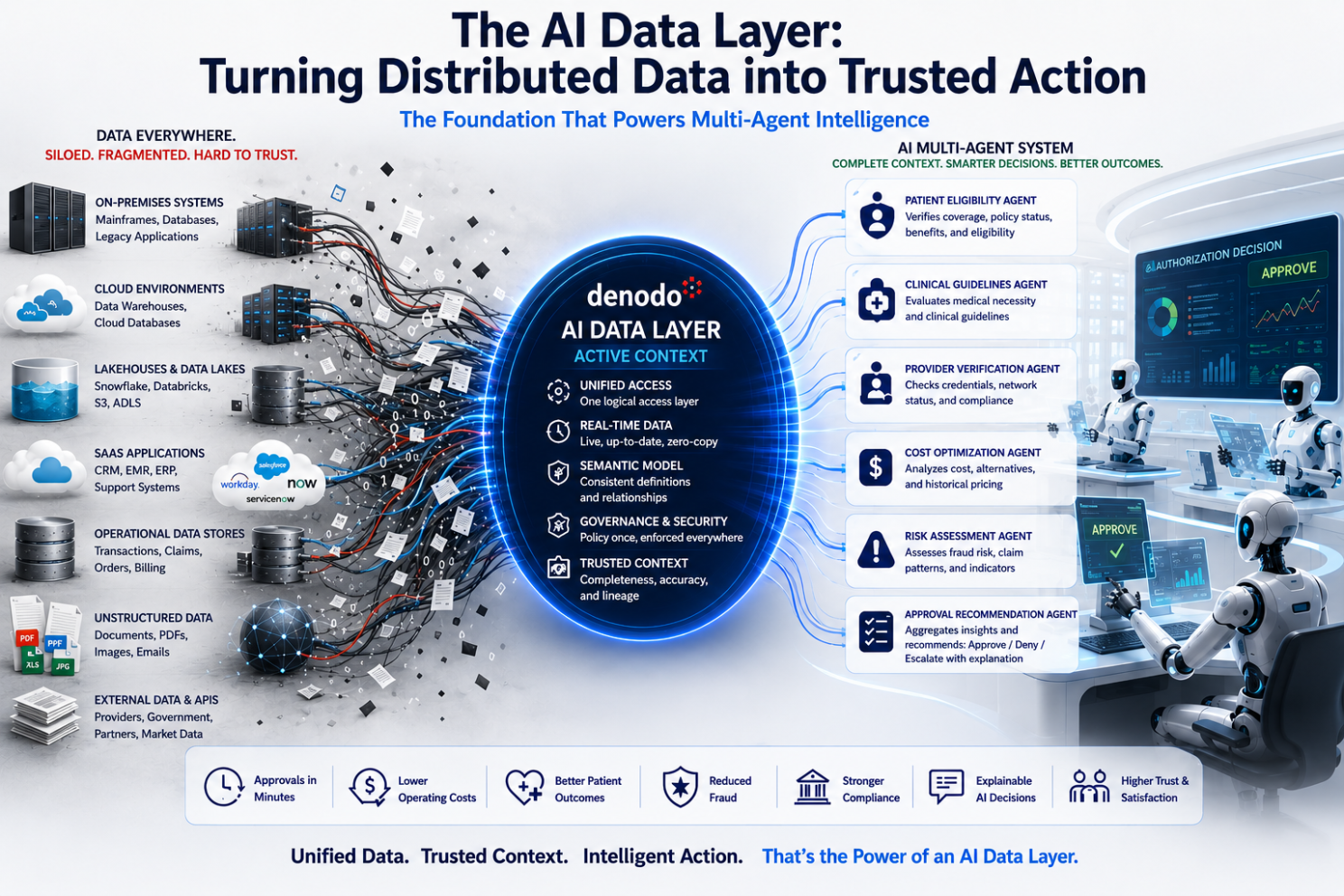
The AI Data Layer
When the approval-recommendation agent asks, “Should this knee replacement be approved?” it doesn’t receive isolated disconnected data points. It receives the complete context needed to make an accurate decision. It receives the patient’s current coverage, clinical history, prior treatments, provider credentials, prescription information, cost data, fraud indicators, and clinical guidelines, all in real time from a consistent, well-governed, semantically unified framework. Instead of six agents operating independently with their own version of the truth, you now have six agents operating with the same common understanding of reality and the active context (the context that shifts from moment to moment) of their enterprise. That is the critical difference that an AI data layer enables, and it is an absolute necessity for an enterprise architecture in the modern enterprise, as it makes enterprise AI possible.
Why This Matters
The future of enterprise AI isn’t about creating smarter agents. It’s about creating smarter access to enterprise knowledge. Organizations are investing billions in AI models, copilots, and autonomous agents. Many of those initiatives struggle because the underlying data architecture was never designed for AI consumption. The challenge isn’t getting AI into the enterprise. The challenge is getting active enterprise context into AI.
The Business Outcome
When organizations establish an AI data layer to empower their agentic AI systems, everything changes. For a health insurer, authorization times drop from days to minutes, fraud detection improves, compliance becomes easier to enforce, operational costs decrease, patient experiences improve, and overall trust in AI increases. Enterprise AI systems are no longer making decisions based on fragments of information but instead are making decisions based on the complete context of the enterprise.
The need for an AI data layer exists across all industries, from banking to insurance, to telecommunications to manufacturing, to retail to energy and to every industry that stands to benefit from developing autonomous AI solutions.
The lesson is consistent: AI agents are only as intelligent as the data they can access. Without an AI data layer, organizations end up with unintelligent agents that operate on stale, disconnected, and incomplete data. But with an AI data layer, they gain something far more valuable: active context, which represents the current, real-time, unified state of an enterprise. Active context is what transforms distributed enterprise data into trusted actionable information.

Chris Walters is a Senior Data Solutions Consultant with Denodo Technologies. He has over 20 years of experience in the architecture, design, implementation, and integration of a wide variety of enterprise systems.
Comments
Nothing yet. Say the first thing.
Sign in to join the conversation.