
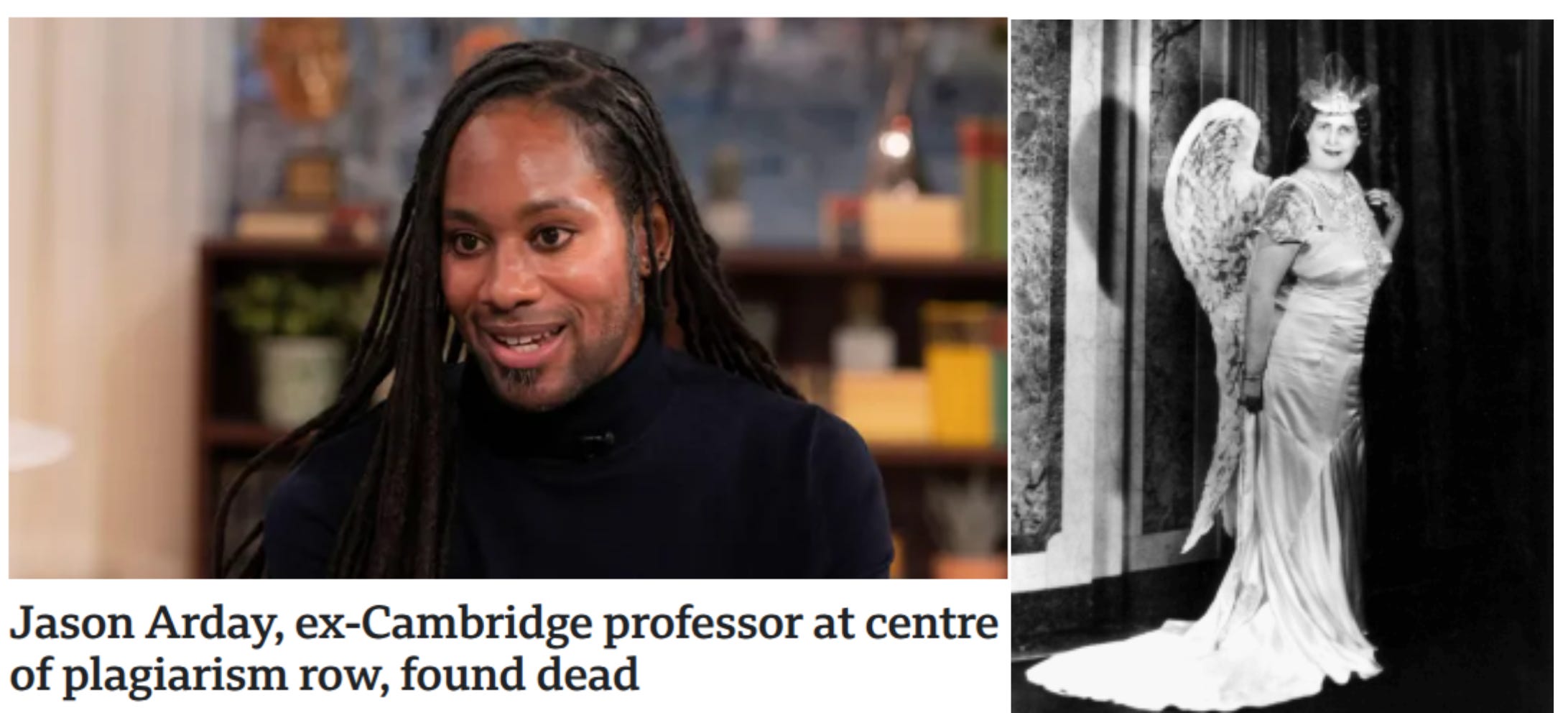
News broke recently that Jason Arday, the former professor at the center of the Cambridge plagiarism row, has died, apparently by suicide. His death marks a sorry end cap to the whole, sorry tale, and will doubtless fuel yet more rounds of recriminations and blame-trading.
“The racists killed him.”
“Those who elevated him are responsible.”
“It was the media.”
“It was Cambridge.”
As somebody who wrote more than once about the Arday affair, I have strong feelings on the subject.
My position since the beginning of this was that the story was never really about Jason Arday. Arday himself was just an odd, dishonest man, who became successful far beyond his capabilities. In a saner world, he’d have been relegated to an academic backwater, or working as a school counselor somewhere.
Instead, he was touted as an Oxbridge superstar, and paraded about as a media darling. Television, podcasts, the lecture circuit, a book deal (reportedly seven-figures, though that report may come from him…)
The spotlight would never have found Jason Arday had the leeches in his orbit not kept pushing him into it. They got something out of it. Out of him.
I feel awful that he is dead. No outcome of this saga that I wished for included that. But what I do not feel is responsible. Others very much should.
After hearing of his death, I found myself thinking of another episode–that of New York socialite and arts patron, Florence Foster Jenkins. Jenkins is perhaps best remembered as The Worst Singer Ever.
If you’re unfamiliar, have a quick listen to her astonishing Queen of the Night:
Jenkins was independently wealthy, and used her money to construct a musical universe around herself in which she was a gloriously-talented coloratura soprano. It wasn’t a project of narcissism. She was a genuine lover of music, had apparently been a somewhat gifted pianist at one point, and was a generous patron of the arts, who regularly gave work and station to up-and-coming musicians.
Her second husband was a man named St. Clair Bayfield, an unsuccessful stage actor from England (Hugh Grant plays him in the film starring Meryl Streep, which is terrific). Bayfield worked hard to manage Jenkins’s environment. He organized private, invite-only concerts to which only friendlies were invited. Jenkins’s generosity was such that few had any incentive to tell her the truth about what she really sounded like, and because she was kindly and eccentric, few wanted to.
For Jenkins’s part, she seemed genuinely not to know. Her first husband had given her syphilis–then a chronic condition–and it’s possible that it had caused her to suffer damage to her hearing, her brain, or both.
The facade fell apart when Jenkins organized and funded a public concert at Carnegie Hall. Bayfield was unable to control attendance, as Jenkins had already distributed a number of tickets to returning service members, and the event sold out quickly. Word had got round.
A gossip columnist for the New York Post named Earl Wilson wrote a scorching review, calling the concert “one of the weirdest mass jokes New York has ever seen.” Jenkins was devastated. Two days later, she suffered a heart attack while shopping and died a month later.
So. Did Earl Wilson kill Florence Foster Jenkins? Of course he didn’t. She was an unhealthy, 76-year-old woman, and Wilson’s reporting was accurate. Jenkins was powerfully awful.
But imagine an alternate reality. In this one, the people surrounding and benefiting from Jenkins don’t carefully guard access to her. Instead, they shove her onto every stage they can find, because doing so makes them look good. She’s Carmen at the Met. Lakmé in Paris. Violetta in Venice.
Reporters who express interest in covering her are threatened with police action and lawsuits. Concert-goers who don’t enjoy the offerings are called “ableist” and scolded to keep quiet.
Now, in any number of ways, Jason Arday was not a Florence Foster Jenkins. Jenkins did not go through her life lying to people and telling tall tales about herself. She made meaningful contributions to the New York City arts scene, as opposed to simply coughing up race-baiting slop. And Jenkins herself wasn’t in on the charade, whereas Jason Arday most assuredly was.
But imagine that after years of this dance–years of being exhibited around as some kind of once-in-a-generation diva–that the game falls apart. The wall of silence crumbles, and Jenkins is exposed. Imagine that her promoters–themselves under fire for their behavior–lash out at critics, maligning them, and insisting that it is the audience, and art reviewers, who bear responsibility for the fiasco.
Would we take that seriously? Would we accept that from them? I think we would not, and nor should we in this case.
One final dimension to add: imagine, in this fantasy scenario, that Jenkins isn’t one of a kind. That there are hundreds, thousands, of similarly untalented songstresses on stages all across the world, all backed by similarly scheming and self-interested puppeteers. Imagine that their clearly stated intention is to continue their fraud. To grow it. Imagine that they are receiving public funds to carry on the farce, and are sure to use Jenkins’s death to shame whistleblowers back into silence.
What would we have to say to them? I ask because whatever it is, now is the time to say it.
For my part, at least two words come to mind…
Comments
Nothing yet. Say the first thing.
Sign in to join the conversation.