
This started as just a Note. It got a little bigger.
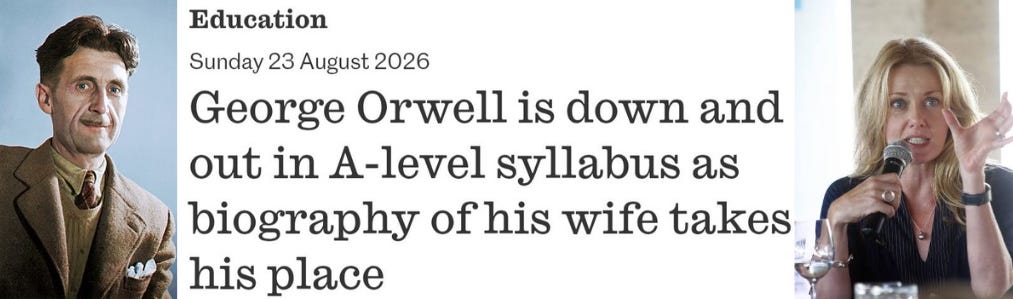
My friend Andrew, also known as The Last Davos Chud, is one of my fiercest trenchmates in the culture wars. He recently posted this:
I sort of hoped it would turn out to be untrue or overblown. It isn’t.
As I read more, the Note I was writing became longer. I became angrier. And angrier. I started to feel that the spotlight hitting this scandal wasn’t nearly bright or wide enough.
So. Eat this, Cambridge OCR (the examining board that sets A-level syllabi). You get a whole post now. Not a good month for Britain’s premier university.
The bee in today’s bonnet is Cambridge OCR’s quiet decision to remove George Orwell’s Down and Out in Paris and London from the reading list for English - Language & Literature, which is a not terribly popular, though important, class for advanced high school students. In its place, students will be encouraged to read Anna Funder’s Wifedom: Mrs. Orwell’s Invisible Life, which we’ll be discussing in a moment.
To the extent that there are mitigating factors here, Cambridge OCR hasn’t scrubbed Orwell from the A-level curricula. He’s still featured, and featured heavily. The move here applies only to one, high-level class, and has been justified as an attempt to spur discussion and debate (as if such a thing weren’t possible after reading…George Orwell.)
In general terms, I can’t say I’ve ever fully vibed with the trend of, “What if instead of talking about this very significant man, we talked about his wife instead?”
The curiosity about the women behind the men is understandable enough, in that reliably, the spouses of major historical figures led genuinely interesting lives. But the trope feels born of a time when women were relegated to second-fiddle status. Since that time is over, is it discordant that there remains so much interest in the supporting cast perspective?
Hamnet, The Paris Wife, Z: A Novel of Zelda–those are just about the wives of writers. The musical Six is about the wives of Henry VIII, Sophia Coppola’s Priscilla is about about the lonely wife of the King of Rock n’ Roll, Jackie is the JFK assassination told from the perspective of Jacqueline Kennedy Onassis. The list goes on and on.
To be very clear, “I don’t vibe with it” is not the same thing as “I have a problem with it.” I absolutely do not take issue with this genre of storytelling, it’s just not usually what I go for. That’s true for the male halves also. I have no real interest in reading about Denis Thatcher, or Doug Emhoff, or the hunky spinal surgeon Hannah Waddingham is dating. Their partners are simply much more interesting to me.
I raise this point because I’m beginning to think that “What was it like for the spouse?” is a question that’s given a valence it no longer needs. It’s obviously a very popular line of inquiry—so much so that in this case, it was considered important enough to replace the actual work product of the main character. Is it important though?
My wife is an accomplished early childhood educator, with an unusually eclectic background. She’s also charismatic and hot, so is often asked to speak at conferences and trainings, where crunchy wine-mom types hang on her every word. Should I be going around these events distributing pamphlets about my Substack, and history as a stage actor? Or should I maybe just let her have the limelight?
It’s a matter of context. Fair enough, at The Hague, she’s “Amal Clooney, whose husband is some actor.” At the Oscars, maybe it’s okay that she’s just “George Clooney’s wife,” and that we aren’t getting more of her backstory than that.
The first draft of my Note about this Orwell thing included a story along these lines, and since it’s short, I’ll relate it before we get going.
This episode reminds me of one of my very first tangos with the online wokes. It’s not an exact fit, but Andrew’s post raised the memory, so here it is.
It was 2016, and I was still a turbo-lib. The Summer Olympics were happening, and the feminist blogosphere was bent out of shape because the Chicago Tribune had reported on the wife of one of the Chicago Bears winning the bronze medal for trap shooting. The headline read:
“Corey Cogdell, wife of Bears lineman Mitch Unrein, wins bronze in Rio.”
My feeling was that this was a perfectly appropriate headline. Nobody in Chicago could reasonably have been expected to know who the fuck Corey Cogdell was, independent of the context that she was married to a part-time starter on the city’s football team. A local paper reporting on a local tie-in from the Olympics struck me as unremarkable.
Oh, no no.
See, by referring to Cogdell as “wife,” the story about her achievement was “centering a man.” What the Tribune should have done, apparently, was simply drop a name nobody’d ever heard of so that nobody would bother reading the article, and leave out the semi-interesting factoid that she was married to a semi-familiar athlete. The usual suspects were “literally shaking” about this.
I posted that I thought the spat was dumb. (I believe deployed the big guns and called it a “nothingburger.”) This led to my being promptly put back in my place, where I remained until years later, when I started a Substack to roast the people who hurt my fee-fees.
Best served cold, indeed.
I guess my point is that we would seem to be a bit schizophrenic about when it’s very important to have spousal details and when it’s terrible, actually. Orwell’s wife needs a whole book. An Olympian’s husband can’t even share a headline.
As to this A-level business, ugh. This is an honest-to-Betsy scandal. An act of vandalism, really. A small one, but one that matters, and one I have no plans to let go.
Eileen O’Shaughnessy was Eric Blair (pen name: George Orwell)’s first wife, and an interesting woman. She served in the Spanish Civil War, edited Animal Farm, and wrote a (mediocre, in my view) dystopian poem called ‘The End of the Century, 1984’ that went on to influence the novel 1984.
Wifedom is not her story. Not really.
It’s a fictionalized, feminist-lens semi-autobiography of O’Shaughnessy based on a series of letters she composed to her best friend Norah. The book was published in 2023 by an Australian human rights lawyer named Anna Funder, who is also an acclaimed writer. Funder’s 2003 work Stasiland, a history of the East German secret police, earned rave reviews and won several awards, including the Samuel Johnson Prize. It’s clear why she’d take an interest in Orwell.
Even when I get really feisty and fired up, I try to keep a tone of snarky disinterest for my writing. I doubt I’ll succeed in maintaining that here. This kind of thing pokes me straight in the eye. It makes me think the right-wingers are right.
These people (Cantabridgians, mostly) really are barbarians. They are coming for western culture. They do hate me, and hate us, and hate everything we hold dear, and want us to hate ourselves. They do want to tear it down, and trade it for trash, and burn our oak doors to keep their egos warm.
Wifedom is no substitute for Down and Out in Paris and London. Its inclusion in the A-level curriculum isn’t just misguided, it’s insulting. English students in England need to be reading George Orwell. They do not need to be reading fanfic about his wife.
If your blood isn’t up about this yet, it’ll get there.
Down and Out is fully available online, as is a sample of Wifedom through Amazon. I would strongly encourage you to go read at least the openings of both. Please actually do this. However much you may think this decision from Cambridge OCR is bullshit, I assure you, you aren’t exasperated enough.
Comments
Nothing yet. Say the first thing.
Sign in to join the conversation.