
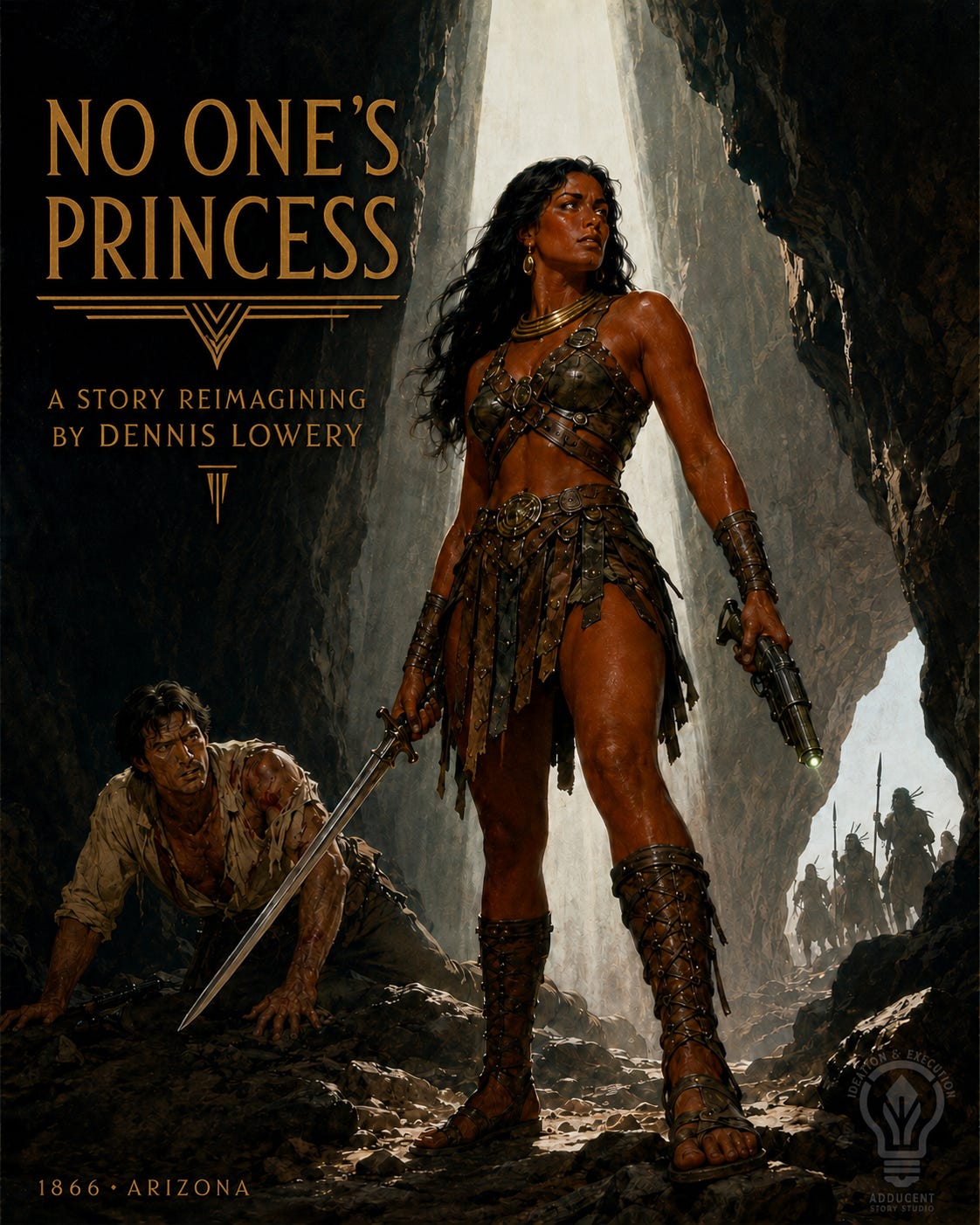
The gash in my side still bled, which was good and bad.
I’d learned that much a long time ago. Good that though spilling out, I still had blood in me. Bad because the rough plug I’d made from my shirt wasn’t slowing it much. And a wound that stops bleeding quits because there isn’t enough left in you.
I lay where I’d gone down, against the back wall of the cave, and kept the Colt up pointed at the opening. The one thing my right arm would still do.
Forty feet to the cave mouth. A purple rectangle of sundown going black. Three of them out there in the rocks — I’d counted before dusk turned everything into shades of gray. Two to the left of the trail and one high on the right shoulder of stone abutting the cave, where a man could lie flat and wait. They weren’t in a hurry. They didn’t need to be. A man who crawls into a stone hole—without any exit I’d discovered—comes out the same way, or he doesn’t come out.
Powell was back on the trail with his throat opened. Too fast for me to get to him, and I’d had to deal with the Apache who’d shot me. By time I could check him, his eyes had glazed. I’d run, left his body behind—a thing I’d told myself, in all my years under arms, I would never do—and I’d done it in under a minute. That moment doing it might keep me breathing. For a while.
The cold crept up the wall behind me.
Not the cave’s cold. I already felt it in the stone at my back and the rock under my legs. The flat mineral chill of a place the sun never reached.
This was different. From the wrong direction—down, off the rock, against the grain that natural cold follows—and it found the gaping wet at my side. It went in like a crooked finger, a talon of ice.
I’d felt that once before.
Antietam. The guns on Nicodemus Hill, my company below, off our horses at first light to screen them. The Federals broke through before the guns could limber, and we pulled back toward the West Woods.
A ball had already lodged in the meat of my thigh. In the woods, the socket bayonet — the long three-sided kind — through the shoulder put me down with a ragged hole that gaped from the twist of the Yankee’s angled thrust and return.
The blue line went over me and past me.
The trampled ground turned to blood-mud; its cold seeped into my back. That chill, patient, taking me an inch at a time. And not one thing I could do but lie there.
A sergeant whose name I never got came back through it, got two hands in my collar, and dragged me out by main strength, my heels plowing furrows. I cursed him the whole way. Being dragged out galled worse than the wound.
My eyes traveled the cave’s murk. There was no sergeant here. And here I’d stay. The Indian’s ball had come in low and glancing — soft .58 lead, and I knew its work, had watched it bring down other men. It hadn’t bored through. It had plowed. A furrow the length of my forearm along the ribs and flank, the edges torn and canted. The trench, packed with shreds of shirt and grit. The blood didn’t jet. It welled and kept coming — thick, dark, steady — down my side, into the waistband, pooling at my hip, emptying me by the minute. The numbness already had my feet. It climbed as it had in the West Woods nearly four years ago — the ground going from under me, my legs helpless. Arms and hands still mine, I thumbed my Colt’s hammer back. The click echoed.
Light, then.
On the wall to my left. Where there was nothing to make light — no fire, no muzzle, no last of the day, not this deep inside stone.
A paleness on the rock that hadn’t been there, slight as breath on a winter glass, and getting thinner.
I turned my head to it, while the head would still turn.
The air over the cave floor moved. Not wind. A draft. The cold thickened with it, the way water takes on a grain in the last second before it sheets to ice. Through it, the rock had gone soft at its edge. Not gone, but uncertain. Like a man seen through the shimmer off a hot gun barrel, except this was cold.
I swung the Colt on it.
It came off the wall.
Into the center of the cave. A ghost-light column, a man’s height and better. The cold came off it in waves that made my teeth ache. The light didn’t hold steady. It guttered — swelled until the whole cave was cast in white and every rock threw its shadow, dropped to almost nothing. Then swelled again. Each time it fell, something in me went with it; nothing under me to trust.
Wrong. All of it. A bleeding-out man’s head plays tricks — I knew that. But mine hadn’t made the cold that ached my teeth.
Then there was someone in that shower of light.
Not stepping out of some dark beyond, a coming together inside the light. The way a face appears out of water as the ripples settle — there, then more there, then wholly there. A woman stood in the pale wash breaking over her, one hand pressed flat against the shaft of light as if it were a thing she could lean on.
A woman. Red. Not painted, not burned, but copper-red skin. Black hair down her back. A harness of leather and worked metal crossed over her, a short kilt made from thick, hardened leather strips, each broad at the top and tapering slightly toward the bottom, hung in two staggered rows to overlap, and high sandals laced to the knee.
At her hip, a long blade, a shorter one, and an odd handgun I had no name for, with a green glint at its muzzle.
At her throat a collar of gold, heavy, a raised, engraved boss at the center of it catching light and throwing it back.
In a blink, something came down on her. A weight out of the air onto her shoulders, she went to one knee, her head bowed under it. Her braced hand pressed harder against the nothing she leaned on. The cords in her hand and arm went taut with strain. Breath tore from her lips, too fast, like a swimmer up after too long under.
Whatever that weight was, it cost her, and she paid right there before she looked at me. She pushed again, both arms. Muscles in her thighs and calves coiling and releasing as she stood.
Her eyes shifted to me.
They surveyed me like a soldiers: the Colt in a now-shaking hand, the wound, then my face. And there she stopped. Something moved across her features, and she shut it down before it finished.
Something, a word maybe, came up in her throat, and she swallowed it. Her hand started toward me, and she took it back.
All of it in the time it takes to draw one breath, and then her face closed, leveled, and gave nothing. Her lips parted.
“Rise, John Carter.”
My name. The woman said my name in a low, clear voice. Words shaped strangely, but each straight, declarative with no softness.
“Rise. Barsoom needs you.”
I lay with the shaking Colt up, my legs gone and forty feet of cave between me and outside, where three men wanted me dead. And a red woman out of a light that wouldn’t hold called me by my name and told me to stand, as if it was a thing I had left in me to do.
Out among the rocks, a voice called, sharp, climbing. In no language I knew. The Apache.
The first one came in low and fast, knife out, along the left wall, using the tumbled stones for cover.
I’d been a soldier long enough to fire by instinct. The Colt bucked once in my hand, but the shot ricocheted from stone. The kick of it shot through my arm and shunted the gun against my chest. I let it lie there. That was all I had. One round into a wall, and my arm spent.
The Apache came on.
He never reached me. He’d committed before his eyes caught up to what stood in the light, and when they did, the warrior tried to turn and stop at once and did neither.
She was on him.
I didn’t see her cross to him. My eyes faded when there was space between them. They came back, and that space was gone. Her sword through his chest. He went down as her bloody blade slid out.
She moved wrong.
Not clumsy — nothing in her was clumsy — but slow against what it seemed her body meant to do. What my own body was once capable of with a sword and gun. Watching her fight like she was in deep water. Or hobbled in a dream where the arm won’t come up in time.
Every motion cost double. It was in her shoulders, how she set her feet too wide and crabbed to plant them. Struggling with her stance against a weight that pressed and bent her toward the ground.
A swish of air, and the second man got close enough to thrust. She took it on the metal of her guard, forearms tightened, bunched as she parried. But the force shook her where it had no business staggering a fighter as whipcord strong as she seemed. For half a breath, she was open. Then her short dagger drove up under his ribs, ripped up, and he wasn’t a threat anymore. Chest heaving, she sank to one knee and darted a dark-eyed glance at me.
Outside, movement on the loose scree. A low, commanding voice, and then hurried footfalls going away. Not a man breaking. A man sent.
The woman’s hooded eyes left me and went to the cave’s opening.
I’d counted three at dusk. I’d counted short. And one of them hadn’t left.
He stood at the edge of the glow that wasn’t firelight. Eyes bright in his sun-darkened face, he looked at her, at the two dead, and back at her. The way a man studies a price written on a board — reading it, working out whether he’ll pay.
This Apache was older. His rifle held easy, not raised. He read the situation as I would. He’d lost two men already and debated spending a third—or himself—thinking he could take her.
She didn’t finish her turn toward him. Her eyes went past me to the luminant column in the middle of the cave, sinking now, lower than before. She took a step back toward it, away from the Apache, as if it were something she couldn’t afford to ignore.
The warrior in the cave mouth watched her. So did I, and I understood it—her—no better than he did.
She reached the light and put her hands into it.
Her fingers moved in the silvery shaft, quick and certain, working something I couldn’t see. It steadied where she touched it — the flicker went out, the edges going hard and true.
To work it, she had to turn her back to the cave opening.
The man at the mouth took his chance.
He broke fast for his years, at her, knife low — a long gun was no good in short quarters and bad light. And he’d want to be sure. Three steps.
She was half-turned from him, both hands in the shine.
I got the Colt up. Slow. Too slow. My arm swung wide, a foot off where he was. My round spanged off the wall. I couldn’t lift and aim again. I lay there and watched him reach her.
He went for her throat — the big vein under the jaw, the sure kill — and his knife’s point struck metal instead.
I saw it in pieces. The blade skated off the boss at the center of her collar. His weight drove it, and the boss tore loose with a hard snap, and the same wrench that took it dragged the edge of the knife across her throat — a ragged furrow, a thumb’s width shy of the jugular he’d gone for.
A small, bright thing hit the dirt, not a foot from my face. My eyes flicked to it and back to her.
Blood came fast and darkly sheened her chest.
She didn’t go down.
She should have. A man cut like that goes down and stays down. I should be watching her bleed out beside me. She swayed, caught herself, and came around full pivot to face him, her hand rising — not to her throat, toward him, the short blade in it.
Her face had set. Jaw locked, eyes gone flat and forward. I knew that set; it’s what’s inside that gets a man up when staying down is easier, the smarter play or the escape. When quit wins. The burning thing inside that had gotten me through countless bad scrapes that should have ended me.
That was resolve. She seethed with it as blood ran down into her harness.
The Apache stopped.
He’d spent everything on that strike, certain it would finish her. It hadn’t. She stood there with her blade up — a woman still on her feet with a wound that puts men down for good — and I watched him read her.
He took a step. Away from her.
The Apache backed to the mouth of the cave, slow, eyes on her the whole way, his blade still up. At the lip, he stopped and looked a moment longer — not weighing another rush. Settling what he’d seen to carry with him. He slipped into the shadows, and the desert went quiet.
She let him go. Didn’t follow, didn’t pull the strange pistol, though she had the shot. She stood with her dagger lowered and watched the empty dark where he’d been.
Then it was the two of us and the light.
Her hand went to her throat. Her fingers found the gold — the ring of it — buckled and scored, but there. The torc had turned the blade, standing between her throat and that killing thrust. Her fingers touched it again, shifted it to settle flat against her upper chest.
She didn’t look down.
The piece from it lay among dirt and rocks where I’d watched it fall — a shield of gold, with a sigil or symbol, the size of a walnut. Torn clean, the sheared lugs bright at the break. Whatever it was, it had been the center of the torc. She stood there bleeding, staring at me, and didn’t know it was gone.
I tried to tell her and got as far as the first hard sound. I shook and couldn’t push the words past my lips.
The light came steady now, the flicker gone. It grew wide, rising and spreading, spilling onto the walls.
She was saying something. My name, and then a language I’d never heard. Her words were sharp and certain, but a question shaped their tone. And on her face the look of a woman who knew something I didn’t. She repeated what she’d said before, in English with that odd inflection, “Barsoom needs you, John Carter.”
The light took her.
Then me.
The cave fell away — the light — all receding into darkness.
My last sight: not the cave, not the woman, but a torn golden badge shining in the dirt where she’d never looked.
# # #
Dejah Thoris is a princess of Mars who has spent her life refusing the title. She does not believe the man she crossed worlds to save is worth the cost of crossing, but she had made a promise. And came anyway. A warrior who saves the hero, for once. What John Carter is, she doesn’t yet understand — and neither does he.
How far would you go to keep a promise to someone you’d lost — even if it meant saving a man you doubted was worth it?
I’ll write the next installment—in Dejah’s voice—if enough of you want to read it. Tell me in the comments or via email to Dennis@DennisLowery.com.
Comments
Nothing yet. Say the first thing.
Sign in to join the conversation.