
First, a brief note this holiday season to let you know that my debut novel, The Unmapping, is secretly a Christmas novel! That’s right: A significant portion of the plot centers around Wisconsin’s aluminum Christmas tree industry, and something big happens on Christmas Day… therefore, if you haven’t read it yet, now is a great time, and also, it makes a great gift. Pick it up at Bookshop.org or Amazon or wherever books are sold. It’s only $3.99 on e-book and there’s a great audiobook version too. And, the beautiful hardcover / sprayed-edge version is on sale.
I went on a first date a couple weeks ago. We’d been chatting on text, but I don’t like chatting on text. I’d rather meet in person. So I didn’t know too much about him, other than that his name was Jon. I went on a walk in the neighborhood before I met him. After a heat wave, the weather was starting to turn, and the leaves were tinged red. We were meeting at a taco place in my neighborhood where I’d never been, although I recall my mother saying it wasn’t very good. My mother and I have different ideas on flavor so I figured it was still worth a shot. It was walking distance from my house, after all. It felt good to walk; I was nervous. The previous night I had a nightmare that my date and I both came down with Covid and the evening was spent coughing all over each other. I woke from that dream at three in the morning with a pounding headache. Groggily I swallowed some pain pills and went back to bed and it was fine. By evening, the headache was long gone, but still, I worried it was an omen. His first name was Jon and his last name was Donor. I stopped at a nearby grocery store so I could fix my lipstick in the bathroom before we met. Satisfied, I made my way to the neighborhood taco place, where Jon Donor was waiting outside.
He looked an awful lot like my husband.
Because he was my husband.
About twice a year, Seth and I go on a “first date” as different people. We do this in spring on the anniversary of our real first date (which itself is a little hazy, but we’ve settled on a date somewhere in between our differing ideas of when it was), and also at some other point during the year. The latter tends to happen when I’m feeling fed up and want to be someone else and live someone else’s life. On these dates we are different versions of ourselves, to varying degrees. Aspiring authors or artists or scholars. I don’t remember much about my former identities, except that in many of them I was named Robin. In spring this year I was a mildly successful romance author writing novels about sexual relationships with armchairs. On this latest date, my name was Gennara (no last name), a former middle school music teacher who had recently quit my job so I could launch a Substack on the history of science.
Lucky for me, Jon Donor was similarly interested in science. Jon Donor made a living as a lab rat, traveling the country to participate in the most lucrative studies, where doctors would give him money to drug him, so that he could be part of science in the making. Such a lifestyle afforded him plenty of time to read about the history of all things. Including the history of scientific thought and progress.
“It’s so frustrating,” I told him. “‘Science’ used to be tangible. One person could decide they wanted to understand the universe and all they’d have to do was go outside with a notebook and a healthy supply of chutzpah, and they’d make groundbreaking discoveries in a dozen different disciplines.” I was thinking about Leonardo Da Vinci, about Alexander von Humboldt. “Today,” I said, “science has become so fragmented. It’s become impossible to understand if you’re not inside it.”
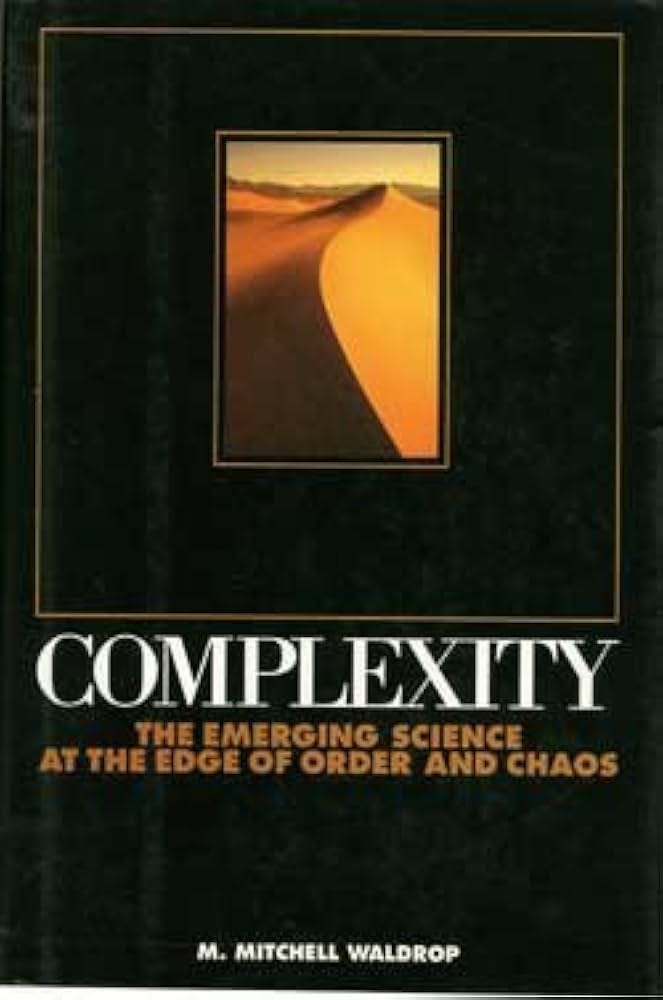
He didn’t disagree, but recommended a few papers that would be understandable even for outsiders, as well as a nonfiction book called Complexity: The Emerging Science at the Edge of Order and Chaos by M. Mitchell Waldrop. Coincidentally, I was halfway through reading it.1
Complexity traces the recent history of complexity science and provides a clear account of its central theories and ideas, with a particular emphasis on the search for common patterns across complex systems—from brain chemistry to species population dynamics to the stock market. The story is told through the formation of the Santa Fe Institute, in a series of mini-biographies on the people who created it and the key minds that shaped it. There is Stuart Kauffman, who initially wanted to be a medical doctor but was secretly obsessed with discovering the origin of life. There is Brian Arthur, the rebellious Irish economist who dared to theorize increasing returns and to view economic systems as complex, adaptive systems—and who ultimately found a more welcoming intellectual home in physics than economics. There is Chris Langton, who nearly died from a hang-gliding crash, and who—while feeling his mind slowly return as if from behind a curtain—began the line of thought that would eventually sow the seeds of his groundbreaking contributions to artificial life. Yet ultimately, more than any one person, Complexity is the biography of the Santa Fe Institute itself. Its system and its inputs. Its parental figures and the ideas that shaped it. Rather than learn about childhood trauma, we learn about the challenges that come with new ideas borne from troubled minds.
And at times it is simply lovely to read:
[Stuart Kauffman] remembers taking a solo hike back up into the Sierras near Lake Tahoe to one of his favorite spots, Horsetail Falls. It was a lovely summer day, he recalls. He sat on a rock by the falls, thinking about his autocatalysis work and what it meant. “And suddenly,” he says, “l knew that God had revealed to me a part of how his universe works.” Not a personal God, certainly; Kauffman had never been able to believe in such a being. “But I had a holy sense of a knowing universe, a universe unfolding, a universe of which we are privileged to be a part. In fact, it was quite the opposite of a vainglorious feeling. I felt that God would reveal how the world works to anyone who cared to listen.”
But even more than the narrative passages, the ideas in this book were exciting to me. Especially the concept known as the “edge of chaos.” This is the zone between rigid order and complete randomness that describes many real-world systems. The simple example is water and ice. In one phase, there is a rigid structure frozen into place. In the other, water moves freely. At thirty-two degrees, ice is warm enough to start melting, and water is cold enough to start freezing, but it doesn’t happen all at once. It turns out that, if you examine the process close up, it looks much the same as if you watch it from far away. On a micro and macro scale, the freeze/melt process happens piece by piece, changes its context, and continues changing. A snowflake crystallizes outwards fractally, then loses energy, so melts at the edges, then crystallizes again, and melts, and on and on. Yes, I’m talking about fractals again,2 I’m talking about chaos, but what interests the scientists in Complexity isn’t chaos per se, but what happens at that critical point just before chaos. Consider the image on the cover of a sand ridge. It’s at the point of criticality, just stable enough to hold its shape, but unstable enough that a single grain could cause a landslide.
It’s in this threshold, Kauffman theorizes, where life began. At a certain level of molecular complexity, molecules began interacting with each other and catalyzing each other in a process that mimics metabolism. At this point, life is inevitable. And it’s at this threshold where the brain can think without overloading, where species can evolve without being destroyed, where an ecosystem can stay in balance. At the balance point, or critical point, a system can absorb and adapt to shocks. This is life. This is the life-ness of life. This is how life becomes more complex and yet more ordered at the same time. Complexity itself provides the order.
So there was my answer! It may be true that science has gotten more complex, but in this respect it hasn’t gotten more siloed. Complexity science brings together economics, physics, computer science, evolution, molecular biology, and pretty much every discipline you can think of. A discipline to cover all disciplines. These scientists truly believe that they are on the cusp of discovering new great theories that run the universe, on par with the Laws of Thermodynamics (the second of which they’ve functionally upended: the Second Law states that a system always tends towards disorder, whereas complexity science shows how systems actually become more structured over time, creating their own order3).
This all matters to me because in my real life, in which my name is Denise not Gennara, I’m writing a novel about a scientist, so I’m trying to figure out what that means: to be a scientist. The scientist I’m taking as inspiration—Sergei Zimov, creator of the “Pleistocene Park” —is an expert in many areas, from ecology to mineralogy to geophysics. To understand more about him, I decided that I should become an expert in these areas—or at least have a broad understanding of them. Furthermore, I decided that I should study his own inspirations (like the Russian scientist Vladimir Vernadsky) and his inspirations’ inspirations (like Humboldt and Goethe many more) and so on. I was excited about the reading. Too excited. I checked out probably twenty books from the library over the course of two weeks. The books kept stacking up and I just kept feeling like there was more I needed to know before I could take a step further. I was overwhelmed and frustrated and felt creatively blocked.
Reading Complexity, I was no longer overwhelmed. I simply enjoyed the reading. I’d found my own personal edge of chaos: a book that pushed the limits of my understanding without being too much for my little brain. There is a balance between “informative” and “fun,” and it can be found in stories. Lately, I’ve found it in biographies (including the biography of an Institute4). Afterwards, I moved onto more traditional biographies (Alexander von Humboldt, Johann Wolfgang von Goethe), and then my research felt less overwhelming. By centering my novel research in biographies, I still learned a lot about science and philosophy, but rooted in stories, it was both easier to take in and more fun to read.5
It was almost the same feeling as going on a fake first date. The desire to learn about other people, a desire that only expands the more you feed it. During the date we were discovering each other’s biographies, while creating our own. Although I forgot a few key details about my fake life, I filled in the rest without issue (it’s all a blur now).
I’ve always liked first dates.6 You ask question after question, each one sparking yet another,7 bringing you deeper, searching for the bottom, which you will never find. And that’s the point. Seeking without an end in sight. Eight and a half years after our first date, I’m still learning new things about my husband—or if not about him, then through him, as I try to understand his perspective on the world. Sometimes we need to pretend to be other people to get there.
These dates give us a new angle from which to examine our own lives. Naturally, Gennara was facing a similar creative block as I was. But Jon Donor had another piece of advice: I should just keep writing, even while taking in new information, without worrying about knowing everything ahead of time—it’s impossible to know everything. “You’ll figure out what you need to know when you need to know it.”
This advice scored many points with Gennara. The tacos we ordered were flavorless, and the atmosphere was terrible,8 but the conversation was going well.
I broke the conceit only once, while we were walking back to my place afterwards (he wanted to meet my cats). He suggested a shortcut through the woods (but how did he know?) and I lost him at one point and called out, “Seth!”
“Yeah?” he said.
“I mean, Jon!”
“Yeah.”
(Meanwhile, he completely forgot my fake name).
Then we found ourselves waiting at a stoplight. It was a long stoplight. What does one say in such a time? Any real conversation would soon be cut off. “That’s a long stoplight.” “You’re right about that.” The answer is to say nothing. The answer is to kiss. After a dozen first kisses, each one still feels new.
-Denise
Noticements recently celebrated its five year anniversary! To commemorate this milestone, I’ve set up a paywall. Okay, really, it’s not so much a commemoration as a realization that many of my oldest posts are very lame, and I don’t feel the desire to delete them, but I don’t really want anyone reading them. When I first started this newsletter, it didn’t have a direction. It was late 2020, the height of Covid, and I simply wanted to write about my life. I challenged myself to write one essay a week, and they weren’t always very good, but for a long time I kept up with it. For instance, longtime readers may remember me writing about a a similar first date at Marshall’s many years ago; this is one of the posts now behind a paywall, as are many of the others that didn’t really go anywhere. When looking back, I feel that they could have gone somewhere if I’d spent more time with them,9 and I feel both pity and encouragement for younger me, like, you were so close, you could have done so much better!
So: I’m not asking one to upgrade to a paid subscription. If you want to support me in this way, I figure you deserve to read my old lame posts if desire. But I’d prefer you don’t! No need to look behind the dark green curtain! Instead, if you want to support me, buy my book. That said, following the cues of Clancy Steadwell , I set it up so that if someone wanted a yearlong subscription, it’s just $30, and will include a free signed and personalized copy of The Unmapping shipped to your door. (Which is equal to the cost of me purchasing and shipping it).
Happy fifth birthday, noticements!
“Dead Inside,” a short story published in Fiction Attic Press
The Unmapping was on Wisconsin Public Radio!
Stoner by John Williams. It’s as beautiful as everyone says it is. Then, after you’ve read it, read this spoiler-full review at The Scholars Stage (h/t Stetson for the link)
The other aforementioned books: Goethe: Life as a Work of Art; The Invention of Nature: Alexander Humboldt’s New World
Speaking of biographies, here is a wonderful profile by Alexander Sorondo of Alan Moore, author of V for Vendetta, Watchmen, and many other masterpieces:
The latest Lunar Dispatch from Will Dowd, written in the haze of post-anesthesia10:
Or not coincidentally. Seth had recommended this book to me.
I’m sorry. I promise not to write about fractals again for, like, six months.
The Second Law of Thermodynamics isn’t really at odds with complexity science, it’s mostly about the idea of entropy, which is real, and is based on closed systems, which are worth considering even if they functionally don’t exist. But it feels more exciting to say the Santa Fe bros overturned a law of physics, doesn’t it?
Most biographies end with a death. The Santa Fe Institute is still alive but its main founders all moved on by the early 1990s. Now, it’s focused less on big picture theory and more on practical applications.
A long time ago, I turned from math to storytelling and I think this is why. I do love the parts of the book that dive into the technical details, but I also need its moments of grace, passages that anchor the abstractions in narrative. Another relevant passage from Complexity:
Science is about a great many things, says Doyne Farmer. It’s about the systematic accumulation of facts and data. It’s about the construction of logically consistent theories to account for those facts. It’s about the discovery of new materials, new pharmaceuticals, and new technologies. But at heart, he says, science is about the telling of stories-stories that explain what the world is like, and how the world came to be as it is. And like older explanations, such as creation myths, epic legends, and fairy tales, the stories that science tells help us understand something about who we are as human beings, and how we relate to the universe. There is the story of how the universe exploded into existence some 15 billion years ago at the instant of the Big Bang; the story of how quarks, electrons, neutrinos, and all the rest came flying out of the Big Bang as an indescribably hot plasma; the story of how those particles gradually condensed into the matter we see around us today in the galaxies, the stars, and the planets; the story of how the sun is a star like other stars, and how Earth is a planet like other planets; the story of how life arose on this Earth and evolved over 4 billion years of geological time; the story of how the human species arose on the African savannah first some 3 million years ago and slowly acquired tools, culture, and language. And now there is the story of complexity. “I almost view it as a religious issue,” says Farmer. “For me as a physicist, as a scientist, my deep-down motivation has always been to understand around me. For me as a pantheist, nature is God. So by understanding nature I get a little closer to God.”
Both of the passages selected might paint the book as more wishy-washy than it is. There is plenty of nerdy math stuff too.
Not that they’ve always been perfect, but they’re always interesting, especially the bad ones
Yes, it is possible to ask questions of people you’re not dating, but I like to ask the questions that are, like, super invasive.
It turns out my mother had never been there before and I just made up that she said it wasn’t good, although I should have listened to my imagination figment anyway
I was fully prepared to send this essay out two weeks ago, but at the last moment was unsatisfied and wanted to rewrite it. The rewrite took longer than expected due to some medical issues, surgery and recovery, so here we are.
What changed? In my previous essay, I teased that a “part two” to the chaos theory / Jurassic Park post would cover haunted houses. I was thinking about it in the same breath as this fake first date, so I thought this essay would cover both. But it didn’t really fit. So: I went to a haunted house. I was scared, and I wasn’t, and I held both feelings simultaneously. I didn’t know I needed to hold someone’s hand, but I did, the whole time, with a friend who was very patient with me. That’s about all I have to say about it. I told a friend I’d try to incorporate it in my next newsletter. Here it is. You’re welcome, Jeff.
Last time I had anesthesia, when I came out of it, I slurrily asked the nurse a million questions, thinking my questions were all fascinating, and that her answers were even moreso. When she left, I wrote down as much as I could remember in my Notes app, praising myself for my hyper-lucid guerilla-style interview. Of course, when I looked back the next day, it was all nonsense, and I deleted it.
No posts
Comments
Nothing yet. Say the first thing.
Sign in to join the conversation.