
In 1844, the German writer Heinrich Heine wrote of a new, concerning medical condition sweeping the continent called “Lisztomania.”
According to the legend, the dramatic music of Hungarian Romantic-era composer and pianist Franz Liszt frequently brought audiences into delirium. Women fainted, fans sobbed, people fought for his handkerchiefs and gloves and whatever scrap from his person they could get their hands on. Hair cuttings were snatched from his head and stowed away hidden in cleavage. The dregs of his coffee were saved in glass phials. A tossed off cigar stump was retrieved from a gutter and set into the locket of a woman who wore it, stinkily, every day, scaring away the rest of her household. His portrait peppered brooches and cameos on 19th century boobs everywhere.
Heine wrote of this “mania” as both highly sexual and deeply disgusting. He compared it to “musical cantherides” — a secretion from a beetle that was used as an aphrodisiac — that evoked Bona Dea, Roman goddess of fertility. And yet also somehow covered in scabs (full of “scabrous things”). (If this contrast doesn’t define Romanticism, I don’t know what does. Sublime in a way that can be painful to look at, yet somehow transcendent and supernatural.)
Heine argued that Lisztomania had nothing to do with the music, but the presentation, the “mise en scene.” It was in the way Liszt staged the lighting dramatically, paused at just the right moments for applause, and positioned his piano so the audience could see his profile and hands, his dramatic gestures, his tossed back hair as he swooned into the sky. (Such a positioning is common now but was groundbreaking back then). Part of it also probably comes from the idea of the myth itself, the story of a man whose music will make you swoon, and so you prepare to swoon, and so you do. The anticipation was half the story, maybe more.
There were real fears about an epidemic or contagion. Medical professionals provided remedies like leeching and laudanum, and suggested somehow immunizing the public. How? Earplugs? Blindfolds? An anti-aphrodisiac?
It’s true he was super sexy:
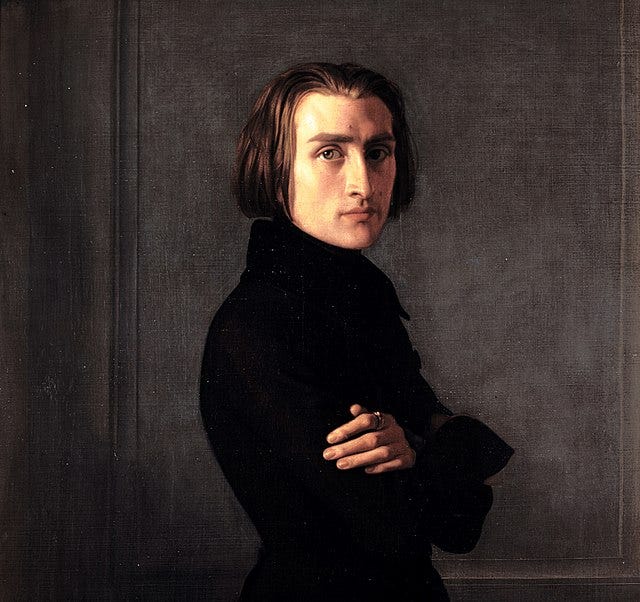
I mean seriously, look at this swagger:
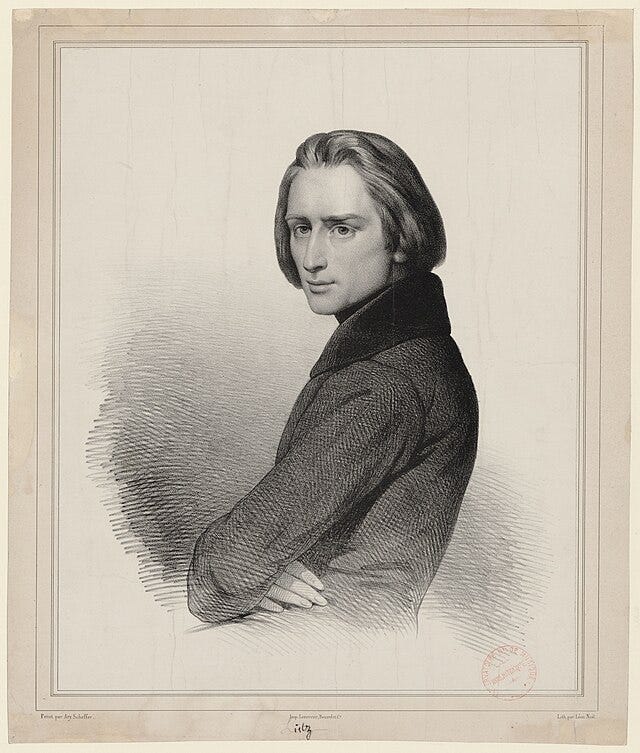
The medical professionals shouldn’t have worried about quelling any contagion; they should have worried about the opposite. Soon, musical performance in general would become more contained and controlled. It used to be that audiences could clap whenever they wanted and move about and dance. The parts of symphonies and suites are called “movements” for a reason. But while some sounded the alarms on the epidemic of Lisztomania, a few other Romantic-era composers were doing what they could to make Lisztomania impossible. Unfortunatley, this included many I hold in high regard: Wagner, Mendelssohn, Schumann, who institutionalized the form of performance. They believed orchestral concerts should be dark and quiet and serious so the listeners can achieve transcendence.
I think transcendence is great, but I’d rather live in a world where Lisztomania is possible. For me, classical music is wrapped up in movement. When I play cello, it’s a physical experience. I get heated up, my arms get tired, my fingers weaken and recover. I strip down to tank tops and sandals even in midwinter and I feel faint onstage with my long black sleeved concert dress absorbing the hot auditorium lights (and yet I keep playing). While listening, I’m often walking or driving outside, watching the woods go by. This is where my most transcendent moments happen with classical music. When a bird flies by at just the right moment as the music crescendos, bringing me to tears. Not while sitting in a dark room in complete silence, where we are not allowed to cheer or applaud as the music goes on, where people hold in their coughs until a burst of hacks and gasps between movements, where some first-timers don’t know the rule about holding applause between movements, and commit the sin of all sins: a single errant clap.
I got onto this topic because I recently wrote an essay about J.S. Bach for Romanticon called “Bach is a Strange Loop,” and how it turned out was completely unexpected. I had planned to write about the physical challenge of practicing the deeply repetitive Bach cello suites for a year or longer. It’s the physicality of music I’m most interested in. The essay turned into something else—something fun, about history and consciousness and my new obsession, Douglas Hofstader, and I’m proud of it—but I’m still thinking about this physical aspect, still trying to put words to it.
Recently, I traveled an hour’s drive to see a performance I was really looking forward to. A talented cellist I admire was taking on the Schumann cello concerto, one of my favorites. I drove with a friend through the countryside as the leaves were beginning to turn. For reasons outside my control it was one of those days filled with sadness, and I was quiet, speaking only when spoken to, but looking forward to seeing one of my favorite pieces come to life. And this would be a good place to cry if I needed to, with tears falling in time to the beat of the music. And yet, during the concert itself, I felt nothing but a vague appreciation. Partly this was because of my mood, but partly, I wondered if it was due to the “mise en scene,” or lack thereof.
One week later, my community orchestra had its first concert of the season. And now I felt guilty inviting friends to join. If I myself didn’t enjoy sitting in an audience, how could I ask that of my friends who don’t really care about classical music? I still put out a few tepid invites and some came to support me, which is even more of a compliment, I suppose, than if they actually wanted to come for the music. During the concert, I had a great time. It was hot and loud and I hit all the right notes (most of the right notes). Then there was the afterparty, where we all get to yell about Bach over beers.
Still, sometimes it doesn’t feel enough. I wished I could transfuse my love for the Sibelius symphony we played into its listeners. An impossible task in one night. Learning to love classical music doesn’t happen all at once. There’s no on-off switch of “classical music appreciator.” Each song requires its listener to form a new, individualized relationship, and this relationship can be tempestuous. The day I first listened to Sibelius’s Symphony No. 1, I hated it. Hated it! Also, I had gotten some bad news and was in a terrible mood. But the first movement started too slow and the melody, when it came, it was trying too hard. I was walking in the woods, and the sun was hazy through the trees and the late fall flowers were in bloom, black-eyed Susans and wild cucumbers and purple phlox, all things that I love, especially when paired with classical music, but that day, Sibelius ruined it. I couldn’t wait for it to be over, and thought the ending of the final movement, too, was pompous and undeserved.
I got a decent sleep, woke up, listened to it again, and loved it.
Or not love—it was too soon for that—but the understanding that I would, soon, love it. A recognition of the melodies that would soon affix themselves in my brain.1
I do think orchestral concerts are valuable, if nothing else, because they can introduce audiences to new music, which they can then listen to over and over later, at home in private, where they can dance and cheer and clap whenever the hell they want. I had never heard of Howard Hanson before, but his “Romantic” symphony, played at the same concert as the Schumann, blew me away, and now it’s a frequent guest on the Spotify rotation. The orchestra also played an original piece called “Prairie Music” by a local composer, but it’s too new, too unknown—I now have no way of listening to it. I tried to remember the feeling of the piece as we drove back home afterwards, but I couldn’t. The sun was setting in front of us, poking bright holes through the clouds. My friend said it looked like an upside down sunny side egg, which made sense, but for some reason I said “I’m not sure about that,” and she said, “Maybe it doesn’t.” I’m sad that I said that and sadder that she agreed.
Maybe it’s the limitations of communication I’m saddest about. It will never be fully possible for me to transfer my feelings into your brain. Hofstadter said that music is the closest we have to understanding someone’s soul. I don’t write music but if my soul infuses into the pattern of a song, I want your soul pattern to match. Whoever you are. I want to connect. Like E.M. Forster says, “Only connect! Live in fragments no longer.”
Such connection is impossible—except in those small, brief moments of transcendence, where connections burst about every corner of the brain. The moments where a smash of dissonant chords evens out into a soaring melody. The moments of simplicity, where the water meets the sky. And everything in between. But only briefly. Only ever for a moment.
I don’t expect symphony halls to dramatically change their rules or for huge orchestras to start playing in crowded bars. The closest thing we have to a Liszt these days is the quirky, overly dramatic conductor. The conductor of the Schumann concerto, for instance, could not refrain from stomping on the podium at odd times, never on the beat. Like a primo ballerino who forgot his part. Give him a beer. Let him cheer.
Maybe he was trying to communicate something, if not the tempo: This is the part worth listening to. If not now, later. In the dark, alone. Or in the sun, on the water. Whatever it takes, wherever it works.
Only connect!
-Denise
The past couple of noticements have been weird, format wise, so there is a bit of backlog here:
The aforementioned Bach essay: “Bach is a Strange Loop” for Romanticon
A review of the play collection Zoomers by Matthew Gasda (a fellow Hofstadter-lover), another place where I get to talk about Bach, for The Republic of Letters
Another much goofier piece for The Republic of Letters on why it’s good that Ocean Vuong cries all the time: Ocean Vuong: Romantic Hero 2
AI, Impressionism, and the Fleeting: Now On Gustave Caillebotte and the Art to Come for The Metropolitan Review
I was on a podcast! “Denise S. Robbins on God, Aliens, and Sam Jennings” with Alexander Sorondo for big reader bad grades
Lots of author interviews for Cap Times! Jane Hamilton, Mark O’Connell, Sasha Debevec-McKenney. If you only read one, read this one with André Aciman (author of Call Me By Your Name). A couple of outtakes will be included in a forthcoming newsletter
The Bach suites take an even longer time to take root. Months, years. It’s a big ask to say, Please listen to the same song for hours and hours, eventually you will love it, you will learn to love it, your brain will form to it and you will hear things differently. But that’s what I wanted to say in my essay for Romanticon, and I’m not sure I succeeded. I still hope you read it if you haven’t already!
Everything is Romanticism!*
*I mean, no, but, everything I’m interested in lately is.
No posts
Comments
Nothing yet. Say the first thing.
Sign in to join the conversation.