
A quick note before this week’s essay...
This week on Our Rough Draft, Tim and I talked about a quiz I recently added to my website. It asks a simple question: How do you naturally show up in the world?
As we talked, I realized it has a lot to do with this week’s essay.
Because before teams can build agreements, before they decide how they’ll work together, they need to know who’s actually in the room. Curiosity doesn’t just change our relationships with other people. It changes the way we understand ourselves.
Maybe that’s where good teamwork begins.
Now...on to this week’s story.
I don’t always write about work, but when I do, it is always about teamwork.
As the school year is back upon us I am considering norms versus expectations versus agreements. I believe that norms are necessary and I think the way we often approach them can turn a team off as fast as a Kindergartener sneezing in your mouth.
We often start teams by building norms. Maybe that’s because norms are essential for teams to function. I just don’t think that’s where we should begin.
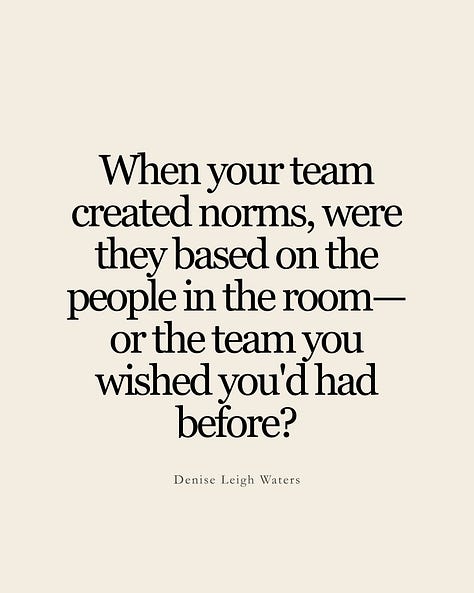
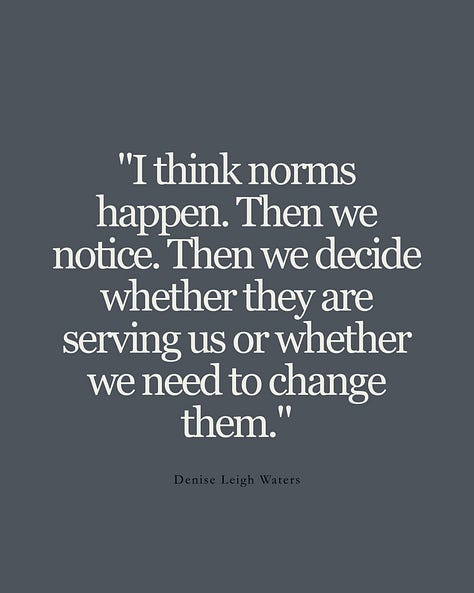
I think norms happen. Then we notice. Then we decide whether they are serving us or whether we need to change them. That takes time. I don’t think you can pull a brand new group of people together and make the very first thing you do build norms because you’re really just building the norms you wished your last team used.
The research will tell us that starting with negative memories of teams skews our norms in a negative direction. We know that norms can be pretty basic. There are some schools of thought that say, start with a list and then talk about how those resonate rather than just doing a brain dump. I think that can work, but still, not the starting place I would point us to.
If I had a new team, as the leader I would establish some clear expectations. Not anything that consensus is needed on.
Things like:
Show up on time.
Meet deadlines.
Silence your phone.
Dress professionally.
Wear Gold on Fridays.
And the fewer the expectations the better.
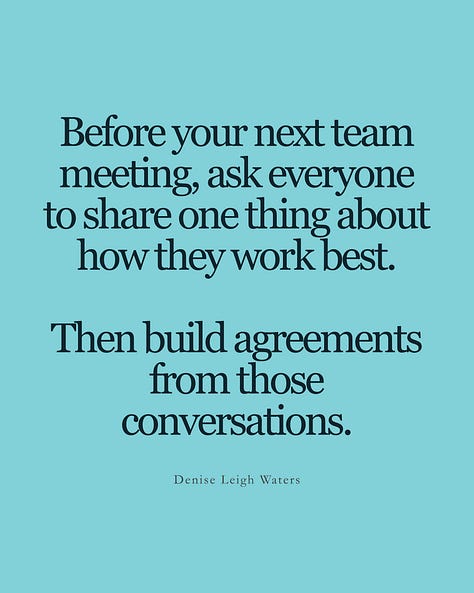
Then before we move to agreements, we do some personal reflection. You let the team think about their personal work styles.
Before we ask people to commit to how they’ll work together, we ought to spend some time getting curious about who they are.
Things like:
I process slowly.
I like direct feedback.
My plate is full.
I need quiet to think.
And then the magic happens, the team shares their personal styles and the agreements come from those. The agreements aren’t hypothetical anymore. They’re a response to real people with real differences.
For example: I’m noticing we have three fast processors and one very deliberate decision-maker. Should we propose an agreement that builds in a pause before decisions to allow everyone to be on the same page.
Another might be, I see the big picture and I think in systems. Sometimes I move quickly. While those are my strengths, I usually need a teammate to remind me to pause occasionally.
My plate is full right now which means I appreciate efficiency.
I like direct feedback.
Give me the goal and trust me to figure out how to get there.
Once the conversation has included everyone, you begin to see the agreements that are needed.
Sometimes you find teams that are aligned and certain topics don’t need an agreement.
Sometimes you find teams that are aligned and that is exactly why you need an agreement because someone has to challenge group-think! Or better yet the agreement says, we will consider alternate ideas before reaching a decision.
It’s like a layer cake. Your personal way of working, your team agreements, and the job expectations. They work in concert. They support one another. And unlike Rachel Green’s trifle, the layers aren’t supposed to compete with each other.
So while we are all forming and storming together, remember you don’t have to go through all the steps all at once. As educators and leaders, I think we tried to jump the system by going to norms first, hoping we can avoid the hard parts of teamwork.
But what I know to be true is this: the best teams have struggled. That’s what happens when you bring humans together to do good work.
And, the fun comes from humans working together to accomplish something bigger than one person could do alone. The humanity–the struggle–the disagreements–the readjustments–the bids–the repair–that is the work. That is the fun. Don’t underestimate a good misunderstanding for team growth!
Agreements grow out of understanding people. Norms grow out of living those agreements.
As you re-enter a classroom, a school, a partnership or a team you’ve been on for a long time, consider what norms are often left unsaid and what agreements you can begin to use to move the work forward. Always happy to share sources and ideas, hit me up!
Before you go . . .
What’s your favorite team activity?
Tell me about it!
Sometimes the writing is done before I am, in those cases I record a bit to continue my thinking. Here’s what I had to say about Norms. And in case you would rather listen, I record the essay, too.
After the Writing | Read Aloud
Time is a trip.
Thinking about my practice.
Thinking about writing.
This week’s conversation on Our Rough Draft explores the idea behind the quiz on my website and why understanding ourselves is often the first step to understanding one another.
If you haven’t listened yet, I’d love to have you join us.
And if you’re curious about your own work style, take the quiz. It isn’t about putting yourself in a box. It’s about giving yourself—and the people you work with—a place to start.
Wherever you’re starting this week, I’m glad you’re here.
Keep wandering, I will be.
— Denise
No posts
Comments
Nothing yet. Say the first thing.
Sign in to join the conversation.