
I’m spending the rest of August thinking about teams—how we build them, what we expect from them, and the assumptions we make about the people sitting around the table.
Last week, I argued that maybe building the team isn’t actually the leader’s job. Maybe all of us have some responsibility for what happens when we come together.
But that raises another question.
What happens when we decide who everyone is before the work even begins?
We love an inventory. A personality test. A set of letters. A color. A role.
They can help us understand each other.
But somewhere along the way, I wonder if we started using them to tell us what people can’t do instead of helping us discover what they might learn to do next.
This week, I’m going back to The Limited, Disney, Eddie Bauer, and a mountain of very carefully arranged Mickey Mouse plush to think about how I learned something I didn’t know I believed:
People can learn.
Now . . . on to this week’s story.
My first real job was at The Limited. I learned how to make sure that every sale included three items. Someone wanted a shirt, I talked them into earrings and socks. Oh my, we were in legging land back then. I can picture the green and pink diamond-shaped earrings to this day. I remember folding the shirt perfectly and laying out the socks and earrings on top of it, saying, “See, they are meant for each other.” And, of course, the customer said, yes. They were paying with Dad’s card.
As the fashion changed and we offered better, cuter skirts and pants, I could sell outfits and add on jackets. My item number never fell below three. It was a goal, and I took it seriously. When someone came in to buy just a gift of, say, earrings, I would push and cajole and convince them to buy more than one thing. On the rare occasion I couldn’t and my numbers started to dip, I would add on even more for the rest of my shift to get back to that three.
I was maniacal.
Give me a goal, I would achieve it.
In college, I continued to work part time because Scottsdale Fashion Square was too far to go without a car, even sometimes with a car. That Limited, though, at Scottsdale was something to behold. It occupied the upper floor in the newly built part of the mall that spanned from Fashion Square to Camelview. Once two malls, now connected.
It had an entire department dedicated to coats.
In the fucking desert.
Built for everyone who had nothing but disposable income.
At some point, I turned my attention from fashion to fun and took a job at Disney. My lifetime love for all things magical served me well as I became the lead for the collectibles area and again set records with my numbers. I created a clientele I could call when a new limited-edition item became available, decades before D23 became a thing.
I learned how to merchandise, how to sell, even how to rebuild plush mountain. I hated it, but I was good at it.
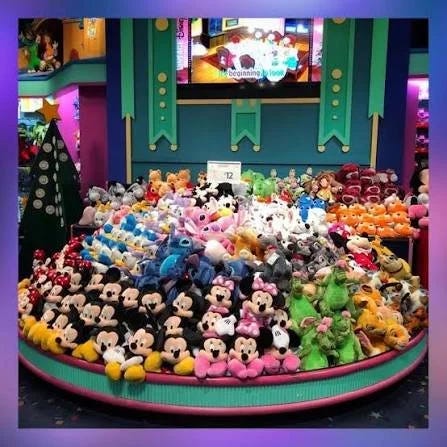
We presold movies on VHS along with a free lithograph if you signed up today. The Lion King was the easiest because those cute Nala and Simba plush sold themselves. Get the video, the two plush, an add-on lithograph, and while you are here, did you know you could buy your park tickets, too?
Disney took me across the valley after graduation and eventually introduced me to Eddie Bauer and Sherie. Sherie was on a mission to hire great assistant managers, and she plucked me from Disney and Mitzi from Miller’s Outpost. Together we became the best store in the company in year-over-year sales.
That isn’t true.
We were just #2, but still.
We were pretty fucking incredible.
I still remember my first day at Bauer. I was in early with Michelle and Bryan, and we were doing a floorset. Rearranging the store and putting out new merchandise. Back then, we would do wholesale swaps of the entire store, spending hours completing the task overnight.
It wasn’t until later, when I worked at the corporate office, that I would push back against so much work and find myself in a fight with the ever-fashionable Frank and Joe, who ran merchandising. No, back then I was just trying to figure out how to adjust the wooden shelves in the store to fit the new duffel bags. It took me longer than it should have, and I had to develop systems to work faster, motivation to keep myself going when it felt like I was lagging behind.
Moving heavy things was far different from stacking the Mickeys to make the eyes all line up.
But I learned it.
I always learned it.
You want me to sell perfume now? Sure. Let me design a pamphlet to go with it to explain the ingredients. Denim? Sure, I can explain the fit. New fashion items for work, AKA Eddie Bauer? I’ve got you, and let me model as well. Down comforters, check. Candles that burn clean, yes sir. Not to mention scheduling, people management, loss prevention, and sales margins.
I went from Assistant Manager to Communications Manager. I taught myself how to build a website before they were just drag and drop. I created campaigns and programs that could sell or rebrand, could tell a sad story or inspire others. I learned and grew and changed and adapted because that was what was required of me.
It wasn’t until later that I considered the idea of not being able to learn.
It was after I moved to education. It was after a master’s degree and maybe even after becoming a principal.
Sure, I had experienced it growing up. My mom, for instance, used to tell me that she yelled because she was a yeller. I would ask her to stop, and she would say, “I’m a yeller.”
But later, when I had kids, she didn’t yell at them.
That’s growth, isn’t it?
I understood that there were people with a fixed mindset. I understood the concept of expertise and deep knowledge, that people focused their learning in one direction. But the idea that you worked in a job and were expected to do new things and you, as the person, human, teacher, decided, Nope, not for me—that was new.
I met people who would use inventories meant to help us learn about each other and instead use them to say, This is who I am and who I always will be. You cannot make me be different.
ENTJ became a crown, ISTP a weapon.
I was shocked, stuck, transfixed even.
What do you mean, can’t learn?
Won’t learn, right?
Sherie used to say that: Are you unwilling or unable?
Unable was never really an option. If you didn’t know how to do something, you learned. I didn’t know how to rebuild a store overnight or sell down comforters or build a website.
Until I did.
But now this is just who I am had become the overriding storyline.
I kept thinking: What do you mean that’s just who they are and who they will always be? What do you mean?
Fixed. Stuck. Done.
My degree was in family resources and human development, my experience was in retail, and in all those situations, I was met with growth.
People changed. Jobs changed. Expectations changed.
We learned.
But now, in leadership roles, I was being told that you are just one way, or he is just one way, and the skills needed to be another way are unreachable. I was told that you take up this role on a team, and he takes another.
I was told that I fit in a box.
I never fit in a box before.
Everything I know says we can learn to do and be whatever we set our minds to. So imagine my surprise when every time a team gets together, there is a survey or an inventory to find out what types of people we have on the team. And then, when we know, we use people in such a way that the role becomes what they do, and they are not asked to do anything additional.
I’m the recorder. You are the speaker.
But what if that is all shit?
What if we have oversimplified? What if we haven’t asked people to learn and grow? What happens when we assume they are done?
We create teams where people keep doing what they already know how to do. We create classrooms and schools where familiar ways of teaching become the way to teach. And then we meet students who need something different, and we aren’t prepared to meet their needs.
We created our own problem.
So next time you are assigned a role on a team based on your score on a quiz, question it. Challenge it. Ask what new thing you are expected to learn by being on this team.
Ask what you can learn.
Otherwise, our worlds are getting smaller. More niche. More boxed in.
We are just plush on the mountain, fixing our eyes in one direction.
Before you go . . .
What have you decided you’re “just not good at”?
Leading?
Speaking up?
Conflict?
Numbers?
Technology?
Being the organized one?
And the harder question:
Is it something you can’t do—or something you haven’t learned yet?
Tell me. I’m curious what happens when we stop treating our current skills as permanent ones.
Sometimes the writing is done before I am.
This one left me thinking about all the ways we sort ourselves—and each other—into categories. Helpful shorthand can become a pretty small box if we aren’t careful.
So I kept talking.
Here’s what I had to say after writing this week’s essay.
And if you’d rather listen than read, I record the essay, too.
After the Writing | Read Aloud
I’m not against inventories.
I think they can help us notice things about ourselves—how we show up, what comes easily, what we avoid, and where we might want to grow.
The problem comes when we treat the result like a destination instead of a starting place.
That’s why I created A Starting Place for Connection.
It’s not designed to tell you who you are or put you in a box. It’s a chance to notice how you connect right now—and think about where you might want to stretch, practice, or try something new.
Because that’s really the point, isn’t it?
You can start somewhere without having to stay there.
And next week, we’ll keep pulling apart what we assume about teams.
Until then, maybe move one Mickey so he’s looking in a different direction.
Keep wandering, I will be.
— Denise
No posts
Comments
Nothing yet. Say the first thing.
Sign in to join the conversation.