

It’s been a rough summer on the farm, between some major storms earlier in the year (I’d never seen storm damage turn a living tree completely limp!) and that horrible day when something got into our chickens.
But today is beautiful, with enough clouds to keep down the glare and a nice little breeze to cut the heat. After I’m done here, I think I’ll take another walk around the fields.
This month’s playful math newsletter is a bit of a hodge-podge. First, I have a couple of back-to-school email subscriptions for you to consider.
Then our main event: Beverley Paine (@theeducatingparent) and I were chatting in the comments about a math project she did with her kids, and it reminded me of an old experiment of mine, an activity that underscored how hard it is for students (and adults!) to make sense of big numbers.
Try it for yourself, and have fun playing math with your kids!
—Denise
P.S.: Remember, digital ebook and printable activity prices at my Playful Math Store are going up next week. Not by enough to break the bank, but enough to account for several years of inflation. (And hopefully enough to discourage spambots from testing their stolen credit cards on me.) If you want something, shop now!
One of my favorite arithmetic-practice puzzles!
The Ken-Ken Classroom email offers a range of challenges, so you can choose the level that fits your students.
“Students love KenKen for the same reasons you do: It’s fun, it’s challenging, no two puzzles are alike, and you get to use different parts of your brain. As a teacher, you can be confident that your students are mastering basic computation skills while employing advanced problem-solving strategies.”
—Team KenKen
With a variety of coloring pages and excerpts from other books, the Dover Samplers bring a bit of whimsy to your inbox. They occasionally include mazes, logic puzzles, or other mathematical content—but mostly, they’re just for fun.
Dover Coloring Newsletter: free coloring pages, book recommendations, tips and tricks, coloring contests and giveaways, and much more from Dover’s line of coloring books for both adults and children.
Dover Books Sampler: including coloring pages, literature excerpts, puzzles, children’s activities, art and music, and more, delivered right to your inbox. Plus, get gift ideas for the holidays, exclusive offers for Sampler subscribers, and more.
Homeschooling Memories…
Half of our students were missing from that month’s homeschool teen math circle, but I challenged the three who did show up to wrap their brains around some large numbers. Human intuition serves us well for the numbers we normally deal with from day to day, but it has a hard time with numbers outside our experience. We did a simple yet fascinating activity.
First, draw a line across a page of your notebook. Label one end of the line $20 (the amount of money I had in my purse), and mark the other end as $1 trillion (rough estimate of the US government’s yearly overspending, the annual deficit):

Where on that line do you think $1 million would be?
Go ahead, try it! The activity has a much greater impact when you really do it, rather than just reading. Don’t try to over-think this, just mark wherever it feels right to you.
The kids were NOT eager to commit themselves, but I waited in silence until everyone made a mark.
Okay, now, where do you think $1 billion would be?
This was a bit easier. Once they had committed to a place for a million, they went about that much farther down the line to mark a billion.
Twenty dollars is a normal, rather small amount of money. A million dollars is huge, the kind of money my students can only dream about, and a billion dollars is unimaginable. Their gut instinct rebels at putting these marks very close to the purse-money end of the line.
On the other hand, it’s natural for the kids to suspect a trick. Why would the teacher insist that they make a mark, unless she’s trying to trap them?
The first girl made her mark in the middle of the line, but the more she thought about the possibility of a trick, the more it bothered her. She erased the mark and made a new one about 1/3 of the way between the purse and the trillion.

The boy marked much closer to the purse, about one-tenth of the way along the line.

When he saw that his neighbor’s mark was even closer to the purse, he declared, “She’s probably right!”

Once the initial commitment of a guess has been made, the students didn’t struggle as much with the second mark. Each of the girls approximately doubled the distance of their first mark from the $20 end of the line. The boy erased the label on his first mark and renamed it a billion, then cut that distance in half and called the new mark a million.



It’s interesting the way our brains work for this sort of question—it’s is actually more logarithmic than linear. The students’ responses are typical of how many adults visualize large numbers:
a thousand is roughly twice as much as a hundred
a million is roughly twice a thousand
a billion is roughly twice a million, etc.
No, the above statements are not true, but they represent what the numbers feel like to many people. We can easily visualize the small numbers that we commonly work with, but we must rely on vague notions of “big, bigger, biggest” to deal with large numbers. Our intuitive number sense seems to work like a semi-logarithmic scale, with the small numbers evenly spaced and the bigger numbers crowded together at the end.
Linear Number Line for Small Numbers

Logarithmic Number Line for Large Numbers

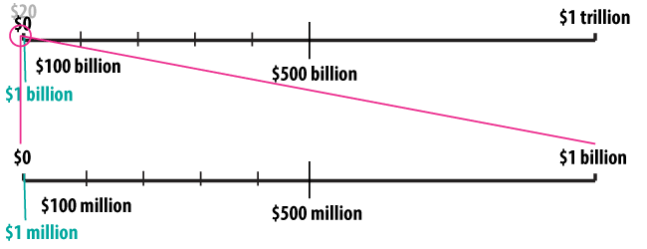
Going back to our original line, we can see that the $20 in my purse is so small compared to $1 trillion that we can count it as zero. A trillion is a thousand billion, so half of that would be $500 billion. Mark that on your line:

Split that into five chunks to find $100 billion.

Now imagine dividing the first chunk into 100 small pieces. One of those pieces would be $1 billion:

And how much is a million? We can’t see it on this scale, but imagine magnifying the tiny chunk between 0 and 1 billion out to the size of the original line. Then a billion is a thousand million, so half of that would be $500 million. Split that into five chunks to find $100 million. And imagine dividing the first chunk into 100 small pieces:
If your students want more experience with mind-blowing large numbers, we also did page 23 of this file, the section called Large Numbers and Everyday Things:
As Mike Lawler and sons discover in this video, very tiny numbers are just as difficult to imagine as very large ones:
Our human difficulty in visualizing large numbers explains why politicians feel comfortable throwing around huge budget amounts, confident that their constituents won’t understand how horrifying the numbers really are.
__________
“Playful Math: Pondering Large Numbers” copyright © 2026 by Denise Gaskins. Image at the top of the blog copyright © belchonock / Depositphotos.
Thanks for reading Denise Gaskins' Playful Math Newsletter! This post is public so feel free to share it.
No posts
Comments
Nothing yet. Say the first thing.
Sign in to join the conversation.