
Sonnets are, ostensibly, love poems. As such, I think they can be unfairly reduced to over-sentimentality. And like a lot of literary misconceptions, this idea probably emerges in the high school classroom. For instance, so many of us study Romeo and Juliet as teenagers, and in that play we encounter some of the most famous sonnets of all time. Indeed, the play begins with a sonnet that recapitulates the entirety of the plot:
CHORUS.
Two households, both alike in dignity,
In fair Verona, where we lay our scene,
From ancient grudge break to new mutiny,
Where civil blood makes civil hands unclean.
From forth the fatal loins of these two foes
A pair of star-cross’d lovers take their life;
Whose misadventur’d piteous overthrows
Doth with their death bury their parents’ strife.
The fearful passage of their death-mark’d love,
And the continuance of their parents’ rage,
Which, but their children’s end, nought could remove,
Is now the two hours’ traffic of our stage;
The which, if you with patient ears attend,
What here shall miss, our toil shall strive to mend.
In this sonnet, Shakespeare coins the phrase “star-crossed lovers” – an astrological idiom that, in 2026, remains a part of our everyday speech. He also lays out the beats of Romeo and Juliet: feuding families, teenage love, and tragic death. Thus, many people associate the sonnet form with this specific play, and therefore we assume that the sonnet is the stuff of the intense love affair.
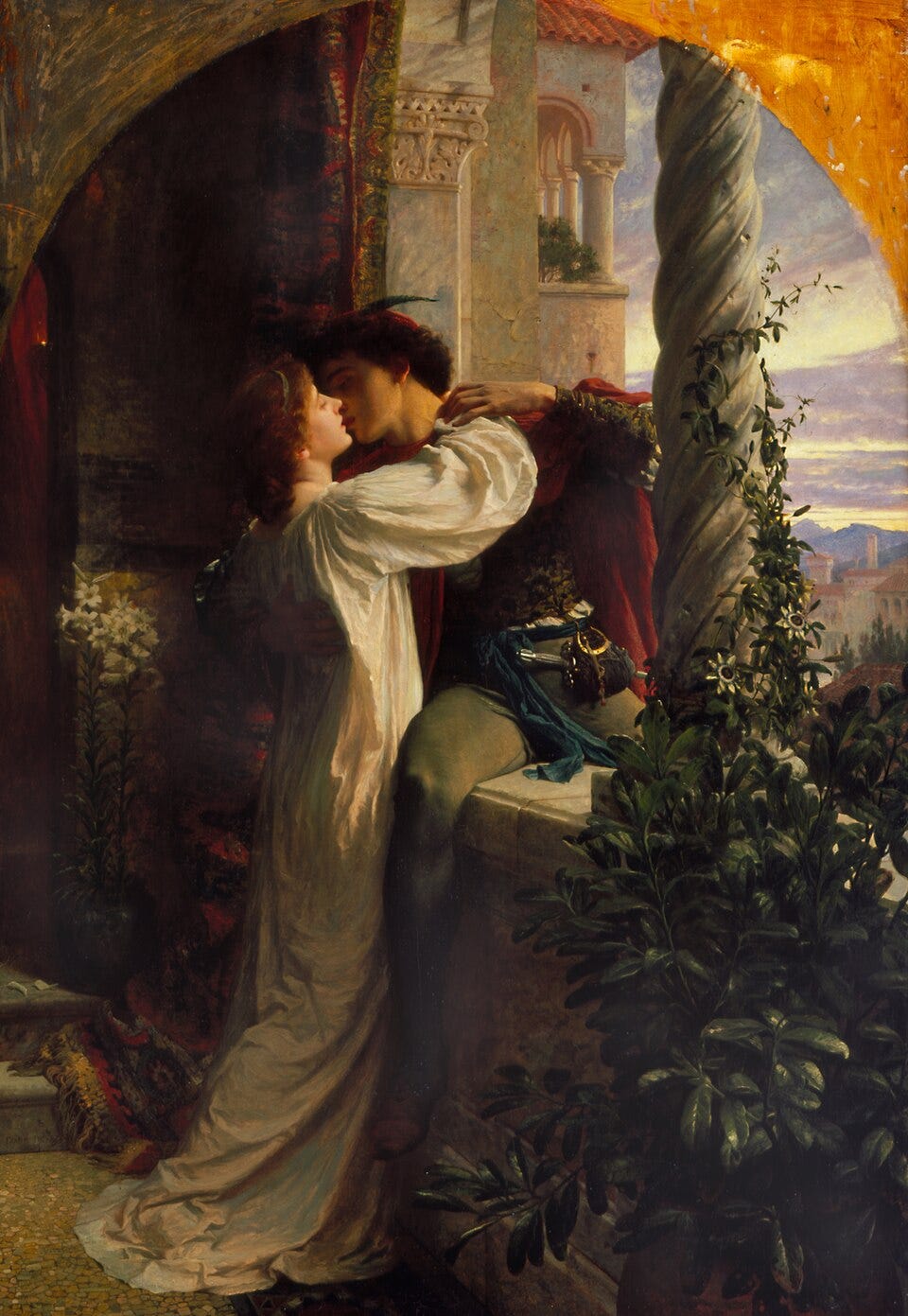
But Shakespeare’s sonnets get a lot more interesting when we don’t approach them as a series of love poems. Or, at least, when we avoid treating “love” as their central theme. When we consider some of the deeper and darker themes from Shakespeare’s corpus – which I’ve written about here in the past, through plays like Macbeth and Hamlet – the sonnets become a different thing entirely.
Comments
Nothing yet. Say the first thing.
Sign in to join the conversation.