
Believe it or not: if you’ve read the Harry Potter series, you are already familiar with the core tenets of Shakespeare’s Macbeth. The parallels are striking: prophecies which may-or-may-not be self-fulfilling; the bloody pursuit of power and relentless ambition; free will versus destiny.
And if you’re thinking, But these are just the core tenets of all storytelling everywhere, you’d pretty much be right. We really do see Macbeth everywhere. The TV shows Breaking Bad and Succession come to mind as prime examples.
Throughout this Demystifying Shakespeare self-study course, I’ve tried to emphasize exactly that. If you are reading (or watching) something in English, it is probably, at least in some way, Shakespearean. My favorite analogy is that Shakespeare is the Beatles of literature: it would still exist without him, but he changed the game forever.
So, Macbeth. That mainstay of secondary school education. Witches! Prophecies! Murder! Revenge! Madwomen!* Ghosts! A winning formula in literature both then and now. Indeed, part of Macbeth’s enduring allure is its darkness, its absolute refusal to let-up, even as Macbeth does deplorable things like order the murder of children. But maybe I’m getting ahead of myself. Macbeth doesn’t begin the play like this.
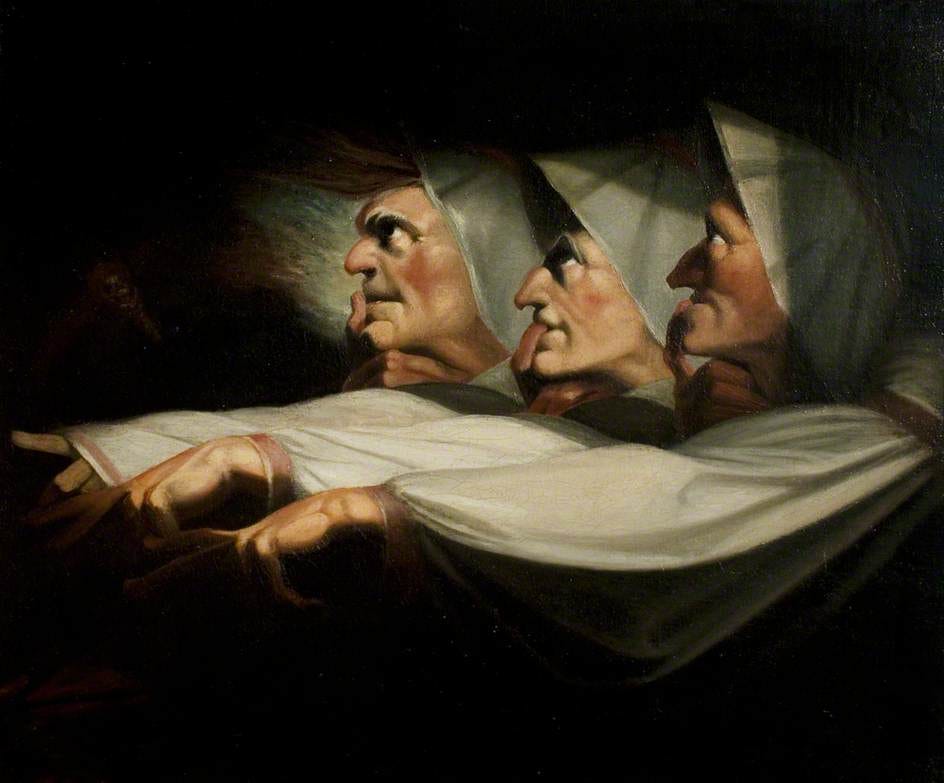
In fact, at the beginning of the story, Macbeth is a pretty average guy, albeit a privileged one. He’s got some power and some land and money. He’s even got a castle, and a fancy title. His problem? Despite all of this, he is not the King. Macbeth wants it all. And as the story develops, Macbeth wants all or nothing.
Such begins the tragic downfall of Macbeth.
*as usual, I’m keen to probe Shakespearean madness further.
Here, I’m going to give a 2-minute overview of the Macbeth plot. It contains spoilers!
Macbeth is a celebrated Scottish nobleman who meets three witches. They give him a prophecy: that he will become the King of Scotland. Macbeth begins to wonder whether this could actually happen, and he delivers the news to his wife, Lady Macbeth.
Lady Macbeth encourages Macbeth to fulfill the prophecy. They conspire to kill the current King (King Duncan), while Duncan stays in the Macbeth castle. Macbeth murders King Duncan and becomes King, but he also becomes paranoid. He orders more murders, including those of his friend Banquo and Macduff’s children, and becomes haunted by guilt, hallucinations, and the fear of losing power. A cycle of violence is set in motion and the other noblemen of Scotland realize that Macbeth must be stopped.
Meanwhile, Lady Macbeth is driven mad – she takes her own life in the final act. An army marches on Macbeth’s castle, but even even as Macbeth’s enemies outnumber him, he clings to the witches’ prophecy. Ultimately, the prophecies don’t protect Macbeth, and he is killed in the battle.
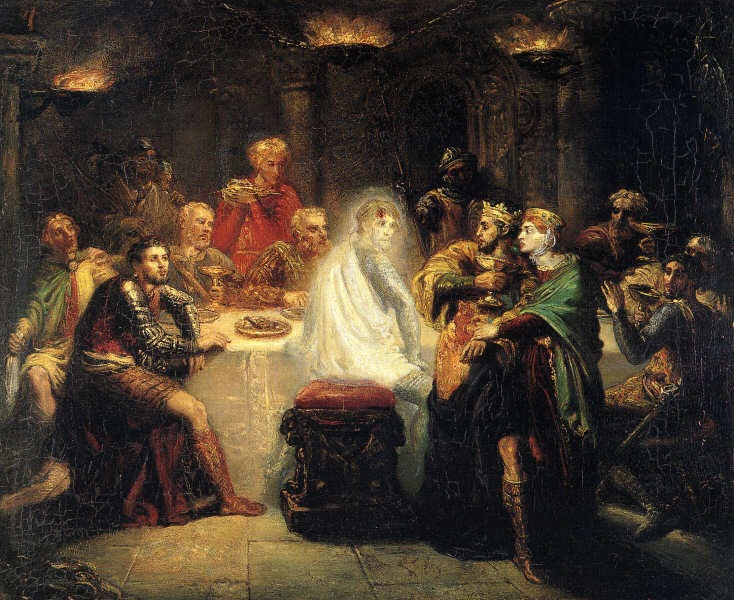
If this sounds familiar, it’s probably because you encountered Macbeth in school. If you were to ask someone who hasn’t read the play for years what happens, they’d probably mention these three things, and I’m curious if they come to mind for you as well:
The witches.
Lady Macbeth.
“Tomorrow and Tomorrow and Tomorrow…”
Although these are all important, they represent the broad strokes with which we paint Shakespeare in secondary school education. We do a disservice to these works of literature in the high school classroom.
I disagree with these reductions. Here, I want to write not about Macbeth’s tyranny, nor even his ambition; not the witches’ supernaturalism, or the play’s cycle of violence. Instead, I want to think about Macbeth’s imagination.
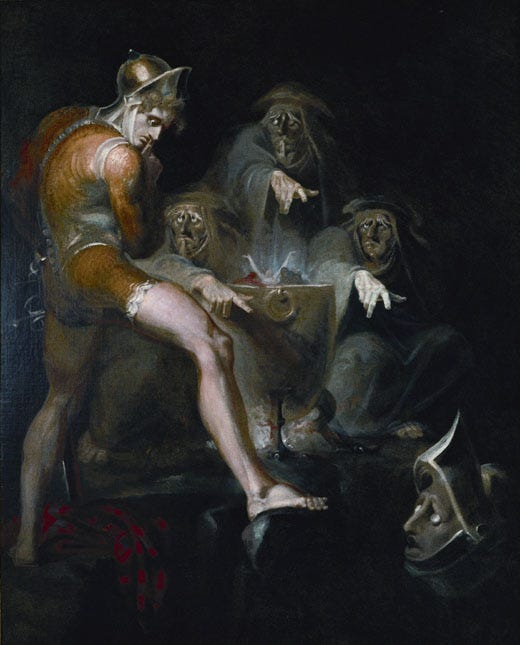
What I failed to realize, when I first encountered this play at fifteen, was this:
Macbeth isn’t really about the three witches at all. It’s about how Macbeth’s imagination reacts to their prophecy, and the events that follow. What matters most, really, is that the witches deliver to Macbeth a prophecy – but the witches themselves could’ve been anything with authority. In fact, Shakespeare’s choice to make the witches, well, witches, was a strategic political move, more than anything else. I’ll explain more on that later, when I write about Macbeth rabbit-holes to fall down if you want to study further.
My point is that Macbeth is a play so full of sound and fury. But amidst it all, Macbeth is driven by a desperately over-active imagination. And his imagination is, at its core, fuelled by hope: the hope that he might wield real power.
I prefer to think about Macbeth in this way, rather than as a tyrant or a murderer. Because really: who among us has not fallen victim, at some point, to a bit of an over-active imagination? And even further: who among us does not love a bit of power? Crave it? Indeed, part of the allure of the Macbeths, to me, is that I get it. I do. I can understand.
A confession, then. There has always been a dark little sliver inside of me that relates to Lady Macbeth. Dare I say: I believe that there’s something within her to be admired.
And that’s the power of Shakespeare: to make us sympathize with murderers.
Below, I’ll write about how Shakespeare does just this, through psychological warfare. I’ll analyze key excerpts from the play, list Oxford-style tutorial essay questions, and give additional reading lists for further study on Shakespeare’s witches, Lady Macbeth, and madness.
Comments
Nothing yet. Say the first thing.
Sign in to join the conversation.